Short answer
There is no single universal "love corner." Two popular approaches use different maps: a front-door-aligned bagua often places the relationship area in the far back-right corner from the entrance, while compass-oriented systems associate Kun (坤) with the southwest. Pick one method, record it, and do not combine them. Then make the space calm, safe, accessible, and useful before adding any optional pair, colour, or symbol. A corner, a pair of ducks, a crystal, or a colour cannot predict a relationship, repair one, or summon a partner.
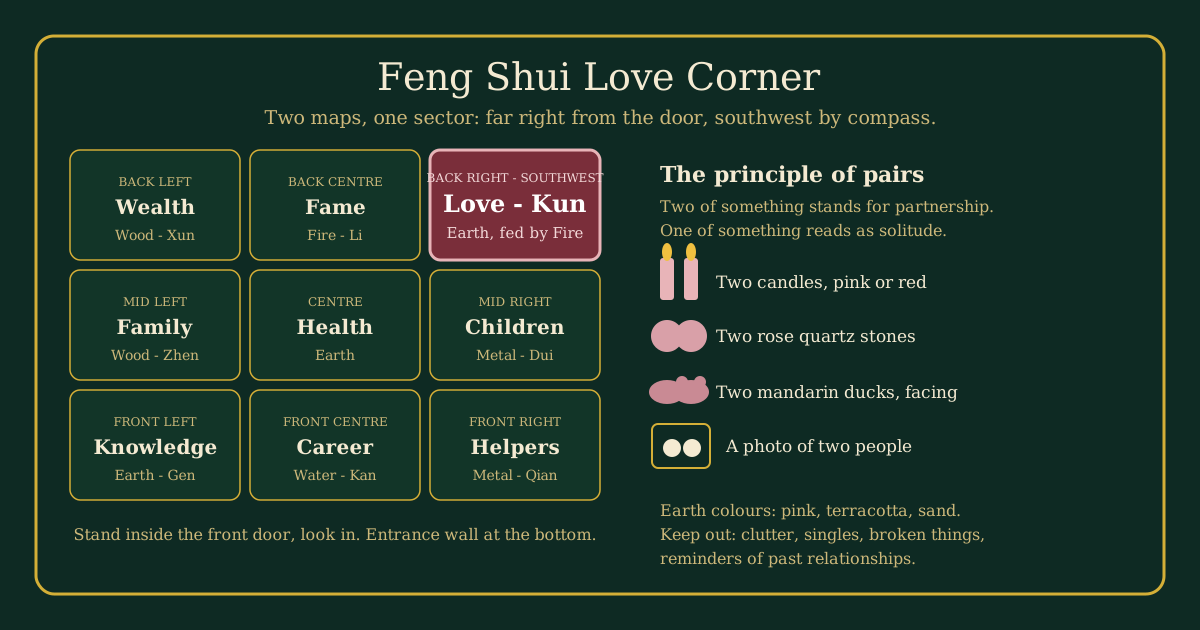
The love-corner question is popular because it offers a tidy answer to an untidy subject. People want a home to feel supportive while they deal with a new relationship, a long marriage, a breakup, loneliness, or the ordinary work of living with another person. Search results often turn that understandable wish into a formula: find one corner, add a particular pair of objects, and expect love to follow.
That formula leaves out the part that matters most. Different feng shui systems use different maps. A pair of candles can still be the wrong choice if they sit where a curtain can catch them, or where a child or pet can reach them. A mirror can still be a problem if it throws light into a sleeper's eyes, whatever the chart says. And none of these choices replaces a conversation, a boundary, an apology, or a decision about how two people live together.
This guide preserves the cultural language while giving you a better process: identify the map, inspect the space, choose a useful action, and keep symbolism optional. It is the companion to the wealth corner guide, which uses the same two-method structure for the southeast sector, and it agrees with that guide row by row on method, element logic, and limits.
Why online love-corner advice conflicts
Two statements appear constantly online:
- "The love corner is the far back-right corner from the entrance."
- "The love corner is in the southwest."
Both can be references to a bagua-based practice, but they are not instructions to stack on top of each other. The first is commonly used with a front-door-aligned or simplified nine-area overlay. The second uses a compass-oriented association with Kun, the Earth trigram. If a page gives both answers without explaining the difference, a reader may end up moving a pair of ducks from one part of a room to another without knowing what they are studying.
The disagreement is not a signal that you need more objects. It is a reason to slow down and name the method.
For a whole-home, apartment, or room drawing that goes beyond this one association, use the bagua floor-plan guide. It walks through boundaries, irregular plans, entrance alignment, compass orientation, and a one-week test without treating a square as a forecast about your love life. The bagua room-by-room guide covers the same map room by room, and it warns plainly that "relationship corner" plus "bedroom" produces a genre of advice presented with a certainty the tradition does not support. This guide follows that warning.
| Method | How the map is oriented | Where the love association is commonly placed | Best use | Boundary |
|---|---|---|---|---|
| Front-door-aligned bagua | Align the map's entry side with the main entrance wall, then read inward | Far back-right area from the entrance | A simple room-by-room reflection or organisation exercise | It is an overlay, not a measurement of a building's occupants or their relationships |
| Compass-oriented bagua | Use the building or unit's directional orientation | Southwest / Kun sector | Studying directional vocabulary and traditional correspondences | A phone compass, a complex floor plan, nearby metal, and an unclear facing direction can all create uncertainty; do not claim false precision |
This table is the core decision aid for this guide. It solves a question most "activate your love corner" articles leave unresolved: which map are you actually using?
Before you map anything: the four non-negotiables
Do a normal home check first. It is more useful than locating a corner in a room that cannot function.
1. The room must work for the people in it
Open the entry door, closet, bathroom door, and cabinet. Walk the route a person takes at night. Consider a child, pet, visitor, mobility aid, stroller, or person arriving late. Do not make a route narrower with a floor plant, a stool, a heavy ornament, or an unstable screen just because a chart calls that location important. In a bedroom, both sides of the bed need a real path. A bed pushed against a wall leaves room for one person to get in and out freely, whatever the sector says.
2. Fire stays where it belongs
Pairs of candles are the classic love-corner object, and candles are open flame. Put them on a stable, heat-safe surface away from curtains, bedding, paper, and anything a pet or child can knock over. Never leave them burning in an empty room or overnight. A lamp, a warm bulb, or a red lampshade gives the same fire association without the flame, and for most households it is the better choice. If a choice creates a burn, trip, or exit problem, it has failed its practical job regardless of its symbolism.
3. The object is maintainable
A plant needs suitable light, a pot that does not leak, and care the household can actually provide. A lamp needs a sensible cord route. A display needs dusting. Fresh flowers need replacing before they wilt. Paperwork, exercise gear, and storage boxes need a home that does not become a pile. If a choice creates an uncleanable, damp, or obstructed corner, it has failed its practical job. Dusty candles and wilted flowers send the opposite message from the one intended, and they do it without any symbolism at all.
4. Real relationship work has its own place
A love-corner ritual can prompt a useful question: "What does this relationship need attention on?" The answer might be a conversation that has been postponed, a boundary that needs stating, a shared task that needs doing, or time together that needs protecting. It is not a substitute for doing that thing. If you need a calculation, use a tool such as CalculatorVillage's budget calculators for the money side of a shared household, and seek qualified advice for a consequential decision. A corner cannot do the work of two people.
Method one: the front-door-aligned bagua
This is the method behind the familiar "back-right corner" explanation. Start with the entrance that functions as the main arrival point to the home or apartment - not a balcony door, a side gate used only for bins, or a hallway door in the shared building. Stand just inside it and look inward.
Imagine the floor plan divided into a three-by-three grid. In a common front-door-aligned layout, the love and relationship association sits in the far-right area, away from the entrance. Some people apply the same grid to one room, such as a bedroom or a living room. That is a personal study choice, not a rule that requires every room to contain nine separate life outcomes.
A simple way to document the method
Draw a rough rectangle for the unit or room. Mark the main entrance. Divide it into nine equal-ish areas. Mark the far back-right area with "front-door-aligned bagua: love association." Then write the date and method in the margin.
Do not redraw the grid until it gives a nicer answer. Irregular apartments, L-shaped rooms, open plans, shared hallways, and oversized closets rarely fit a neat square. The purpose of the diagram is to help you notice the space, not to create a test you can fail.
What to inspect in that area
Ask practical questions in this order:
- Is there a leak, stain, dampness, mould, loose outlet, damaged floor, or blocked vent?
- Can the area be reached and cleaned without moving too many things?
- Does it hold something the household actually uses: a chair, a lamp, a shelf, a plant, a laundry hamper, or nothing at all?
- Is the first sightline calm enough for the people who live there?
- Would one small optional design choice make it more intentional?
That order turns a symbolic prompt into a useful household review.
Method two: compass-oriented Kun and southwest
In directional bagua language, Kun is commonly associated with the southwest and Earth. This may be the method a teacher, book, or school intends when it names Kun rather than "the back-right corner." It is a different starting point.
Kun is the most yin of the eight trigrams. In the tradition it represents earth, receptivity, and the mother figure, and it is linked with close relationships in the broadest sense: marriage and partnership first, then friendships, family bonds, working partnerships, and the relationship a person has with themselves. Its number in the Lo Shu square is 2. The Later Heaven arrangement of the bagua places the Earth element in the southwest, which is why compass-oriented sources name this sector for love and marriage rather than any other.
If you are studying this method, begin by learning what your source means by the home's orientation. A compass reading near appliances, large metal objects, reinforced concrete, or an unfamiliar unit entrance may be less straightforward than it appears. A phone sensor can be a rough observation tool, not a surveying instrument. The site's compass reading guide covers the repeatability protocol: three readings, magnetic declination, and why a single phone reading is not a survey. If the direction affects a renovation, purchase, or a high-stakes decision, do not pretend an informal reading is enough evidence.
Once you have a reasonable southwest sector, use the same practical review: moisture, access, maintenance, light, storage, and what the room needs to do. In traditional five-element language, Earth may guide a preference for ceramics, stone, square forms, warm tones, or an image of mountains. Keep this as visual symbolism. It does not cause a meeting, repair a marriage, or prove a home is a better place to live.
Do not mix the two methods
The most common mistake is saying a bedroom's "love corner" is southwest and the back-right corner at the same time, then using both to prescribe different objects. Choose one system for one exercise. If you are curious about the other, make a separate sketch and compare what each helps you notice. The comparison is the learning; forcing them to agree is not.
Advertisement
The element logic: earth, fed by fire
The southwest sector's element is earth. In the five-element cycle, fire generates earth, so fire supports the area. Wood controls earth, so practitioners use fewer plants and less green here. Earth generates metal, so metal draws on earth, and heavy metal is kept moderate. Earth controls water, so practitioners who follow the cycle keep standing water and water imagery out of this sector. The five-elements guide is the consistency check for every element claim in the table below; if a list elsewhere disagrees with it, the guide wins.
| Element | Relationship to earth | What it means for this sector |
|---|---|---|
| Fire | Generates earth | Supportive. Warm light, red accents, a lamp, candles used safely. The classic supporting element. |
| Earth | The sector itself | The base. Ceramics, stone, pottery, square forms, terracotta, sand, ochre, warm neutrals. |
| Metal | Generated by earth, so it draws on earth | Moderate. Warm white as a base is fine. Heavy metal sculpture, large metal frames, and angular metal objects are kept light here. |
| Wood | Controls earth | Light. Fewer plants and less green than in other sectors. One healthy soft-leafed plant is generally fine. |
| Water | Controlled by earth | Kept out. No fountain, no aquarium, no water imagery in the sector, and no water feature in the bedroom. |
Colours
The traditional colours follow the two supporting elements. Soft pink and blush are the classic love colours, used on walls, cushions, or flowers. Red is the fire accent for passion, used sparingly: a cushion, a throw, a lampshade, not a whole wall. Peach and coral are warm, welcoming accents. Terracotta, sand, and ochre are the grounding earth tones for pots, rugs, and throws. Warm white and cream are the calm base the other colours sit on.
Colour works the same way it works anywhere else in a home: sample it, view it at the time of day you use the room, and keep only what you like. A deep red can make a bright room feel warm; it can also make a small dark alcove feel heavy. A pink accent can be soft; a room covered in hearts and pink crystals can feel more like a shop display than a relationship. A few warm touches are enough.
The principle of pairs
The single most consistent piece of love-corner advice is to use pairs. Two of something represents partnership; a single item can be read as solitude. Practitioners repeat this rule more than any other in the love-corner literature, and it is the one idea that survives across schools that disagree about almost everything else.
| Pair | Where it goes | Notes |
|---|---|---|
| Two candles, pink or red | Love corner shelf, bedside table, dining table | Brings fire and light together. Use a stable surface and never leave them burning unattended. |
| Two matching cushions | Sofa, bed, reading chairs | The cheapest pair. Matching matters more than price. |
| Two bedside tables and two lamps | Both sides of the bed | Gives each person an equal place. The bedroom section below covers this in full. |
| A pair of mandarin ducks | Southwest sector or bedroom | The classic symbol. Ceramic or stone, facing each other. See the symbols section. |
| Two rose quartz stones | Bedside table or love corner shelf | A popular modern addition. Small tumbled stones are the bedroom form. |
| A photo of two people together | Love corner wall, bedroom, living room | A recent photo both people like. Replace a photo of one person alone. |
| Art showing two figures, two birds, or two flowers | Love corner wall | Any pairing you personally connect with works as well as the classic symbols. |
| Two chairs, two wine glasses on display | Dining area, living room | The rule extends to furniture. Two of everything in shared rooms is the habit, not a one-time purchase. |
The rule has a mirror image: avoid the single. A single figure in art, a lone tree, one bird, one chair facing a wall, one bedside table, one pillow on a double bed. None of these is a prediction. They are worth changing because a room arranged for one person is a room that tells one person the space was not made for two. The same logic applies to odd numbers: three candles or a single figurine undo the idea of pairs, so practitioners who follow the rule count to two and stop.
The symbols, one by one
A symbol is useful when it reminds you of a value: care, patience, fidelity, warmth. It is not useful when it promises an outcome. Each symbol below is reported the way the tradition presents it, with the facts that sit behind it kept separate.
Mandarin ducks
The pair of mandarin ducks is the most famous love symbol in the practice. In Chinese folk tradition the birds are presented as mating for life, and a pair of ceramic or stone ducks, facing each other, stands for lifelong partnership and conjugal fidelity. Practitioners place the pair in the southwest sector or the bedroom, and the figurines are always sold in pairs. The ducks appear in Chinese art as wedding gifts and in porcelain, textiles, and paper-cutting, often swimming together in a lotus pond.
The zoology is different from the folk claim, and the difference is worth stating. Free-living mandarin ducks form strong seasonal pair bonds, and some pairs breed together in more than one season. They do not necessarily remain with one mate for life, and ornithologists describe them as seasonal monogamists. That does not make the traditional symbol meaningless. It shows that symbolism is a human reading of selected behaviour, not a zoological rule. The symbol describes what people hoped a marriage would become, not what every duck does.
Rose quartz
Rose quartz is called the stone of unconditional love in modern crystal literature, and a pair of rose quartz stones is the most common modern addition to a love corner. The site's crystals guide places rose quartz in pairs on the bedside table as the standard love-sector placement, and notes that small tumbled stones are the bedroom form: large clusters and sharp points stay out of the bedroom because they are heavy, they catch the light, and a point aimed at the bed reads as a poison arrow in the same tradition.
Buy the stone by the facts, not the label. The crystals guide covers the buying checks in full: glass is identified by round air bubbles and a hardness near 5.5 against quartz at 7, dyed quartz is caught with an acetone swab, and a stone that feels warm immediately is suspect because real quartz stays cool to the touch. A pink glass pair is a pair of glass objects, whatever the shop ticket says.
Peonies
Of all the flowers in Chinese art, the peony is the one most associated with love. It bears an exquisite bloom and is a symbol of feminine beauty and the spring season, and museum collections describe it as a symbol for spring, beauty, love, or prosperity. Practitioners use fresh peonies near the love corner or hang a peony painting on the wall. The caution that comes with them is practical: keep them fresh and vibrant, because wilting flowers represent stagnant or declining energy in the tradition, and a dead bouquet in a corner meant for care sends the opposite message. A framed peony print is the lower-maintenance version, and it never wilts.
Check any plant against the ASPCA toxic and non-toxic plant list before bringing it into a pet household. The wealth-corner guide uses the same check for the same reason: a plant that harms a pet is a real problem, whatever its symbolism.
Double happiness
The double happiness character, 囍, is the traditional emblem for love and marriage, formed by doubling the character for joy. It appears at weddings and on the windows or doorways of newlyweds, in red paper-cutting and embroidery. A framed 囍 print in the love corner is one of the oldest and simplest placements in the tradition, and it needs no maintenance beyond dusting. It is also the most portable of the symbols: it works in a rental, in a single room, and in a home where a pair of duck figurines would look out of place.
Dragon and phoenix
The dragon and phoenix pair is the most common animal love symbol in Chinese culture. The dragon and the phoenix paired together represent balanced love: the phoenix symbolises the bride on her wedding day and is often embroidered onto wedding clothes, while the dragon stands for the groom. Practitioners place a dragon and phoenix pair in the southwest corner, set high on a shelf or cabinet. The symbol carries a stronger meaning than the mandarin ducks: where the ducks stand for quiet persistence, the dragon and phoenix stand for energetic complement. The site's four celestial animals guide covers the dragon and phoenix as directional guardians, which is a different use of the same animals; do not confuse the two.
The mystic knot
The mystic knot, also called the endless knot, is a loop woven from a single red cord with no start and no end. It represents an unbroken bond and is given between couples at anniversaries, attached to wedding gifts, or worn as a pendant. It is one of the eight auspicious symbols of Buddhist tradition, and feng shui writers list it beside the mandarin ducks as a traditional relationship symbol. A small knot hung in the love corner or near the bed is the quietest of the symbols here, and the easiest to live with.
The peach blossom animal
One advanced technique works from the birth-year animal rather than the room. In this method, each person has a peach blossom animal, one of the four animals Rat, Rabbit, Horse, or Rooster, determined by the animal of the birth year. Practitioners display a flawless figurine or artwork of that animal in the love corner. This is a personal layer on top of the sector work, not a replacement for it, and it needs the birth-year animal first. The site's zodiac birth-year chart prints the animal for any birth date, and the BaZi guide explains how the year pillar is read. Do not buy a peach blossom figurine before checking which animal the method actually assigns; the four animals are not interchangeable, and a wrong one is just a decoration.
Advertisement
What belongs there? Choose from the room's real job
There is no mandatory love-corner shopping list. Start with the room.
In a bedroom
The bedroom is the room that most symbolises the love relationship, and it is where the pairs principle does its most useful work. Matching bedside tables and lamps, a solid headboard, space on both sides of the bed, soft warm colours, and no mirror facing the bed. The bedroom section below covers this in full. Do not turn a bedroom corner into a paperwork pile or a noisy water feature because an online chart calls it a love location. The sleep-supportive bedroom guide explains the practical checks: light, noise, temperature, and a clear route to the door.
In a living room
A living-room love corner is usually a shelf, a side table, or a wall. Choose an object that gives the corner a clear purpose: a stable lamp, a pair of candles on a safe surface, a framed photo of two people, a piece of art showing two figures, or simply open floor space with two chairs that face each other. A living room benefits from a calm visual anchor. It does not need a crowded display of ducks, crystals, knots, and flowers competing for attention. One pair, one colour touch, and a tidy surface are enough.
In a home office
This is the least natural place for the topic, and that is worth saying. A home office is for work, income, paperwork, and focus, and the home-office desk placement guide covers it on those terms. If the southwest sector of a home office is the only love corner available, keep the treatment light: a single framed photo of two people, or a pair of small objects on a shelf, and nothing that competes with the desk. Do not put a couple's photo where a video call will frame it unless both people are comfortable with that. Work and relationship symbolism share a room best when neither shouts.
In an entry
An entry is a poor love corner. It needs a place for keys, shoes, deliveries, a coat, and a quick glance before leaving, and it is the most walked-through space in the home. If the front-door-aligned method puts the love association in an entry, treat it as a prompt to keep the entry clear and welcoming, and work with the far-right corner of the bedroom instead. A healthy plant can work in an entry if it gets light and does not narrow the doorway. A pair of ducks on a shoe bench will be knocked over, and a knocked-over symbol is a chore, not a cure.
The bedroom in detail
Many practitioners say the bedroom has as much influence on relationships as the love corner itself. The details below come up repeatedly in the literature, and each one is also a practical improvement to a room used for sleep.
Space on both sides of the bed. Each person should be able to get in and out freely. A bed pushed against a wall is said to leave room for only one. The couples bedroom guide puts this first among its layout tests, ahead of any sector work, because safe circulation, door and closet operation, and both sleepers' preferences decide whether a textbook layout works in a real room.
Matching bedside tables and lamps. Two tables, two lamps, roughly equal. The point is not symmetry for its own sake. It is that each person has an equal place: a surface for water, a book, a phone, and a light they control. A single table with two lamps on it is a compromise; two tables is the version practitioners mean.
A solid headboard. Ideally a single piece across the bed, on a stable wall. Split headboards are discouraged in the literature because they divide the bed visually. The couples guide adds the practical side: check the other side of the wall for a noisy plumbing chase, elevator shaft, or neighbour's television, and secure a wall-mounted headboard according to its instructions. A stable low headboard and well-fitted window covering can help when a window wall is the only safe plan.
Soft, warm colours. The colours-by-room guide covers palettes that suit couples: soft pink, peach, warm neutrals, earth tones. Sample any colour at the time of day you use the room. A bedroom that reads warm at noon can read heavy at midnight.
No mirror facing the bed. One folk reading says a mirror facing the bed invites a third party. The site's mirror placement guide keeps it practical: many bedroom traditions prefer that a sleeper cannot see themselves reflected in bed, and the test is to lie down at night and notice whether the mirror catches headlights, a bright screen, a doorway, movement, or your reflection in a distracting way. Move, cover, or angle it if that improves rest. Do not claim a mirror causes illness, infidelity, or nightmares.
No work, exercise gear, or clutter. A bedroom that holds a desk, a drying rack of laundry, a pile of unsorted paper, and a treadmill is a room that cannot rest. The decluttering guide covers the reset sequence: one category at a time, a home for each thing, and a surface that can be wiped clean. Exercise equipment and work bring an energy that does not suit the area, and they also bring noise, cords, and clutter that do suit a bad night's sleep.
No television facing the bed. A television is a bright screen and a work object in a room meant for rest. The sleep guide covers the light and noise side. If the television cannot leave the room, keep it off at night, keep it out of the direct sightline from the pillows, and do not let it become the thing the room is arranged around.
If you are single and looking
For people hoping to meet a partner, practitioners often suggest making literal and symbolic room. Clear space in the wardrobe and a drawer, as if for someone else's things. Use two bedside tables and keep both sides of the bed accessible. Add pairs to the love corner, even simple ones such as two candles. Replace solitary art in the bedroom with images of pairs or of things you enjoy. Look after yourself in the space: many teachers emphasise that the relationship area also represents the relationship with yourself, and a corner that feels caring is a reasonable start.
None of this guarantees meeting a partner. It changes the room from a space arranged for one person into a space that has room for two, and it does that work whether or not anyone new ever arrives. A wardrobe with an empty drawer is also simply a tidier wardrobe.
Advertisement
If you are in a relationship
Choose love-corner items together, so the space reflects both of you. Put up a recent photo of the two of you that you both like. Keep the corner tidy; a neglected relationship corner is said to mirror neglect elsewhere, and the practical version of that claim is simpler: a dusty shelf is a shelf nobody looks at. Look at the bedroom details above, especially the balance between the two sides of the bed. Remove anything that represents tension or past conflict: gifts, photos, or letters from former partners are the items practitioners move out first, not because an object holds a curse, but because a room full of reminders of a past relationship is a room that keeps the past in the present.
The zodiac love compatibility guide covers the animal-pair side of the same question: which pairings the tradition calls harmonious and which it calls clashing. It is a different system from the sector work in this guide, and the two should not be mixed into one reading.
Difficult layouts: bathroom, kitchen, missing corner, shared building
A bathroom in the mapped area
Do not panic and do not buy a cure. A bathroom is a water-using service room. Give it the best practical review in the house: check for leaks, run appropriate ventilation, keep the route safe, clean the surfaces, keep storage manageable, and report a failed fan or moisture problem. If you enjoy a wood-toned tray, a plant that truly suits the light, or an earth-coloured container, treat it as a design choice. A pair of items on a shelf and warm earth colours are a design choice, not a repair. The bathroom layout guide gives a full moisture-and-privacy checklist.
A kitchen in the mapped area
A kitchen in the southwest brings fire from the stove into an earth sector. Practitioners balance it with earth tones and keep the stove clean, which is also the practical advice: a clean stove, a clear route, and surfaces that can be wiped. Do not add candles to a room that already has open flame and cooking oil. A pair of items on a shelf away from the heat, and earth-toned finishes, are enough. The kitchen layout guide covers stove and sink placement, which matters more than any sector symbol.
An L-shaped plan or "missing" area
An irregular footprint does not remove a part of your life. Do not add a mirror outside, an unstable flagpole, or an object that bothers neighbours to symbolically extend the plan. If the southwest corner is missing from an L-shaped plan, mark the outside corner with a pair of planters or lights, and work with the far-right corner of the bedroom instead. Look at the actual exterior: drainage, access, lighting, privacy, maintenance, planting, and local rules. If a missing area is a balcony, yard, or shared setback, its real responsibilities matter more than a diagram.
A condo, apartment, or shared hallway
Map the unit you control, not the entire tower or another household's home. Respect lease terms, condo rules, fire safety, and shared access. You can keep a small entry clear, use a removable organiser, choose a lamp or plant that fits your unit, and document any moisture issue. You do not need to renovate a rental or apologise for a fixed layout to practice a cultural design preference. A rented room with two bedside tables and a recent photo of two people is a complete love corner.
Three worked examples
These are labelled hypothetical rooms, built to show how the method works. The measurements are planning examples, not rules.
Example 1: A renter's bedroom with one nightstand and a mirror facing the bed
A renter uses the front-door-aligned method. The far-right corner of the bedroom holds a single nightstand, a tall mirror on the opposite wall faces the bed, and the bed is pushed against the left wall because the room is narrow. The audit says: the mirror catches the hallway light at night, the single nightstand means one person has nowhere to put water or a book, and the bed against the wall leaves one side blocked.
The useful changes cost little. Move the mirror to the wall beside the door, where it reflects the room instead of the bed. Add a second small table, even a stool with a stable top, on the blocked side, and pull the bed out far enough to walk past it. If the room is too narrow for two full tables, use two wall-mounted shelves at the same height. Add a recent photo of two people on the shelf, and a pair of small tumbled rose quartz stones if the household likes them. The room now has two places, two lights, and no reflection in the sleeper's eyes. Nothing about the relationship has changed, and the room is easier to live in.
Example 2: A southwest living room that is also the television room
A couple uses the compass method. The southwest sector of their home is the living room, and the television faces the sofa from the same wall. Online advice suggests a pair of ducks and pink cushions. The audit says otherwise: the room's real problem is that the television dominates the seating, the sofa faces away from the door, and the only shelf is crowded with three candles, a clock, and a stack of magazines.
The useful choice is to move the television to the side wall so the sofa can face the door and the room, clear the shelf to one pair of candles and one framed photo of the two of them, and add two matching cushions in a warm tone. If the couple wants symbolism, a pair of ceramic mandarin ducks on the cleared shelf is enough. The room now has a conversation layout instead of a screen layout, and the love corner is a shelf that can be dusted in a minute.
Example 3: A southwest bathroom in a condo
An owner uses the compass method and finds the ensuite bathroom in the southwest. The room has a slow drip under the sink and a fan that runs loudly. The first actions are to address the drip, ask the building about the fan, and reduce counter clutter so cleaning is easier. A pair of earth-toned hand towels, a small framed photo on the shelf outside the wet area, or a wood-framed print may be an enjoyable finishing choice after the repair. Neither item changes the building's value, the owner's relationship, or the result of a future sale. The bathroom is a bathroom, and a well-maintained one is more useful than a decorative cure.
A monthly five-minute reset
- Check the mapped area for water, heat, cord, trip, or access problems.
- Remove one item that does not belong there.
- Wipe or vacuum the surface and make the object you keep easy to maintain.
- Replace wilted flowers and dust the pair of objects you chose.
- Review one real household task: a conversation that needs having, a shared plan that needs a date, a repair request, or a document that needs filing.
- Notice whether the space now supports the way you live. If not, change the layout rather than adding another symbolic object.
This is the most grounded version of "activating" a corner: make it easier to care for a home and meet a responsibility.
Sources and limits
The descriptions of the front-door-aligned and compass-oriented love-area methods summarise widely used contemporary bagua conventions, as presented in Amanda Clarkson's love-corner guide at Feng Shui Mood, the fengshui.net love guide, and the fengshui-expert.fr love-sector guide, all read for this guide; schools differ in terminology and procedure. The Kun trigram, earth element, and mother association follow those sources, which agree on the southwest placement, the earth element, and the fire support. The mandarin duck symbolism follows the Metropolitan Museum of Art's description of the birds as thought to mate for life and symbolising a harmonious conjugal relationship, and the artnet survey of Chinese love symbols, which calls the peony the flower most associated with love; the zoology note, that free-living mandarin ducks form strong seasonal pair bonds and do not necessarily stay with one mate for life, follows the chinaculturepro guide to mandarin duck meaning. The double happiness character's use at newlyweds' windows and doorways follows the University of British Columbia Museum of Anthropology paper-cutting collection. The peach blossom animal is reported as a practitioner technique, not a verified mapping, and no mapping table is printed here. The practical moisture guidance comes from the U.S. EPA's mould and moisture guide, pet-plant precaution from the ASPCA plant database, and electrical-safety caution from Electrical Safety First. These sources support maintenance and safety decisions, not feng shui predictions. Follow local building, tenancy, condominium, electrical, and safety requirements, and seek qualified advice for persistent moisture, mould, electrical work, plumbing, structural alterations, or relationship decisions.
What to read next
For the broader symbolism behind Wood, Water, Fire, Earth, and Metal, continue with the five-elements guide. For the sector that shares this guide's structure, read the wealth corner guide. If you are choosing a home instead of rearranging one you already own, use the Feng Shui home-buying checklist to separate daylight, condition, access, maintenance, and legal checks from cultural preference.