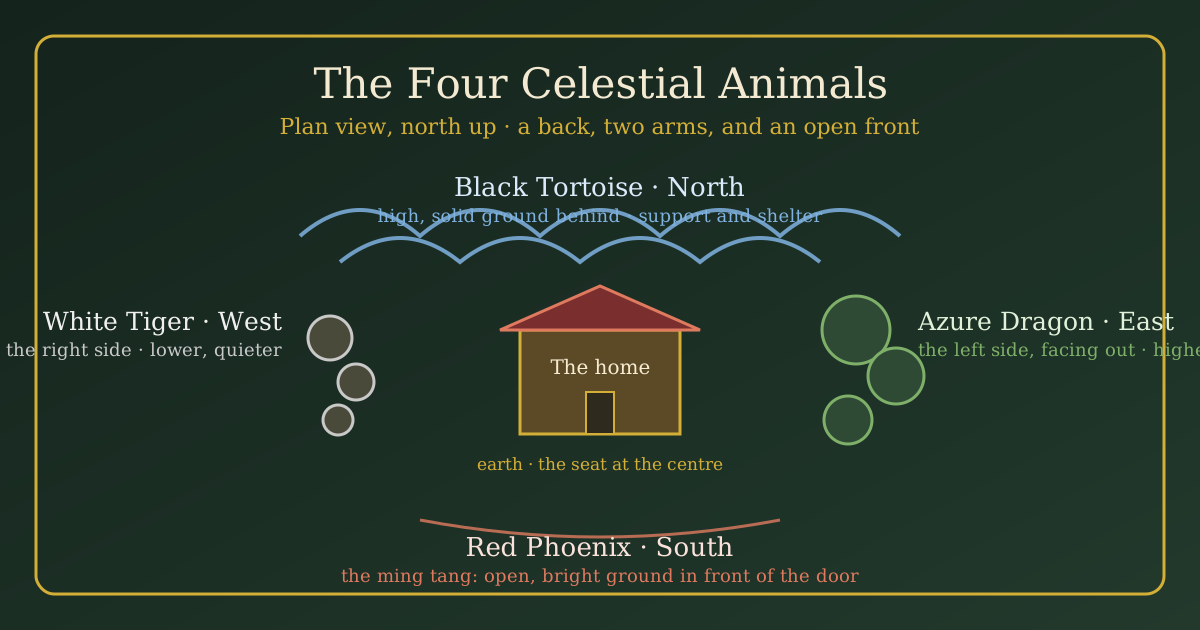
Compass feng shui, the kind with charts and flying stars, gets most of the attention. But the oldest layer of the tradition does not use a compass at all. It uses four animals. Stand in front of an ideal home in the form school's imagination and the land itself is arranged like a creature-guarded seat: the Black Tortoise behind you, high and solid; the Azure Dragon coiling down the slope on your left; the White Tiger crouched lower on your right; and the Red Phoenix in front, low and open, across a bright space called the ming tang. Practitioners call the whole shape the armchair formation, and for well over a thousand years it has been the first test applied to a gravesite, a village, and then a house: does this place have a back, two arms, and an open front?
This guide is the reference for that model. It sets out each animal with its direction and its element, explains the formation the four make together, then applies the model three times: to a plot of land being assessed for purchase, to a built street where nothing can be moved, and to the inside of a flat where the animals shrink to furniture. The landform reasoning is kept separate from the symbolism throughout, because this model, more than most of feng shui, has a practical skeleton that stands up on its own: shelter, drainage, light, and a clear way in.
Where the four animals come from: a map of the sky
The four animals were not invented for houses. In Chinese astronomy, the four symbols, si xiang, divide the band of the sky the moon travels through into four palaces, and each palace holds seven lunar mansions, twenty-eight in all. The Azure Dragon governs the eastern palace, the Vermilion Bird the southern, the White Tiger the western, and the Black Tortoise the northern, where the tortoise is often drawn entwined with a snake. The scheme is documented in Chinese astronomical records more than two thousand years old, on tomb ceilings, mirrors, and star charts, long before it appears in books about where to put a house.
Feng shui's form school borrowed the sky map and rotated it onto the land. A home, like a palace of the sky, could have a north, an east, a south, and a west with a guardian on each side, and the landforms that stood in those directions could be read the way the sky was read. This origin explains two things about the model that otherwise look arbitrary. First, the animals come as a set with fixed directions; you cannot rearrange them, any more than you can rearrange the sky. Second, each animal carries the season and element of its palace, which is why the model dovetails with the five-element system covered in the five elements balancing guide: tortoise with water and winter, dragon with wood and spring, phoenix with fire and summer, tiger with metal and autumn, and the dwelling itself, at the centre, with earth.
The four animals, one at a time
| Animal | Direction | Stands for in the landscape | Element and season | What it should look like |
|---|---|---|---|---|
| Black Tortoise | Behind (north) | Support, protection, backing | Water, winter | High, solid, and close enough to matter: a hill, a ridge, a substantial building |
| Azure Dragon | Left (east) | Growth, activity, the rising side | Wood, spring | Land or planting slightly higher than the right, gently descending toward the front |
| White Tiger | Right (west) | Guarding, containment, the resting side | Metal, autumn | Lower and quieter than the dragon side; present, but not looming |
| Red Phoenix | Front (south) | Outlook, approach, opportunity | Fire, summer | Low and open: a bright space, a gentle distant rise, nothing bearing down on the door |
The Black Tortoise is the most important of the four. In the classical texts the whole search for a site begins with finding the tortoise: rising ground behind the plot that shelters it. A tortoise should be substantial and reasonably close. A mountain range on the horizon is scenery, not a tortoise; a slope, a wooded rise, or in a city a taller building directly behind the home is. A site with no backing at all, a plot on an exposed ridge crest or in the middle of a flat plain with nothing behind it, fails the model's first test, and form school readers historically walked away from such plots before checking anything else. Indoors, the tortoise shrinks to the wall behind a bed's headboard or a desk chair, and the instinct is the same one any person has about sitting with their back to a wall rather than to a door.
The Azure Dragon is the active side. Dragon land should move: a slope that descends, trees, the livelier side of the plot, and traditionally it should stand a little higher than the tiger. In a modern street, the dragon side is read in the neighbour building, the tree line, or the ground itself on the home's left. A strong dragon with a weak or absent tiger is a common and mostly acceptable pattern; the reverse, a looming tiger over a sunken dragon, is the pattern the texts warn about, read as the guarding side overpowering the growing side.
The White Tiger is the quiet side. The tiger should be present, because a plot open on both flanks has no arms at all, but lower, calmer, and less busy than the dragon: a lower roofline, a hedge, a gentle bank. The tiger's job in the image is containment, the arm of the chair that keeps the seat from feeling exposed on the right. Newer streets often invert the model by accident, with the tallest neighbouring mass on the tiger side; the form school reads that as a flaw to note and weigh, not a catastrophe to flee.
The Red Phoenix is the front, and it is mostly emptiness. Phoenix ground should be low and bright, traditionally a wide flat or a gentle rise at a distance, with the space immediately in front of the door, the ming tang or bright hall, kept open and clear. The phoenix is the animal most often damaged by later building: the new block across the street that walls off the frontage, the extension that eats the front garden, the wall built at the gate. A home can survive a weak dragon. A home with its phoenix built over has lost its approach, its light, and its outlook at once, and the model treats that as the second most serious failure after a missing tortoise.
Advertisement
The fifth position: the centre is the dwelling itself
The four animals guard four sides, which raises the obvious question of what stands in the middle. In the five-element mapping the centre belongs to earth, and in the model the centre is the home itself: the tortoise, dragon, tiger, and phoenix are not the site, they are its setting. Some versions of the tradition give the centre its own creature, the Yellow Dragon, and the entwined snake in the Black Tortoise's imagery is sometimes separated out as a fifth and sixth figure in more elaborate schemes. For a homeowner the refinement matters less than the plain point underneath it: the model is read from the seat outward. A perfect set of animals around a badly sited house (built in the plot's lowest, wettest corner, or pushed hard against its back boundary with no garden behind it) is a good setting wasted, and the texts say so. The seat should sit in the protected middle of its formation, slightly toward the tortoise, with the largest open ground in front of it, which is where the ming tang comes from. When readers apply the formation to a plot they already own, the centre is the one part they can still adjust: extensions, garden rooms, and major planting all move the effective seat, and moving it forward into its own phoenix or backward into its tortoise are the two errors this part of the model exists to catch.
Reading a built street: what counts as each animal in a city
The classical images are hills and woods. Most homes front tarmac, so the working translation matters, and practitioners use a consistent one.
| Animal | In a suburb or a city, count as this animal |
|---|---|
| Tortoise | A taller building, a wooded rise, or rising ground directly behind the home; a high rear fence and mature trees are the weak, garden-scale version |
| Dragon | The taller, longer, or busier mass on the left: a bigger neighbouring house, a tree line, rising ground |
| Tiger | The lower, quieter mass on the right: a garage, a bungalow, a hedge, falling ground |
| Phoenix | Open frontage in any form: a green, a wide street, a park, low rooftops, or water; a close high wall or tower across the street is the failed version |
| The seat | The home set back a little into its plot, front door reachable by a clear, lit path |
Two street features need a word of their own. Roads are read in this model as water, the moving kind: a road in front of the home belongs to the phoenix's open space and is unremarkable at ordinary street width and speed, while a road aimed directly at the door is a different pattern with its own literature, covered in the T-junction guide. And the tortoise in terraced streets is usually the row itself: a mid-terrace home has the terrace's mass behind and beside it, which is why form school readers tend to rate terraces kindly on backing and to spend their attention on the frontage instead.
Left and right: the mistake everyone makes once
Dragon and tiger are assigned from inside the home looking out. Stand at the front door, face the street, and your left hand is the dragon side, your right hand the tiger side. Visitors, estate agents' photographs, and most listing plans approach the house from the street, which reverses the pair, and a large share of confused readings trace back to this single flip. The compass directions in the table follow the classical orientation (the home facing south, tortoise to the north), but the left-right rule does not depend on the compass: whatever direction the home faces, the dragon is on the occupant's left facing out. Readers assessing a real home should do it from the doorway, in person, left hand raised. It takes five seconds and it is the difference between reading the site and reading its mirror image.
Applying the model to a plot: an assessment sequence
The lot shape analysis and the corner lot field guide cover the plot's own geometry. The four animals assess what surrounds it, in this order.
- Tortoise first. Stand on the plot and look behind the building line. Is there rising ground, a wood, or substantial building mass at the back, close enough to shelter the site? Note its height and distance. Nothing behind, or ground falling away behind, is the model's strongest negative.
- Phoenix second. Look out from the front. Is the approach open, lit, and level or gently falling? What stands across the street, and how close? A high mass tight against the frontage counts against the site almost as heavily as a missing tortoise.
- Dragon and tiger third. Compare the flanks. Left should be equal or higher, right equal or lower, and both should exist. A flank open to a road, a drop, or a car park on both sides means no arms.
- The seat itself. The building ground should sit slightly raised above its frontage and level or gently sloped, so water drains away from the house toward the ming tang and the street, not back under it.
- Wind and water as the checkable layer. The same formation that satisfies the model also shelters a house from prevailing wind at its back, keeps its front in the sun in northern latitudes, and sheds water forward. If a site passes the animal test but sits in a frost hollow or a flood path, the practical layer outranks the pattern, in this guide and in the older texts alike.
A labelled hypothetical: two plots, one street apart
The example below is invented to show the assessment working. The plots and prices are illustrative.
Two same-sized plots are for sale in a new development. Plot A backs onto a wooded ridge that rises behind it; its left boundary carries a row of mature trees on ground slightly higher than the plot; its right boundary is a low hedge against a neighbour's single-storey garage; its front opens onto a green, with low houses beyond. Plot B sits at the crest of the development's rise, with the ground falling away behind the building line; its left side is open to the estate road; its right side is overshadowed by a three-storey block; and its front faces a retaining wall across a narrow street, built to hold the next terrace up.
Read with the four animals, Plot A is a textbook armchair: tortoise present and close, dragon higher than tiger, phoenix open, seat draining gently toward the green. Plot B fails in sequence: no tortoise, phoenix walled, tiger looming over an absent dragon. The practical reading lands in the same place for ordinary reasons: Plot B's house will take the weather on its back wall, lose its front light to the wall and the block, and overlook nothing but masonry. The tradition's language and the surveyor's language describe one landscape here, which is exactly why this part of the tradition has survived: the animals are a memory device for a sound way of looking at land, and a buyer can use the device without signing up for the cosmology.
The model indoors: furniture-scale animals
Most readers cannot choose their land. The model still applies at the scale they control, and modern practitioners use it mainly this way. The command position guide is built on the same grammar: a solid backing, a clear view of approach, no exposure at the flanks.
- Tortoise: the wall behind the headboard, the high back of the desk chair, the bookcase behind a reading seat. A bed or desk floating in the middle of a room, back to the open floor, is a seat with no tortoise, and most people feel it before they can name it.
- Phoenix: the space in front of the seat or bed. A desk pushed against a wall gives its sitter a phoenix of forty centimetres; pulling the desk out, or turning it to face the room, restores the bright hall at furniture scale.
- Dragon and tiger: the heights on either side. A tall bookcase on the left of a desk and a low cabinet on the right reproduces the classical proportion. Reversed heights are not a disaster, but the model notices them, and so, readers often report, do they.
- The seat: bed, desk, and main sofa are the seats that matter, in that order for most households. Apply the model to those three and the rest of the flat can be ordinary.
The front yard guide and the backyard energy guide work the same two animals outdoors at garden scale: the backyard is the tortoise's territory, where height, planting, and enclosure belong, and the front yard is the phoenix's, where openness, light, and a clear path matter more than any object placed there.
Limits of this guide
The four animals are a traditional model of landscape, borrowed from an ancient map of the sky, and this guide reports the model as its tradition states it. It makes no claim that a tortoise hill changes a household's fortune, health, or wealth, and no part of the model should substitute for the checks that actually decide whether a plot is sound: drainage, flood records, geology, planning status, and the survey. What the model genuinely offers, and the reason it has outlived the cosmology it arrived with, is a disciplined way of seeing a site whole: back, flanks, front, and seat in one glance, with the practical questions (where does the wind hit, where does the water go, where does the light come from, how do I arrive) built into the picture. A reader who walks a plot with those four questions is using the four animals the way they were always best used, whether or not they ever say the animals' names.