The short answer
Chinese zodiac love compatibility compares the animal signs associated with two birth years. In popular tradition, some animals are grouped as harmonious and others as more challenging. That can be a fun cultural lens and a useful prompt for conversation. It cannot tell you whether a relationship is safe, loving, viable, or destined. A year animal is only one part of a much larger set of Chinese calendrical and divinatory traditions, and no chart replaces how two people actually treat one another.
Use a compatibility result as a question, not a verdict: What do we each need when stressed? Where do our routines clash? What feels fair in this relationship? Those answers matter far more than a score.
What a Chinese zodiac compatibility chart is actually comparing
The familiar Chinese zodiac is a repeating twelve-animal cycle: Rat, Ox, Tiger, Rabbit, Dragon, Snake, Horse, Goat (or Sheep), Monkey, Rooster, Dog, and Pig. A person is commonly associated with the animal for the lunar year around their birth. The animals connect to the Chinese calendar and to the twelve Earthly Branches, and their meanings are carried through art, folklore, family traditions, popular media, and astrology.
That context matters. A compatibility chart is not a personality test built from observed relationship data. It is a traditional interpretive system. The International Dunhuang Programme’s overview of zodiac compatibility makes the useful point that a year sign is not the whole picture; other signs can influence a traditional reading. Modern Chinese cultural guides also describe zodiac matching as a folk custom that many people now approach as a light, social test rather than a marriage rule.
Treat that distinction with respect. The tradition has cultural depth. It does not gain accuracy by being presented as a machine-generated prediction.
Check the birth year carefully first
Do not assign a sign from a Gregorian calendar year without checking a birthday around Lunar New Year. The lunar new year changes date, usually falling between late January and mid-February. Someone born early in a calendar year may belong to the prior animal year in a standard Chinese-zodiac convention.
Before comparing two people, record:
- each complete birth date;
- the calendar convention used by the tool;
- whether the person was born near Lunar New Year;
- the animal name and its translation: Goat and Sheep are both common English labels for the same sign;
- whether the result is a simple year-animal comparison or a fuller Four Pillars/BaZi interpretation.
This is not pedantry. A compatibility result becomes less trustworthy when a website does not say what it calculated. Our free Chinese zodiac compatibility tool is a starting point for the year-animal lens; it should not be described as a complete relationship reading.
The three lenses behind popular compatibility results
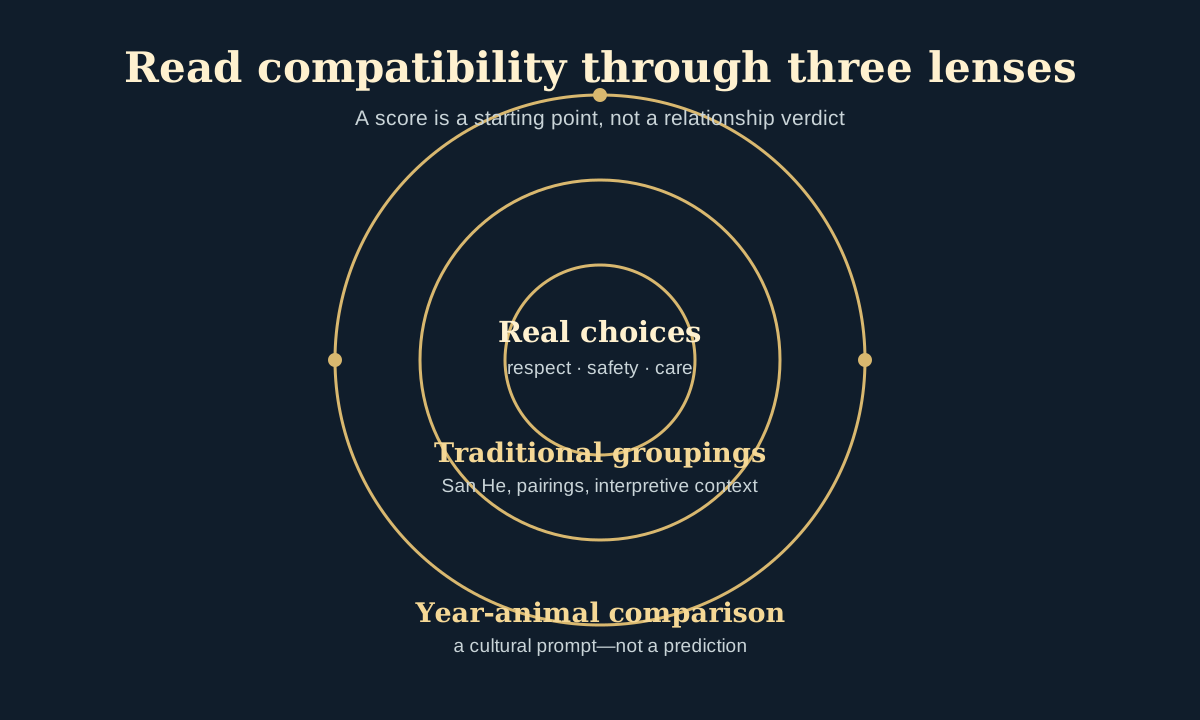
Online charts often show one score. That is tempting, fast, and usually misleading. At minimum, separate three ideas.
Lens 1: the year animal
This is the entry point most readers know. It offers an accessible shared language: perhaps a Rat is described as resourceful, a Tiger as direct, a Rabbit as diplomatic, or a Dog as loyal. These are cultural archetypes, not clinical traits. People of the same birth year do not have the same attachment style, values, history, or communication habits.
Use the animal as a story prompt. If a description calls one sign quick-moving and another cautious, ask whether that difference appears in actual decisions: money, social plans, chores, travel, conflict, or downtime. If it does not, do not force it to fit.
Lens 2: traditional groupings
Many compatibility guides introduce San He (three-harmony) groupings:
| Traditional grouping | Often-described shared theme | A grounded conversation prompt |
|---|---|---|
| Rat · Dragon · Monkey | initiative, ingenuity, momentum | How do we decide quickly without leaving someone behind? |
| Ox · Snake · Rooster | steadiness, planning, precision | When does planning help, and when does it become control? |
| Tiger · Horse · Dog | action, ideals, independence | How do we make room for freedom and reliability together? |
| Rabbit · Goat · Pig | care, aesthetics, cooperation | How do we name needs instead of avoiding difficult conversations? |
Popular charts also use pairings and “clash” relationships drawn from Earthly Branch patterns. Those systems vary in translation and detail. A clash is not a curse, a warning of betrayal, or a reason to fear someone. At most, it is a prompt to examine a recurring difference - pace, spending, privacy, family expectations, or a way of handling disagreement.
Lens 3: the actual relationship
This is the lens that gets skipped when a page promises a 95% match. Ask about consent, respect, emotional and physical safety, truthfulness, money, caregiving, family pressure, recovery after conflict, and whether both people can be themselves. None of those are visible in a zodiac pairing.
If a relationship is frightening, controlling, violent, or isolating, seek local support and prioritize safety; do not look for a metaphysical remedy. If a relationship is loving but stuck, a calm conversation, culturally informed counselor, or qualified therapist can be more useful than a second score.
Advertisement
How to use a compatibility result well
Take one result at a time. Read it together if both people are interested. Then translate every symbolic statement into an observable question.
| If a chart says… | Ask instead… |
|---|---|
| “You are naturally compatible.” | What do we do that builds trust, and how do we keep doing it? |
| “You have a clash.” | Where do our needs or habits genuinely collide, and what agreement would help? |
| “One sign leads and one supports.” | Are decisions shared freely, and does each person have room to say no? |
| “Your elements are unbalanced.” | Which shared environment or routine currently feels draining, busy, or restorative? |
| “This pairing needs a cure.” | Is there a concrete problem - noise, money, time, conflict, cramped space - that we can address directly? |
That translation preserves the playful and reflective use of the tradition while avoiding fear-based dependence. A lucky object, colour, or arrangement should never be used to pressure someone into staying in a harmful situation or excusing repeated behavior.
Why a simple year-sign score is incomplete
Chinese metaphysical traditions include methods more detailed than a twelve-sign comparison. Four Pillars of Destiny, often called BaZi, works with year, month, day, and hour pillars in a traditional system. It has its own schools, calendar calculations, and interpretations. Even within that tradition, a responsibly framed reading is interpretive - not a guarantee about another person’s future or intentions.
This does not mean readers need to collect private birth details from a date just to have a conversation. It means a simple chart should state its scope plainly. The closer a site comes to promises about marriage, fertility, illness, money, or fate, the more important its limits become.
Do not share another person’s full birth date, time, or place without their permission. Birth information can be personal. For casual exploration, the year-animal result is enough.
A relationship-friendly way to explore the twelve animals
Below are gentle prompts, not diagnoses. Use the line that resonates, ignore the rest, and avoid describing a partner as a fixed type.
Rat. If resourcefulness is the theme, discuss how you handle scarcity, schedules, and quick changes. Does efficiency ever leave emotional needs unspoken?
Ox. If reliability is the theme, ask what makes each person feel secure. When does consistency become rigidity, and when is it a gift?
Tiger. If courage and directness are the theme, explore how you disagree. Does speaking plainly feel clear to both people, or does one need more pause before a decision?
Rabbit. If harmony is the theme, ask whether peace is genuine or whether one person swallows concerns to avoid conflict.
Dragon. If ambition is the theme, talk about big plans and ordinary maintenance. How do you celebrate vision while sharing unglamorous work?
Snake. If reflection is the theme, clarify privacy and transparency. What is healthy private time, and what information must be shared?
Horse. If movement is the theme, balance spontaneity with rest and commitments. How do you say yes to adventure without overbooking each other?
Goat/Sheep. If sensitivity and beauty are the themes, name practical support. How are chores, money, and creative space shared?
Monkey. If curiosity is the theme, use it to keep play alive. Also ask how important promises are tracked when life becomes busy.
Rooster. If precision is the theme, distinguish a useful request from criticism. What kind of feedback helps each person feel respected?
Dog. If loyalty is the theme, define boundaries and care. Who has access to your time, home, money, and private conversations?
Pig. If generosity is the theme, make sure generosity is reciprocal and sustainable. What does each person need in order to rest?
The point is not to locate yourself in a paragraph. It is to find one question worth asking with kindness.
Love, home, and symbolic balance
Some readers arrive at zodiac compatibility because they are choosing a room, moving in together, or trying to make a shared bedroom feel fair. Use the house for practical support, not as a prophecy. A room works better when both people can reach light, exit safely, sleep comfortably, store essential items, and have their preferences heard.
Our Feng Shui bedroom layout for couples turns those needs into a floor-plan worksheet. It explains why matching furniture is optional, why a bed against a wall is not a relationship prediction, and why mobility, temperature, light, and consent come first. For a shared desk or work zone, the home-office desk placement guide provides the same kind of trade-off process.
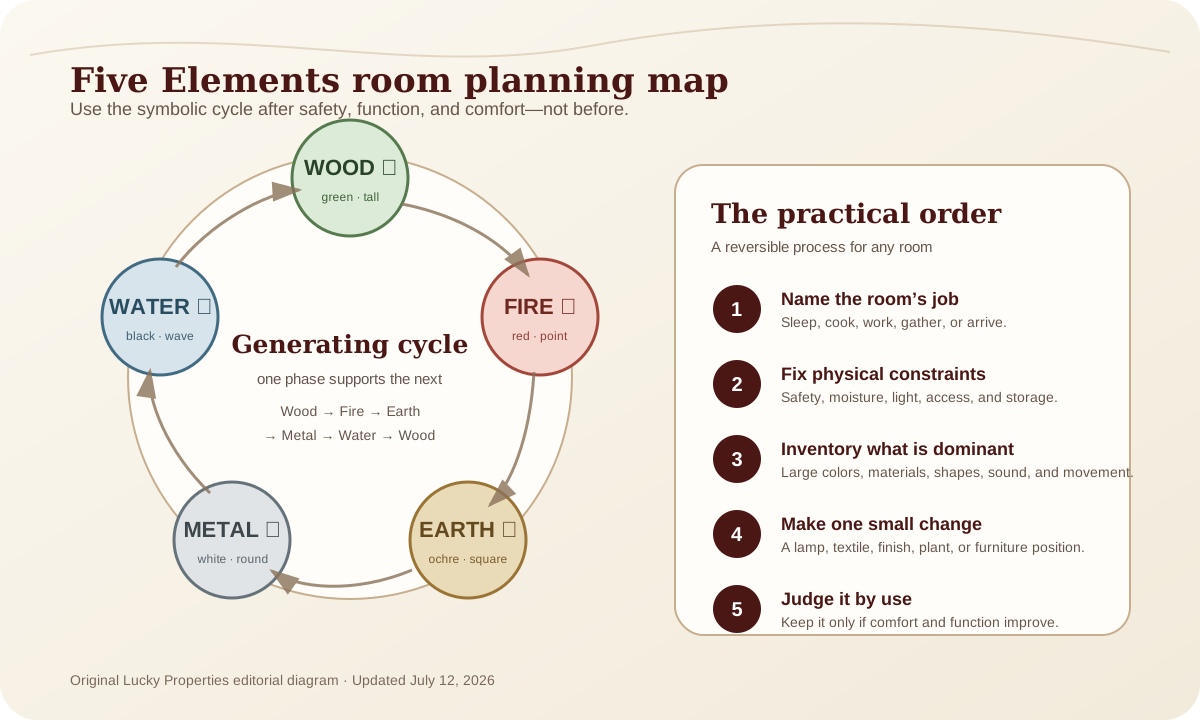
Five Elements can be a gentle visual language for a home: wood, fire, earth, metal, and water associations can help two people talk about whether a room feels lively, stable, crisp, or quiet. They are not prescriptions for who should dominate a relationship. If the framework is useful, begin with the practical Five Elements guide, then make one reversible change and see whether both people actually like it.
A four-question compatibility check-in
Instead of a score, try this monthly check-in. Each person answers separately first.
- What has made you feel cared for this month? Name a behavior, not an astrological trait.
- What recurring friction needs a small agreement? Pick one: time, money, household labor, social energy, family, sleep, or privacy.
- What room or routine would help? Maybe it is a charging spot, separate task light, a shared calendar, a clearer budget meeting, or a quiet hour.
- What is one request you can make without blame? Keep it specific and possible this week.
The zodiac result can be the invitation to this conversation. The conversation - not the result - is where relationship information appears.
Reading a result without turning it into fate
A compatibility page is most useful when it gives a reader a next action that is neither fearful nor vague. Try this three-step interpretation method:
- Name the tradition. Say “this chart describes a traditional year-animal pattern,” not “this is what will happen to us.” That one sentence keeps the limits visible.
- Find the smallest relevant theme. If a result mentions independence, do not assume a problem exists. Ask whether one person needs more social time, solo time, or decision-making room right now.
- Choose a real-world experiment. Create a weekly planning check-in, try a clearer division of one household task, schedule a no-phone meal, or change one shared-room annoyance. Keep the experiment only if both people find it useful.
The method works even when the chart says the pair is supposedly “ideal.” A flattering result can tempt people to overlook a disagreement that deserves care. It also works when the chart says “clash.” Two people can have different habits and still build a safe, joyful, durable relationship through agreements and repair.
When a reader is single
Compatibility content should not make a single reader feel incomplete or encourage them to screen potential partners by birthday. Use the twelve animals to explore your own preferences for pace, solitude, home, family, and play. Then write three non-negotiables that have nothing to do with astrology: perhaps kindness under stress, shared views on children, sobriety, financial transparency, religious freedom, or a willingness to repair after conflict. Those are more meaningful selection criteria than a zodiac triangle.
When family members object to a pairing
In some families, zodiac matching carries sincere cultural weight. Meet that belief with respect rather than ridicule, and also remember that the people in the relationship deserve agency. A constructive conversation can acknowledge the tradition, ask what worry sits beneath it, and discuss the practical evidence of the relationship: how conflicts are handled, whether both people are safe, how finances work, and what support exists. Avoid using a chart to pressure, shame, or isolate anyone.
When a result feels uncomfortably accurate
Humans are good at recognizing broad descriptions of themselves and partners. Rather than debating whether the result is “true,” inspect the concrete example that made it resonate. If it points to a genuine pattern, decide what support, boundary, or conversation would help. If not, let it go. A symbolic system is allowed to be meaningful without becoming an authority over every decision.
A privacy-aware way to use astrology tools
Fortune and compatibility tools often request birthdays, times, locations, names, and relationship details. Consider what is necessary. A year-sign comparison needs much less information than a detailed birth-chart practice. Do not enter someone else’s data casually, especially a child’s, former partner’s, or new date’s. Do not send screenshots containing birth details into group chats without permission.
When a site offers a result, look for a plain explanation of what it calculated and a clear cultural/entertainment limitation. Be skeptical of pages that use a frightening result to sell an urgent “cure,” promise a reunion, diagnose a partner, or guarantee wealth, pregnancy, health, or marriage. Good fortune content leaves the reader with agency.
A year animal is one calendar label, not a complete personal chart. If you want to understand the vocabulary that a Four Pillars report adds, use the BaZi (Four Pillars) study guide; it keeps the traditional labels separate from claims about relationship outcomes.
A compact reference: use, limit, next move
| Situation | Helpful use of a zodiac result | Important limit | Better next move |
|---|---|---|---|
| A new relationship | A playful icebreaker about habits | It does not measure attraction or trust | Ask about values and boundaries directly |
| Recurring arguments | A neutral prompt about different styles | It does not assign blame | Choose one conflict-repair habit to test |
| Moving in together | A way to discuss shared atmosphere | It cannot plan a room | Measure routes, storage, light, and budgets |
| Family concern | A respectful cultural conversation | It cannot override adult agency | Discuss the specific fear and real evidence |
| A frightening online prediction | A reminder to pause | It is not an emergency diagnosis | Step away, talk to a trusted person, seek appropriate support |
This table is deliberately less dramatic than the most viral compatibility pages. Dramatic scores attract clicks, but readers deserve a source that makes room for culture, uncertainty, and real choice.
Sources and next steps
- International Dunhuang Programme: zodiac compatibility and its wider astrological context
- TravelChinaGuide: modern context for Chinese zodiac compatibility as a folk custom
- Lucky Properties: Chinese zodiac compatibility tool
Try the pair tool as a conversation starter, then come back to this guide for the limits and prompts. If you are setting up a shared room, make the physical next step instead: test one layout, ask both people what they need, and choose the option that makes daily life calmer for both.