Short answer
Feng Shui decluttering is most useful when it is not a hunt for “bad energy.” Start by finding the object or pile that makes a daily action harder: a door that will not open fully, a chair that cannot pull back, a counter that cannot be used, a night route that feels unsafe, or a shelf you avoid because it needs repair. Clear that friction first. Traditional ideas about flow can then help you decide what the room should support, but they should never turn ordinary clutter into a prediction about your health, relationships, money, or future.
Why “clear everything” is often the wrong instruction
Most Feng Shui decluttering pages begin with a large promise: remove stagnant energy, invite abundance, change your life. The promise can make an already difficult task feel urgent and personal. It also skips the useful question: what is not working in this room today?
Clutter is not one thing. A stack of papers beside a desk may be an unfinished decision. Shoes behind a front door may be a storage problem. A crowded bookcase can be a safety concern if it is unstable. A kitchen counter full of appliances may tell you that there is no landing place for daily items. A box of photographs under a bed might be neutral, cherished, painful, or simply inconvenient; the answer depends on the person and the room.
In Feng Shui language, a clear route is often described as allowing Qi to move. In daily life, it means people can enter, carry groceries, open doors, reach a light switch, clean a surface, leave quickly, and use a room without beginning with a negotiation. That overlap is where the tradition becomes genuinely helpful.
The Lucky Properties approach is deliberately modest: make the home easier to use, then notice whether its visual atmosphere feels more settled. If a symbolic choice is meaningful to you, use it after the practical work—not instead of it.
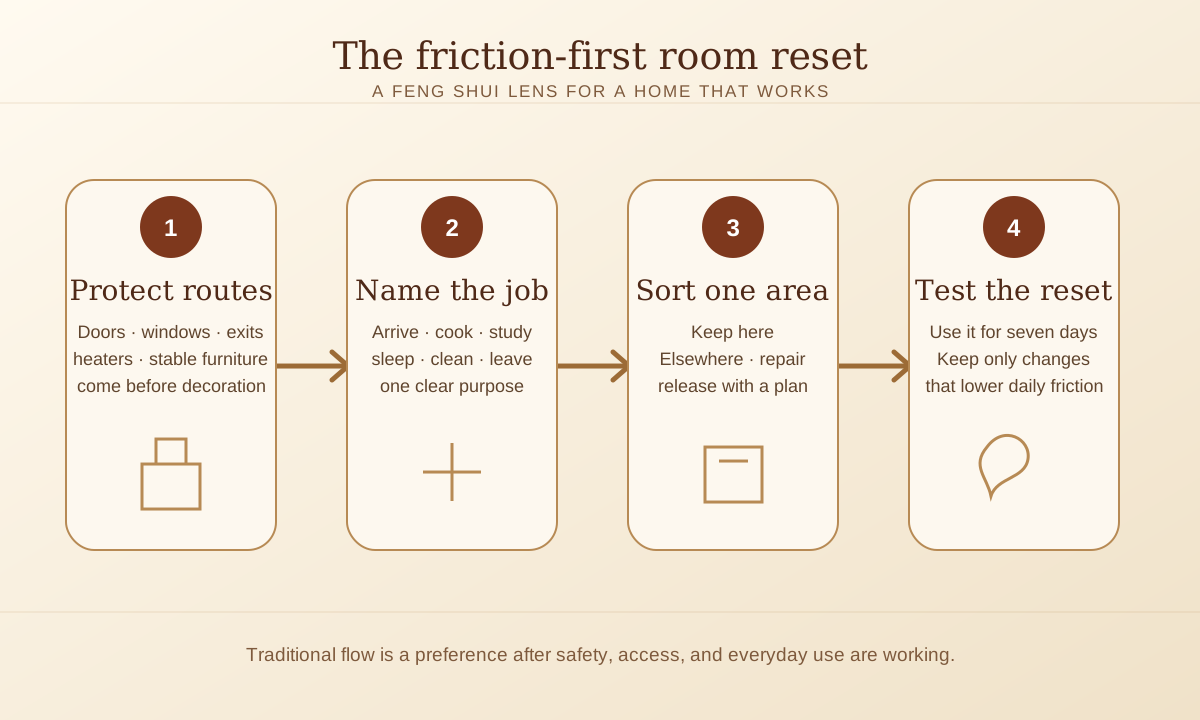
The friction-first reset: four checks before you sort
Do not start by pulling everything out of a closet. Begin with a five-minute walk through the room and record the first repeated point of friction.
| Check | Ask this | First response |
|---|---|---|
| Route | Can a person reach doors, windows, seating, storage, and exits without squeezing or moving a pile? | Clear the route before sorting decorative items. |
| Task | What is this surface or corner supposed to help someone do? | Give it one visible job: arrive, cook, study, sleep, eat, clean, or leave. |
| Repair | Is the “clutter” really a broken, damp, unstable, or missing-storage problem? | Separate repair, maintenance, and safety items from ordinary sorting. |
| Return | Can the items that stay return to a realistic home in under a minute? | Reduce the number of homes, not just the number of objects. |
This is an original decision framework, not a traditional formula. It prevents a common failure mode: spending an afternoon arranging small objects while the coat closet door still hits the shoe pile or the desk chair still cannot move.
Safety is not a symbolic trade-off
Keep exit routes, doors, windows, electrical panels, smoke alarms, heaters, vents, and access panels usable. The U.S. Fire Administration advises households to identify two ways out of every room and to keep doors and windows unblocked in a home fire escape plan. In a high-rise, learn the building’s stair and evacuation instructions rather than relying on a room arrangement alone.
Likewise, do not turn a tall bookcase, dresser, or television unit into a decluttering project without checking stability. The U.S. Consumer Product Safety Commission’s Anchor It! guidance explains why TVs and furniture such as dressers and bookcases need secure anchoring where appropriate. Put heavy objects low, follow the manufacturer’s directions, and use a qualified installer when the wall, furniture, or hardware is uncertain.
Those checks are not optional because an object is pretty, expensive, inherited, or associated with an auspicious part of a room. They are the baseline that lets a home feel safe enough to enjoy.
Choose a scope that ends today
The most durable reset is one that has a finish line. Choose one of these scopes:
- the floor immediately inside the front door;
- one kitchen counter and its nearest drawer;
- the 60 centimetres around the desk chair;
- the path from bed to bathroom;
- one shelf that has become a catch-all;
- one bag, box, or bin that has no identified owner.
Avoid choosing “the whole bedroom,” “the entire garage,” or “all paperwork” unless you have time, help, and a clear disposal plan. A large category may need several sessions; that is normal. Put a date on the next session rather than leaving an open pile in the centre of the room.
For each chosen area, use four temporary destinations: keep here, belongs elsewhere, repair or decide, and leave the home. Use a bag or box for the last category only when you know the next legal, safe step: recycling, donation, disposal, return, or a conversation with the owner. Do not create a “donation mountain” that blocks a hall for weeks.
Start at the entry: make arriving and leaving less complicated
The entry is called the “mouth of Qi” in many Feng Shui explanations. You do not need to believe that phrase literally to understand its value. Arrival is the transition that happens most often. If a person must step over bags, hold a door with a hip, or search for keys while balancing groceries, the home begins with friction.
Entryway reset card
- Open the door through its normal swing. Nothing should need to be kicked aside.
- Put the items used on nearly every trip—keys, bag, transit card, shoes, mobility aid, pet lead—in the smallest practical landing zone.
- Move seasonal or occasional items out of the first reach zone.
- Check the light at the hour you normally return home.
- Remove only the objects that turn arrival into a bottleneck; do not add a large console, tall plant, or mirror if it narrows the route.
The small-condo entryway guide has a more detailed arrival checklist for renters and compact halls. It is a better next step than buying a “cure” because it tests door swing, storage, lighting, and building constraints first.
Advertisement
Living rooms: clear the social route, not every sign of life
A living room is allowed to show that people live there. Books, blankets, a child’s current project, a pet bed, or a few everyday objects are not automatically clutter. The question is whether the room can still support its main activities: sitting, talking, watching, reading, hosting, and moving through it.
Begin with the route from entry to primary seating, then the route to the kitchen, balcony, washroom, or stairs. Remove objects that make people weave between furniture. Look at the main sofa: can someone sit down, stand up, and see the room entry without being placed directly in the busiest line of travel? If the answer is no, moving a side table may solve more than styling a shelf.
| Living-room friction | Smallest useful change | What not to do |
|---|---|---|
| Coffee table becomes a dumping ground | Give remotes, chargers, and current reading one contained tray | Buy another decorative container without deciding what it replaces |
| A sofa blocks the only path | Test a smaller table, different angle, or one removed chair | Use a plant as a barrier in an already narrow route |
| Visual clutter comes from cables | Trace, label, and secure cables according to product instructions | Hide damaged cords under a rug or behind a pile |
| Open shelves feel relentless | Keep a small edited group and move the rest into closed, stable storage | Move every object to another already-full room |
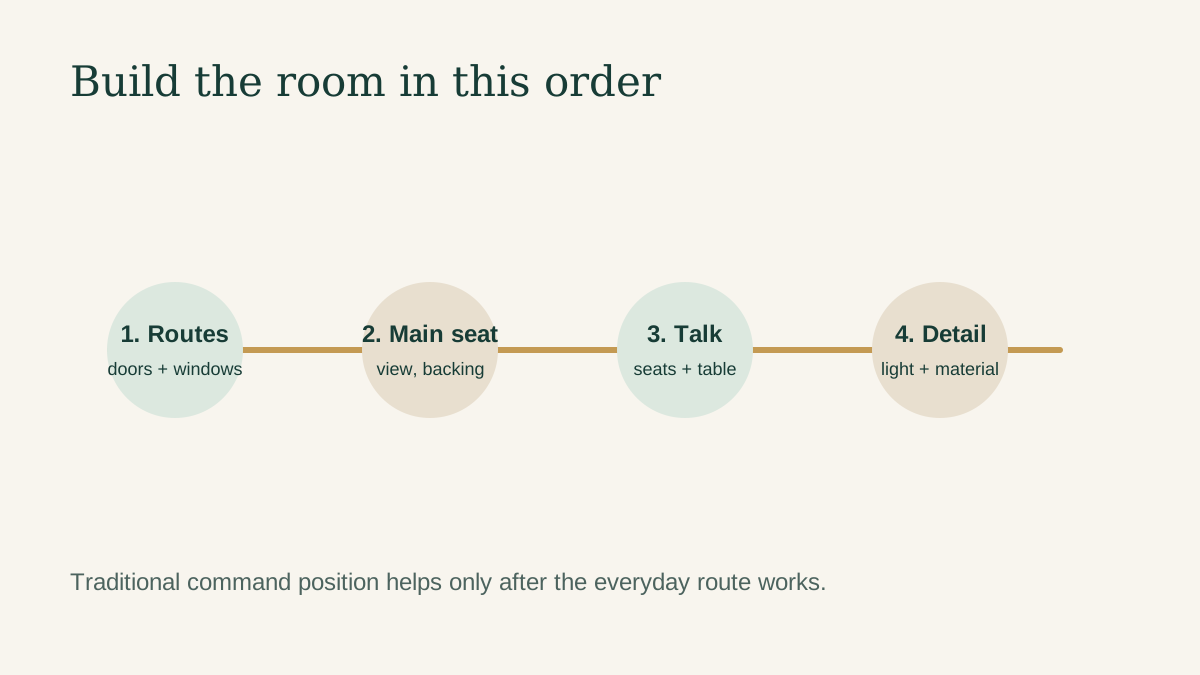
Traditional Form School language values a room with a clear, settled centre and a main seat that does not feel exposed. Treat that as a cue to test circulation and sightlines. The living-room layout plan shows how to choose a sofa position before using accessories to make a room look calmer.
Bedrooms: remove what interrupts rest, not evidence of a life
Bedroom decluttering advice can become especially loaded. A box under a bed, a framed photograph, a mirror, or a single bedside table does not determine whether someone will sleep well, find love, or keep a relationship. What matters is whether the room makes rest, dressing, privacy, and nighttime movement harder.
Try a pillow-level audit instead of a purge. Lie down at the usual bedtime and note what you can see: work papers, blinking chargers, a bright mirror reflection, laundry that needs a decision, a busy open closet, or a path that would be hard to use in the dark. Pick one or two conditions to change first.
A realistic bedroom sequence
- Clear a stable route from bed to door and bathroom.
- Move active work items out of the direct pillow view where possible; a closed box or end-of-day desk routine may be enough.
- Sort bedside items by nighttime use, not by how well they photograph.
- Keep only stored items that are clean, contained, accessible, and appropriate for the space under the bed.
- Address light, noise, temperature, dampness, loose furniture, and electrical concerns directly rather than labelling them energy problems.
For couples, do not use decluttering to erase one person’s belongings or preferences. Agree on a shared threshold for routes, surfaces, and storage; let each person retain personal areas where that is workable. The couples’ bedroom layout guide uses a floor-plan worksheet to make those trade-offs visible.
Kitchens: protect the work zone and the maintenance zone
Kitchen clutter is usually not about symbolism. It is about a shortage of landing space, awkward storage, too many duplicates, a project that never received a decision, or a repair issue being hidden behind objects. Start with the counter required for ordinary food preparation. Remove items that do not belong there, then ask where the displaced item will actually live.
Keep exits, stove controls, appliance instructions, and cleaning access clear. Do not store flammable or heat-sensitive materials where an appliance manufacturer says not to. Do not use a decluttering session to ignore a leak, damaged outlet, pest issue, broken cabinet, or vent problem. Those require an appropriate repair or building-maintenance path.
The traditional idea of the kitchen as a nourishment space can be a useful reminder to make the room workable for the people who use it. It is not a reason to promise wealth or health from a spotless counter. For an arrangement audit, use the practical kitchen layout guide.
Study desks: clear for the next task, not for a promised grade
Students and remote workers often encounter the harshest Feng Shui claims: face one direction and academic success will follow; put an object in a corner and concentration will appear. A better study reset makes the next task easier to begin. That may mean a clear writing area, a working light, a chair that can move, a charger that is not tangled, and a place for the paper currently in progress.
Use three zones on a desk:
| Zone | What belongs there | Reset rule |
|---|---|---|
| Active | The current assignment, device, light, and a necessary tool | Keep only what is needed for the next 30–60 minutes |
| Reference | One book, note, or device you will consult | Return it after the session instead of letting it become a permanent stack |
| Exit | A tray, folder, or basket for papers that need a decision later | Review it on a defined day; it is not a storage solution forever |
If the desk faces a wall because of a small room, do not turn that constraint into a personal failure. Create a useful wall: a simple task list, a calm image, or a blank surface. Then check the real constraints—screen glare, chair clearance, outlet safety, and noise. The study-desk guide helps students test their setup without promising focus, memory, or exam results.
Bathrooms, laundry, and the “later” pile
These spaces accumulate objects that are inconvenient to decide: expired toiletries, unfinished products, towels waiting for a wash, cleaning supplies, paperwork left “for later,” and items that belong in another room. Do not turn a bathroom reset into a claim that water symbolism causes financial loss or illness. Instead, check moisture, ventilation, cleaning access, product dates where relevant, secure storage, and the route to the fixtures.
In a laundry or utility area, keep products in their original labelled containers and follow their use and storage instructions. Do not combine cleaners because a decluttering session made the shelf look untidy. If there is persistent moisture, visible mould, pest evidence, or a ventilation problem, stop styling the room and use the appropriate building, maintenance, or health guidance.
Shared homes and rentals: agree before you “clear”
The fastest way to turn decluttering into a household conflict is to treat another person’s belongings as a design problem you are entitled to solve. In a shared home, the useful Feng Shui question is not “whose energy is wrong?” It is “what has to stay clear for everyone to use this room?”
Make the agreement as small and visible as possible. A household might agree that the entry door opens fully, the dining table is cleared before a meal, the sofa route stays open, and the bathroom counter has one shared tray. That leaves personal desks, wardrobes, hobby equipment, and shelves to individual choice unless both people want help. If children live in the home, create storage they can safely reach rather than expecting a decorative system they cannot maintain.
Renters have another layer: leases, building rules, and a limited number of places to add shelves, hooks, or partitions. Do not remove required fixtures, block sprinklers or vents, or use a heavy free-standing storage unit as a substitute for permitted storage. Reversible changes—one basket, a labelled drawer, a hook allowed by the lease, a lamp, a tray, or a routine—often reveal what is actually needed before money or drilling is involved.
Keep paperwork and records out of the “quick discard” category
Paper piles are visually tiring, but they may contain identity documents, tenancy records, insurance information, tax material, medical instructions, school records, or receipts needed for a return or warranty. Do not clear an unknown pile just to create a blank surface. Put it in a labelled review folder, set a realistic review date, and use secure disposal for sensitive records when you have confirmed they are no longer needed. The Feng Shui goal of a calmer visual field is not served by creating a future emergency.
If you are preparing to move, sell, renovate, or deal with a major life change, separate “needed this week” from “needed for the transition.” A half-packed box may be a sensible project, not stagnant energy. Give it a marked location that does not impede a route, and keep the rest of the home functional around it.
When an item is emotionally difficult
Some items are not clutter; they are grief, family history, an unfinished move, a disagreement, a future plan, or a reminder of a difficult time. Feng Shui language can make those objects feel charged, which is not always helpful. You do not need to dispose of a meaningful item because a chart says it holds the past.
Try a gentler sequence:
- Name why the object is hard to decide.
- Choose whether it needs display, protected storage, a conversation, repair, digitisation, donation, or more time.
- Give it a dated decision point if you choose more time.
- Keep it out of a route, a damp location, or a place where it creates daily distress.
If the amount of belongings, conflict, anxiety, or safety risk feels unmanageable, bring in appropriate support: a trusted person, landlord or building manager for property conditions, a professional organiser, or local health and safety help when needed. A symbolic rule is not a substitute for care.
The seven-day test: keep changes that work
Decluttering often fails because the first reset looks good but is impossible to maintain. Test one room for seven ordinary days. Do not add new containers until you know what the room repeatedly asks for.
At the end of the week, ask:
- Did the door, route, drawer, chair, or counter remain usable?
- Did the objects return to their assigned place without a complicated routine?
- Did anyone else in the home lose a needed storage spot?
- Did the change reduce a real annoyance, or did it only make a photograph look simpler?
- Is there a repair, a missing hook, a better light, a smaller piece of furniture, or a household agreement behind the remaining pile?
Keep the answer concrete. “The hallway feels better” can become “we no longer leave bags on the floor because there is one hook and one basket.” That is a result you can repeat.
Sources and what to read next
- U.S. Fire Administration home fire escape plans explain why routes, doors, and windows must stay usable and why a household should know more than one way out.
- U.S. Consumer Product Safety Commission: Anchor It! provides furniture and TV tip-over prevention guidance, especially relevant when reorganising bookcases, dressers, and media units.
- U.S. EPA guidance on indoor particulate matter notes that frequent cleaning can reduce settled indoor dust and allergens; it does not make a decorative object a health treatment.
- Living-room layout plan is the next step when the pile is really a furniture-and-route issue.
- Study-desk guide is the next step when the clutter keeps returning to an active work surface.
Editorial note: Lucky Properties presents Feng Shui as a cultural and design-oriented way to observe a home. This guide is educational. It does not predict health, wealth, relationships, academic results, or property outcomes, and it does not replace fire, electrical, building, tenancy, safety, health, or professional-organising advice.