The short version
Short answer: Stand clear of the building on the line the home faces, take three magnetic bearings a few seconds apart, record the average in degrees, and write your local magnetic declination next to it. That one page of notes, repeated the same way, is a reading you can actually use. Most bad Feng Shui charts are not bad philosophy; they are one hurried phone reading taken beside a steel door.
This guide teaches the measurement. What you then do with the sectors is covered by our Bagua floor plan guide and its room-by-room companion. If you are not yet sure which direction counts as your home's facing, read house facing vs door direction first; a precise bearing of the wrong line is still the wrong line.
Two norths, and why your chart cares
A compass needle does not point at the geographic pole. It aligns with the local magnetic field, and the angle between that direction and true north is called magnetic declination. NOAA's geomagnetism resources describe declination as varying with location and slowly changing over time; its Science On a Sphere materials make the same point visually, showing compass pointing directions diverging from the true-north meridians across the globe. Practical guidance from Campbell Scientific, written for orienting field instruments, gives the working procedure: read the magnetic compass, obtain the declination for the specific site (they name NOAA's geomagnetic service as the preferred source), and apply the correction to find true north.
For a home reading, the declination can be small enough to ignore or large enough to move your facing direction into the neighboring sector. Traditional luopan rings divide the full circle into 24 mountains of 15 degrees each. A location with, say, 12 degrees of declination, read carelessly, puts a home near a sector boundary on the wrong side of it. You do not need to resolve the old magnetic-versus-true debate to take a good reading. You need to record both numbers so the chart can be rebuilt later under either convention.
Before you measure: pick the line
A compass reading measures a direction, so decide which direction you are measuring:
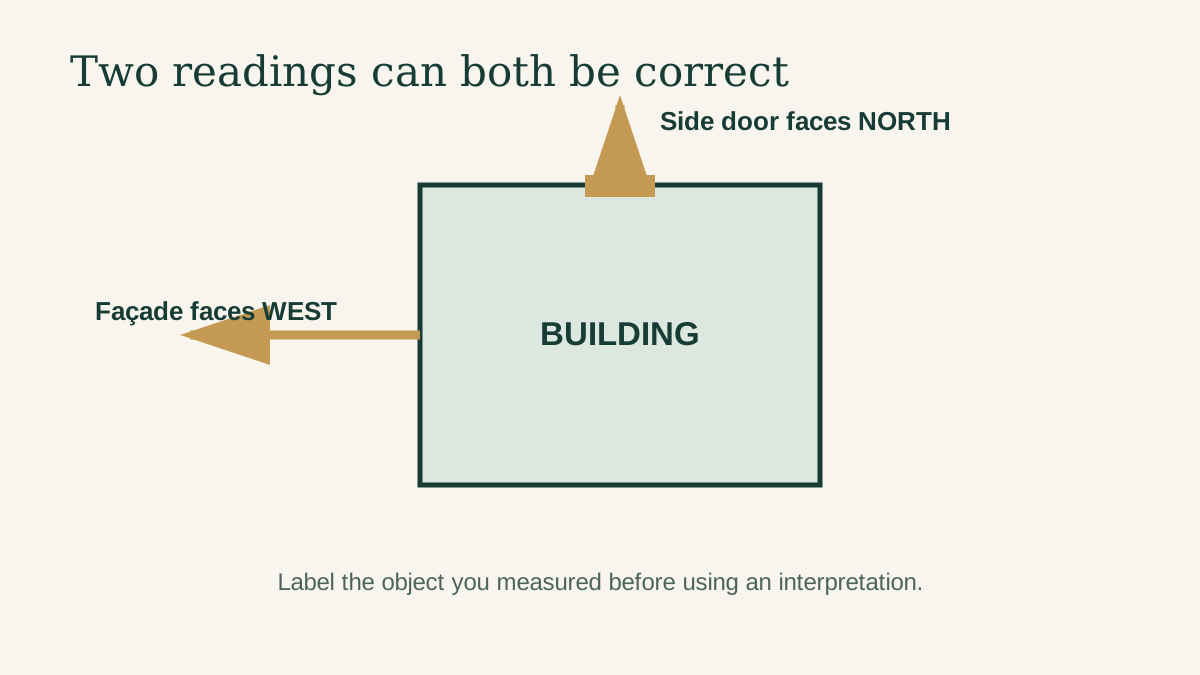
- The facing line is the direction the home's principal face looks toward, the convention most compass-school work starts from.
- The door line is the direction the main door faces when opened outward, which is sometimes, not always, the same line.
- A room line, such as a bed or desk direction, is a separate, smaller measurement taken indoors.
Measure one line at a time and label it. The viewing checklist in our home buying checklist is a good place to note facing and door lines while you still have access to a property you are considering.
Advertisement
The field procedure
- Clear the interference. Move a few paces from the building facade, vehicles, metal gates, and railings. Take off magnetic phone cases. Reinforced concrete, steel doors, and buried services can all pull a needle; distance is the cheapest fix.
- Align your body with the line. Stand on the facing line, looking outward in the direction the home faces, and hold the compass or phone flat and steady at waist height.
- Take three readings. Note each bearing in degrees, a few seconds apart, without moving your feet. If the three disagree by more than about three degrees, something nearby is interfering; move further out and repeat.
- Average and record. Write down the average magnetic bearing, the three raw readings, where you stood, and the date. A reading you cannot repeat is a guess wearing a number's clothing.
- Look up your declination. NOAA publishes location-specific magnetic declination values through its geomagnetic calculators. Record the value and whether it is east or west next to your bearing.
- Convert if your method needs true north. Following the standard correction described in the instrument-orientation guidance cited below: with an east declination, true bearing is the magnetic bearing plus the declination degrees; with a west declination, subtract. Worked example, labeled hypothetical: if a home's magnetic facing reads 182 degrees and the local declination is 10 degrees west, the true facing is 182 - 10 = 172 degrees. Under the magnetic convention the home faces just inside one sector; under the true convention it sits in the next. Neither is an error; they are two charts, and your notes must say which one you built.
Reading the degrees without fooling yourself
- Sector boundaries are the danger zone. A facing within three degrees of a 15-degree sector edge should be reported as borderline, with both candidate sectors named. Decorating advice that flips completely on a two-degree difference is advice to hold loosely.
- Phones drift. Calibrate before each session, and distrust any single reading that disagrees with the street grid you can see. In many planned neighborhoods, streets run on known bearings; a reading that contradicts the visible grid by thirty degrees is the phone, not the street.
- Apartments are harder. Steel structure, elevators, and neighboring units stack interference. Take the reading from the balcony or the ground outside the building face where possible, and treat indoor room readings as approximate. Our orientation guide covers how to sanity-check a unit against daylight, which never lies about east and west.
- Repeat on another day. A second session that reproduces the first within two degrees gives you a measurement. Anything looser gives you a range; report the range as measured.
The 24 mountains, in plain terms
Compass-school charts divide the circle into eight principal directions of 45 degrees, and the traditional luopan ring subdivides each direction into three 15-degree mountains, 24 in total. The names below are the conventional ring labels, given as cultural vocabulary so you can read a chart printed by any practitioner:
| Direction | Three mountains (15 degrees each) |
|---|---|
| North | Ren, Zi, Gui |
| Northeast | Chou, Gen, Yin |
| East | Jia, Mao, Yi |
| Southeast | Chen, Xun, Si |
| South | Bing, Wu, Ding |
| Southwest | Wei, Kun, Shen |
| West | Geng, You, Xin |
| Northwest | Xu, Qian, Hai |
Each mountain is named on the ring by its position, and charts may further distinguish early, middle, and late portions of a direction. For a home reading, the practical translation is simpler: your facing degree lands in exactly one 15-degree slice, and a complete report names that slice, its two neighbors, and the margin to each boundary. If your averaged bearing sits within three degrees of a boundary, report both slices. A chart that pretends a boundary-straddling home has one certain sector is claiming precision the measurement does not contain.
A recording worksheet that takes two minutes
Write these five lines in a notebook or a phone note before you leave the property:
- Address or unit, and the line measured (facing, door, or room).
- Three raw magnetic bearings, in degrees, and their average.
- Where you stood, in words a stranger could follow ("four paces out from the front steps, on the path centerline").
- Local declination, east or west, and the source and date you obtained it.
- The converted true bearing if your method uses one, showing the addition or subtraction.
That worksheet is the difference between a chart that can be checked next year and a number nobody can reproduce. Keep it with the floor plan sketch from the Bagua guide, and the two documents will still agree with each other long after the phone that took the reading has been replaced.
What this measurement can and cannot do
A careful compass reading settles an empirical question (which way does this home face, in degrees, by a stated convention) so that a cultural system can be applied consistently. It does not validate predictions about the occupants, and small angular differences do not change how a home lives. Light, noise, layout, and condition, the things you can verify with your own senses, remain the substance of a good home; the compass simply keeps the symbolic layer tied to a measured bearing. That ordering (measure carefully, interpret modestly) is the house standard across this site.
Sources and method notes
- NOAA, Earth's Magnetic Field (Science On a Sphere dataset): compass needles follow local magnetic field lines, and the angle between compass direction and True North is magnetic declination, varying by location.
- Campbell Scientific, Determining True North and Sensor Orientation: true north is found by reading a magnetic compass and applying the site declination correction, with NOAA's geomagnetic service named as the preferred source for the local value.
- The 24-mountain, 15-degree ring division is the traditional luopan convention referenced throughout this site's compass-school guides; the worked conversion above uses labeled hypothetical figures, not a real address.
Record the bearing, the convention, and the declination every time, and any practitioner, including future you, can rebuild the chart and argue with it productively. That is all a good reading has ever promised.