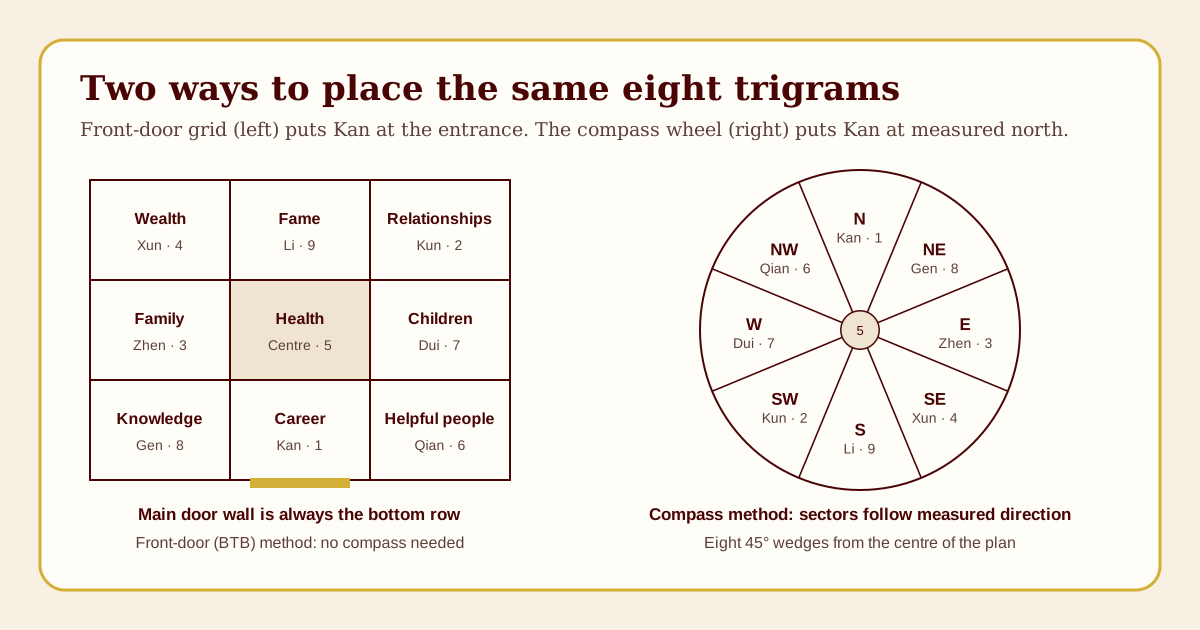
There are two ways to point a Bagua map, and they do not agree. The front-door method (often called BTB, after the Black Sect Tantric Buddhist school) lays the grid so the Career row sits on the wall with your main door, whatever direction that wall faces. The compass method turns the same eight trigrams so the Kan sector points to measured north. Pick one, write it on the drawing, and never read one area from each.
That is the whole decision in a sentence. The rest of this page explains why the two methods disagree, what each one needs from you, how they handle the awkward cases (a door on a corner, a home whose door faces a side street, a flat in a tower), and a table you can use to choose in about five minutes.
Why there are two maps at all
Both methods start from the same object. The eight trigrams of the Book of Changes (Yijing or I Ching) can be arranged in a ring, and one arrangement, usually called the Later Heaven or King Wen sequence, assigns each trigram a direction. The Shuo Gua, the "Discussion of the Trigrams" commentary that circulates with the Book of Changes, describes this sequence: Zhen stands in the east, Li is the trigram of the south, Kan the trigram of the north, Qian the northwest, Gen the northeast, and so on round the circle. You can read the text in the Chinese Text Project's edition of the Shuo Gua, checked November 2026.
Add the Lo Shu magic square, the three-by-three square of numbers in which every row, column and diagonal adds to 15, and each trigram also carries a number: Kan 1, Kun 2, Zhen 3, Xun 4, the centre 5, Qian 6, Dui 7, Gen 8, Li 9. Our Lo Shu square page explains where that square comes from and how the numbers are used elsewhere in Chinese metaphysics.
Up to this point there is one map. The split comes from a single question: what does the bottom of the map attach to?
- Classical compass practice attaches Kan, the north trigram, to north. The home is read by direction, and each sector of the plan inherits the trigram of its compass direction.
- The front-door method attaches Kan to the entrance. The wall with the main door becomes the "Kan line", and the grid is read by position relative to that door: front, middle, back, left and right.
The International Feng Shui Guild's introduction to the Bagua, first published in July 2020, shows both versions side by side: one laid with its front edge along the front of the structure, and one divided into the eight directions plus the centre using a luo pan compass (IFSG, "The Feng Shui Bagua", checked November 2026). The guild presents them as two layouts, not as one map drawn two ways.
Where the front-door method came from
The front-door grid became widely known in North America through Thomas Lin Yun, who taught what he called Black Sect Tantric Buddhist Feng Shui. His published obituary records that he introduced his teachings, "especially Feng Shui, to the West" through lectures, held visiting posts at the University of San Francisco (1980 to 1981) and Stanford (1981 to 1982), and founded the Yun Lin Temple in Berkeley in 1986 (obituary on Legacy.com, checked November 2026).
Most English-language Bagua posters, the ones with Wealth in the far-left corner and Relationships in the far-right corner, are drawn for this method. The life-area labels you see on them (Career, Knowledge, Family, Wealth, Fame, Relationships, Children or Creativity, Helpful People or Travel, and Health at the centre) are its vocabulary. Classical compass schools mostly talk in trigrams, directions, elements and numbers instead.
Neither origin story makes one method "real" and the other fake. They are tools built for different questions. The compass method asks how a building sits in relation to direction and time. The front-door method asks how the parts of a home sit in relation to the way you enter it. If you keep that difference in mind, most of the confusion online disappears.
The same eight areas, placed two ways
Here is the front-door grid, drawn as you would see it standing outside the entrance and looking in. The main door wall is the bottom row.
| Back left | Back middle | Back right |
|---|---|---|
| Wealth (Xun, 4) | Fame (Li, 9) | Relationships (Kun, 2) |
| Middle left | Centre | Middle right |
| Family (Zhen, 3) | Health (centre, 5) | Children or Creativity (Dui, 7) |
| Front left | Front middle | Front right |
| Knowledge (Gen, 8) | Career (Kan, 1) | Helpful People (Qian, 6) |
Now the compass version. Each trigram sits in a fixed direction, and each direction is a 45-degree wedge measured from the centre of the plan.
| Direction | Trigram | Number | Bearing range (degrees) | Front-door equivalent |
|---|---|---|---|---|
| North | Kan | 1 | 337.5 to 22.5 | Career |
| Northeast | Gen | 8 | 22.5 to 67.5 | Knowledge |
| East | Zhen | 3 | 67.5 to 112.5 | Family |
| Southeast | Xun | 4 | 112.5 to 157.5 | Wealth |
| South | Li | 9 | 157.5 to 202.5 | Fame |
| Southwest | Kun | 2 | 202.5 to 247.5 | Relationships |
| West | Dui | 7 | 247.5 to 292.5 | Children or Creativity |
| Northwest | Qian | 6 | 292.5 to 337.5 | Helpful People |
The last column is the key to the whole subject. The front-door grid is the compass ring rotated so that north lands on your door wall. If your door wall faces north, the two maps coincide. For any other door, they disagree, and the size of the disagreement depends on how far your door is turned away from north.
Advertisement
A worked comparison: one house, two answers
Take a plain rectangular bungalow, 12 metres wide and 9 metres deep, with its main door in the middle of the front wall. Stand at the door looking out: the compass reads 180 degrees, so the house faces south and sits north.
Front-door method. The front wall is the Career row. Standing outside and looking in, you face north, so your left hand points west. The back-left corner, Wealth, is therefore the northwest corner of the building, and the back-right corner, Relationships, is the northeast corner.
Compass method. Draw eight wedges from the centre. The door is in the south wedge, Li. Wealth, Xun, is southeast, which on this house is the front-right corner as you stand outside looking in. Relationships, Kun, is southwest, the front-left corner beside the door.
| Area | Front-door method puts it | Compass method puts it | Same room? |
|---|---|---|---|
| Wealth (Xun) | Back left, northwest corner | Front right, southeast corner | No |
| Fame (Li) | Back middle, north wall | Front middle, at the door | No |
| Relationships (Kun) | Back right, northeast corner | Front left, southwest corner | No |
| Career (Kan) | Front middle, at the door | Back middle, north wall | No |
| Health (centre) | Centre | Centre | Yes |
For a south-facing house the two maps are turned a half circle relative to each other: every outer area lands in the opposite corner or wall. Only the centre agrees. A reader who learned the front-door method and then reads a compass article about "the southeast wealth corner" will move a desk to the wrong end of the house, and vice versa. Nothing is wrong with either map. What goes wrong is mixing them.
The arithmetic generalises. Take the compass bearing of the door wall's outward direction and look up which trigram sector it falls in. That trigram is the one the compass method places at your door. The front-door method always places Kan there. The number of 45-degree steps between the two is how far the maps are rotated apart:
| Door wall faces | Compass method places at the door | Rotation between the maps |
|---|---|---|
| North | Kan (Career) | 0 degrees: identical |
| Northeast or northwest | Gen or Qian | 45 degrees: every area moves one place round the ring |
| East or west | Zhen or Dui | 90 degrees: a quarter turn |
| Southeast or southwest | Xun or Kun | 135 degrees |
| South | Li (Fame) | 180 degrees: upside down |
What each method needs from you
Front-door method checklist
- A floor plan, even a rough sketch, with the outer walls of the space you are mapping.
- The location of the main entrance: the door that was designed as the front door, even if the household uses a side door every day. Schools that teach this method generally take the architectural front door; if your household never uses it, say so on the drawing and decide which one you are using.
- A rectangle drawn around the whole footprint, divided into an even three-by-three grid. Stretch the grid to the shape of the plan; the squares do not need to be square.
- The Career row placed along the door wall.
No compass and no degrees are involved. That is the method's main practical advantage, and also its main limitation: it says nothing about which way the building faces in the world, which is exactly what the compass method cares about.
Compass method checklist
- A floor plan drawn to scale, or close to it, because the wedges depend on angles.
- A compass bearing of the building's facing direction. Our compass-reading guide walks through the procedure: three readings away from metal, averaged, with the declination written beside them.
- A decision about which side is the facing side. Usually that is the side with the main door and the street, but not always; house facing versus door direction covers the cases where they differ.
- The centre point of the plan, found from the diagonals of the outline or, for irregular shapes, from its balance point.
- Eight 45-degree wedges drawn from the centre, with north set from the reading. Many practitioners divide further into 24 sectors of 15 degrees each, the "24 mountains" of the luopan.
The compass method also opens the door to classical systems that sit on top of it, such as Flying Stars and Eight Mansions, which use the facing direction and the construction period. The front-door grid cannot feed those systems, because it never records a direction.
Magnetic north, true north, and the floor plan
A compass needle points to magnetic north. Architectural drawings, property surveys and satellite maps are drawn to true (geographic) north. The angle between the two is the magnetic declination, which NOAA's National Centers for Environmental Information describe as changing "over time, and with location" (NOAA NCEI, magnetic declination, checked November 2026). NOAA's geomagnetic calculators give the value for an address and date.
This matters for the compass method only, and only near sector edges. If your facing reading is 180 degrees magnetic, you are in the south sector whatever the local declination, short of an extreme one. If your reading is 158 degrees, a few degrees of declination decides whether the facing is south or southeast, which changes every sector of the map.
Classical luopan practice reads the magnetic needle, and many practitioners do not convert. Others work in true north from survey drawings. You do not need to settle that debate to draw a good map. You need to write on the drawing which north you used, so that you or anyone else can rebuild the same map later.
A sensible rule for a home study:
- If the facing bearing is more than 7.5 degrees away from a sector edge, the north convention will rarely change the sector. Record it and move on.
- If it is within 7.5 degrees of an edge, write down both the magnetic and the true bearing and note that the facing is "on the line". Draw the map both ways if you are curious, and do not make an expensive decision from either one.
The 7.5-degree figure is half of one 15-degree mountain. It is a working margin for a home sketch, not a classical rule.
Advertisement
The awkward cases
The door is on a corner
A door set diagonally into a corner does not sit on one wall. For the front-door method, one common approach is to take the wall the door is closest to parallel with; another is to extend the grid so the door falls in the front row. Record which choice you made. For the compass method, the door position matters less than the facing direction of the building, so take the facing from the main façade rather than from the angled door.
The door faces a side street
In the front-door method, the door wall is the bottom row even if the house's main façade faces another street. In the compass method, you have to decide what the facing is: the side with the door, or the side the building presents to the main road and the light. Classical writers usually weigh the façade, the road and the open space in front, not just the door. This is the case where the two methods are most likely to diverge, so it pays to draw both and label them.
Apartments in a tower
The front-door method uses the unit's own front door. Compass practitioners disagree: some use the building's facing, some the unit's main window or balcony side, some the unit door. Our apartment and studio Bagua guide covers this in detail with worked examples.
L-shaped and irregular homes
Both methods have to decide what to do with a corner that falls outside the building. The front-door method usually calls it a missing area; compass practice does too, but measures it by direction. Our L-shaped and irregular floor plan guide works through one plan with stated dimensions and shows how two common rules produce two different verdicts.
More than one floor
The front-door method usually lays the grid on each floor separately, aligned to where the stairs arrive, or uses the ground-floor door for every floor. Compass practice normally keeps the same facing for the whole building. Either way, write it down.
How to choose: a five-minute decision table
| If this describes you | Lean toward | Why |
|---|---|---|
| You want a quick way to look at your home room by room | Front-door | No equipment, works on any rough sketch, and most English-language books use it |
| You are following a book, course or teacher in a named school | Whatever that school uses | Mixing your source's labels with another method's grid is the most common error |
| You are interested in Flying Stars, Eight Mansions or other classical systems | Compass | Those systems need a measured facing direction and the construction period |
| Your door is on a corner or a side street and you are unsure which wall counts | Compass, with the facing recorded | The facing direction is easier to define than "the door wall" in these cases |
| You rent and cannot change much | Front-door, used lightly | Most of what you can act on is furniture, lighting and storage, which either method can inform |
| You are about to spend real money on a renovation | Neither on its own | Use a qualified designer or builder for the decision; treat any Bagua reading as a preference layered on top |
Whatever you pick, put a label in the corner of the drawing with three items: the method, the north convention (for compass), and the boundary you mapped. That label is what makes the map reusable.
Common mistakes with Bagua directions
Reading a compass article with a front-door map
The most frequent confusion comes from articles that say "the southeast is your wealth corner" being read by someone who has already drawn a front-door grid. Southeast is Xun only in the compass method. In the front-door method, Xun is the back-left area regardless of direction. Our wealth-corner guide compares those two wealth corners directly.
Flipping the map instead of rotating it
Posters are printed as seen from outside the entrance. If you lay a printed template over a plan and flip it face down to make the door edge line up, left and right swap: Wealth trades places with Relationships, and Family with Children. Always rotate. Our printable Bagua template page shows the rotate-versus-flip difference with a diagram.
Reading the compass inside, beside the fridge
Steel doors, appliances, car bodies and reinforced concrete can pull a compass needle by several degrees. Take the facing reading outside, a few paces away from the building and from vehicles, and repeat it.
Using a different north from the one on the plan
A phone compass app may show magnetic or true north depending on its settings. A satellite map shows true north. If you draw the plan from a satellite image and then lay out the wedges from a magnetic reading, the two do not match by the local declination. Pick one and note it.
Treating the result as a forecast
Whichever method you use, the Bagua is a cultural and interpretive lens for looking at a home, not a predictive instrument. Neither map can tell you whether a house is a good purchase, why you are tired, or whether a relationship will last. Lucky Properties covers it as a way to notice light, circulation, storage and use, and to give a household a shared language for what each part of the home is for.
Where to go next
If you have picked a method and want to draw the map, start with the Bagua floor-plan guide, which walks through the 15-minute worksheet. If you chose the compass method, take the reading first with the compass-reading guide. For the wider split between Form School and Compass School thinking, read Form School versus Compass School. And once the grid is on paper, the room-by-room guide turns each area into practical questions about the room that falls there.
Sources
- Chinese Text Project: Shuo Gua (Discussion of the Trigrams), the classical text that places the trigrams by direction. Checked November 2026.
- International Feng Shui Guild: The Feng Shui Bagua, published July 2020, which shows the front-edge layout and the compass (luo pan) layout separately. Checked November 2026.
- Obituary of Grandmaster Professor Thomas Lin Yun, Legacy.com, for his teaching posts in the United States from 1980 and the founding of the Yun Lin Temple in 1986. Checked November 2026.
- NOAA National Centers for Environmental Information: magnetic declination, for the definition of declination and links to the declination calculators. Checked November 2026.
Editorial note: Lucky Properties presents Feng Shui as a cultural and design tradition. This guide is educational and does not predict health, wealth, relationships or property outcomes. It does not replace advice from architects, builders, inspectors, real-estate, legal or financial professionals.