Short answer
House-facing direction and front-door direction can be different. A house-facing direction describes the building’s façade or outward orientation; a door direction describes the way a particular door faces. In a home with a side entrance, recessed door, corner lot, or condo corridor, they may not match. Record both, state how you measured them, and solve daylight, drainage, access, structure, and neighbourhood questions before applying Feng Shui symbols or colour suggestions.
The common mix-up
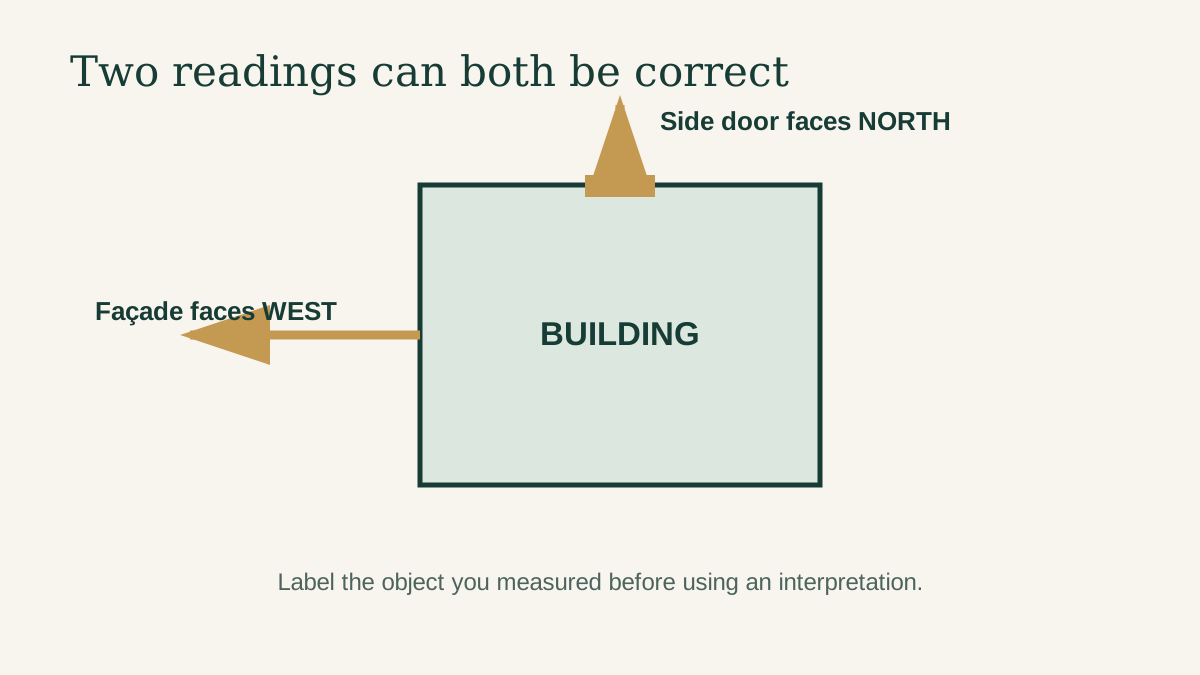
“Stand at the front door and look out” is simple advice, but it answers only one question: the direction of that door. It does not automatically identify the house façade. Classical Feng Shui sources distinguish between the two inputs because different systems may use a building’s facing direction to set a wider map while a door reading concerns the opening itself. Joey Yap’s Real Feng Shui teaching material makes this distinction explicitly and notes that a door and building can face different directions.
The distinction matters most in modern housing: a townhouse may have its street façade on one side and an entrance around the corner; a condo door may face an interior corridor while the unit’s major windows face a completely different view; a house may have a formal front door that is rarely used while everyone arrives through a garage entry.
Record three directions, not one answer
Make a small property note with these fields:
| Field | What you are recording | Why it helps |
|---|---|---|
| Building façade | The side the building was designed or most actively presents to the outside | Makes the property-scale question explicit |
| Main-door facing | The direction you face while standing just outside the door and looking outward | Describes the opening, not necessarily the whole building |
| Daily arrival route | The entrance used by residents and visitors most of the time | Reveals the route that actually needs lighting, storage, and maintenance |
This three-part record prevents a false argument in which two people measure different things and each call the other wrong.
Advertisement
A careful measurement method
Compass apps are convenient but can be affected by a phone case, vehicle, metal railing, electrical equipment, and calibration. A precise classical reading may call for trained practice and a Luo Pan; a homebuyer’s screening note does not need that level of certainty. It does need repeatability.
- Stand outside at the midpoint of the façade or door you are recording, not in the middle of an interior room.
- Hold the compass level and away from large obvious metal objects.
- Take three readings several steps apart and write them down rather than forcing one exact number.
- Photograph the façade and the door location for your own record.
- Label the result: “façade reading,” “door reading,” or “daily entrance reading.”
If the readings jump widely, do not build an interpretation on a false precision. Repeat on another day, check the device, or ask a qualified practitioner if a particular school’s chart matters to you.
Why the façade can matter more than the door
The façade is often the building’s broad relationship to street, sunlight, view, and open space. In traditional Compass School work, it can be used to establish the orientation for systems such as Flying Stars or Eight Mansions. That does not mean a generic “south-facing equals success” slogan is sound property advice.
For a buyer or renter, orientation has concrete implications too. It can influence direct sun, overheating, snow or ice conditions, glare, landscaping, and the location of outdoor living. Those effects depend on climate, window area, shading, insulation, surrounding buildings, and season. Assess them during a viewing, with local professional advice where needed—not with a direction label alone.
Why the door still deserves its own audit
The main door is the everyday threshold. In Feng Shui, it is often described as the mouth of Qi. Practically, it is where security, visibility, locks, packages, weather, shoes, accessibility, and first impressions meet. A door can be beautifully oriented on a compass and still fail the people using it if the step is unsafe, the lighting is poor, or the swing meets a crowded hall.
Use the front-door direction guide for colour and entry layout ideas after this measurement step. Then use the small-condo entryway checklist if the problem is a real narrow arrival path.
Four property situations where the difference matters
A side-door house
The front façade faces the street to the west; the main door is set on the north side under a porch. Record west for the façade and north for the door. Do not pick a colour or chart input until the method tells you which one it uses.
A condo with a corridor door
The unit door faces a corridor, while the living-room windows open southeast. The corridor-door reading describes arrival. The window wall may be more relevant to sunlight, view, and the lived experience of the unit. A building-wide façade can be another layer entirely. This is not a contradiction; it is a reminder that “facing” is underspecified.
A corner-lot house
Two street sides may look equally public. Look at the architecture, address, approach, mail location, and daily use. If no façade is clear, write that uncertainty down rather than inventing a definitive direction.
A rear entrance used every day
The formal front door is for visitors; family and groceries arrive through a garage or rear mudroom. Respect the formal threshold if it matters to the household, but audit the daily entrance for clutter, lighting, and safe arrival. The door people use is the door that shapes the routine.
Direction does not replace due diligence
Never let an auspicious-direction claim crowd out a property inspection. A buyer should investigate condition, drainage, roof, wiring, heating, access, local regulations, insurance, and comparable-market context with appropriate professionals. A renter should inspect locks, egress, heating, dampness, pests, appliance condition, and lease terms. Feng Shui is an interpretive and cultural lens, not an inspection report or prediction.
If the lot itself feels difficult—an unusual taper, missing corner, steep grade, or awkward road relationship—use the lot-shape analysis guide to frame questions. For a road pointing toward the property, read the T-junction house guide and focus on actual traffic, noise, visibility, drainage, and local rules.
Sources and what to read next
- Joey Yap, Real Feng Shui, pp. 7–8, distinguishes door-facing from building-facing measurement and gives a basic measurement procedure.
- Natural Resources Canada’s home-energy information is a better source for evaluating real comfort and energy questions than a generic directional promise.
- Feng Shui front-door direction guide is the practical next step once you know which direction you are actually discussing.
What to read next: Take the three readings first, then open the front-door guide. That order prevents the most common mistake: interpreting a number before identifying what it measures.