Period 9 • Annual Energy Map

Flying Stars Feng Shui

Explore a 2026 Flying Stars reference map. Use it as cultural context alongside real checks for comfort, maintenance, safety, and the way your home functions.

Last Updated: July 13, 2026

Flying Stars as a study map, not a risk report

Flying Stars (Xuan Kong Fei Xing) is a traditional time-and-direction framework within Feng Shui. Its numbered stars, compass sectors, annual cycles, and Period language are part of a cultural system of interpretation. They are not measurements of air quality, structural safety, medical risk, relationship quality, legal risk, or financial outcomes.

Many online charts reduce this system to a shopping list: a “dangerous” sector, a predicted loss, and an object sold as a cure. That is not a responsible way to use a home. A household should never postpone a repair, inspection, safety improvement, accessible route, or conversation with a qualified professional because a chart labels a direction favourable or challenging.

A better way to explore the grid

  1. Orient consistently. Record whether you are using the building façade, the entrance used daily, or a room wall. These may be different directions.
  2. Name the traditional association. The grid can help you learn the vocabulary of stars, elements, Bagua directions, and Period classifications.
  3. Observe the real room. Is the route clear? Does the light work? Is there noise, glare, condensation, a blocked vent, or an unfinished maintenance issue?
  4. Choose a reversible action. Clear a surface, move a lamp, put away a cable, improve storage, or choose an object that has personal meaning. Keep the change only if it makes the room work better.

The chart below is a learning interface. Use its numbered placements and traditional themes as reflection prompts; do not use it to forecast illness, theft, accidents, career results, money, fertility, romance, or harm.

Check the current audit for your home:

In this school’s Period 9 framework, #9 receives special emphasis. These are traditional classifications, not evidence that a sector will create prosperity or harm.

Traditional directional annotations - 2026

South (S)
NE, N, NW
Northeast (NE)

Annual Flying Stars Chart - 2026

Monthly Flying Stars

The annual chart shows the year pattern. The monthly flying stars page breaks the same nine-palace layout down month by month.

View the monthly flying stars chart

Related Articles in Feng Shui

Explore our latest deep-dives and insights in this area.
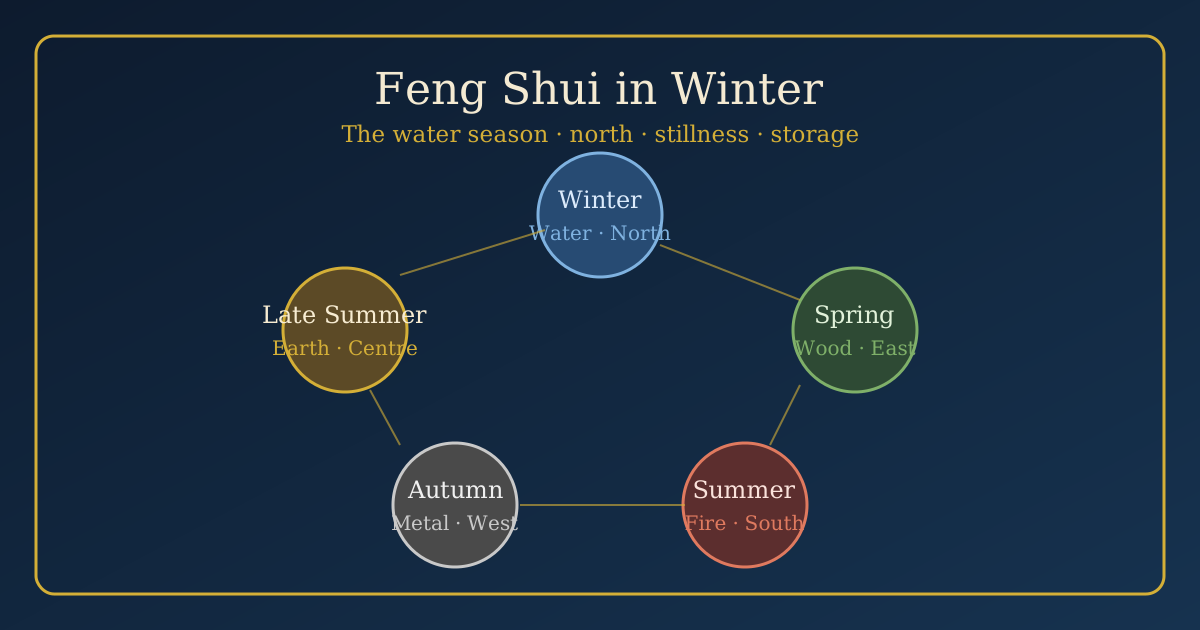
Feng Shui in Winter: How Tradition Reads the Water Season at Home
Feng Shui
2026-10-21 • 15 min

Feng Shui in Winter: How Tradition Reads the Water Season at Home

In the five-element system that feng shui shares with traditional Chinese medicine, winter belongs to water: the north, the colours blue and black, cold, stillness, and storage. Practitioners do not fight that reading. A winter home in this tradition is not a summer home with the heating on. It is a home rebalanced for a dark, cold season: fire and earth added in measured amounts through light, colour, and textiles, the north side of the home kept calm and uncluttered, the entry set up for boots, salt, and wet coats, and the long evenings used for the quiet the season is said to favour. This guide sets out the correspondence table as tradition states it, works room by room through a winter home, separates the symbolic layer from the building layer (drafts, condensation, safe candle and heater use), and closes with a month-by-month winter checklist and a labelled hypothetical worked example.

Read Article
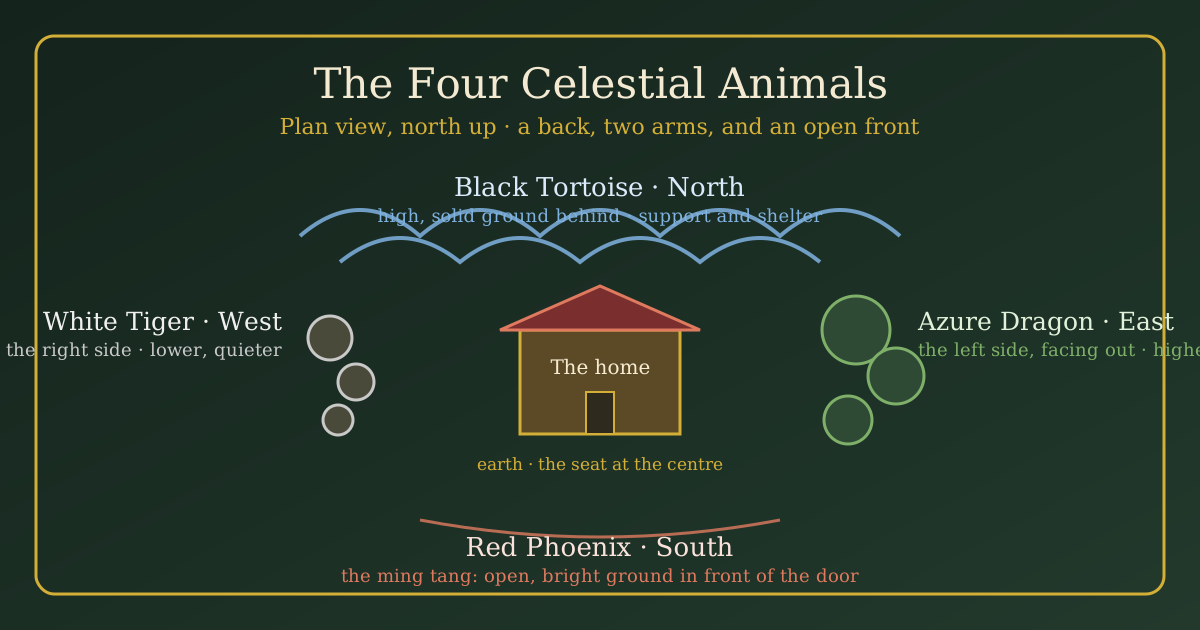
The Four Celestial Animals in Feng Shui: Tortoise, Dragon, Tiger, and Phoenix Around Your Home
Feng Shui
2026-10-21 • 15 min

The Four Celestial Animals in Feng Shui: Tortoise, Dragon, Tiger, and Phoenix Around Your Home

Before feng shui had compass charts, it had four animals. The Black Tortoise stands behind the home, the Azure Dragon on its left, the White Tiger on its right, and the Red Phoenix in front, and together they describe the ideal site: protected at the back, embraced on both sides, open at the front. The image comes from Chinese astronomy, where the four symbols divide the sky into four palaces, and it became the form school's oldest test of a plot of land. This guide sets out each animal and its direction, explains the armchair formation the four describe together, shows how the model is applied to a real lot, a street, and the inside of a flat, and separates the landform logic (shelter from wind, drainage, a clear approach) from the symbolism laid over it.

Read Article
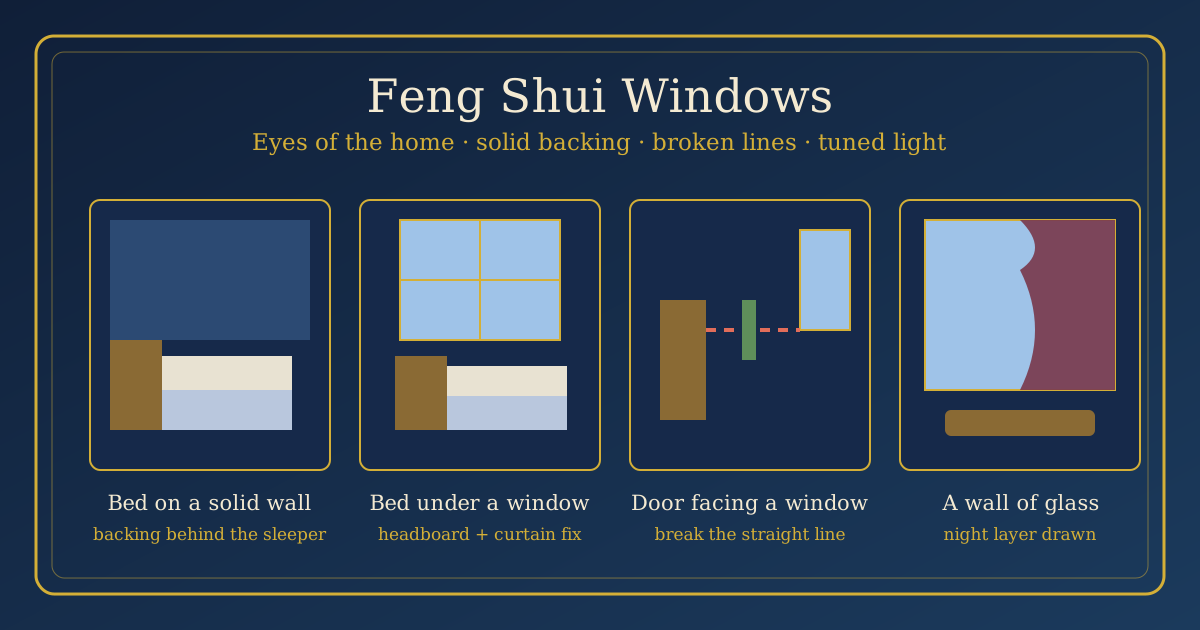
Feng Shui Windows: Placement, Curtains, and Light, Room by Room
Feng Shui
2026-10-19 • 15 min

Feng Shui Windows: Placement, Curtains, and Light, Room by Room

In feng shui tradition, windows are called the eyes of the home: they are the openings that take in light, air, view, and weather, second only to the front door in how much they change a room. Tradition asks for balance (enough glass to keep a room bright and aired, not so much that beds, desks, and sofas sit exposed with nothing solid behind them), keeps the wall behind a bed solid where the plan allows it, breaks up a straight door-to-window line, and treats curtains and blinds as the working controls that tune a window by time of day. This guide sets out those rules as tradition states them, puts the checkable layer beside them (the IRC R310 bedroom egress numbers, why a window behind a sleeper also means drafts, light, and noise, and why glass turns into a mirror at night), and closes with a room-by-room table and a window-by-window maintenance walk.

Read Article

Flying Stars FAQ

Understanding annual energy shifts

Important: Educational Purposes OnlyThe Feng Shui insights, Bazi analyses, palm readings, and property evaluations provided on Lucky.properties are for entertainment, cultural, and educational purposes only. They do not constitute certified financial, real estate, legal, or investment advice. Always consult with registered real estate professionals and certified financial advisors before making property transactions or investment decisions.