The best feng shui check for a rental is a short, scored walk-through that separates what you can never change (the door, the building position, noise, daylight, the bed wall, beams) from what you can change within a lease (lamps, mirrors, rugs, screens, plants). Let the first group decide yes or no. Let the second group break ties.
Last checked: 13 November 2026
| Fact | Figure or rule | Source |
|---|---|---|
| Night noise outside the bedroom | WHO Europe's night noise guideline target is 40 dB Lnight,outside, with 55 dB as an interim target | WHO Regional Office for Europe, 2009 |
| Bedroom escape window | US model code for houses (IRC R310), which local codes may change: 5.7 sq ft net clear opening, at least 24 in high and 20 in wide, sill no more than 44 in above the floor | City of St. Paul handout quoting IRC R310 |
| Smoke alarms | Inside and outside each bedroom and on every level, tested monthly, replaced 10 years from the manufacture date | US Fire Administration |
| Carbon monoxide alarms | On every level and outside sleeping areas | US Consumer Product Safety Commission |
| Landlord repair duty (Ontario example) | A landlord must keep the unit in a good state of repair; heat cannot be cut off from September 1 to June 15 | Landlord and Tenant Board, Tribunals Ontario |
| Where to start on rights (US) | Read the lease carefully and contact a housing counseling agency | HUD |
Why a renter needs a different checklist
Most feng shui checklists are written for owners, who can change a layout and recoup the cost at sale. A renter has a lease, a landlord's rules and a deposit to protect, and almost all bargaining power comes at the viewing, before signing. A buyer asks whether the home can be improved. A renter asks whether it is acceptable as it stands. Our home buying checklist covers inspections and long ownership; this page covers one apartment, one visit, one lease.
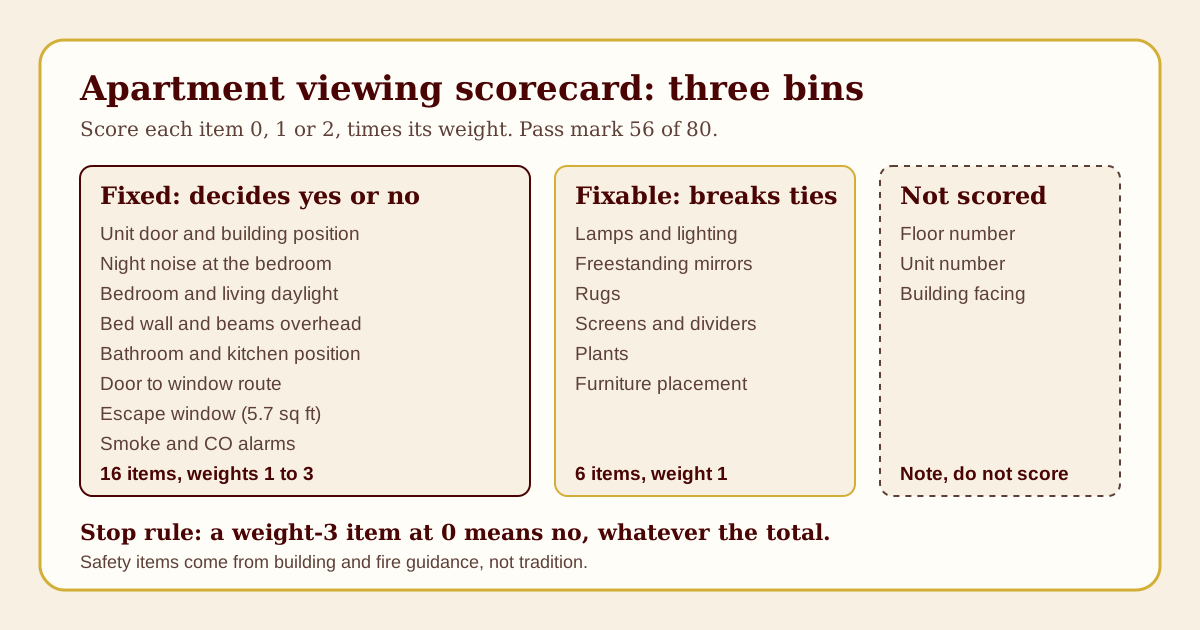
So every item in the scorecard below sits in one of three bins. Fixed items are the ones you cannot change inside a lease, and they decide. Fixable items can be solved with removable things, and they break ties. Not-worth-worrying items cannot be checked or compared in a viewing, so they are noted and not scored. Safety is not optional in any bin: alarms and an escape window come from building and fire guidance, not tradition.
What the tradition says, and where schools disagree
Feng shui is a Chinese tradition of reading a place for how it is entered, lit, sheltered and used. Practitioners work in different schools, and they do not always agree.
- Form school looks at what the eye and body meet: the approach, what points at the door, what presses on the sleeping or working spot.
- Compass school (Eight Mansions, Flying Stars) adds directions and calculations from the building's facing and a resident's birth data.
- BTB or Black Sect practitioners in the West often start from the entrance and lay the Bagua with the door wall at the front, the method the International Feng Shui Guild describes.
- Folk custom adds number beliefs and charms outside the schools.
For a renter, form school ideas travel best, because you can see and walk through them at a viewing and most line up with ordinary comfort. Compass calculations need a reliably measured facing, which a twenty-minute visit cannot give, so the scorecard leaves them out of the points.
One caution. The tradition is a cultural and design framework. It does not predict that a flat will make you rich, healthy or loved, and this page makes no such claim. What it can do is give you a structured set of things to notice.
A 20-minute viewing plan
Plan the time so you do not spend it all in the kitchen.
In order: 0 to 3 minutes on the street, lobby and unit door; 3 to 8 in the bedroom; 8 to 12 in the main room; 12 to 15 on the bathroom and kitchen; 15 to 20 on alarms, storage and your questions.
Bring a tape measure, a phone torch, a printed scorecard and a rough floor plan sketch. Take photos only if the landlord or agent agrees.
Fixed items: the ones that decide
Each item gives the traditional concern, the plain reason it also matters in daily life, and how to check it at the viewing. The numbers match the scorecard further down.
The door and the building (items 1, 2, 14)
1. What the unit door faces
- Tradition: Many practitioners say a front door that faces another door, a lift or a stair is a point where movement and attention are pulled straight at the home. Practitioners differ on remedies, and many do not use them at all. Our door, elevator and corridor guide lays out the readings.
- Daily life: A door opposite a lift or stairwell means more foot traffic, voices and door slams outside your wall, and less privacy when you open it.
- At the viewing: Stand in the corridor at the unit door. Note what is straight ahead. Open the door and see whether anyone on the corridor can see across your living space. Ask the agent how many units share the corridor.
2. Where the unit sits in the building. Form school asks what stands beside and below a home, and reads a unit above a garage or shop as an unsettled base. The practical issues are noise and vibration: bin rooms, garage ramps, plant rooms, lift shafts, restaurants, gyms and rooftop equipment. Look for them in the lobby and corridor, press your palm to the bedroom wall to feel for a pump or lift, and ask what is above, below and beside the bedroom.
14. The entry. Practitioners often ask that the entry be open enough to walk in comfortably. In daily life, a door that swings into a wall, no room for shoes and a direct view into the bed make every arrival awkward. Open the door fully and check where it lands and whether a shoe rack and bag fit within reach.
Sound and light (items 3, 4, 5, 15)
3. Night noise at the bedroom window
- Tradition: Rushing traffic, a road pointing at the building and sharp noise are read as disturbing to rest in form school thinking.
- Daily life: This one has the firmest evidence behind it. WHO Europe's 2009 night noise guidelines name 40 dB Lnight,outside, measured outside the bedroom window, as the target, with 55 dB as an interim target for places that cannot reach it yet. A single visit cannot measure that, so use it as a reminder that night noise is a health question, not a taste.
- At the viewing: Visit or revisit at the hour that matters to you, ideally at night, and stand in the bedroom for two minutes with the window shut and then open. A phone sound-level app is a rough guide, not a calibrated meter, so use it to compare two flats on the same night rather than to pass or fail one. Ask whether bars, a bus stop or a late loading bay is nearby.
4. Bedroom daylight and window. Most schools treat light as a sign of lively surroundings, and compass school adds a direction to each window. In daily life, morning light helps waking, and window direction matters most for heat and glare. Switch the lights off and see whether you can read a notice on the far wall. Ask which way the window faces and when the sun arrives; if you saw it only in the afternoon, book a morning visit.
5. Living area daylight. Walk the main room with the lights off and note any corner that stays dark. If your sofa or desk would sit there, score it down.
15. What the window looks at. Form school calls a wall, sharp roof corner or building edge aimed at a window a pressing form. In daily life a window facing another at close range costs privacy, and a glass tower opposite can throw glare (see the glass buildings guide). Note what is within about ten steps of each main window.
Routes and rooms (items 6, 7, 8, 13, 16)
6. The route from door to window. A straight line from the door to a rear window or balcony is read as energy rushing through; many practitioners soften it with a rug, plant or screen, and others do not worry. In daily life it means drafts and no sense of arrival. Stand at the door and see what you see, and check that a screen or shelf could sit on that line without blocking it.
7. Bathroom position. Practitioners often prefer that a bathroom not sit at the entry or open onto the kitchen or bed. In daily life that affects odor, moisture, privacy and night noise. Run the fan and the tap, check that it vents outside or has an openable window, and that the door latches.
8. Kitchen and stove. Many practitioners prefer that the cook can see the door and that the stove not face it. In daily life the issues are a stove beside the door or against a bedroom wall, and weak extraction. Stand at the cooker, look at the door, and check the hood.
13. Floor plan shape. Bagua schools look for missing corners. In daily life, odd corners and long narrow rooms waste floor. Pace each room, write the sizes on your sketch, and check that a bed, table and chair fit.
16. Storage. Tidy, enclosed storage is part of most schools' advice on clutter. Count closets, measure hanging height and depth, and note anything shared with the landlord's own stored items.
Above and behind the bed (items 9, 10)
9. Beams and low soffits over the bed or sofa
- Tradition: Form school holds that a heavy beam overhead presses on whoever sits or sleeps under it. See the guide to ceiling beams over the bed.
- Daily life: A low beam is a head-height hazard, can make a bed feel boxed in and often hides ducts or pipes. Because you cannot remove it in a rental, the question is whether the bed or desk can go somewhere else.
- At the viewing: Look up in every room. Measure the beam's height from the floor and mark where the bed and sofa would go. If the only bed position is under a beam, score the item low.
10. The bed wall
- Tradition: Practitioners often describe a "command position": a bed or desk from which you can see the door without being in line with it, with a solid wall behind you. Opinion varies on how strict to be; see the command position guide and the bed direction guide.
- Daily life: A bed against a wall shared with a lift, a bathroom or a neighbor's living room means sound at head height. A solid exterior wall can be colder in winter, which may matter more than any tradition.
- At the viewing: Find the wall the bed would use and knock it, listen and ask who is on the other side. Check that the door can open fully while the bed is in place and that you can reach the window from the bed.
Safety: egress and alarms (items 11, 12)
These two are not feng shui rules. They sit here because a good flat is one you can leave in an emergency and that will warn you if something is wrong.
11. An escape window in the bedroom
- Daily life: The US model code for houses, the International Residential Code section R310, which states and cities adopt and may change, asks every sleeping room to have an operable emergency escape and rescue opening, with 5.7 sq ft of net clear area (5 sq ft at grade), at least 24 in clear height and 20 in clear width, with the sill no higher than 44 in above the floor. It must open from inside without keys, tools or special knowledge. Local codes differ, older buildings may follow older rules, and larger apartment buildings come under other code provisions and may rely on a different escape plan altogether, so this is a measuring guide and not a legal test.
- At the viewing: Open the bedroom window fully and measure the clear opening, not the frame. The two minimums multiply to only 3.3 sq ft (24 in x 20 in = 480 sq in; divided by 144 gives 3.33), so the 5.7 sq ft area is the stricter test. Arithmetic: 5.7 x 144 = 821 sq in. At 24 in high, the window must be at least 34.2 in wide; at 20 in wide, it must be at least 41 in high. If the window is fixed shut, has a restrictor or has security bars you cannot release, ask the landlord how a person leaves in an emergency.
12. Smoke and carbon monoxide alarms
- Daily life: The US Fire Administration advises alarms inside and outside each bedroom and sleeping area and on every level of the home, tested monthly, with the entire alarm replaced 10 years from its manufacture date. It also recommends interconnected alarms, so when one sounds they all sound. The US Consumer Product Safety Commission advises carbon monoxide alarms on every level and outside sleeping areas, preferably interconnected. Rules about who must supply and maintain alarms differ by place.
- At the viewing: Look at the ceiling in the bedroom and in the corridor outside it. Count alarms, ask whether they are interconnected, and ask for the manufacture date printed on the back of at least one. If you cannot reach it, ask the landlord to confirm in writing. Check whether there is a gas appliance, a fireplace or an attached garage, because those raise the importance of the CO alarm.
Advertisement
Fixable items: the ones that break ties
These six items matter, but each can be changed without touching the walls. Score them from 0 to 2 for how easily you could solve them, not for how they look today.
Items 17 to 22 are lighting, mirrors, rugs and floor, screens and dividers, plants, and furniture placement. For each, ask whether a removable item solves it: a lamp, a freestanding mirror, a rug with a non-slip pad, a folding screen, a potted plant on a stand, or a rearranged layout. Check for fitted mirrors on wardrobe doors facing the bed, rules on rugs, outlets for lamps, and the floor space and door swings that decide whether furniture can move.
If an item can be solved with a lamp and a rug, it scores 2. If it needs a landlord's permission and a drill, it scores 0 or 1.
Not worth worrying about
23. Floor number. In some Chinese-speaking communities, 8 is a liked number and 4 is avoided, and some renters carry that preference into floor choices. Treat it as a cultural preference and a tiebreaker. Our pages on why 8 is considered lucky and the avoided number 4 explain where those beliefs come from, and the lucky house numbers guide covers the address side.
24. Unit number. The same applies. A unit number is a label, and you cannot alter it, so do not let it outweigh light, noise or safety.
25. The building's facing direction. Compass school treats facing as central, but it needs careful measurement and a chosen method, and a renter in a multi-unit building usually cannot verify it in a viewing. Note it if it matters to you, and give it no points.
The scorecard
Score each fixed and fixable item 0, 1 or 2 at the viewing. Multiply by the weight. The maximum is 80.
| # | Item | Bin | Weight | 0 | 1 | 2 |
|---|---|---|---|---|---|---|
| 1 | Unit door faces | Fixed | 2 | Directly at a lift or stairwell | Another door | Open or offset |
| 2 | Position in building | Fixed | 3 | Next to bin room, garage ramp or plant | One mild neighbor | Quiet neighbors |
| 3 | Night noise at bedroom | Fixed | 3 | Loud, disturbs sleep | Noticeable | Quiet |
| 4 | Bedroom daylight | Fixed | 3 | Dark with lights off | Some | Bright |
| 5 | Living area daylight | Fixed | 2 | Dark | Partial | Bright |
| 6 | Door to window line | Fixed | 1 | Straight line, no room to soften | Straight, can soften | Broken or offset |
| 7 | Bathroom position | Fixed | 2 | Opens at entry or bed, no ventilation | One issue | Well placed |
| 8 | Kitchen and stove | Fixed | 1 | Stove at the door, no extraction | One issue | Well placed |
| 9 | Beam or low soffit | Fixed | 2 | Over the only bed spot | Over a flexible spot | None |
| 10 | Bed wall | Fixed | 3 | Shared with lift or bathroom, no other option | One compromise | Solid and quiet |
| 11 | Bedroom escape window | Fixed | 3 | Fixed shut or too small | Borderline | Meets size guide |
| 12 | Smoke and CO alarms | Fixed | 3 | None or expired | Partial | In place, dated, interconnected |
| 13 | Floor plan shape | Fixed | 1 | Awkward, wasted space | Some waste | Simple |
| 14 | Entry | Fixed | 2 | Door hits wall, no space | Tight | Comfortable |
| 15 | Window outlook | Fixed | 1 | Wall or facing window at close range | Some | Open |
| 16 | Storage | Fixed | 2 | None | Some | Ample |
| 17 | Lighting | Fixable | 1 | Fixable only with permission | Partly | Lamps solve it |
| 18 | Mirrors | Fixable | 1 | Fitted, cannot move | Partly | Removable |
| 19 | Rugs and floor | Fixable | 1 | Not allowed | Limited | Fine |
| 20 | Screens | Fixable | 1 | No room | Some | Easy |
| 21 | Plants | Fixable | 1 | No light | Some | Good |
| 22 | Furniture placement | Fixable | 1 | Only one layout | Two layouts | Many |
| 23 to 25 | Floor, unit number, facing | Not worth worrying about | 0 | Noted, not scored |
Total weights: the fixed items add up to 34 and the fixable items to 6, so 40 weight points and 80 points at the top. Because feng shui is a design tradition and not a measurement, treat the pass mark as a conversation starter and not a verdict.
Pass mark: 56 of 80 (70 percent).
Stop rule: if any item with weight 3 scores 0, say no, whatever the total. Those are items 2 (building position), 3 (night noise), 4 (bedroom daylight), 10 (bed wall), 11 (escape window) and 12 (alarms). Alarms are the one exception: a missing alarm can be supplied by the landlord before you sign, so score it again after you ask.
Worked example: two apartments, one afternoon
The two flats are invented for this example. Both are one-bedroom units at the same rent in the same neighborhood. Flat A is on the fourth floor of a mid-rise, with a street-facing bedroom. Flat B is on the second floor of a courtyard building, cheaper to heat and quieter, but with a beam and an entry bathroom.
| # | Item | Wt | A score | A pts | B score | B pts | Note |
|---|---|---|---|---|---|---|---|
| 1 | Unit door faces | 2 | 2 | 4 | 1 | 2 | B faces another door |
| 2 | Building position | 3 | 1 | 3 | 2 | 6 | A is above a delivery bay |
| 3 | Night noise | 3 | 1 | 3 | 2 | 6 | A faces the street |
| 4 | Bedroom daylight | 3 | 2 | 6 | 1 | 3 | B bedroom faces a courtyard wall |
| 5 | Living daylight | 2 | 2 | 4 | 1 | 2 | |
| 6 | Door to window line | 1 | 1 | 1 | 2 | 2 | |
| 7 | Bathroom | 2 | 2 | 4 | 0 | 0 | B opens at the entry, no fan outlet |
| 8 | Kitchen | 1 | 1 | 1 | 1 | 1 | |
| 9 | Beam | 2 | 2 | 4 | 0 | 0 | B beam sits over the only bed spot |
| 10 | Bed wall | 3 | 2 | 6 | 1 | 3 | B shares a wall with a neighbor's living room |
| 11 | Escape window | 3 | 2 | 6 | 2 | 6 | Both measured over 5.7 sq ft |
| 12 | Alarms | 3 | 1 | 3 | 2 | 6 | A has no CO alarm yet |
| 13 | Plan shape | 1 | 2 | 2 | 1 | 1 | |
| 14 | Entry | 2 | 1 | 2 | 2 | 4 | |
| 15 | Outlook | 1 | 1 | 1 | 2 | 2 | |
| 16 | Storage | 2 | 2 | 4 | 1 | 2 | |
| 17 to 22 | Fixable (6 items) | 6 | 9 of 12 | 9 | 8 of 12 | 8 | |
| Total | 40 | 63 | 54 |
Flat A scores 63 of 80 (79 percent) and passes. Flat B scores 54 (68 percent) and falls two points short. The scorecard did not say B is a bad flat, and its quiet position and good alarms are real strengths. It says B asks you to accept a bedroom with a beam over the only bed spot, a shared bed wall and a bathroom at the front door, none of which can be changed.
Flat A has a gap: no CO alarm, scored 1. That is a question for the landlord before signing, in writing. If the answer is yes, item 12 scores 2 and A rises to 66. A's night noise (scored 1) is the thing to re-test at night before committing.
The decision came from the fixed items. The fixable column barely moved the result: 9 against 8 out of 12.
Advertisement
Questions to ask the landlord or agent
Write the answers down, and ask for important ones by email so you have a record.
- Which way does the bedroom window face, and what is directly above, below and beside the bedroom?
- Are there any bars, bin rooms, plant rooms or loading bays close to the unit?
- Are smoke and carbon monoxide alarms in the bedroom and the corridor, and when were they last tested and replaced? What is the manufacture date?
- Are the alarms interconnected, and who is responsible for batteries and replacement?
- Does the bedroom window open fully, and is there any lock, restrictor or bar on it? How would someone leave in an emergency?
- Does the heating and cooling work in every room, and who pays for what?
- Can I put up shelves, hooks or a mirror, and what are the rules on drilling and removing items at move-out?
- Are rugs, plants and furniture on the balcony allowed?
- Is there a landlord's storage area or meter cupboard inside the unit, and when can they enter?
- What is the process and timescale for repairs, and who do I contact?
- How long is the lease, what notice must I give, and are there fees to renew?
Tenant rights in general terms
Tenant law differs by country, state, province and city, and this page cannot say what applies to you. Read the lease before signing, and use your official source for the rest. In the United States, HUD's tenant rights page tells renters to read the lease agreement carefully and recommends contacting a housing counseling agency for local help; state and local rules govern deposits, repairs and entry. In Ontario, Canada, the Landlord and Tenant Board's guide says a landlord has to keep the rental property in a good state of repair, even if the tenant was aware of the problems when they agreed to rent, which is worth knowing before you sign for a flat with visible faults. It also says a landlord cannot cut off or interfere with heat from September 1 to June 15, electricity, fuel, or hot and cold water. Elsewhere, search for your national or provincial tenant authority.
Edge cases and common mistakes
- Viewing at one hour only. A flat on a quiet street at 2 p.m. can be loud at midnight. See the finalist twice at different times.
- Paying for a remedy to cover a fixed problem. A fountain, a crystal or a charm does not change a beam or a noisy wall. If the flat fails the stop rule, keep looking.
- Ground-floor flats. Check street noise, privacy and daylight closely. The model code allows a smaller escape opening at grade (5 sq ft).
- Shared flats. You may only control your own bedroom. Score the bedroom you will actually have, and ask about the shared bathroom and kitchen rules.
- Studios. The bed, desk and sofa share one room, so the beam and sightline items matter more. Our studio layout guide has layouts for one-room units.
After you sign
Once the lease is signed, you move from choosing to arranging. Keep to the removable, within-lease changes in the fixable bin, photograph the unit on the day you arrive, and note any alarm that is missing or past its date in writing. The moving-in first 30 days guide lays out a sequence for the first month, and the renters guide covers life after move-in.
Where to go next
Take the scorecard to your next viewing, then read the renter's whole-home guide so you have a list of removable changes ready for the day you get the keys.
Sources
- WHO Regional Office for Europe: Night noise guidelines for Europe, published 15 October 2009, for the 40 dB Lnight,outside target and the 55 dB interim target. Checked November 2026.
- US Fire Administration: Smoke alarms, for placement in and outside bedrooms and on every level, monthly testing, 10-year replacement and interconnection. Checked November 2026.
- US Consumer Product Safety Commission: Carbon Monoxide Information Center, for CO alarm placement on every level and outside sleeping areas. Checked November 2026.
- City of St. Paul, Department of Safety and Inspections: Egress window handout, summarizing International Residential Code section R310: 5.7 sq ft, 24 in, 20 in and 44 in. Checked November 2026.
- Tribunals Ontario, Landlord and Tenant Board: Guide to the Residential Tenancies Act, for the landlord's repair duty (even where the tenant knew of the problem) and heat as a vital service from September 1 to June 15. Checked November 2026.
- HUD: Tenant rights (District of Columbia page), for reading the lease carefully and contacting a housing counseling agency. Checked November 2026.
- International Feng Shui Guild: The Feng Shui Bagua, for the entrance-based method of laying the Bagua over a plan. Checked November 2026.
Editorial note: Lucky Properties presents Feng Shui as a cultural and design tradition. This guide is educational. It does not predict health, wealth, relationships or rental outcomes, and it does not replace your lease, local building and fire codes, tenant law, or advice from a landlord, building manager, housing counselor or other qualified professional. The two apartments in the worked example are invented for illustration.