The short answer
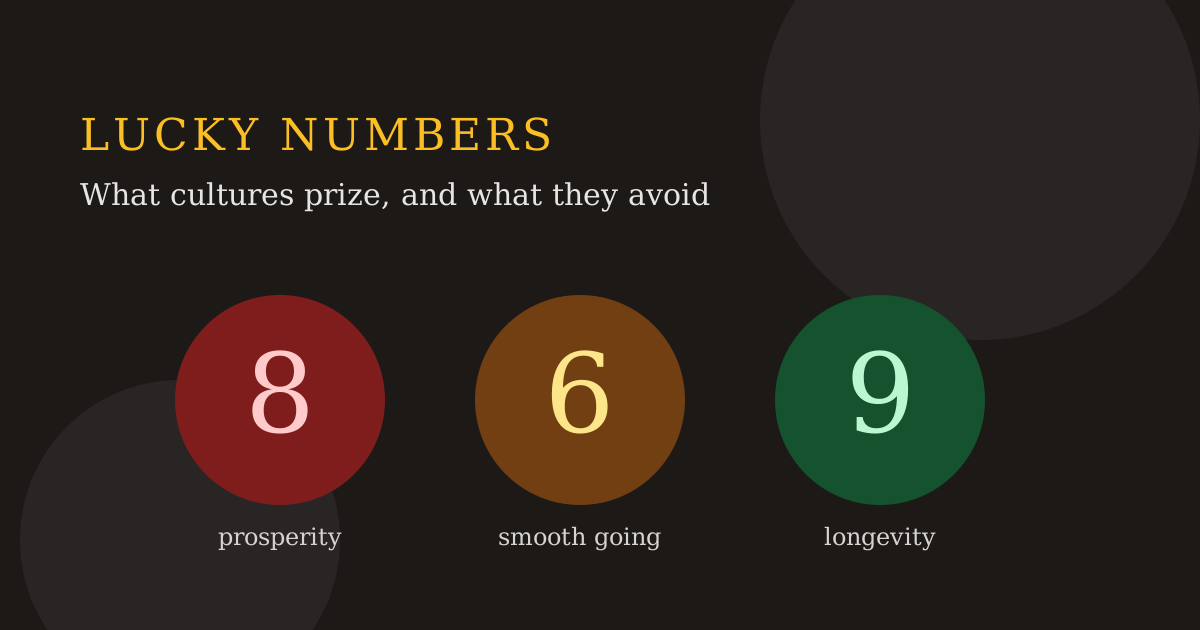
There is no universally luckiest house number. Eight, six, and nine carry favourable associations in some Chinese-language communities, while four can be uncomfortable for some buyers because of sound associations. Modern address numerology uses a separate digit-reduction method. Classical Feng Shui looks more broadly at landform, orientation, time, layout, and the relationship between people and place.
Use a house number as a cultural preference or a reflection prompt - not as proof that a home will create wealth, health, harmony, or a higher resale price. Before judging symbolism, verify the official address, make sure the number is visible to visitors and emergency responders, and investigate the property's condition, affordability, location, and management.
This guide gives you one consistent calculation method, a number-by-number lookup, condo examples, real transaction evidence, and a decision checklist you can use during a viewing.
First, separate three systems that are often mixed together
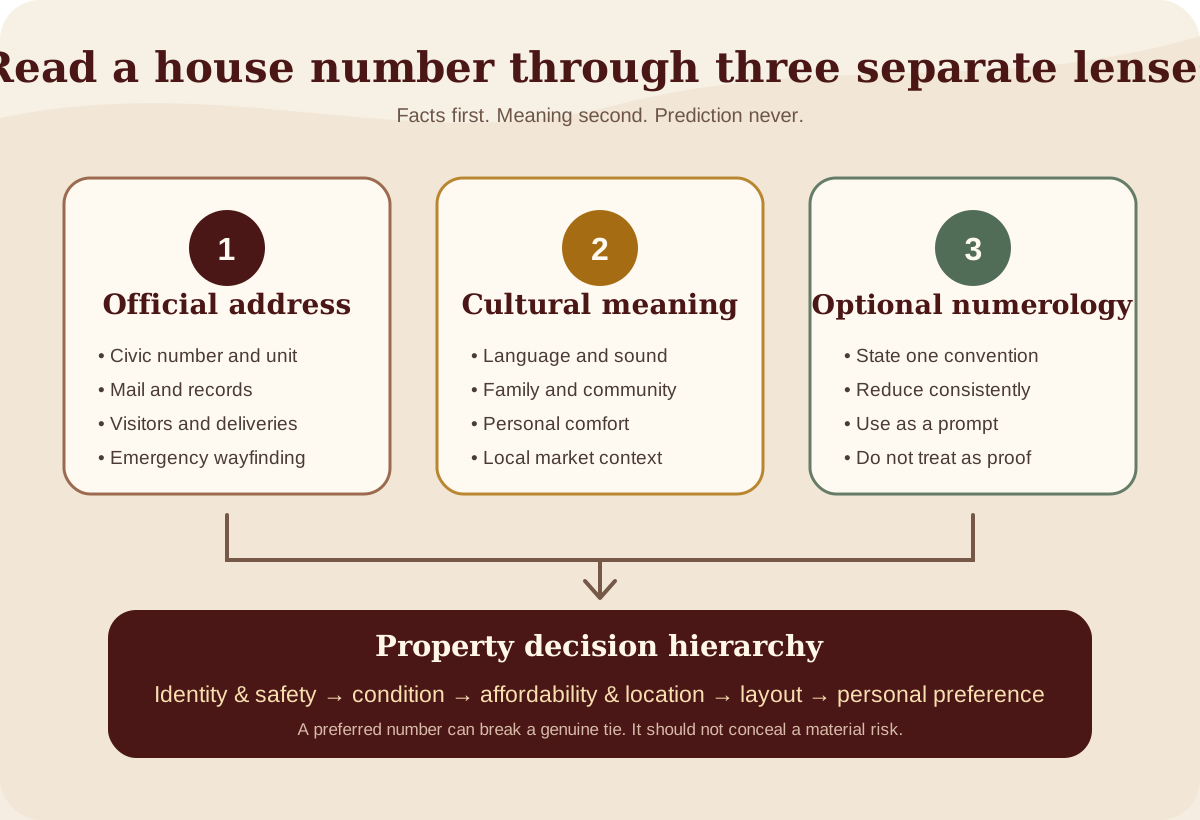
Most online house-number guides collapse three different ideas into one. Keeping them separate prevents confident-sounding but contradictory advice.
| Lens | What it asks | What it does not prove |
|---|---|---|
| Official address | What number and unit identify the property for mail, records, visitors, deliveries, and emergency response? | Whether the home is emotionally or symbolically right for you |
| Chinese number symbolism | Does the spoken number carry a positive, neutral, or uncomfortable association in a language and community that matter to the household? | A universal meaning shared by every Chinese language, dialect, family, or market |
| Modern address numerology | What single-digit theme results from adding the identifier's digits and, by one stated convention, letters? | A classical Feng Shui calculation or a prediction of future events |
Classical Feng Shui is broader than a number lookup. The Feng Shui Society describes the practice in terms of physical landscape, space, time, and orientation. Its overview of classical schools discusses landform, structural placement, compass direction, and the Lo Shu in Flying Stars analysis. That is different from simply adding the digits of an address.
This distinction matters because many pages call digit reduction a “Lo Shu house-number calculation.” The Lo Shu is a three-by-three magic-square framework, not the name for reducing 128 to 1 + 2 + 8 = 11 and then 1 + 1 = 2. If you want to study that framework, use our separate Lo Shu Grid study tool.
How to calculate a house number consistently
Address-numerology conventions vary. There is no government, scientific, or classical Feng Shui standard that makes one convention authoritative. The value of a method is consistency: write down what you included, use the same rule for every property, and keep the result in the “personal preference” part of your decision.
Lucky.properties uses this practical convention:
- Start with the official civic number for a detached or street-access home.
- For an apartment or condo, calculate the unit identifier and building number separately. Do not silently blend them into one number.
- Add the digits. Zero stays in the official address but contributes zero to the sum.
- If the identifier contains a letter, use the repeating Pythagorean sequence: A/J/S = 1, B/K/T = 2, C/L/U = 3, D/M/V = 4, E/N/W = 5, F/O/X = 6, G/P/Y = 7, H/Q/Z = 8, and I/R = 9.
- Keep adding the digits until you reach 1 through 9. If the total passes through 11 or 22, you can note that intermediate result, but this guide reduces it to 2 or 4 so every property uses the same lookup table.
Worked calculation examples
| Identifier | Calculation | Result | What to record |
|---|---|---|---|
| House 128 | 1 + 2 + 8 = 11; 1 + 1 = 2 | 2 | Official civic number 128; intermediate total 11 |
| House 1008 | 1 + 0 + 0 + 8 = 9 | 9 | Zeros remain part of the legal identifier |
| Unit 902 | 9 + 0 + 2 = 11; 1 + 1 = 2 | 2 | Unit result only |
| Building 168, Unit 902 | Building: 1 + 6 + 8 = 15; 1 + 5 = 6. Unit: 9 + 0 + 2 = 11; 1 + 1 = 2 | 6 and 2 | Building context and private unit remain separate |
| Unit 24B | 2 + 4 + B(2) = 8 | 8 | Use the letter because it distinguishes the official unit |
| House 48 | 4 + 8 = 12; 1 + 2 = 3 | 3 | Cultural reading of “48” and numerology result are separate |
You can test an identifier with the House Number Reflection Tool. Enter only the civic number or unit identifier - not the street name, city, postal code, listing price, or every digit printed on a real-estate listing.
House number meanings from 1 to 9
The meanings below are traditional numerology themes, not claims about what will happen inside a home. A better use is to turn each theme into an observable design question. If a result says “partnership,” for example, inspect whether two occupants actually have equal storage, comfortable circulation, and places to talk.
| Number | Traditional theme | Useful question during a viewing | Do not infer |
|---|---|---|---|
| 1 | Independence, initiative, new starts | Can each person get privacy, and does the layout support focused work without isolating the household? | That living here will create a promotion or separation |
| 2 | Partnership, cooperation, care | Are shared rooms, storage, and entry routines workable for all occupants? | That the address guarantees romance or family harmony |
| 3 | Expression, sociability, creativity | Is there an inviting place to talk, make, play, or host without sacrificing quiet rooms? | That the home causes artistic success or arguments |
| 4 | Structure, routine, foundations | Are maintenance records, systems, and everyday storage orderly enough to support stable routines? | That a digit makes a building structurally safe or unlucky |
| 5 | Change, movement, flexibility | Can rooms adapt to guests, work, children, mobility needs, or future changes? | That occupants will travel, move, or become restless |
| 6 | Service, responsibility, home care | Are household tasks fairly supported by the kitchen, laundry, storage, and private retreat space? | That the address creates an ideal family |
| 7 | Reflection, study, privacy | Is there genuine acoustic and visual quiet without poor light or social isolation? | That the home makes someone spiritual, lonely, or scholarly |
| 8 | Ambition, resources, material stewardship | Does the home support work and financial organization while preserving rest and relationships? | That the number produces wealth or a resale premium |
| 9 | Completion, visibility, contribution | Can the household display what matters while controlling glare, heat, noise, and overstimulation? | That the address creates fame, burnout, or a special Period 9 result |
This approach keeps the symbolic vocabulary while grounding it in choices you can inspect and change. Two number-8 homes can offer completely different daily experiences. One may have excellent daylight, calm bedrooms, sensible storage, and a manageable mortgage. The other may be noisy, over-priced, and poorly maintained. The shared digit does not erase those differences.
Why 8, 6, 9, and 4 receive so much attention
Chinese number preferences are often related to sound, wordplay, custom, and social memory. Eight is widely treated as favourable; six and nine also carry positive associations in some contexts. Four is avoided by some people because its pronunciation resembles a word associated with death in Mandarin and several other Chinese varieties.
But “Chinese culture says X” is too broad. Pronunciations differ across Mandarin, Cantonese, and other varieties. Meanings can shift with a sequence, family custom, region, generation, and situation. A person may avoid unit 4 yet happily live at 48. Another may care about 8 for a business address but not a home. A third may attach no meaning to any of them.
Treat these preferences as real when they matter to the people involved, without presenting them as universal laws.
Is 8 the luckiest house number?
Eight is probably the best-known favourable number in Chinese real-estate contexts, but “best-known” does not mean universally luckiest. It may have personal value, be memorable in a particular market, or attract some buyers' attention. It cannot tell you whether the roof leaks, the reserve fund is adequate, the commute works, or the household can afford the property.
Sequences such as 168, 688, or 888 are frequently marketed as auspicious. Do not reverse-engineer guaranteed messages from every sequence. If a seller asks a premium because an address contains repeated eights, compare recent local sales, property condition, and competing alternatives. Symbolic desirability can be part of demand; it is not an independent appraisal method.
Is 4 always an unlucky house number?
No. Four has an uncomfortable sound association for some Chinese-language speakers, which can affect personal preference and, in some markets, the size of a potential buyer pool. It also reduces to the “structure” theme in modern numerology. These are two different readings.
If an address includes 4, ask four grounded questions:
- Does anyone who will live there have a persistent negative reaction to it?
- Is that reaction strong enough to affect comfort after the novelty of the purchase is gone?
- Is there credible local evidence that comparable buyers discount such units?
- Are you allowing the number to distract from price, inspection, financing, layout, or building management?
A buyer who dislikes 4 does not need to be argued out of a deeply held preference. They also do not need a decorative “cure” sold as a guarantee. The decision is a preference call: pass, accept the number as neutral, or take the home because its practical fit matters more.
Advertisement
What research says about numbers and real-estate transactions
There is evidence that number preferences can show up in specific property markets. That is not the same as evidence that a number creates luck or that the same premium exists everywhere.
A peer-reviewed study by Matthew Shum, Wei Sun, and Guangliang Ye examined apartment transactions in Chengdu, China, from 2004 to 2006. In that sample:
| Finding | What the researchers observed | What you should not conclude |
|---|---|---|
| Secondhand apartments | Floors ending in 8 averaged 235 RMB per square metre more than other floors | Every address containing 8 deserves a premium today |
| Newly constructed apartments | The price premium disappeared under uniform new-home pricing | Numbers never affect buyer interest |
| Sale speed | New apartments on floors ending in 8 sold 6.9 days faster on average | An 8 will make any property sell quickly |
| Buyer preference | Buyers with more 8s in their phone numbers were more likely to choose a floor ending in 8 | Every Chinese buyer shares the same preference |
The research is valuable because it demonstrates a behavioural market effect in a defined place, period, property type, and pricing environment. Its limits are equally important. It studied floor endings, not a universal house-number formula; Chengdu in 2004–2006 is not Toronto, Vancouver, London, Sydney, or Singapore in 2026; and an average association does not determine the value of one property.
If resale is your concern, ask a local real-estate professional for neighbourhood-level comparable sales that control for floor, view, size, parking, condition, fees, and building quality. Do not use an overseas study or a numerology page to set an offer price.
Condo and apartment numbers: building versus unit
For a multi-unit property, the building and unit perform different real-world jobs. Canada Post's civic-address guidance treats the unit number as an integral part of the address and shows accepted formats such as placing it before the civic number with a hyphen or using a unit designator. That practical distinction is a good reason to keep the two identifiers separate in a symbolic reading too.
Think of the building number as shared context and the unit identifier as the private destination. Then inspect the parts that determine everyday life:
- building finances, insurance, reserve funding, and planned repairs;
- elevator reliability and wait times;
- noise transfer from corridors, neighbours, mechanical rooms, and streets;
- daylight, overheating, ventilation, and view privacy;
- wayfinding from the entrance to the unit;
- parcel, visitor, accessibility, and emergency procedures;
- rules governing doors, plaques, hallway décor, and alterations.
Example: Building 168, Unit 1408
The building number reduces to 6. The unit number reduces to 1 + 4 + 0 + 8 = 13, then 4. A culturally sensitive reader may notice that the unit contains both 4 and 8. A numerology reader may use the unit's 4 theme as a prompt to inspect structure, routine, storage, and maintenance.
Neither reading tells you whether the 14th floor is labelled 14, whether the elevator serves it reliably, whether west-facing glass overheats, or whether a special assessment is coming. Those questions deserve priority because they produce material costs and daily consequences.
Example: Unit 4B
Using this guide's convention, 4B becomes 4 + 2 = 6. The letter belongs in the calculation because it distinguishes the unit. A different numerology site may discard the letter or use B = 2 without cycling later letters; that is why you should record the convention instead of treating the result as an objective property fact.
For mail, emergency response, leasing, insurance, and official records, always use the address assigned by the relevant authority or building. A symbolic calculation never authorizes an altered identifier.
The number you can see matters more than decorative “cures”
Address visibility is not mystical - it is wayfinding and safety. Toronto's municipal code, for example, requires the appropriate number to be maintained in a conspicuous, clearly visible location facing the street that provides primary access. It prohibits displaying an address other than the official one. Calgary similarly explains that emergency responders rely on clearly posted addresses.
Rules differ by municipality and building, so check the applicable bylaw, fire guidance, lease, and condo rules before changing a plaque. A practical visibility audit includes:
- View from the approach: Can a first-time visitor see the number from the road, sidewalk, path, or corridor?
- Contrast: Do the digits stand apart from the wall in daylight and low light?
- Size and type: Are the characters large and simple enough to read at the relevant distance?
- Lighting: Is illumination reliable, shielded from glare, and permitted?
- Obstruction: Will plants, snow, seasonal décor, gates, or parked vehicles hide it?
- Consistency: Does the displayed number match official records and the unit used for deliveries?
- Secondary access: If local rules require rear or alley identification, is it present and visible?
Do not add an unofficial digit, cover a 4 with a sticker, or display a second “lucky” number as if it were the address. A decorative house name or artwork can be meaningful, but it should not obscure or compete with official identification.
Should a lucky number affect your offer or rental decision?
Use this order of operations. It protects the household while leaving room for culture and personal meaning.
1. Confirm identity and authority
Verify the civic address, unit, legal description where applicable, and the authority that controls changes. Make sure the listing, lease, insurance quote, financing documents, and building records refer to the same property.
2. Check safety, condition, and building health
Investigate structure and systems, permits, hazards, maintenance history, condo documents, and professional advice appropriate to the transaction. The Real Estate Council of Ontario notes that underlying problems may not be visually obvious and that a qualified inspector examines major systems such as electrical, roofing, plumbing, heating and cooling, foundation, and septic systems.
No house-number reading should persuade you to waive due diligence. A favourable number cannot repair a foundation or fund a condo reserve.
3. Test affordability and location fit
Include mortgage or rent, taxes, fees, insurance, utilities, repairs, commuting, accessibility, schools or services, and exit options. If you are comparing purchase scenarios, model the financial side with an appropriate tool at CalculatorVillage and verify inputs with qualified professionals.
4. Test the lived layout
Walk the real route from outside to entry, kitchen, bathroom, bedroom, storage, work area, and outdoor space. Visit at a relevant time of day. Listen for noise, look for glare, note stairs and pinch points, and ask whether every occupant can use the home comfortably. Our front-door direction guide starts with a repeatable way to identify the actual entrance before considering compass symbolism.
5. Consider culture and personal response
Now ask whether the number feels welcoming, neutral, or persistently uncomfortable. If two homes are equal on price, condition, location, layout, and management, number preference can be a reasonable tie-breaker. If they are not equal, write down what you would sacrifice for the preferred number. Seeing the trade-off often clarifies the decision.
A five-minute house-number viewing worksheet
Use this at an open house, rental viewing, or condo showing.
| Check | Record | Why it matters |
|---|---|---|
| Official civic number | ______ | Identifies the property |
| Official unit, if any | ______ | Identifies the private destination |
| Building digit result | ______ | Optional shared-context prompt |
| Unit digit result | ______ | Optional household prompt |
| Cultural association that matters to us | ______ | Makes the preference personal and explicit |
| Visible from approach in daylight? | Yes / No | Wayfinding |
| Likely visible at night? | Yes / No / Test | Wayfinding and safety |
| Display matches official address? | Yes / Verify | Avoids confusion |
| Property fundamentals checked? | Inspection / financing / documents / other | Prevents symbolism from displacing due diligence |
| Emotional response after facts are known | Welcome / neutral / uncomfortable | Useful as a final preference |
Take a photo only when permitted. Review it later beside your inspection notes and budget - not by itself.
Four realistic decision examples
Buyer comparing House 48 with House 62
House 48 reduces to 3; House 62 reduces to 8. A buyer who values the cultural association of 8 may initially prefer 62. But suppose 48 has a dry basement, safer crossing, quieter bedrooms, and a price that leaves a repair reserve, while 62 has water intrusion and stretches the budget. The number preference is not worth the material risk. If both homes were genuinely equivalent, the preference could break the tie.
Condo buyer considering Unit 1408
The buyer likes 8 but dislikes 4. Instead of declaring the sequence lucky or unlucky, they name the conflict directly. They inspect the unit, review building documents, test heat and noise, and ask whether the number will continue to bother them. If discomfort persists after the facts are favourable, choosing another unit is legitimate. There is no need to invent a cure or claim the 8 “cancels” the 4.
Renter in Unit 24B
The renter cannot alter the corridor plaque. The unit reduces to 8 under this guide's letter convention, but that does not promise prosperity. The practical questions are whether the lease is affordable, the unit is safe and maintained, the route is accessible, and deliveries can find it. If desired, the renter can use the 8 theme as a prompt to create a small place for bills, documents, or work boundaries inside the unit.
Seller with an address some buyers avoid
The seller should not hide, relabel, or apologize for the official number. They can make it legible, repair the entry, photograph the property accurately, and let the home's condition, price, light, layout, and documentation do the work. If local comparable data show a buyer-pool effect, the listing strategy should come from that evidence - not a global claim that every number 4 home sells for less.
Common house-number mistakes
Calling digit reduction classical Feng Shui
It is clearer to label it modern address numerology. Classical Feng Shui methods consider much more than the printed address.
Combining every number on a listing
Postal codes, listing IDs, prices, parking stalls, locker numbers, and phone numbers are not the house identifier. Adding them produces a result that changes with the advertisement, not the home.
Mixing building and unit without saying so
Calculate them separately. If you choose to create a combined reading, label it as your own extra convention and do not compare it with separately calculated homes.
Treating a number meaning as a diagnosis
A 5 does not cause chaos. A 7 does not cause isolation. A 9 does not cause burnout. Inspect clutter, acoustics, circulation, light, temperature, household routines, and relationships directly.
Assuming a universal resale premium
One study in one market can establish that a preference has appeared in transactions. It cannot price your property. Use current, local, like-for-like comparables.
Hiding or modifying the official address
Decorative changes must preserve accurate, legible identification and comply with municipal and building rules. Never let a symbolic preference create a safety or delivery problem.
Letting symbolism overrule due diligence
The most expensive house-number mistake is not choosing 4. It is ignoring inspection, financing, legal, building, or neighbourhood evidence because a preferred number creates false confidence.
Frequently asked questions
What is the luckiest house number in Feng Shui?
There is no universally luckiest house number. Eight, six, and nine have favourable associations in some Chinese-language contexts, but classical Feng Shui considers the wider property and modern digit-reduction numerology is a separate practice. Treat the number as a preference, not a guarantee.
Is house number 4 always unlucky?
No. Four has an uncomfortable sound association for some Chinese-language speakers, but reactions vary by language, family, market, and sequence. Modern numerology gives 4 a structure-and-routine theme. Neither interpretation predicts what will happen in the home.
Do apartment and condo unit numbers count?
Yes, if you choose to use address numerology, calculate the official unit identifier separately from the building number. The unit is also an integral part of the practical mailing address. Do not combine building and unit unless you clearly label that as an additional personal convention.
What do zero and letters mean in a house number?
Zero remains part of the official identifier but adds zero in digit reduction. For letters, this guide uses a repeating Pythagorean mapping from 1 to 9. Conventions vary, so record your method and use it consistently.
Can a lucky house number increase resale value?
It can influence some buyers in some markets, but there is no universal premium. A Chengdu transaction study found specific floor-8 effects in its 2004–2006 sample; that result does not price an individual home elsewhere. Use current local comparable sales and professional advice.
Can I change or cure an unlucky house number?
Only the relevant authority can change an official civic address, and building rules may control unit displays. A plant, plaque, colour, or sticker does not change the legal identifier or guarantee luck. Improve visibility and the entrance within local rules, or choose another home if the number remains personally unacceptable.
Sources and methodology
This guide separates documented address requirements and transaction findings from traditional interpretation. Sources were reviewed on July 12, 2026:
- Shum, Sun, and Ye, “Superstition and ‘lucky’ apartments: Evidence from transaction-level data”, Journal of Comparative Economics 42(1), 2014. The study covers Chengdu apartment transactions from 2004–2006.
- Canada Post civic-address guidelines for the role and formatting of civic and unit identifiers.
- Toronto Municipal Code, Chapter 598 for one official example of accurate, conspicuous address display. Check the rules where your property is located.
- Real Estate Council of Ontario: Home inspections for the practical scope and value of inspection in buyer decisions.
- The Feng Shui Society: What is Feng Shui? and Types of Feng Shui for the broader roles of landscape, space, time, orientation, form, and compass methods.
Numerology meanings are presented as reflective prompts because they are interpretive traditions, not scientifically validated predictions. Property, financial, legal, and safety decisions should rely on evidence and qualified local professionals.
Continue your property review
Run your identifier through the House Number Reflection Tool, then move to the physical approach with the Front Door Direction Guide. For a room-by-room framework, the Five Elements practical guide helps you translate symbolic language into light, material, temperature, storage, and use.
If the digits themselves are what caught your eye, the wider map is in Lucky Numbers Around the World: why eight carries its prosperity echo, how India, Japan, Korea, and Thailand read their favourite numbers, and how the same traditions show up in business addresses and shop numbers. Read them as cultural literacy for buyers, sellers, and neighbours, not as a pricing formula: the number on the door is one preference among many, and this guide's research section above is the part to trust with money.