The short version
Short answer: Eight is lucky in Chinese culture because of a pronunciation. In Mandarin, eight is ba; the word for prospering, as in fa cai (to get wealthy), is fa. Say them side by side and the digit sounds like wealth arriving. Cantonese keeps the rhyme (baat and faat), so the belief holds from Beijing to Hong Kong to Toronto's Chinatowns. Everything else about 8, the doubled 88s, the 8888 phone numbers, the premium prices, the Olympics ceremony timed to the minute, is that single sound, compounded by repetition and confirmed by a market where people demonstrably pay more for the digit. This page unpacks the homophones, the famous combinations, and the receipts, and keeps the language tradition separate from classical Feng Shui.
For the global map, see lucky numbers around the world. For the digit 8 avoids, see the number 4 guide.
One syllable that repriced a digit
Chinese is rich in homophones, and number luck is what happens when a culture takes its puns seriously. The core pair:
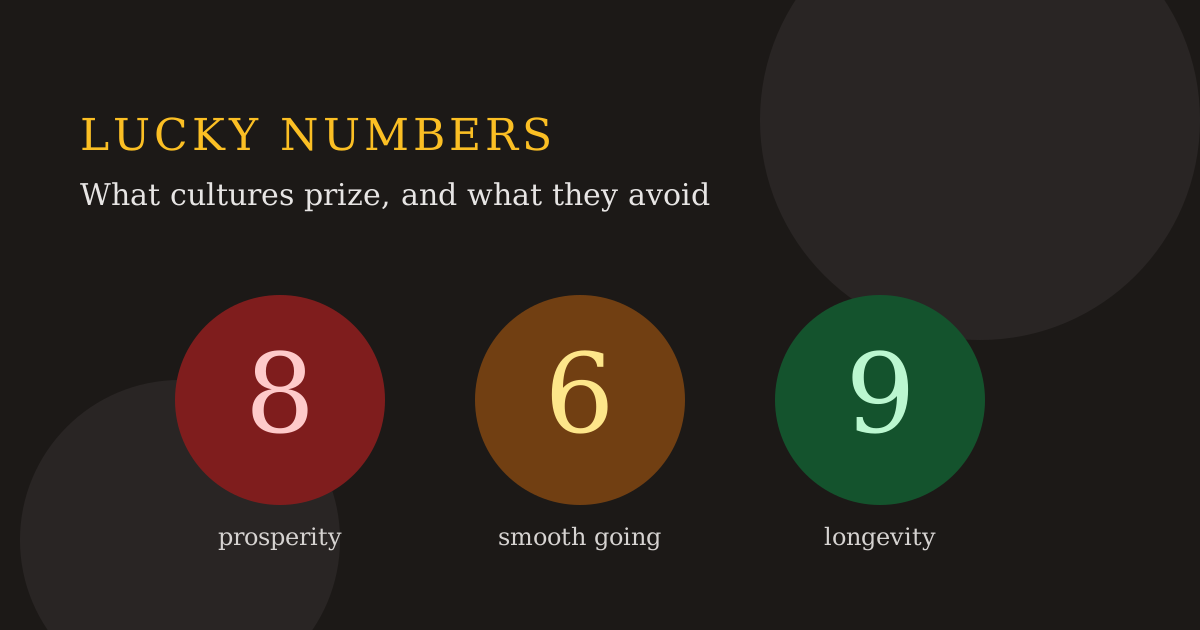
- 8 (ba) ~ fa, to prosper. The verb in fa cai, the New Year wish for getting wealthy. This is the whole engine.
- 9 (jiu) ~ jiu, long-lasting. The digit of endurance, and the reason 99 and 999 appear in wedding dates and longevity gifts.
- 6 (liu) ~ liu, smooth or flowing. Things going well without drama. Internet slang later turned 666 into a compliment meaning brilliant, which is why gamers type it as applause.
- 2 (er) and pairing. Doubling and couples; good things come in pairs in the wedding register.
Stacking multiplies the message. 88 is double prosperity (and a texting farewell, since ba-ba sounds like bye-bye). 888 is the fa syllable three times over. Read as phrases, whole strings become sentences: 168 is yi lu fa, prosperity all the way down the road; 518 is wo yao fa, I will prosper; 520 drifts romantic, echoing wo ai ni, I love you, which is why 20 May (5/20) became an unofficial lovers' day. A premium phone number in China is graded the way you would grade a slogan, and the telephone numbers guide shows the invoices.
The receipts: what 8 has cost people
Beliefs are easy to assert and better to document. On the record:
- 2003: Sichuan Airlines paid a reported US$280,000 for the customer hotline 8888-8888. Its spokesperson told the Associated Press the number would make customers happy when they called, which is the belief translated into marketing.
- 2008: The Beijing Olympics opened on 8/8/2008 in the evening, at eight minutes past eight, a timestamp Chinese planners chose with the digit's reputation stated openly in coverage of the Games.
- 2016: Hong Kong's plate "28" sold for HK$18.1 million. The 2 promises pairing, the 8 promises prosperity, and Cantonese reading hears "easy prosperity." It remains the emblematic lucky-number plate in a market whose outright records are letters (see license plate records).
- 2020: A Beijing court auctioned a debtor's mobile number ending in five 8s for RMB 2.25 million, the highest documented court sale of its kind at the time.
Around those headlines sits the everyday market: carriers reserving 8-heavy numbers for premium contracts, Hong Kong and mainland brokers grading strings, hotel floors, wedding dates, and shop-opening ceremonies timed to the digit. You do not need every buyer to be a believer. You only need enough of them at the same auction.
Advertisement
8 in the home: where language luck meets the front door
Because this is Lucky Properties, the housekeeping: an 8 in your address is language luck, not a Feng Shui cure. Classical Feng Shui works with orientation, layout, and the five elements; it does not grade door numbers. Address numerology, the modern practice of reducing a house number to 1-9 and reading its theme, gives 8 a theme of abundance and ambition, and if that reading pleases you, it is a perfectly good tiebreaker between two homes you otherwise like equally. Our house numbers guide does the reduction math, covers every digit 1-9, and keeps the same distinction. The lucky license plates guide shows what happens when the same homophone meets genuine scarcity at auction.
Using 8 well, without overpaying for it
- Say it in the right language. The luck lives in Mandarin and Cantonese pronunciation. If your household speaks neither, 8 is a handsome, balanced digit with a good story, and you should pay story prices (little or nothing), not auction prices.
- Buy the ending, not the string. In phone numbers and plates, the last digits carry the premium. One trailing 8 buys the symbolism at the lowest tier.
- Mind the mirror. Where 8 costs more, 4 costs less for the mirror-image reason. If 4 does not bother you, the discount is real money kept. The number 4 guide maps that market.
- Let it be a pleasure, not a plan. An 8 on the door, the plate, or the wedding date is a small daily nod to hopes you already have. It documents optimism. It does not underwrite outcomes, and this site will not pretend otherwise.
8 in daily life: prices, gifts, and the octagon on the wall
Between the Olympics and the auctions, 8 does quieter work everywhere in the Chinese-speaking world. Gift money at weddings and New Year gravitates to 88, 188, and 288 yuan denominations, enough to carry the syllable without staging a performance. Shopkeepers price at 8.8 and 88 because the number reads as a small blessing stapled to the transaction. Phone shops display their 8-ending stock the way jewellers display the lit shelf. None of this requires a single believer to run the system; it requires only that sellers believe buyers like it, which is how most traditions actually persist.
Feng shui households know 8 in another costume: the bagua mirror, the octagonal protective mirror hung above doors, takes its shape from the eight trigrams (ba gua literally means eight symbols). That is a different 8 from the prosperity homophone, older and structural, and it is worth keeping them separate the way this site keeps address numerology separate from classical feng shui. The digit collects meanings the way harbours collect ships.
And a fairness note for the digit itself: 8 is not lucky in every reading even inside Chinese tradition. It is the prosperity digit of business and celebration, but longevity wishes reach for 9, smoothness for 6, and a full traditional blessing strings them together rather than crowning one. The market made 8 the most expensive digit on earth; the culture keeps it as first among equals. Both are true, and the receipts above show what "first" is worth when the auctioneer starts talking.
Choosing an 8 of your own: a field guide to the small market
Most readers will meet the prosperity premium as buyers, not spectators, so here is how the micro-market actually behaves at the counter. Car dealers in Chinese-influenced cities keep mental (sometimes printed) surcharges for plates ending in 8, with the price climbing per 8 and per position toward the end of the string; an 8 in the final seat out-prices the same digit two seats upstream, because buyers read numbers the way poets end lines. Phone counters do the same openly, tagging the 8-ending SIMs. Property portals in Hong Kong and across the diaspora let searchers filter by floor and unit, and units carrying a final 8 enjoy the quietest bidding wars in the building.
Budget guidance brokers repeat: buy the cheapest respectable 8 rather than the dearest available one, because resale premiums reward recognisability, not your personal poetry. A single clean 8 at the end of a phone number or plate survives changes of fashion; a baroque seven-digit construction charms exactly one buyer, you. And keep the counter-tradition in your other pocket: 9s hold their value in longevity-minded families, 6s in the smooth-going school, and a number that means nothing to the market but everything to your family (a birthday, an anniversary) is the one asset in this entire economy that cannot be outbid. The digit 8 collected the auction records, but the lived tradition was always plural, and the shrewd participant shops the whole shelf.
Sources
- Associated Press reporting on Sichuan Airlines' purchase of 8888-8888 (2003), via Geekzone: https://www.geekzone.co.nz/content.asp?contentid=1302
- The Times via Scottish Financial News (August 2020), Beijing court auction of a number ending in five 8s at RMB 2.25 million: https://www.scottishfinancialnews.com/articles/and-finally-lucky-number
- The HK HUB record table for Hong Kong plates, including "28" at HK$18.1 million (2016): https://thehkhub.com/hong-kong-number-plate-with-unusual-letter-d-sells-for-hk20-2m-us2-5m/
What the digit asks of a sceptic
End where the evidence is strongest. 8's luck is not a hypothesis about the universe; it is a documented fact about prices, and prices are among the clearest records a culture produces. When millions of people independently pay more for the same car wrapped in a different plate, the same flat on a different floor, the same SIM card with a different tail, the digit has acquired a utility indistinguishable from luck in its effects: it pleases guests, reassures elders, speeds resales, and opens conversations. You may hold the metaphysics at arm's length and still hold the asset, which is why the shrewdest participants in this economy are often its gentlest believers. They are not buying magic. They are buying the room's agreement that magic would look like this, and rooms, in the end, are where prosperity either happens or does not.