The short version
Short answer: Four is the avoided number across China, Japan, Korea, and Vietnam because in Mandarin (si), Cantonese (sei), Japanese (shi), and Korean (sa), the word for four sounds like the word for death in the same language. The avoidance has a clinical name, tetraphobia, and visible architecture: buildings that jump from floor 3 to floor 5, hospitals without a room 4, phone numbers ending in 4 selling for less than their neighbours. It is a language tradition, not a classical Feng Shui rule, and it is far from universal even inside East Asia: 4 also means the four seasons, holds the beat in music, and reads as structure and stability in modern numerology. This page covers where the avoidance came from, where it shows up, where it does not, and what to do if it follows you to a property viewing.
The companion pages are the number 8 guide, where the same homophone logic runs in the lucky direction, and the lucky numbers world hub.
Four languages, one unfortunate rhyme
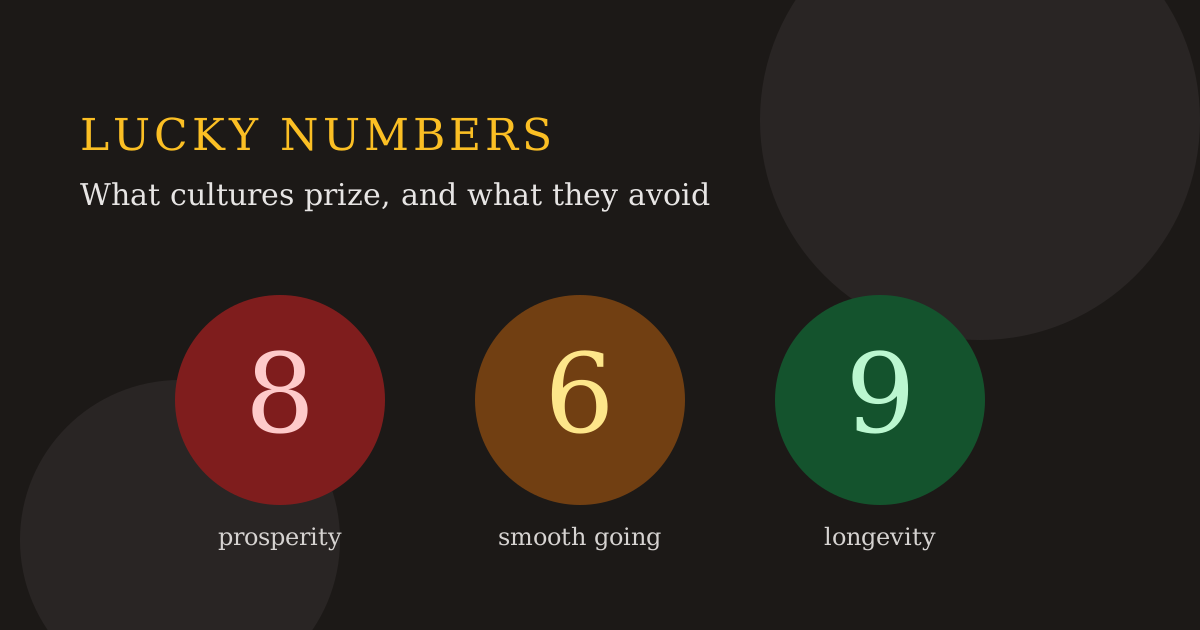
Tetraphobia is the mirror image of the number 8 phenomenon. Where 8 rides a lucky homophone (ba echoing fa, to prosper), 4 is dragged by an unlucky one in four major languages at once, which is why the avoidance spans a whole region rather than one country:
- Mandarin: four is si; death is si. Different tones, close enough at speed to make the association stick.
- Cantonese: four is sei; death is sei. Hong Kong runs both the 4 avoidance and the 8 premium at full strength, which is why its auctions dramatise the pair.
- Japanese: four can be read shi, identical to the word for death; a softer reading, yon, exists precisely so speakers can step around it. Japanese also gives the digit a second shadow through 9 (ku, suffering), a reading China does not share.
- Korean: four is sa, death is sa. Korean buildings routinely mark the fourth floor F instead of 4.
- Vietnamese: tu (four) sits near tu (death) in Sino-Vietnamese vocabulary, and the avoidance appears there too, more mildly.
Notice what this is and is not. It is a set of puns, taken seriously by enough people, for long enough, that developers, hospitals, and telecom companies plan around them. No classical text orders anyone to fear a floor number; the market simply noticed that units numbered 4 could be harder to sell and rooms numbered 4 made patients' families wince.
Where tetraphobia shows up
Buildings. The signature artefact. Towers across East Asia omit 4, 14, 24, and sometimes all 40-something floors; the physical storey above 3 is labelled 5. The practice emigrated: in Canadian and Australian cities with large East Asian buyer pools, some condo developers dropped 4 (and occasionally 13) from floor numbering during the 2010s condo boom, occasionally drawing municipal pushback because inconsistent numbering confuses first responders, which is a real-world cost of a symbolic preference and a fair point for the skeptics.
Hospitals and hotels. Japanese and Chinese hospitals may skip room 4 and sometimes ward numbering with 4 entirely; maternity and intensive care areas are the most conservative. Hotels aimed at regional travellers do the same with room numbers and floors.
Numbers for sale. Phone numbers ending in 4 anchor the discount tier of the Chinese premium market, while 8-ending numbers anchor the premium tier (the telephone numbers guide follows the money). Plates carrying 4s in Hong Kong attract less bidding heat. Flight numbers, product model numbers, and even prices in 4-avoidant markets quietly steer around the digit.
Addresses. A house number heavy in 4s can meet resistance from some buyers in specific markets, which matters at resale time rather than move-in time. If a home carries a 4 and you love it, the house numbers guide puts the digit in perspective: modern numerology reads 4 as structure, diligence, and routine, and classical Feng Shui does not score door numbers at all.
Advertisement
Where 4 is perfectly welcome
The avoidance is regional and generational, not human. Four is the count of seasons, directions, and the Western elements (earth, air, fire, water). It holds 4/4 time, the commonest rhythm in popular music. In the Lo Shu magic square at the root of Flying Star Feng Shui, every direction's numbers sum in a grid that includes 4 without incident, and the 4 star itself traditionally governs scholarship and romance. Within China, readings can rescue the digit: a 4 attached to a following 8 (48, 84) is often smoothed over by the prosperity ending, and in music 4 is fa, the fourth note, which lands close to the prosperity syllable itself. Plenty of younger buyers in Shanghai, Seoul, and Tokyo treat tetraphobia as their grandparents' setting rather than their own. When you meet the belief, treat it the way locals do: a preference to respect in shared spaces, not a property of the digit.
If a 4 follows you home: practical guidance
- Separate the systems. Folk homophone (si/death), modern address numerology (4 = structure), and classical Feng Shui (no door-number verdict) are three different things. Anyone blending them into one scary story is selling something.
- Price it, don't fear it. In a 4-avoidant market, a 4-heavy address or unit can be a negotiated discount today and a thinner buyer pool tomorrow. Weigh both; the arithmetic usually favours buying the home you like at the discount.
- Be a gracious host. If guests or family read 4 as death, skip it in room choices, seating counts, and gifts when it costs you nothing. Gift etiquette in particular avoids sets of four across much of East Asia; sets of eight send the warmer message.
- Watch the combinations. The sharper readings are compounds: 14 ("certain death" in some Cantonese readings) and 24 bother people more than a lone 4, while 48 bothers them less. If a combination will be spoken aloud often (a unit number, a phone ending), say it in the relevant language before you commit.
The balanced view
Tetraphobia is best understood as etiquette fossilised into architecture. It costs developers a little numbering logic, saves some residents a daily wince, and gives the indifferent a discount to collect. What it has never done is change what happens on the fourth floor. Live there well, and the floor behaves exactly like the fifth. The lucky numbers hub puts 4 in the full world table beside 7, 13, and 17, and the license plate records guide shows the same beliefs with auction paddles attached.
The compounds: why 14 bothers people more than 4
A lone 4 is a syllable; combinations are sentences, and tetraphobia reads sentences carefully. 14 can be heard as "certain death" in Mandarin and Cantonese readings, which is why it out-avoids its parent digit and why 4 and 14 together can empty a floor plan of both numbers. 24 gets read as "easy death" in the same folk phonetics and is nearly as unwelcome. Running the other way, 48 and 84 survive their first digit because the sentence ends on fa: prosperity gets the last word. 54 is sometimes rescued as "will not die," a small folk pun that realtors enjoy quoting. None of this is linguistics with peer review; it is the oral folklore of markets, and markets are where these readings cash out.
The etiquette extends beyond buildings. Gifts in sets of four are avoided across much of East Asia the way the West avoids walking under ladders at weddings: clocks are the famous taboo gift in China (the phrase for giving a clock echoes attending a funeral, a different homophone trap), and sets of four cups can quietly suggest the funeral count. Hosts who know this give sixes and eights. Guests who learn it stop wondering why the banquet had eight courses of symbolism and not a four in sight. When you travel in the region, treat floor numbers and gift counts the way you treat chopstick etiquette: small knowledge, visibly appreciated.
Walking a 4-floor home: a viewing checklist for the tradition-aware
For readers who will actually stand in one of these units, feeling is data but so is the tape measure. Work through the practical list before letting symbolism vote. Check corridor light and unit position first: end units trade a little quiet for a window the middle units never get, and tetraphobia's discount often parks itself on exactly these. Confirm the orientation and real floor height with the actual compass direction and the building's fire-escalation height, since "floor 4" spans everything from near-ground to proper elevation in low-rise stock. Price it against the identical 3rd and 5th floor stacks, not against the building average, because the per-stack spread is the true tetraphobia price and the only number that tells you what you are being paid to hold.
Then do the resale arithmetic out loud: who is your future buyer pool in this building, this street, this city? A 4-floor unit in a neighbourhood with strong East Asian demand carries the discount forward; in a market indifferent to the digit, the discount evaporates at exit and only the light and quiet remain yours. Traditions, like currencies, convert at borders, and a home is partly a currency. Finally, the blessing inventory if you buy: the household altar shelf, the door dressing, the plants, the address numerals, and a housewarming guest list chosen for warmth. The buyers who thrive on the 4th floor are rarely the ones who disprove the taboo; they are the ones who priced it, blessed it, and got on with living above a story other people are still paying to avoid.
Sources
- Hong Kong and regional reporting on Transport Department plate auctions and market number preferences, including The HK HUB record coverage: https://thehkhub.com/hong-kong-number-plate-with-unusual-letter-d-sells-for-hk20-2m-us2-5m/
- The Times via Scottish Financial News (August 2020), on Chinese phone-number auctions and the pricing of digit patterns: https://www.scottishfinancialnews.com/articles/and-finally-lucky-number
- Khaleej Times (March 2014), on UAE premium number auctions and pattern pricing: http://www.vodahits.com/uaes-priciest-mobile-number-tops-dh7-8-million/