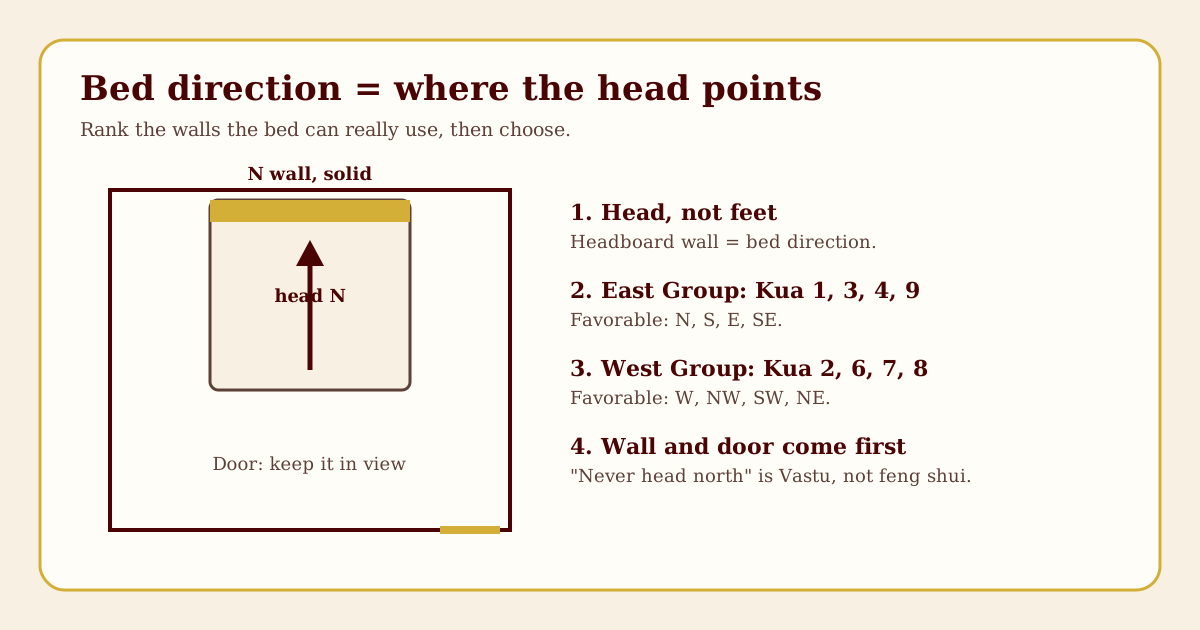
In feng shui, "bed direction" means the compass direction your head points, which is the direction of the wall the headboard stands against. There is no single best direction for everyone. The compass school (Eight Mansions) gives each person four favorable and four unfavorable directions based on their Kua number, while form school cares about the wall, door and window and ignores the compass.
Last checked: 13 November 2026
| Key fact | Figure or rule | Source |
|---|---|---|
| What "bed direction" measures | The direction the crown of the head points | Eight Mansions practice, as used in our Kua guide |
| Directions per person | Four favorable and four unfavorable, set by Kua number | Eight Mansions (Ba Zhai) tradition |
| Size of each compass sector | 45 degrees, centered on the named direction | Our Kua and compass guides |
| "Never sleep head north" | Vastu Shastra rule; head east or south is preferred there | WebMD, Sleep Foundation |
| Study on sleep direction | One cross-sectional survey of 153 students; 1 of 7 sleep measures differed by direction, and cause cannot be shown | Moosavi and colleagues, International Journal of Indian Psychology, 2015 |
| Magnetic declination | Varies with location and time; NOAA's calculator is typically accurate to 30 minutes of arc (half a degree) | USGS; NOAA NCEI Declination Calculator |
| Evidence verdict | "Still no definitive answer" on whether sleep direction affects health | Sleep Foundation |
What you are actually choosing
Search for "which direction should your bed face" and you will find charts that disagree. Most of the disagreement is not about the compass. It is about three questions blended into one.
- Which end of the body points where? The compass school uses the head. A bed has a headboard end, so "head north" and "headboard on the north wall" are the same thing, provided you sleep with your head at the headboard.
- Whose rules? Eight Mansions ranks directions per person. Vastu Shastra, from India, ranks them for everyone. Form school ranks the bed's position against walls, doors and windows and uses no compass.
- What wins when they conflict? A compass sector is a ranking among options. A solid wall behind the head and a door you can see are, for most teachers, closer to requirements. If a sector means putting the headboard under a window, most practitioners keep the window clear and accept a lesser direction.
The rest of this page follows that order. If the schools are new to you, form school versus compass school explains how they differ.
Why the answers online contradict each other
Eight Mansions: a personal ranking
Eight Mansions, Ba Zhai in Chinese, starts from your Kua number, worked out from your birth year and gender. The Kua puts you in the East Group (Kua 1, 3, 4, 9) or the West Group (Kua 2, 6, 7, 8). A Kua of 5 has no row of its own: tradition borrows Kua 2 for men and Kua 8 for women, both West Group.
Each person then gets eight named directions. Four are favorable: Sheng Chi, Tian Yi, Yan Nian and Fu Wei. Four are unfavorable: Huo Hai, Wu Gui, Liu Sha and Jue Ming. Everyone has all eight compass points assigned somewhere, so north is favorable for one person and unfavorable for the next. That is the system working as designed, not an inconsistency in it.
For a bedroom, practitioners use the favorable four in a rough order. Our Eight Mansions house guide records the order teachers commonly give for the main bedroom: Tian Yi first, then Yan Nian or Fu Wei, with Sheng Chi kept for desks and working rooms. Some charts published online rank Sheng Chi first for the bed instead. Sources do not agree, so treat the four favorable directions as a group and pick within them using the room.
Form school: wall, door, window
Form school, sometimes called landform or the command position approach, reads the room as a visitor and a sleeper would. The bed sits against a solid wall, the sleeper can see the door without being in line with it, and nothing hangs over or presses on the head. There is no compass in it. The command position guide covers the idea across the whole home, and the bedroom layout for couples and awkward bedroom layout guide handle where the bed goes relative to door, window and wall. This page leaves those questions to them and stays on the compass.
Vastu Shastra: one rule for everyone
The best-known "never head north" advice does not come from feng shui. It comes from Vastu Shastra, the Indian tradition of building and orientation. WebMD's summary of Vastu sleeping direction says practitioners avoid a north-pointing head, call east ideal and south the optimal direction, and explain it with Earth's magnetism. The Sleep Foundation's page on the best direction to sleep reports the same pattern: east best, south a close second, north discouraged. Neither page offers clinical measurements of Vastu's claims.
The mix-up happens because the same Sleep Foundation page also says that in feng shui, sleeping with your head pointing north "is considered the most harmonious position". That summary flattens the system. In Eight Mansions there is no universal north. The two traditions each have rules about head direction, and they do not agree with each other, so a reader who combines them gets a contradiction that neither tradition contains.
Here is how the same direction reads under each rule set:
| Head points | Vastu Shastra (as summarized by WebMD and Sleep Foundation) | Eight Mansions |
|---|---|---|
| North | Avoid | Favorable for Kua 1, 3, 4, 9. Unfavorable for Kua 2, 6, 7, 8 (Jue Ming for Kua 2 and 5 male) |
| East | Ideal | Favorable for Kua 1, 3, 4, 9. Unfavorable for Kua 2, 6, 7, 8 |
| South | Optimal or close second | Favorable for Kua 1, 3, 4, 9. Unfavorable for Kua 2, 6, 7, 8 |
| West | Not covered by the pages we opened | Favorable for Kua 2, 6, 7, 8. Unfavorable for Kua 1, 3, 4, 9 |
If you follow Vastu, you are following a different tradition with a different map. That is a legitimate choice, but do not stack the two rule sets and expect them to agree.
Step 1: find your Kua number
You need your Kua only if you are using Eight Mansions. The calculation depends on birth year, gender and where the lineage places the year turn (lunar new year or Li Chun), so a winter birthday can land one Kua away depending on whom you ask. Do the arithmetic in the Kua number directions guide, which walks through it with worked years. This page does not repeat it.
Write down your Kua number, your group, and your eight directions from the table below. For a partner or a child, do it for each person separately.
The full Kua-to-directions table
Read across your row. The first four columns are your favorable directions in the order the tradition lists them. The last four are the unfavorable ones, from the mildest (Huo Hai) to the strongest caution (Jue Ming). The table matches the one in our Kua guide, row for row.
| Kua | Group | Sheng Chi | Tian Yi | Yan Nian | Fu Wei | Huo Hai | Wu Gui | Liu Sha | Jue Ming |
|---|---|---|---|---|---|---|---|---|---|
| 1 | East | SE | E | S | N | W | NE | NW | SW |
| 2 | West | NE | W | NW | SW | E | SE | S | N |
| 3 | East | S | N | SE | E | SW | NW | NE | W |
| 4 | East | N | S | E | SE | NW | SW | W | NE |
| 5 male (use Kua 2) | West | NE | W | NW | SW | E | SE | S | N |
| 5 female (use Kua 8) | West | SW | NW | W | NE | S | N | E | SE |
| 6 | West | W | NE | SW | NW | SE | E | N | S |
| 7 | West | NW | SW | NE | W | N | S | SE | E |
| 8 | West | SW | NW | W | NE | S | N | E | SE |
| 9 | East | E | SE | N | S | NE | W | SW | NW |
Two checks catch most copying mistakes. Your four favorable directions should all sit in your own group's half of the compass: north, south, east and southeast for the East Group, and west, northwest, southwest and northeast for the West Group. And your unfavorable four should be the other group's set in full.
Notice how the table undercuts the Vastu rule. Under Eight Mansions, a Kua 4 person has north as Sheng Chi, their first favorable direction, and a Kua 7 person has north as Huo Hai, a mild unfavorable one. A rule that says "never north" would be right for the second and wrong for the first.
Advertisement
Step 2: take a reading you can trust
The compass is where most people go wrong. The full method is in our compass reading guide; the essentials are below.
Stand where the head will point from. Stand at the foot of the bed, face the headboard, and read the bearing in that direction. Eight Mansions sectors are 45 degrees wide and centered on the named point, so each runs 22.5 degrees either side of it. North covers 337.5 to 22.5 degrees and east covers 67.5 to 112.5. A reading of 20 degrees is still north; 25 degrees is northeast.
Keep metal out of the reading. A metal bed frame, box-spring coils, a radiator, a speaker magnet or steel in the building can pull a needle off line. Read in the middle of the room with the compass level, then again from a second spot such as the doorway. If the two readings differ enough to cross a sector edge, treat the room as suspect and repeat the test in a hallway aligned with the same wall.
A phone is a guide, not an instrument. Phone compasses sit next to a battery, a speaker and often a magnetic case. Calibrate if the app asks, remove the case and repeat the reading. A phone can tell north from east. It cannot settle a wall that sits near a sector boundary.
Allow for magnetic declination. A compass needle points to magnetic north, not true north. The US Geological Survey defines the angle between them as declination and notes that it varies with both location and time. NOAA's National Centers for Environmental Information offers a Declination Calculator for past, present and near-future dates, and says results are typically accurate to 30 minutes of arc, which is half a degree. Practitioners differ on whether to correct for it: many classical teachers read the magnetic bearing directly, others correct to true north. It matters only when a wall sits near a sector edge. Look the figure up for your address, note your teacher's convention and apply it consistently.
Write down what you found: the compass type, the readings from each spot and whether you corrected for declination.
Step 3: list the walls the bed can really use
Before you look at your favorable directions, list the walls where the bed can safely stand. Practical limits remove most of the options in a typical bedroom:
- The door swing. The bed cannot block the door, and you need a clear route from bed to door.
- Windows. A headboard under a window leaves the head exposed to drafts, light and noise. Many form school teachers rule it out. The sleep environment guide covers light, noise and temperature.
- Ceiling beams. A bed under an exposed beam is a classic form school caution. See the beam guide.
- Bathroom walls. Heads on a wall shared with a toilet cistern or a door facing the bed raise concerns for many practitioners; the bathroom door facing the bed guide sets out the options.
- Real clearances. Leave room to walk around the bed and open wardrobes. Keep the bed clear of radiators and heaters.
What remains is usually two or three walls. Label each by the compass direction its headboard would give, using your trusted reading. Those are the only options the compass can rank.
Step 4: rank those walls
For each remaining wall, find its direction in your row of the table. Put it in one of three bins:
- Favorable. Sheng Chi, Tian Yi, Yan Nian or Fu Wei. Within these, prefer Tian Yi, then Yan Nian or Fu Wei for a main bedroom, as our house guide records. Sheng Chi is the one teachers say suits a desk best.
- Mildly unfavorable. Huo Hai, which tradition treats as small friction. Teachers usually accept it if the room needs it.
- Strongly unfavorable. Wu Gui, Liu Sha and especially Jue Ming. Where a choice exists, tradition keeps the head away from these, with the strongest caution on Jue Ming.
Then run the decision table below. It is built for the moment when the compass and the room disagree.
Decision table for conflicts
| Situation | What most teachers prioritise | What to do |
|---|---|---|
| A favorable wall is also solid, away from the door line, with no window or beam above | Both agree | Use it. Choose the highest-ranked favorable wall |
| Your best favorable wall has a window directly behind the bed | Form first | Keep the window clear. Use a different favorable wall, or a mildly unfavorable one if no other fits |
| Your only solid wall is a Jue Ming direction | Room first, with a partial fix | Keep the headboard on the solid wall and consider reversing which end you sleep at (see below) |
| Two walls are favorable, one is in line with the door | Form first | Take the wall out of the door line, even if it ranks lower within the favorable four |
| A favorable wall is only reachable by blocking a wardrobe or a clear route | Practical first | Do not block access. Choose the next wall, or move the wardrobe if you can |
| All available walls are unfavorable | Least bad | Choose the mildest, with Huo Hai before Wu Gui, Liu Sha, then Jue Ming |
| The bed needs to sit in the room centre (floating) | Form first | Most teachers dislike it. Put the headboard against a wall unless the room truly has no other fit |
| You are renting and cannot move the bed's wall | Lease and room | Use the adjustable options in the next section |
The order is the one most teachers apply in practice, but individual teachers differ. Where a teacher you trust says otherwise, follow them.
When the bed cannot move: adjustable alternatives
Sometimes the room allows only one position. A studio, a loft bed and a narrow room with a single solid wall are common examples. Several adjustments change the head direction without moving the furniture.
Sleep at the other end. Turn around and put your head at the foot of the bed. A bed against the north wall with the headboard on the north wall gives a north head. Sleeping the other way gives a south head. This is the simplest way to switch to the opposite direction. The cost is real: you lose the headboard at your back, and the feet end may have a footboard, a draft or less support. Some form school teachers say the head should stay at the solid headboard. If you try it, give it a few nights and see whether you rest, or keep what works.
Advertisement
Worked example 1: one sleeper, four walls
Inputs: A woman born in 1982 (after early February) is Kua 6 (West Group): 8 plus 2 is 10, reduced to 1, plus 5 gives 6. Her bedroom door is on the south wall and there is a window on the east wall. The north and west walls are solid. Her Kua 6 row reads: Sheng Chi W, Tian Yi NE, Yan Nian SW, Fu Wei NW, Huo Hai SE, Wu Gui E, Liu Sha N, Jue Ming S.
| Wall | Head direction | Rank for Kua 6 | Room check |
|---|---|---|---|
| North | N | Liu Sha | Solid wall, out of the door line |
| East | E | Wu Gui | Window behind the head, ruled out |
| South | S | Jue Ming | Door wall, ruled out |
| West | W | Sheng Chi | Solid wall, no window |
Decision: West is both a favorable direction and a solid wall, so compass and room agree. She chooses west. Had the west wall carried a window, the north wall (Liu Sha) would be the room-first choice, and she would note that Liu Sha is a strong caution but not the strongest.
Worked example 2: a couple in different groups
Inputs: Partner A is Kua 1 (East Group). Partner B is Kua 2 (West Group). Their shared bedroom has two usable walls, east and west, because the north wall has the door and the south wall has a window and a radiator.
To compare directions, we use a scoring convention of our own, not a classical formula: favorable directions score from +4 (the first, Sheng Chi) to +1 (Fu Wei, the fourth), and unfavorable ones from -1 (Huo Hai) to -4 (Jue Ming). It follows the column order of the table, not the bedroom order given earlier; ranking Tian Yi first instead leaves east and west still tied, at plus three each.
| Direction | Partner A, Kua 1 | Partner B, Kua 2 | Sum |
|---|---|---|---|
| N | Fu Wei, +1 | Jue Ming, -4 | -3 |
| NE | Wu Gui, -2 | Sheng Chi, +4 | +2 |
| E | Tian Yi, +3 | Huo Hai, -1 | +2 |
| SE | Sheng Chi, +4 | Wu Gui, -2 | +2 |
| S | Yan Nian, +2 | Liu Sha, -3 | -1 |
| SW | Jue Ming, -4 | Fu Wei, +1 | -3 |
| W | Huo Hai, -1 | Tian Yi, +3 | +2 |
| NW | Liu Sha, -3 | Yan Nian, +2 | -1 |
The sums show north and southwest are worst for the pair. East, southeast, northeast and west tie at plus two, and the room allows only east or west. On the east wall, A scores plus three and B minus one; on the west wall the figures reverse. East gives B the mildest unfavorable direction, Huo Hai.
Decision: Tradition has no tiebreaker here. Teachers usually protect the person who sleeps worse. If one partner has more trouble sleeping, give that person the favorable direction and accept Huo Hai for the other. If neither does, pick on the room: the quieter wall, the one farther from the door. The Kua directions guide discusses the same compromise logic for desks and sofas.
A caution about sums: a plus four for one person and a minus four for the other adds up to zero but is not neutral. Check the worst single score first, then the total.
Worked example 3: the only solid wall is a bad direction
Inputs: A Kua 8 man (West Group) rents a one-bedroom apartment. The bed fits on the east wall only, because the door, a wardrobe and a window take the others. Kua 8 row: Sheng Chi SW, Tian Yi NW, Yan Nian W, Fu Wei NE, Huo Hai S, Wu Gui N, Liu Sha E, Jue Ming SE. East is Liu Sha, a strong caution.
Options: (1) Keep the headboard on the east wall and accept Liu Sha, the form school answer. (2) Sleep with the head at the foot end, so the head points west, which is Yan Nian, at the price of losing the headboard behind the head. (3) Turn the bed to the north wall, which is Wu Gui and blocks the wardrobe, so no better.
Decision: Many teachers would accept option 1 or 2 depending on whether the sleeper rests better with a headboard behind them. Try the reversed end for three to five nights and note how quickly you fall asleep and how rested you feel. If you sleep as well either way, take the favorable direction. If you sleep worse, your own rest outweighs a compass ranking.
Children, bunk beds and shared rooms
Children have a Kua too, worked out from their own birth year. The Eight Mansions house guide linked above records the usual split: the house chart picks the child's room, and the child's own Kua sets the desk facing and the bed head. Our kids' bedroom layout guide and nursery guide cover the room, and the practical rules apply first: a bed away from windows, cords and heaters, and bunk beds fitted and used as the manufacturer instructs.
For a child's own bed, do the same steps as for an adult: Kua, trusted reading, list of walls, rank. Where a compass sector conflicts with safety, safety wins. A bed moved next to a radiator or under a window for a compass reason is not a good trade.
For bunk beds, both sleepers share one direction by default because the bunks run along the same wall. If the children are in different groups, you can set the heads at opposite ends: the lower child's head at the headboard end and the upper child's head at the other, so each points a different way. Check that the ladder, guard rails and ceiling clearance still work with the reversed end, and follow the manufacturer's instructions, since the safety rules decide before the compass does. If it does not work, choose the direction that suits the child who sleeps less well.
For infants and toddlers, many teachers would not rearrange a nursery around a compass at all. Keep the sleep surface and room safe first and treat any compass preference as a minor extra.
What the studies do and do not show
The study. Moosavi and colleagues published "The Relationship between Quality of Sleep and Geographical Directions during Sleeping Process" in the International Journal of Indian Psychology in 2015. It was a cross-sectional descriptive study. Researchers selected 200 undergraduate students in Mazandaran Province, Iran, and after excluding people with physical disorders, those on sleep or psychiatric medication, and pregnant or breastfeeding women, 153 remained. Sleep quality was measured with the Pittsburgh Sleep Quality Index, and sleep direction was recorded as head-to-foot orientation.
What it found. Sleep direction split roughly into north-south (30.7 percent), south-north (22.8 percent), east-west (26.2 percent) and west-east (20.3 percent). Of the seven sleep measures, only one, difficulty falling asleep, was reported as significantly related to direction: north-south sleepers reported the least difficulty and west-east sleepers the most. The other six, including bedtime, time taken to fall asleep, sleep duration, subjective sleep quality and daytime drowsiness, showed no significant relationship. Even the one result is shaky: the paper reports p below 0.001, but the test statistic it prints (a chi-square of 16.92 with 9 degrees of freedom) works out to a p-value of about 0.05, right at the usual cut-off. The authors still concluded that north-south sleeping might be added to sleep hygiene advice.
What it cannot show. A cross-sectional survey cannot show that direction caused anything. People who choose a direction may differ in other ways, such as the room's layout, the building's age or the noise on that side of the house. The sample was young university students in one province, the data came from questionnaires, and the study did not measure the magnetic field. One borderline result among seven measures is not evidence that any direction improves sleep, and this page does not use it that way.
The wider picture. The Sleep Foundation's overview mentions other studies, including one reporting more deep sleep for north-south sleepers and one finding no significant effect of magnetic exposure at night. It gives no sample sizes or effect sizes, calls the field a small but growing body of evidence, and says there is still no definitive answer. We could not open those primary papers, so we do not describe them further.
What has better support. The same Sleep Foundation page points to screens that suppress melatonin, light that signals wakefulness, noise, and room temperature (it gives 65 to 68 degrees Fahrenheit). It also suggests a self-test: note your head direction, try another for three to five nights, keep a diary of how fast you fall asleep, how often you wake and how rested you feel, then keep what works.
So the honest position is this. Feng shui bed direction is a traditional ranking, and the research on sleep orientation is small and unsettled. Neither justifies spending money, moving a bed into a draft, or losing sleep over a compass sector. Once the bed is placed, the bedroom paint color guide and the bedroom plants guide cover the rest of the room.
Advertisement
Common mistakes
- Reading the compass beside the bed frame. Read in the middle of the room and repeat it.
- Mixing Vastu and Eight Mansions. "Head south, never north" and "use your Kua directions" are different systems. Know which you are applying.
- Moving the bed to a window wall for a favorable sector. Most teachers rank the solid wall above the compass.
- Ignoring the year turn. A January or February birthday may fall into the previous year's Kua depending on the lineage you follow.
- Hemisphere confusion. The Sleep Foundation's suggestion of a north or south head, drawn from the early studies it summarizes, assumes the Northern Hemisphere, and it says the opposite would apply in the Southern. That note is about the studies, not about feng shui. Eight Mansions teachers differ on whether anything changes south of the equator, so ask your own teacher.
Where to go next
If your bed direction is settled and the rest of the room is the problem, work through the sleep environment guide next: light, noise and temperature are the factors with the best evidence behind them, and they are cheaper to fix than a bed move.
Sources
- Sleep Foundation, "Best Direction to Sleep": summary of Vastu and feng shui direction claims, the statement that there is still no definitive answer, the self-test and the lists of what affects sleep. Checked November 2026.
- Moosavi, Ahmadi, Setareh and Monajemi, "The Relationship between Quality of Sleep and Geographical Directions during Sleeping Process", International Journal of Indian Psychology, vol. 2, issue 4, 2015: sample, design, the seven measures and their results, the reported statistics and the authors' conclusion. Checked November 2026.
- WebMD, "What to Know About Vastu Sleeping Direction": Vastu Shastra head direction rules (east, south, north) and the absence of clinical evidence cited. Checked November 2026.
- USGS, "What is declination?": definition of magnetic declination and the fact that it varies with location and time. Checked November 2026.
- NOAA NCEI, Declination Calculator metadata: what the calculator provides and its stated accuracy of 30 minutes of arc. Checked November 2026.
- Eight Mansions direction sets and the Kua table: cross-checked against the site's own Kua number directions guide and Eight Mansions house guide, which record the tradition's standard tables. No guild page could be opened for this edition.
Editorial note: This article presents feng shui bed direction as a cultural and design tradition. It is educational, does not predict outcomes for health, sleep, relationships or money, and does not replace building codes, your lease, product safety instructions or advice from a doctor or other qualified professional. If you have trouble sleeping, speak to a health professional. Where traditional teachers disagree, we say so, and we cannot verify claims that no source we could open supports.