Read the living room's colors from its compass sector, then adjust them for the windows. On this site's chart, a north living room leads with grey and navy, east and southeast with greens and blues, south with warm neutrals and red accents, southwest and northeast with sand and terracotta, and west and northwest with whites, greys and camel. Put the lead on the sofa or rug, keep walls calm, and check fabric fade before you pay.
Last checked: 17 November 2026
| Key fact | Figure or rule | Source |
|---|---|---|
| Generating cycle | Wood produces fire, fire earth, earth metal, metal water, water wood | Internet Encyclopedia of Philosophy, Wuxing |
| Overcoming cycle | Wood conquers earth, metal wood, fire metal, water fire, earth water | Internet Encyclopedia of Philosophy, Wuxing |
| Living room sheen | Eggshell, "a good choice for moderate traffic areas such as living rooms" | Behr, how to choose an interior sheen |
| Paint coverage | 250 to 400 square feet per gallon (Behr Ultra eggshell) | Behr product page |
| Light damage | Cumulative and irreversible; dose is lux times hours | Canadian Conservation Institute, CCI Notes 13/1 |
| Upholstery abrasion | 15,000 Wyzenbeek double rubs for low traffic, 30,000 for high traffic; not a lifespan indicator | Association for Contract Textiles guidelines, via Architex |
| Upholstery lightfastness | Grade 4 minimum at 40 hours (AATCC 16), revised October 2003 | ACT upholstery guideline, as reproduced by Kothea |
| Cleaning codes | W water-based, S dry-cleaning agents only, WS either, X vacuum only | Living Spaces |
| Bulb color | Most ENERGY STAR bulbs that match incandescent are 2200 to 3000K; 5000 to 6500K reads bluer | ENERGY STAR |
| Sunniest windows | Solar-collecting windows face within 30 degrees of true south (northern hemisphere) | U.S. Department of Energy |
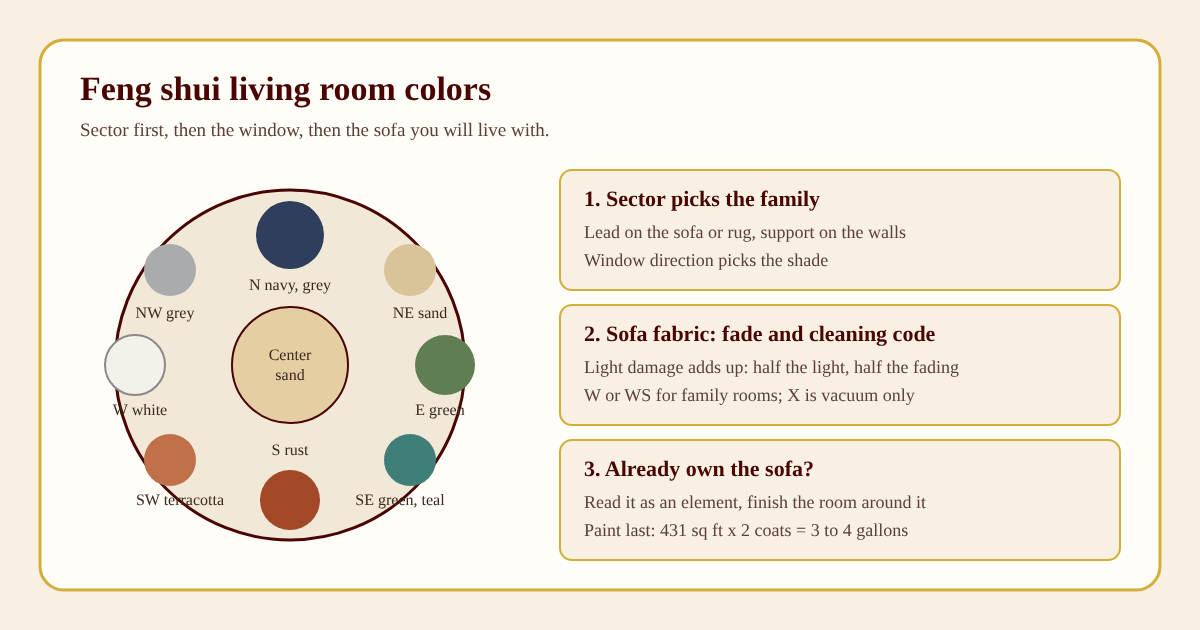
This page is the living room chapter of our feng shui colors by room guide, which explains the five phases, the two ways of assigning a color, and the paint facts (LRV, undertone, sheen) that apply everywhere. Here we only do the living room, and we spend most of the page on the three purchases that carry most of its color: the sofa, the rug and the curtains. Paint is the cheapest of the four to change, so it comes last in every decision below.
Which "direction" is your living room?
Feng shui and the paint shop both talk about a room's direction, and they mean different things.
- The sector. Stand at the center of the floor plan with a compass, divide the plan into eight 45-degree slices plus the center, and see which slice the living room sits in. That is the reading the color charts use. Our Bagua room-by-room guide shows how to draw it.
- The windows. The direction the main window faces decides the daylight. That is what paint makers mean when they tell you to test a color in your own light.
A living room can sit in the north sector of a house and still have its big window facing west. The chart below gives the colors from the sector; the window table after it tells you how to shift the shade and which fabrics need protecting. If you only know one of the two, start with the windows: light is the part you can measure.
The direction chart: walls, sofa, rug and curtains
How we built it. A living room is a mixed-use room, so we follow the hub's decision rule for multipurpose rooms: the sector's element leads, the living room's own function (earth to settle the seating, wood for family and liveliness) supports. The lead goes on a large piece you choose once (usually the sofa or the rug). The element that feeds the lead in the generating cycle goes on the walls or the second large piece. The element that overcomes the lead, in the overcoming cycle, is kept to small amounts. This is our application of the compass-school chart, not a rule from a single classical text; other schools, especially those that map the Bagua from the front door, will place some rooms differently.
One rule runs across every row: the hub warns against a scheme in one single phase, so whatever the sector, keep at least one earth or wood piece. In the north row that means timber and plants, not a large sand rug, because earth overcomes water there; in the west and northwest rows a camel chair or a sand rug works. Where the lead and support are both cool, that piece is what keeps the room from reading cold.
| Sector (element) | Walls | Sofa | Rug | Curtains | Accents | Keep small |
|---|---|---|---|---|---|---|
| North (water) | Warm white or pale grey (metal feeds water) | Navy, slate blue, charcoal or mid grey | Blue-grey, slate, or a deep blue pattern | White or grey linen | Plants and timber (water feeds wood) | Large sand, yellow or terracotta (earth overcomes water) |
| Northeast (earth) | Sand, wheat, warm beige | Camel, ochre, terracotta | Oatmeal, sand | Cream | Red or orange cushions, warm lamps (fire feeds earth) | Big blocks of green (wood overcomes earth) |
| East (wood) | Sage, soft green or a warm neutral | Green, or blue (water feeds wood) | Teal, blue or natural jute | Natural linen | One red or coral note (wood feeds fire) | Large white, grey or metallic areas (metal overcomes wood) |
| Southeast (wood) | Soft green or warm white | Green or teal | Blue, teal or a green-and-blue pattern | Natural linen or soft green | Purple or plum, which many modern books tie to this wealth sector | Large white, grey or chrome |
| South (fire) | Warm neutral, soft ochre (fire produces earth, so earth calms without fighting) | Rust, terracotta, or green (wood feeds fire) | Warm red-brown, rust or green | Light-filtering, in a lightfast fabric | Red, orange, candles and warm lamps | Large black or navy (water overcomes fire) |
| Southwest (earth) | Warm sand, soft ochre, clay | Camel, tan leather, terracotta | Sand, terracotta | Cream or blush | Pink, red, pairs of objects (fire feeds earth) | Big blocks of green |
| West (metal) | White or pale grey, or sand (earth feeds metal) | Cream, light grey or camel | Ivory or grey, round shapes fit metal | White, in a lightfast fabric | Brass, gold, soft yellow | Strong red (fire overcomes metal) |
| Northwest (metal) | White, pale grey or warm white | Grey, white or camel | Grey or ivory | White or grey | Silver, gold, round mirrors and frames | Strong red |
| Center of an open plan (earth) | Warm neutral, sand | Camel, oatmeal, terracotta | Sand or a low-contrast earth pattern | Cream | Fire accents | Big blocks of green |
Two things the chart does not do. It does not make a color good or bad for the people in the room: Lucky Properties treats feng shui as a cultural and design tradition, not a prediction. And it does not override your comfort. If the room's chart color makes you tense, keep it to a cushion and use the support color for the big pieces.
Advertisement
Then adjust for the window
Once you know the color family, the window decides the shade and the fabric. The table assumes a home in the northern hemisphere. In the southern hemisphere, swap north and south: Australia's Your Home guide notes that the main sun there comes from the north.
| Main window faces | What the light does | Paint shift | Fabric check |
|---|---|---|---|
| South | The side passive-solar design uses to collect sun: the U.S. Department of Energy says solar-collecting windows face within 30 degrees of true south, and Your Home notes the equator-facing side gets more sun in winter, when the sun is low | Our rule of thumb: slightly greyer versions of warm colors keep a sunny room from looking hot, and deep colors hold up in strong light | Highest fade exposure: lightfast sofa fabric, lined or light-filtering curtains |
| West | Late-afternoon sun, strongest in summer (Your Home) | Our rule of thumb: test warm yellows at 5 p.m., since low sun adds warmth to them | Strong afternoon dose on whatever faces the window |
| East | Morning sun, then softer light | Most colors behave; test in the evening too, when the room is used | Moderate; a sofa under the window still gets the morning beam |
| North | Steady, cooler daylight with little direct sun | Warm undertones and the lighter bands of the hub's LRV table (50 to 70 and above) keep it from looking grey | Lowest fade exposure: the place for a dark or saturated sofa |
Paint makers give the same advice for every orientation: paint a sample board about two feet square, move it around the room, and look at it in the morning, at midday and in the evening with your own lamps on. The room colors by light guide sets out that test step by step.
The sofa: four checks after the color
A sofa is often kept for many years, so its color is the biggest single color decision in the room. These checks decide whether the color you chose from the chart still looks right in year five.
1. Fade. The Canadian Conservation Institute's note on textiles says light fades dyes and weakens fibers, and that the damage is cumulative and irreversible. It measures exposure as light level times hours and gives an example: 100 lux for 400 hours does the same harm as 50 lux for 800 hours. The useful consequence for a living room: anything that halves the light reaching the sofa halves the rate of fading. Moving it out of the direct beam, a sheer curtain, blinds closed in the hours the sun hits it, or a UV-absorbing window film (which the same note says cuts UV without cutting visible light) all count. Saturated colors near a south or west window are where this matters most.
2. Lightfastness on the spec sheet. Contract fabrics are tested for fading. The Association for Contract Textiles' upholstery guideline, as reproduced by the fabric supplier Kothea from the October 2003 revision, asks for a minimum grade 4 at 40 hours under AATCC 16. Some residential fabrics carry no rating. If the store can give you a rating, compare it to that benchmark; if it cannot, treat a dark or bright fabric by a sunny window as a risk.
3. Cleaning code. The tag under the cushion carries a code. Living Spaces defines them: W means water-based cleaners, S means dry-cleaning agents only, WS means either, and X means vacuum only, with no cleaning solution of any kind. A pale sofa in a family room with children or pets is a poor match for S or X, because spills are hard to fix at home. This is a practical point, not a feng shui one, but a stained cream sofa does nothing for the room's calm.
4. Wear. The same contract guideline gives abrasion minimums: 15,000 Wyzenbeek double rubs for low-traffic use and 30,000 for high traffic, per the current guidance published by the textile maker Architex. Architex adds that a result above the guideline is not an indicator of how long the fabric will last, so use the number as a floor, not a promise. A family sofa used every evening sits closer to the high-traffic end.
The sofa's position, which is the other half of this decision, has its own page: feng shui sofa placement covers the wall behind it, the door and the clearances.
Already own the sofa? Build the room around it
Most people are not buying a sofa this year. Read your sofa as an element and finish the room from it. Find your sofa's color in the left column, then your sector in the chart above. If the two agree, the sofa is already doing the lead's job. If they do not, the right-hand columns tell you what to add so the room still reads in its sector's family.
| Sofa color | Element on this site's chart | Walls that support it | Rug that completes it | Add for the sector |
|---|---|---|---|---|
| Mid or light grey | Metal | Warm white or sand (earth feeds metal) | Ivory, grey or blue-grey | In an east or southeast room, add greens on the rug and plants so wood still leads |
| Cream or white | Metal | Sand, warm beige | Sand or a soft pattern | In a north room, a navy throw and a slate rug carry the water lead |
| Brown leather or camel | Earth (brown also reads as wood on some charts) | Sand, ochre, warm white | Terracotta or oatmeal | In a west or northwest room, add white, grey and brass so metal leads |
| Navy | Water | White or pale grey (metal feeds water) | Grey or blue-grey | In a south room, keep the rest warm: rust cushions, a warm rug, warm bulbs |
| Green | Wood | Warm white or soft sage | Blue, teal or jute | In a west room, metal overcomes wood; add water between them (a blue-grey rug, navy cushions), since metal feeds water and water feeds wood |
| Black leather | Water | Warm white | A warm rug to soften it | In a south room, keep it the only black piece and use a red-brown rug |
| Rust or terracotta | Fire (rust) or earth (terracotta) | Warm neutral | Sand or green | In a west or northwest room, keep it to the sofa and bring metal in on walls and frames |
| Blush pink | Fire (soft) | Warm white, sand | Sand or cream | Suits southwest and south rooms; in the north, add grey and navy around it |
The green-sofa-in-a-west-room row uses the hub's balance rule: when two elements clash, add the one that sits between them in the generating cycle rather than removing the color you like. Metal produces water and water produces wood, so water is the bridge between a metal room and a wood sofa; a blue-grey rug is usually the easiest way to buy it.
Advertisement
The rug and the curtains
The rug is the next largest block of color and the easiest to move house with. Our rug guide works out sizes for an 84-inch sofa and two chairs and gives the color for each element; use the rug column of the chart above to pick the family, then that guide for the size.
Curtains are the cheapest way to change the room's color and the only one that also controls light. On a south or west window they do two jobs at once: they carry the white, cream or linen of the chart, and they reduce the light dose on the sofa. For fabric, length and how much light to let through, see the windows and curtains guide.
Paint last: how much to buy
Walls take the support color in most rows of the chart, in eggshell, which Behr describes as a good choice for moderate traffic areas such as living rooms.
Worked example. A living room 14 by 18 feet with an 8-foot ceiling.
- Gross wall area: 2 x (14 + 18) x 8 = 512 square feet.
- Subtract two windows of 6 by 5 feet (60 square feet) and one door of 3 by 7 feet (21 square feet): 431 square feet to paint.
- Two coats: 862 square feet.
- Behr lists its Ultra eggshell at 250 to 400 square feet per gallon. 862 divided by 400 is 2.2 gallons; 862 divided by 250 is 3.4 gallons. Buy 3 gallons for smooth, previously painted walls, 4 for rough or porous ones, and buy them in one batch so the color matches.
- Only an accent wall? The 18-foot wall is 144 square feet, 288 for two coats: 0.7 of a gallon at the best rate and 1.2 at the worst. A single gallon may run short on a deep color over a lighter one.
The 60-30-10 proportion from the hub (about 60 percent of what you see in the support color, 30 in the lead, 10 in accents) is a design convention, not a feng shui rule. In this room the walls are 431 square feet and an 8 by 10 rug is 80, so the walls are what carry the 60, which is one more reason to keep them calm and put the lead on the sofa and rug.
Evening light changes all of it
A living room is used most in the evening, under lamps. ENERGY STAR says most of its certified bulbs made to match incandescent light are rated 2200 to 3000K, that 3500 to 4100K is whiter, and that 5000 to 6500K is bluer. On this site's chart, warm light is itself a fire note: it warms greys and creams toward earth, while a bluish bulb pushes the same walls toward metal and water. Choose the bulb before the final paint choice, and judge the swatch and the fabric sample under it. The lighting guide covers fixtures and placement.
Two rooms worked through
A north-sector living room with a west window and a grey sofa already in it. The sector says water leads. The sofa is metal, which feeds water, so it already supports the lead. Walls: a warm white with an LRV around 70, because west light turns warm whites slightly orange at sunset and very yellow whites further. Rug: slate blue or blue-grey, which puts water on the floor. Curtains: grey linen, closed in late afternoon in summer to cut the dose on the sofa. Accents: plants and timber, since water feeds wood. Keep out: a big terracotta rug, which would put earth (the element that overcomes water) on the largest flat area.
A south-sector living room with large south windows, buying a new sofa. The sector says fire, but a red wall in the room that gets the most sun would be both loud and hot. Walls: soft ochre or warm neutral, in eggshell. Sofa: rust or terracotta, with a lightfastness rating, placed so the midday beam does not fall on it; if the only good wall is opposite the window, plan for light-filtering curtains from day one. Rug: green or warm red-brown (wood feeds fire). Accents: red cushions and warm 2700K lamps. Keep out: large navy or black, which in this chart overcomes fire.
Before you pay
- Know both directions: the room's sector and the main window's direction.
- Choose the lead piece first: sofa or rug, in the sector's family.
- Ask for the sofa fabric's cleaning code and, for a south or west room, a lightfastness rating.
- Bring home fabric and paint samples and look at them in morning, afternoon and evening light, under the bulbs you will use.
- Measure the walls and buy all the paint from one batch.
- Plan the window treatment with the sofa, not after it fades.
Sources
- Internet Encyclopedia of Philosophy, Wuxing (Wu-hsing): the generating and overcoming sequences of the five phases, and wood's link to blue-green and the east. Checked November 2026.
- Behr, How to choose an interior sheen: eggshell for moderate traffic areas such as living rooms. Checked November 2026.
- Behr Ultra eggshell enamel product page: 250 to 400 square feet per gallon. Checked November 2026.
- Canadian Conservation Institute, Textiles and the Environment, CCI Notes 13/1: light fades dyes and weakens fibers; damage is cumulative; exposure is lux times hours; UV-absorbing window films. Page modified 18 July 2025; checked November 2026.
- Architex, ACT performance guidelines: 15,000 and 30,000 Wyzenbeek double rubs for low and high traffic; results above the guideline are not a lifespan indicator. Checked November 2026.
- Kothea, Textile performance guidelines (USA only): the ACT upholstery guideline revised October 2003, including colorfastness to light grade 4 at 40 hours (AATCC 16). Checked November 2026.
- Living Spaces, Understanding upholstery cleaning codes: W, S, WS and X. Checked November 2026.
- ENERGY STAR, Color and mood: 2200 to 3000K for bulbs that match incandescent, 3500 to 4100K whiter, 5000 to 6500K bluer. Checked November 2026.
- U.S. Department of Energy, Passive solar homes: solar-collecting windows within 30 degrees of true south. Checked November 2026.
- Your Home (Australian Government), Orientation: main sun from the north in Australia; east and west windows get more sun in summer early morning and late afternoon. Checked November 2026.
Editorial note: Lucky Properties presents feng shui as a cultural and design tradition. This guide is educational. It does not predict health, wealth, relationships or property outcomes, and it does not replace the fabric maker's care label, the paint label, your lease or homeowners association rules.