The feng shui answer to where a rug goes is simple: it gathers and grounds a group of furniture, so it should be big enough that the group sits on it, or at least rests its front legs on it. Shape and color are read through the five elements. The shop answer is a number: measure the furniture, then add the margins in the tables below.
Last checked: 13 November 2026
| Key fact | Figure or rule | Source |
|---|---|---|
| Living room, all furniture on the rug | Leave 12 to 18 inches of bare floor around the perimeter; elsewhere the same guide says about 24 inches from rug edge to wall | This Old House rug sizing guide |
| Dining room | Add 24 to 30 inches on every side of the table; rug extends at least 24 inches past the table edge | This Old House rug sizing guide |
| Bedroom, rug under the bed | Extend 18 to 24 inches past the sides and foot of the bed | This Old House rug sizing guide |
| Hallway runner | Leave 4 to 5 inches of floor visible on all sides | This Old House rug sizing guide |
| Small entry | A 2 by 3 foot mat is described as ideal for small entryways | This Old House rug sizing guide |
| Federal flammability test | Covers carpets and rugs with one dimension over 6 feet and a surface area over 24 square feet | 16 CFR Part 1630 (eCFR) |
| Falls | Tripping on a rug is named by the National Institute on Aging as an accident that can change your life | NIA, falls and fractures page |
Most feng shui pages tell you a rug anchors a room without saying whether a 5 by 8 or an 8 by 10 fits a given sofa, and most shopping pages give sizes without the tradition. This guide starts with the measuring, because a rug of the wrong size fails both tests, then covers what the schools read into shape and color, then fibers and safety.
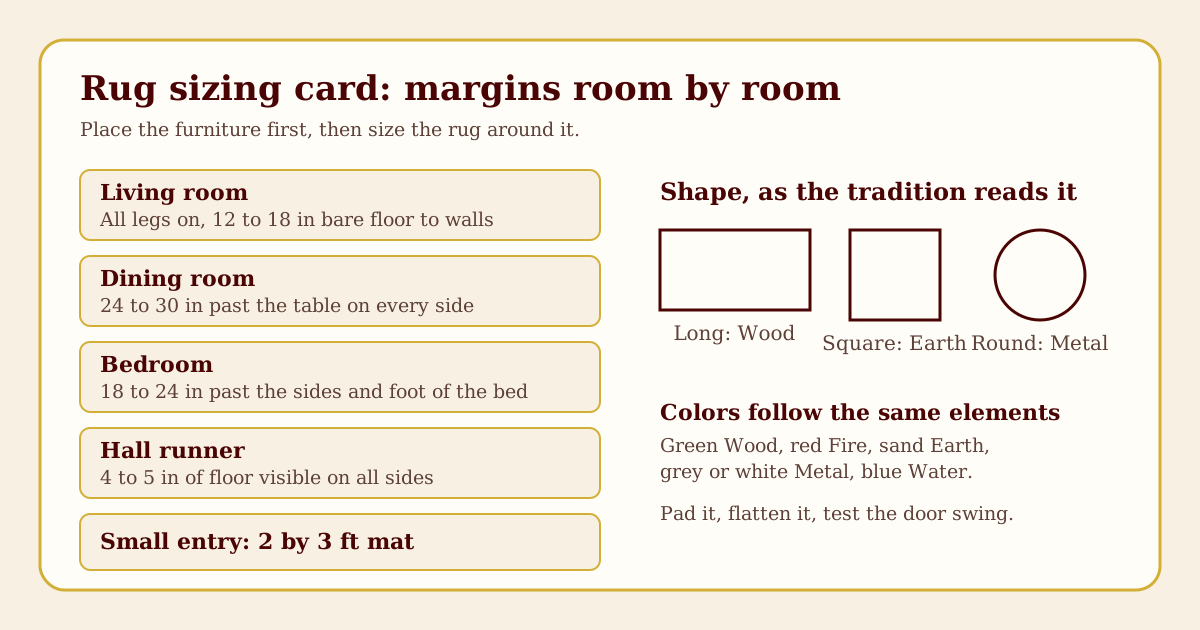
Size first: place the furniture, then measure for the rug
The most common rug mistake is buying one that is too small. A rug smaller than the furniture group looks like a bath mat dropped in the middle of the room, and in feng shui terms it fails the one job the tradition asks of it, which is to gather the group. Place the furniture first; the living room hub covers where the seating group sits, and the fireplace and TV layout guide covers which way it faces. The size rules below come from the This Old House rug sizing guide. Where it gives no number, we say so, and any planning figure of our own is labelled.
Living room: all legs on, front legs on, or floating
The guide describes three ways to place a rug under a seating group.
- All furniture on the rug. Choose a rug large enough for every piece, leaving 12 to 18 inches of floor around the perimeter of the room. This is the most formal look and the one that most clearly gathers the group.
- Front legs on the rug. A medium-sized rug that lets the front legs of all the seating rest on it. The back legs sit on the floor. The guide gives no inch figure for this layout.
- Floating. A rug that fits within the seating area, usually under the coffee table only. Again, no inch figure. It is the layout that most often looks too small.
The guide also gives three spacing figures: about 24 inches from the rug edge to the wall, 36 inches between the wall and the furniture, and 18 inches between the couch and the coffee table. Note that 24 inches sits outside the 12 to 18 inch perimeter it gives for the all-legs layout, so treat 12 to 24 inches of bare floor as the working band.
Worked room: a 14 by 16 foot living room. Inputs: one 84 inch sofa and two armchairs facing it across a coffee table, a group footprint of about 8 feet wide by 7 feet deep (96 by 84 inches), placed in the middle of the room. Goal: all legs on.
- Check the furniture first. The group leaves (192 − 96) ÷ 2 = 48 inches to each end wall and (168 − 84) ÷ 2 = 42 inches front and back. Both clear the guide's 36 inch wall-to-furniture figure.
- Largest rug the room allows. At the 12 to 18 inch perimeter: 192 − 24 = 168 inches down to 192 − 36 = 156 inches long, and 168 − 24 = 144 down to 168 − 36 = 132 inches wide, so about 13 to 14 feet by 11 to 12 feet. At the 24 inch figure: 192 − 48 = 144 inches by 168 − 48 = 120 inches, which is 12 by 10 feet.
- Smallest rug that holds every leg. Our own planning allowance, not the guide's, is about 6 inches of rug beyond the outermost legs on each side, so the legs do not sit on the edge: 96 + 12 = 108 inches by 84 + 12 = 96 inches, or 9 by 8 feet.
- Choice. A 9 by 12 foot rug (108 by 144 inches), run with the 12 foot side along the sofa, sits between the two limits. It leaves (192 − 144) ÷ 2 = 24 inches to each end wall and (168 − 108) ÷ 2 = 30 inches front and back, close to the guide's 24 inch figure.
- If the room were smaller and an 8 by 10 foot rug were the limit, switch to the front-legs-on layout instead of buying a 5 by 8 that sits in the middle of the group.
| Layout | Rule from the guide | Same room, same group | Common size that fits |
|---|---|---|---|
| All legs on | Every leg on the rug; 12 to 18 in of floor to the walls (about 24 in elsewhere in the guide) | Between about 9 by 8 ft and 12 by 10 ft | 9 by 12 ft |
| Front legs on | Front legs of all seating rest on the rug; no inch figure | Rug at least as wide as the sofa (7 ft) and deep enough to reach under the chair fronts | 8 by 10 ft |
| Floating | Rug fits within the seating area; no inch figure | Inside the ring of seats, wider than the coffee table | 5 by 8 ft |
Dining room: allow for the chair pull-out
The dining rule is the clearest. Measure the table and add 24 to 30 inches on all sides so a pulled-out chair stays on the rug; the rug should extend at least 24 inches past the table edge. For a table of length L and width W, that is (L + 48) by (W + 48) inches at the minimum and (L + 60) by (W + 60) inches at 30 inches.
Worked room: a 72 by 40 inch table seating six on a hard floor.
| Edge allowance | Rug length | Rug width | In feet |
|---|---|---|---|
| 24 in each side | 72 + 48 = 120 in | 40 + 48 = 88 in | 10 by about 7 ft 4 in |
| 30 in each side | 72 + 60 = 132 in | 40 + 60 = 100 in | 11 by about 8 ft 4 in |
An 8 by 10 foot rug (96 by 120 inches) gives (96 − 40) ÷ 2 = 28 inches on each long side and (120 − 72) ÷ 2 = 24 inches at each end. It just passes the minimum. A 9 by 12 foot rug (108 by 144 inches) gives 34 inches on the sides and 36 at the ends, which leaves room for chairs to be pushed back. An extension table needs the rug sized to its open length, not its closed length.
Choose a low pile or flatweave under a dining table, because chair legs catch on deep pile, and a mid-tone with a small pattern hides crumbs. The dining room layout guide covers where the table itself sits.
Bedroom: under the bed, at the foot, or beside it
For a rug under the bed, the guide recommends extending 18 to 24 inches past the sides and foot of the bed. In feng shui the bed is the anchor of the bedroom, and a rug under it reinforces that. The couples bedroom layout guide covers where the bed sits and why practitioners want a solid wall behind the headboard.
The widths below are the standard US nominal mattress widths, used as example inputs. Measure your own bed frame, which is often wider than the mattress.
| Bed | Width (input) | Rug width needed (18 to 24 in each side) | What a common size gives |
|---|---|---|---|
| Queen | 60 in | 60 + 36 = 96 in to 60 + 48 = 108 in | 8 by 10 ft: 96 in wide, exactly 18 in a side; 9 by 12 ft: 24 in a side |
| King | 76 in | 76 + 36 = 112 in to 76 + 48 = 124 in | 9 by 12 ft: (108 − 76) ÷ 2 = 16 in a side, 2 in short of the minimum on each side; 10 ft wide: 22 in a side |
Run the long side of the rug down the length of the bed so the extra length gives the 18 to 24 inches past the foot. The rule assumes the rug starts near the headboard; if bedside tables sit on the rug, it must reach under them too.
Worked room: a primary bedroom with a king bed. Inputs: king mattress 76 inches wide, bedside tables beside it, door on the hall side. A 9 by 12 foot rug is the size many people reach for, and on this bed it falls 2 inches short of the 18 inch minimum on each side, 4 inches in total. A 10 foot wide rug (120 inches) gives (120 − 76) ÷ 2 = 22 inches a side and passes. If a 10 foot wide rug does not fit the room, use two runners, one on each side of the bed, and a small rug at the foot. In each case check that the bedroom door still clears the pile and pad, and keep the first step out of bed on a backing that does not slide.
Hallway runner
A runner is sized by the hallway. The guide recommends 4 to 5 inches of floor visible on all sides. For a hall 36 inches wide and 120 inches long:
- Width: 36 − (2 × 4) = 28 inches at the 4 inch figure, or 36 − (2 × 5) = 26 inches at the 5 inch figure.
- Length: 120 − (2 × 4) = 112 inches, or 120 − (2 × 5) = 110 inches.
So a runner about 26 to 28 inches wide and 110 to 112 inches long (about 2 ft 2 in to 2 ft 4 in by 9 ft 2 in to 9 ft 4 in) suits that hall. Runners are not sold in every size, so choose the nearest size that is slightly smaller, not larger.
In feng shui a hall is a path, and the tradition's concern is that movement through it is easy and unobstructed. The hallway guide covers long corridors, narrow halls and how practitioners slow a fast straight line. A runner can help with that only if it lies flat, is secured, and does not catch a foot at the edge.
Entry mat and the door
The guide describes a 2 by 3 foot mat as ideal for small entryways and gives no clearance rule. The entryway guide for small condos covers the entry itself. For the mat, check three things. Swing: open the door fully and close it; a thick mat or heavy pile can stop an inward-opening door, so compare the gap under the door with the pile height. Location: size an inside mat to the walking path, not the whole floor. Backing: wet shoes make a smooth backing slide on tile or wood.
Advertisement
Decision table by room
| Room | Rug job | Size rule | Fiber that suits | Watch for |
|---|---|---|---|---|
| Living room | Gather the seating group | All legs on, with 12 to 24 in of floor to the walls; or front legs on | Wool, nylon, polyester | Coffee table catching on pile |
| Dining room | Hold table and chairs | Table plus 24 to 30 in each side | Low pile or flatweave; olefin | Chair legs half off the edge |
| Bedroom | Anchor the bed | 18 to 24 in past sides and foot | Wool, cotton | King width; a sliding bedside rug |
| Hall | Define the path | 4 to 5 in of floor visible all round | Nylon, olefin | Curling edges, grip |
| Entry | Receive guests, catch grit | 2 by 3 ft for a small entry | Olefin, nylon | Door swing, wet shoes |
Shape and color: what the tradition reads into a rug
Feng shui is a cultural and design tradition about how a home is arranged and used. It has several schools, and they treat floors and furnishings differently.
Form school practitioners look at how a room works: where you enter, where you sit, whether paths are clear. A rug there defines a zone, such as the sitting area or the place to stand at the door. That is why the sizing above matters to them as much as color does.
Compass school and Eight Mansions practitioners match colors and materials to the part of the home, so they may choose a rug whose color or shape belongs to a sector's element. Our five elements balancing guide lays out the cycles.
Black Sect or BTB practitioners lay a map over the floor plan from the front door and may treat a rug as a small way to add a missing element to an area. Folk custom gives rugs smaller roles: an entry mat to receive guests, a rug at the foot of the bed so the first step lands on something soft.
None of the schools makes a rug a source of money, health, love or luck, and this guide does not claim a color, shape or placement brings any of them.
Shape and the five elements
The five-element vocabulary used on this site gives each element a form: tall forms and vertical stripes for Wood, triangular forms for Fire, square forms and horizontal lines for Earth, round forms for Metal and wavy or irregular organic forms for Water. A rug has only a few possible outlines, so the translation is approximate:
| Rug shape | Element it is read as | How practitioners use it | Practical fit |
|---|---|---|---|
| Long rectangle | Wood (long, columnar) or Earth (flat, horizontal), depending on the teacher | Under a sofa group or along a hall | The default for most living rooms and hallways |
| Square | Earth (square, grounded) | Under a square dining table or in a small seating square | Works when the furniture group is itself close to square |
| Round or oval | Metal (round) | Under a round table or in a reading corner | Good where a rectangle would clip a round table or a chair's swing |
| Wavy or irregular organic edge | Water (flowing) | Accent rug, often in a bedroom or by a bath | Check that the edge is not a trip line |
| Pointed, triangular or strong zigzag pattern | Fire (angular) | Used sparingly as an accent | Rare as a whole rug; more often a pattern than an outline |
Teachers split on the plain rectangle: some read a long one as Wood, others read any flat rectangle as Earth because it lies horizontal. Pick one reading and apply it consistently, or let the furniture decide: a round table wants a round rug or a larger square one, a sofa set wants a rectangle wider than the sofa.
Color and the five elements
These are the colors this site's element guide lists for each element, repeated so the rug and the rest of the home agree. The color-by-room guide matches them to rooms.
| Element | Colors (as this site lists them) | Common rug choices |
|---|---|---|
| Wood | Green, teal, turquoise; natural wood, wicker | Muted green or teal rug; natural woven textures |
| Fire | Red, orange, purple, pink, magenta | A deep red or rust accent rug, in small doses |
| Earth | Beige, sand, terracotta, yellow | Sand, oatmeal and terracotta rugs; an easy neutral |
| Metal | White, grey, silver, gold, copper | Grey, cream or white rugs; thin metallic threads |
| Water | Blue, black | Navy, slate and charcoal rugs; deep blue patterns |
A rug is one of the largest blocks of color in a room and the one a renter can roll up and take along. It is also easy to get wrong, because it sets the tone for everything above it. Practitioners often use the productive cycle: if a south-facing room is described as Fire and feels overheated, some would add an Earth rug in sand or terracotta to soften it. That is optional. If a room is simply too red, the practical fix is to change the rug.
Pattern matters too. A large, high-contrast pattern reads as busy under a sofa, so low-contrast patterns suit bedrooms and living rooms, with a stronger statement saved for an entry or hall. In the worked rooms above, that points to a sand or warm grey rectangle for the living room (an Earth or Metal reading), a mid-tone for the dining room, and a soft muted green or sand under the king bed.
Fibers: what to buy for which room
Fiber decides how a rug wears, cleans and behaves around pets and children. The University of Georgia Extension fiber page is the source for the table below. It describes fibers in general, not rugs only, so treat its notes as guidance and defer to the rug's care label. Jute and sisal are not covered by the sources opened for this article, so no claims are made about them.
| Fiber | What the extension page says | Suits | Cautions |
|---|---|---|---|
| Wool | Absorbent; subject to attack by moths and carpet beetles unless treated; damaged by dry heat | Living rooms, bedrooms | Ask whether it is moth-treated; keep it away from heaters |
| Cotton | Durable and absorbent; susceptible to mildew; stains can set permanently if washed without pre-treating | Washable flatweaves for kitchens and bedrooms | Pre-treat spills before washing; dry it fully |
| Nylon | Extremely durable and strong; low moisture absorption; holds body oils; sensitive to strong sunlight; grays and yellows with age and poor care | Halls, landings, family rooms | Sunny spots; melts in heat |
| Polyester | Strong; resists abrasion, strong sunlight, moths and mildew; may pill and attract lint | Sunny rooms, children's rooms | Lint; melts if too hot |
| Olefin | Resists abrasion, stains and weathering; stains on olefin rugs usually blot away; major use is floor coverings | Entries, dining rooms, damp areas, homes with pets | Very heat sensitive and melts at relatively low temperatures |
For shopping, the care label matters more than the fiber name. Read it for spot-cleaning or professional cleaning, backing type and moth or mildew treatment. Some practitioners prefer natural fibers and read wool, cotton and plant fibers as Wood or Earth, but that is a symbolic preference. A synthetic rug you can clean beats a wool rug you cannot.
Advertisement
Safety: trips, slips and the federal flammability test
The National Institute on Aging page on falls and fractures states that a simple accident like tripping on a rug or slipping on a wet floor can change your life. The Centers for Disease Control and Prevention page on fall prevention advises getting rid of things you could trip over and improving lighting. Neither page, as opened for this article, gives a list of rug rules, so the points below are plain practice, not quotes from either agency.
- No rug should move when someone steps on it. Use a pad or a backing that grips the floor on every edge.
- Edges should lie flat. A curling corner is a trip line. Replace a rug that will not lie flat.
- Keep loose rugs off stairs. A loose runner on a stair, or a rug at the top or foot of one, is a fall risk; fix any stair covering securely or leave the stair bare.
- Think about older adults first. If an older adult lives in or visits the home, the safest choice is often no loose rug on the main route, or a thin rug with a firm pad, and a light on the bedside path.
- Keep each rug to one floor level. A rug across a threshold between floor levels creates a lip.
The mistakes we see most are the same ones that fail the tradition: a 5 by 8 under a sofa and two chairs, so the furniture rings the rug instead of sitting on it; a deep pile or thick pad that catches the door; no pad on a hard floor, so the rug slides and the edges curl; and a rug bought for its color alone that is too small or too deep to use. No element reading fixes any of those.
The federal carpet test. Under 16 CFR Part 1630, carpets and rugs are tested for surface flammability. The rule defines a carpet as a floor covering with one dimension greater than 6 feet and a surface area greater than 24 square feet, and says a rug means the same. It allows one-of-a-kind items, such as an antique, an Oriental or a hide, to be excluded from testing under conditions set by the Consumer Product Safety Commission. By that definition, a 5 by 8 foot rug (40 square feet, one side over 6 feet) is inside it. A 4 by 6 foot rug (exactly 24 square feet, no side over 6 feet) and a 2 by 3 foot mat (6 square feet) are not; Part 1630 refers to small carpets and rugs separately. A carpet treated with a fire retardant must be labelled with the letter "T". Ask the seller which federal standard a rug meets, and keep heaters, candles and fireplace sparks away from any rug.
Rentals and a buying checklist
Before you pay:
- Mark the size on the floor with painter's tape and live with it for a day.
- Measure the clearance under every door the rug will meet, and compare it with the pile plus pad.
- Read the care label for fiber, backing, cleaning method and moth or mildew treatment.
- Plan the pad: one slightly smaller than the rug on all edges, so it does not show.
- Ask about flammability for any rug over 6 feet on a side, and about a "T" label if it was treated.
- In a rental, keep to your lease. Some pads can mark floor finishes, so ask the landlord before using one. The renters' whole-home guide covers other changes that leave no trace.
Next step
Measure your main seating group and mark the rug size on the floor with tape. Then open the living room layout guide to confirm where that group sits in the room before you order, since moving the sofa later changes every number above.
Sources
- This Old House, rug sizing guide: rug sizes and clearances for living rooms, dining rooms, bedrooms, halls and entries, and wall and furniture spacing. Checked November 2026.
- U.S. eCFR, 16 CFR Part 1630, Standard for the Surface Flammability of Carpets and Rugs: definitions and size thresholds, the one-of-a-kind exclusion and the "T" label. Checked November 2026.
- University of Georgia Extension, Understand your fibers: wool, cotton, nylon, polyester and olefin properties. Checked November 2026.
- National Institute on Aging, falls and fractures in older adults: tripping on a rug as an accident that can change your life. Checked November 2026.
- Centers for Disease Control and Prevention, fall prevention: advice to remove tripping hazards and improve lighting. Checked November 2026.
- Five-element shapes and colors follow this site's own five elements balancing guide and colors by room guide, linked above.
Editorial note: This article presents feng shui as a cultural and design tradition for educational purposes. It does not predict outcomes, and no rug, color or placement is claimed to change health, money, relationships or luck. It does not replace building codes, your lease, the flooring or heating manufacturer's instructions, or advice from a qualified fall-prevention or safety professional.