
Buy a solid headboard, in wood or upholstered fabric, with no bars or open slats, bolted to the bed frame and tall enough to lean on when you sit up. That is where the practitioners we read agree. Then check what the tradition never mentions: your mattress warranty's slat rule, the room's side clearance, and the TSCA Title VI label on any frame made of MDF or particleboard.
Last checked: 17 November 2026
Key facts
- Headboard: solid and sturdy; rounded, curved or rectangular shapes; no bars or many perforations; attached mechanically to the bed, not only to the wall. (Anjie Cho, Holistic Spaces, 28 April 2019; Marie Diamond in Livingetc, 4 March 2025)
- Metal frames and open headboards: advised against for bedrooms by Amanda Sophia and Jan Cisek in Ideal Home (22 March 2026). Not every school agrees.
- Storage under the bed: Anjie Cho says beds with storage or drawers "aren't ideal"; Laura Morris lists bedding, seasonal clothing and towels as acceptable (Livingetc, 1 November 2023).
- Slats for Sealy, Stearns and Foster mattresses on a platform bed: at least 3 inches wide, no more than 4 inches apart; a center support and 5 to 6 legs for queen, king and California king (Tempur Sealy support page, updated 7 July 2026).
- Slats for a Purple mattress with no foundation: no more than 3.5 inches apart (Purple support page).
- Mattress sizes: queen 60 by 80 inches, king 76 by 80, California king 72 by 84; Casper suggests a 10 by 10 foot room at least for a queen and 12 by 12 for a king.
- Composite wood in frames: finished goods made in or imported into the U.S. after 22 March 2019 carry a label with the fabricator's name, the month and year made, and a TSCA Title VI compliance statement (U.S. EPA).
- Bunk beds: upper-bunk openings under 3.5 inches, guardrails on both sides above 30 inches, and a warning against children under 6 on the top bunk (U.S. CPSC federal standard, effective 2000).
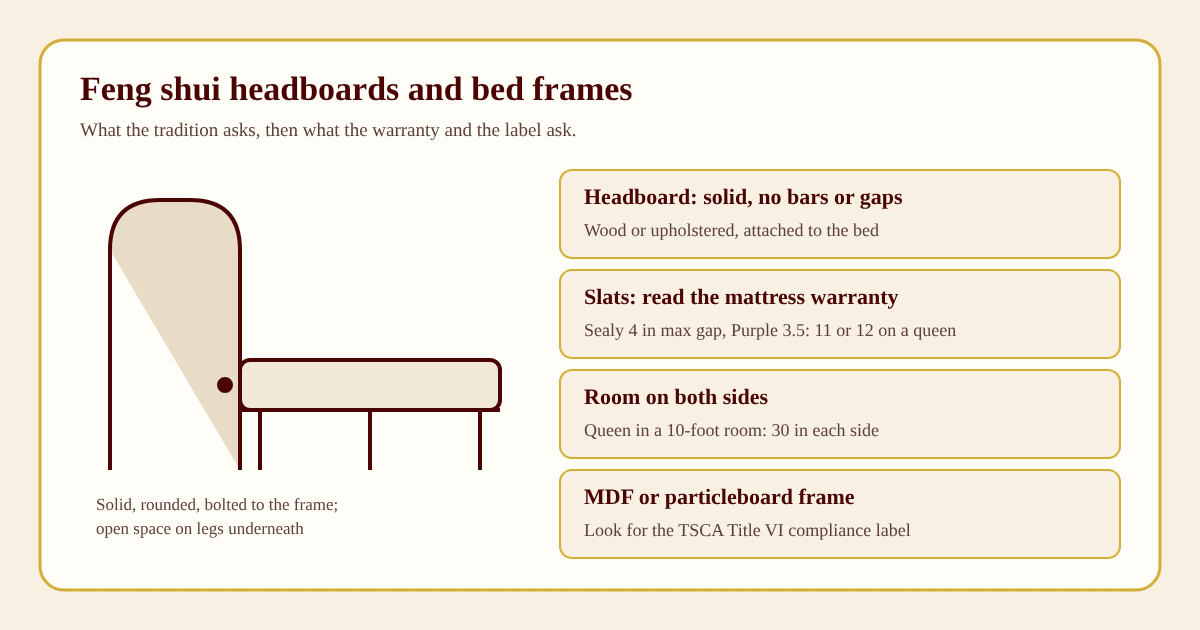
Shopping comes after placement. Where the bed goes, and which way your head points, is a separate question that our bed direction guide answers; decide the wall first, because it sets the width and height the headboard can have.
Decide in this order
Shoppers usually start with the look and find the problems at delivery. Working in the order below means each decision narrows the next one, and the tradition's asks are checked at the step where they cost nothing to meet.
1. Which wall, and how much room? Measure the wall the headboard will stand on and the room around it. The tradition wants space to walk on both sides of the bed (Anjie Cho suggests rearranging until there is), and that space is plain arithmetic. A queen is 60 inches wide. In a room 10 feet across (120 inches), a queen centered on the long wall leaves 60 inches, or 30 inches each side, before nightstands. A king is 76 inches wide; in a 12-foot room (144 inches) it leaves 68 inches, or 34 each side. A king in a 10-foot room leaves 44 inches, 22 per side, and one nightstand often takes most of that. If the numbers are tight, the size question is settled before you look at a single headboard.
2. Which mattress, and what does its warranty ask of the frame? The mattress you own or plan to buy decides how the frame must support it. Read the warranty's foundation section before you shop for the frame, not after. The rules differ by maker; the section on slats below shows two of them and what they mean in slat counts.
3. Frame type. Platform, frame on legs, storage drawers, adjustable base, canopy or bunk. Each has a tradition reading and a practical check, set out in the frame table further down.
4. Headboard. Solid, sturdy, attached to the frame, at a height you can lean on. Shape and material come last within this step, because the room has usually already chosen between a bulky upholstered panel and a slim wood one.
5. Color. Most practitioners want calm, earthy or soft tones near the head of the bed. Marie Diamond names beige, soft browns and warm grays, and pastels such as light yellow, peach and soft pink; Livingetc adds that loud colors are best avoided. Our bedroom colors and paint guide matches headboard fabric to the wall behind it.
Headboard types compared
Read across a row: the left half is what the tradition says, the right half is what to check in the store or on the listing. "Schools differ" means we found named practitioners on both sides.
| Headboard type | How practitioners read it | Where they disagree | What to check before buying |
|---|---|---|---|
| Solid wood panel | Solid support behind the sleeper; Marie Diamond calls wood grounding | None found in the sources above | Real wood or veneer over MDF; if composite, the TSCA Title VI label |
| Upholstered panel (fabric or leather) | Soft and supportive; Anjie Cho rates it about equal to solid wood, Diamond calls fabric grounding | None found in the sources above | Removable or cleanable cover; fabric color against the wall |
| Wingback or tall upholstered | Read like any solid upholstered headboard; our sources do not discuss wings | Not covered by the sources above | Wall height, and whether it blocks a window or switch |
| Rounded or curved | Named ideal by Marie Diamond and Anjie Cho | None found | Same as the panel it is made from |
| Metal with a solid panel | The panel solves the "bars" problem | Schools that dislike metal still dislike it | Bolts and brackets that match your frame |
| Metal bars, spindles or wrought iron | Bars read as confinement or instability (Cho, Diamond, Sophia, Cisek) | Most writers we read are against it | If you keep it, a fabric panel or cushion that covers the bars |
| Slatted or cane with open gaps | Gaps read as fragmented support (Cisek); Livingetc reports Diamond's view that slatted headboards are a major red flag | We found no source that accepts open gaps | How open the weave is; you should not see the wall through it |
| Shelf or bookcase headboard | Not covered by the sources above | Not covered by the sources above | Weight above the head; nothing that can fall in an earthquake region |
| Wall-mounted panel only | Anjie Cho: does not do the job, because it is not attached to the bed | None of the practitioners we read recommends one | Lease rules on drilling; whether it lines up when the bed moves |
| No headboard | Missing support; Jan Cisek calls a headboard essential | Anjie Cho, on floor mattresses: may be fine for people who move often or live in studios | A freestanding headboard that bolts to the existing frame |
Two patterns come out of the table. The tradition's objection is almost always about gaps and attachment, not material: a metal bed with a solid upholstered panel answers most of what practitioners raise, and a wooden headboard with wide slats does not. And the expensive options are not the ones the tradition prefers; a plain upholstered rectangle bolted to a basic frame meets every ask in the left column.
How tall should the headboard be?
None of the sources gives a height in inches, and we would not trust one that did, because mattress thickness and frame height vary so much. Marie Diamond's test is better: the headboard should be tall enough to support you when you sit up in bed. You can measure it at home. Sit on your current bed against the wall with a pillow at your lower back, and have someone mark the wall at the top of your shoulder blades. The headboard's top edge, once it is installed on your frame and mattress, should sit at or above that mark. If you are buying a new mattress at the same time, add the difference in thickness to the mark.
Advertisement
Bed frames: what the tradition asks, what the warranty asks
| Frame | Tradition reading | Practical check |
|---|---|---|
| Frame on legs, open underneath | Anjie Cho's preference: air and space under the sleeper | Center support and leg count for queen and larger (the Sealy rule asks for 5 to 6 legs) |
| Platform with slats | Fine when the space under it stays clear | Slat width and spacing from your mattress warranty |
| Storage bed with drawers | Not ideal, says Cho; acceptable with soft, neutral contents (Morris) | Drawer clearance from the nightstands; what you will actually store |
| Metal frame | Disliked by some schools; see the table above | Squeaks and loose bolts; rubber feet on hard floors |
| Canopy or four-poster | A fabric canopy is the traditional answer to a beam over the bed | Ceiling height; posts that block a door or window |
| Adjustable base | Not covered by the sources above | Whether a headboard bracket kit exists for your base |
| Bunk bed | Not covered by the sources above; safety rules come first | The federal bunk-bed requirements, below |
Slats: two warranty rules, worked out
A slat rule is easy to misread on a product listing, so here are the counts. We assume 3-inch slats, a slat run equal to the mattress length, and a gap at each end of the run; measure your own frame, because the inside length can differ by an inch or two.
- Sealy, Stearns and Foster (platform beds): slats at least 3 inches wide, gaps no more than 4 inches. On an 80-inch queen or king frame, 11 slats of 3 inches with 12 gaps gives 33 inches of slat and 47 inches of gap, which is 3.9 inches per gap. Ten slats would leave 50 inches across 11 gaps, 4.5 inches each, which is over the limit. So a queen frame needs at least 11 slats of that width.
- Purple (no foundation): gaps no more than 3.5 inches. Eleven slats leave 3.9-inch gaps, too wide. Twelve slats of 3 inches use 36 inches and leave 44 inches across 13 gaps, about 3.4 inches each. So a queen frame needs at least 12.
- California king: at 84 inches long, the same 3-inch slats need 12 for the Sealy rule (48 inches across 13 gaps, 3.7 each) and 13 for the Purple rule (45 inches across 14 gaps, 3.2 each).
Wider slats need fewer. The point is that a frame advertised with "10 sturdy slats" can fail one warranty and pass another, and the listing will not tell you which. Count them, or ask the seller for the gap width.
Storage beds and what goes under them
The tradition's worry about under-bed storage is clutter and stored energy close to the sleeper, and that is why the practitioners split. Anjie Cho would rather have open space and legs. Laura Morris accepts storage when what is in it is quiet: bedding, seasonal clothing, towels and neutral items without strong emotional attachment, and not exercise equipment or other active things. Anjie Cho also names books as too stimulating to keep under a bed.
A practical way to use both views: if the room has no other closet space, buy the storage bed, give each drawer one soft category (winter bedding, out-of-season clothes, spare towels), and keep paper, books, tools and anything you would label "sort later" elsewhere. Our decluttering guide has a room reset for the rest of the bedroom.
Footboards
None of the practitioners we read gives a rule on footboards, so treat it as a practical choice. A tall footboard holds a duvet in place and gives the bed a finished look, but in a short room it can block the walking route at the end of the bed and catch shins; a low footboard or none keeps the foot end open. Measure the walkway between the foot of the bed and the opposite wall or dresser before you choose one.
Canopy beds and beams
A canopy earns its place in one specific case: a beam across the ceiling over the bed. The fabric creates a flat plane between the sleeper and the beam. Our ceiling beams guide sets out the order of remedies, of which a canopy is the third. Before buying one, measure the ceiling height against the frame's height and check that a post will not land in front of a door or window.
Bunk beds and children's rooms
For a child's room, product safety rules come before any feng shui preference. Under the U.S. Consumer Product Safety Commission's federal bunk bed standard, in effect since 2000, a bed whose upper foundation is more than 30 inches off the floor needs guardrails on both sides, the openings on the upper bunk must be under 3.5 inches so a child's torso cannot pass, and the label and instructions warn against putting children under 6 on the top bunk. Our kids' bedroom guide covers where a child's bed goes once the frame is chosen.
The label on MDF and particleboard frames
Many headboards and frames sold flat-packed are made from medium-density fiberboard (MDF), particleboard or hardwood plywood. The U.S. Environmental Protection Agency regulates formaldehyde emissions from those panels under the Formaldehyde Standards for Composite Wood Products Act (TSCA Title VI), and the rule covers finished products made with them. The panel limits are 0.05 ppm for hardwood plywood, 0.09 ppm for particleboard, 0.11 ppm for MDF and 0.13 ppm for thin MDF.
What you can check as a buyer is the label. According to the EPA's consumer questions page, a finished good made in or imported into the U.S. after 22 March 2019 carries the fabricator's name, the month and year it was made, and a TSCA Title VI compliance statement. California's Air Resources Board requires its own label on each finished good or its box, with a statement referring to section 93120. If a frame's listing says "engineered wood" and the seller cannot tell you what the label says, that is a reason to ask before you buy, not after the box is open. Solid wood itself is not a regulated composite panel, but a frame sold as wood can still use plywood or MDF for the headboard panel or slats, so read the label either way.
Advertisement
Three shopping cases
A renter with a queen in a 10 by 10 foot room. The arithmetic gives 30 inches each side, so two slim nightstands fit and a wide upholstered wingback probably does not. No drilling is allowed. The plan that meets every ask: a metal or wood frame on legs with at least 11 slats (the mattress is a Sealy), and a freestanding upholstered headboard in a warm gray that bolts to the frame. It is solid, attached to the bed, and leaves with the renter. If the existing frame has a barred metal headboard, a fitted fabric headboard cover is the cheaper fix.
A couple in a small condo who need storage. The only closet is shallow, so a drawer bed is the realistic choice. They follow Laura Morris's list: one drawer of winter bedding, one of out-of-season clothes. The headboard is a solid, rounded upholstered panel, which Marie Diamond names as ideal. Because they sleep differently, they also read our bedroom layout guide for couples, which covers walking space on both sides and who sleeps by the wall.
A guest room under a sloped beam. The bed cannot move off the beam line, so the owner buys a four-poster with a fabric canopy rather than a plain frame, after checking that the posts clear the window. The headboard is part of the four-poster and solid, not spindled.
Where practitioners disagree, and what we make of it
Metal. Amanda Sophia advises against metal frames because she reads metal as active (yang) energy, and Marie Diamond calls metal headboards not ideal. Jan Cisek adds that metal beds amplify electromagnetic pollution. We found no measurement supporting the electromagnetic claim, so we treat the metal question as a style preference within some schools. What every source agrees on is the shape: bars behind the head are the problem, and a solid panel removes it whatever the frame is made of.
Storage. Anjie Cho and Laura Morris, both quoted in the same Livingetc piece, still land in different places, so the question has no single answer. Contents matter more than the drawer.
Wall-mounted headboards. The practitioners we read want the headboard attached to the bed. If you love a wall panel, mount it so it lines up exactly with the frame, and keep in mind that it stays behind if the bed direction changes.
None of this is a promise about sleep, relationships or luck. It is how one design tradition reads a bed, set beside the checks that make a bed work. For the rest of the room, our sleep environment guide covers light, noise and temperature, and the rug guide gives rug sizes for each bed size.
Sources
- Anjie Cho, Q&A Sunday: Feng shui and headboards (Holistic Spaces, 28 April 2019): solid, sturdy headboards; rounded shapes; wood and upholstered roughly equal; avoid bars and perforations; attach to the bed, not only the wall; space on both sides. Checked November 2026.
- Livingetc, 3 things that really matter when choosing your headboard (4 March 2025): Marie Diamond on wood or upholstered material, earthy and pastel colors, height to sit up against, rounded shapes, slatted headboards as a red flag; Anjie Cho on sturdiness. Checked November 2026.
- Ideal Home, bed frame styles to avoid (22 March 2026): Amanda Sophia and Jan Cisek on metal frames, bars and open headboards, and beds with no headboard. Checked November 2026.
- Livingetc, 4 items to never store under the bed (1 November 2023): Laura Morris on acceptable and active items; Anjie Cho on books, drawer beds and floor mattresses. Checked November 2026.
- Tempur Sealy, Approved support systems for Sealy, Stearns and Foster mattresses (updated 7 July 2026): slats at least 3 inches wide, no more than 4 inches apart; center support and 5 to 6 legs for queen and larger; 4 legs for twin and full. Checked November 2026.
- Purple, mattress foundation support article: slatted frames with no foundation need slats no more than 3.5 inches apart. Checked November 2026.
- Casper, Mattress sizes and bed dimensions: mattress dimensions and suggested minimum room sizes. Checked November 2026.
- U.S. EPA, Frequent questions for consumers about the Formaldehyde Standards for Composite Wood Products Act: covered panels and finished products, emission limits, panel labels after 22 March 2019. Checked November 2026.
- U.S. EPA, consumer questions on the TSCA Title VI final rule (revised 12 April 2018): finished-good labels with the fabricator's name, month and year made, and a TSCA Title VI compliance statement. Checked November 2026.
- California Air Resources Board, Frequently asked questions: labeling: a label on each finished good or its box, with the fabricator, date and a statement referring to section 93120. Checked November 2026.
- U.S. CPSC, CPSC issues federal safety standard for bunk beds (2 December 1999): guardrails on both sides above 30 inches, upper-bunk openings under 3.5 inches, warning against children under 6 on the upper bunk. Checked November 2026.