For a feng shui bedroom, choose calm colors from the earth family (sand, warm neutrals, soft clay) with muted wood greens in support, in a paint whose light reflectance value (LRV) sits roughly between 45 and 75, in a flat, matte or eggshell finish. Then test big swatches in your own light before buying. Tradition supplies the palette; the paint chip and the daylight decide the shade.
Last checked: 13 November 2026
| Key fact | Figure or rule | Source |
|---|---|---|
| LRV scale | 0 is absolute black, 100 is pure white; it is the percentage of light a painted surface reflects | Diamond Vogel |
| LRV and accessibility | The ADA Accessibility Guidelines recommend 70% or higher for people with impaired vision, but it is not a strict requirement | Diamond Vogel |
| Paint and solvents | Paints, varnishes and wax contain organic solvents that release compounds during use and, to a lesser degree, in storage | U.S. EPA |
| Painting and air | EPA advises maximum ventilation during painting; indoor VOC levels are often up to ten times higher than outdoors | U.S. EPA |
| Melatonin and light | The body does not produce melatonin during the day or in very bright light at night | NIEHS |
| Warm bulbs | Most ENERGY STAR bulbs made to match incandescent light are rated 2200 to 3000K; 5000 to 6500K reads bluer | ENERGY STAR |
| Five-phase colors | The Han dynasty was thought to rule under the red phase of fire; wood is linked to blue-green | Internet Encyclopedia of Philosophy |
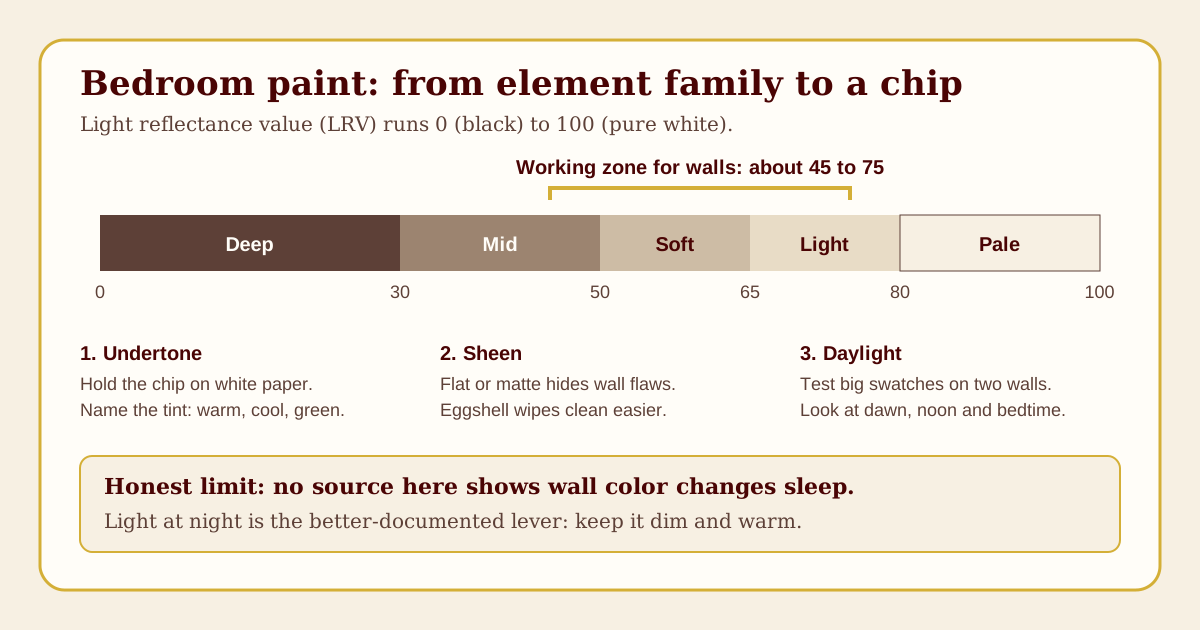
Most pages on this topic stop at color names: green for growth, blue for calm. That leaves you at the paint shop with hundreds of chips and no way to choose. This guide keeps the tradition short and attributed, then spends most of its length on what you can measure and test: reflectance, undertone, sheen, daylight, fumes, and getting the same palette without touching a wall.
This page is the bedroom spoke of our feng shui colors by room guide, which covers the whole home. It does not cover kitchens or exteriors in depth; those have their own pages, such as the kitchen colors and cabinets guide and the exterior house colors guide.
What the tradition says about bedroom color
The five phases (wuxing). Underneath most color advice sits the five-phase scheme: wood, fire, earth, metal and water. The Internet Encyclopedia of Philosophy entry on wuxing records the generating order (wood feeds fire, fire yields earth, earth yields metal, metal yields water, water nourishes wood) and the overcoming order (water douses fire, fire melts metal, metal cuts wood, wood parts earth, earth dams water). It also records that wood is correlated with blue-green, and that the Han dynasty was thought to rule under the red phase of fire. The passage we read does not tie all five colors to phases, so the full color table used below comes from later feng shui practice rather than from this source.
What this site uses. To stay consistent with our other pages, we use the same table as the five elements balancing guide and the colors-by-room hub. Wood is green and teal. Fire is red, orange, pink and purple, plus warm light. Earth is beige, sand, terracotta and yellow. Metal is white, grey, silver and gold. Water is blue and black.
What practitioners say about bedrooms. Our hub guide summarizes the common view: bedrooms rest, so the tradition favors earth and skin-tone palettes, with gentle wood greens in support, and keeps strong fire colors and bright water blues to small amounts because they stimulate or cool the room too much for sleep. Practitioners say this is dose, not prohibition: a red cushion is fine, a crimson wall usually is not.
Where schools differ. Form school practitioners start from the room itself: light, enclosure, the view from the bed. Compass school practitioners assign an element to each direction. Black Sect (BTB) practitioners work from the bagua laid over the floor plan. They can give different answers for the same room.
Feng shui is presented here as a cultural and design tradition. Nothing in it is a promise about love, money, health or sleep, and a paint color cannot deliver one.
What is actually established about color and sleep
We looked for evidence that the hue of a bedroom wall changes sleep quality and did not find a source we could open and cite. That does not prove there is no effect; it means this page will not claim one. Some people do find a room restful in a particular color, and that experience is real but personal.
What is better documented is light. The National Institute of Environmental Health Sciences (NIEHS) notes that light and dark patterns are the major synchronizers of our circadian rhythms, that the aim is as much light as possible by day and as little as possible at night, and that "we do not produce melatonin during the day or in very bright light at night." It adds that adolescents are more sensitive to evening blue light than middle-aged adults.
Two practical points follow for a bedroom:
- Paint interacts with lamps. A light wall bounces more lamp light around, so the same bulb makes the room brighter in the evening; a dark wall absorbs more. Choose bulbs and shades together with the paint.
- Bulb color temperature matters at bedtime. ENERGY STAR notes that most of its bulbs made to match incandescent light are rated 2200 to 3000K, with 3500 to 4100K whiter and 5000 to 6500K bluer. For a bedside lamp, the warm end of that range is the sensible choice. Our feng shui lighting guide goes further on layering lamps.
If better sleep is the goal, spend first on blackout lining and a dimmable warm bedside lamp, then choose paint for how it looks.
From element family to something you can buy
A color name is not a paint. Four measurable properties turn "earth family" into a chip.
LRV: how much light the wall hands back
Light reflectance value is the percentage of light a painted surface reflects. Diamond Vogel's technical page describes the scale as running from zero (absolute black, absorbing all light and heat) to 100 percent (pure white, reflecting all light). Professionals use it to predict how light or dark a color will appear and to work out how many light fixtures a room needs. The same page notes that higher-LRV colors generally need less artificial light.
For a bedroom this gives you a number to compare between brands, which names never do. Read the LRV printed on the chip back or the data sheet; if the maker does not publish it, treat that paint as a guess.
There is no official LRV range for a restful bedroom. These bands are a working sort used in this guide, not a standard:
| Band | LRV | What it tends to do in a bedroom |
|---|---|---|
| Deep | 0 to 30 | Cozy and enclosing; absorbs lamp light; best on one wall, a headboard wall or in bedding |
| Mid | 30 to 50 | Strong color presence; needs good daylight or more lamps; works for accent walls |
| Soft | 50 to 65 | Comfortable for a full room if you like a visible color |
| Light | 65 to 80 | Airy; reflects daylight and lamp light well |
| Pale | 80 to 100 | Bright and clean; can feel stark in cool north light |
Our working zone for walls is about 45 to 75. Below 45 the room usually needs more lamps and warm bulbs to feel soft at night. Above 75, a bedroom with a big south or west window can glare in the afternoon. If anyone has low vision, remember the ADA 70% recommendation, lean to the top of the band and ask a specialist about wall, door and floor contrast.
Undertone: the color hiding inside the color
Undertone is the faint tint under the main hue. A beige can lean pink, yellow or green; a grey can lean blue, violet or brown; a white can lean warm cream or cool blue. Undertone is what makes a color look "off" in your room when it looked right in the shop.
Hold the chip against plain white paper in daylight and name the tint in one word (rosy, yellow, green, blue, violet). Whatever you see will show up more on a whole wall. This is where feng shui and paint vocabulary meet: an "earth" beige with a green undertone reads as wood, and a "metal" grey with a blue undertone reads as water. Judge the felt color, not the label.
Sheen: why bedroom walls are usually flat, matte or eggshell
Sheen is how much light the surface reflects at an angle, separate from LRV. Flat and matte finishes scatter light and hide small flaws in the wall. Eggshell has a faint glow and is easier to wipe. Satin and gloss show every bump and every roller mark, which matters under a low bedside lamp that rakes light along the wall.
For most bedrooms: flat or matte on walls and ceiling, eggshell or satin on trim and doors that get touched, and eggshell on walls in a child's room that needs wiping. Check the data sheet for scrub resistance, since sheen names vary between makers, and test the chip in the sheen you plan to buy.
Advertisement
The decision table: color family to bedroom use
Use this table to move from the tradition's vocabulary to a shopping list. The LRV ranges are this guide's own working ranges for sorting chips, not measured or published figures; individual paints vary widely, so read the real number on the chip.
| Color family | Element in tradition | Working LRV range (this guide's sort) | Daylight it suits | Where to use it |
|---|---|---|---|---|
| Sand, warm greige, warm neutral | Earth | 55 to 75 | All, and most forgiving in north light | Main walls |
| Clay, terracotta, muted peach | Earth, leaning to soft fire | 30 to 55 | South and west rooms with strong light | One wall, headboard wall, bedding, curtains |
| Sage, celadon, muted green | Wood | 45 to 65 | East and south light | Main walls, or one wall with warm neutrals |
| Deep forest, olive | Wood | 10 to 30 | Bright south or west rooms | Accent wall, bedding, velvet headboard |
| Warm white, soft cream | Metal | 80 to 92 | North light, if the undertone is warm | Ceiling, trim, walls in small rooms |
| Light grey, stone | Metal | 45 to 70 | South and west light; can chill a north room | Walls, curtains, rugs |
| Mist blue, pale blue-grey | Water | 60 to 80 | South and west light | Walls in a hot-sleeper's room, bedding |
| Navy, ink, charcoal | Water | 3 to 20 | Bright rooms with several lamps | Bedding, headboard, curtains, one wall |
| Dusty rose, plum, mauve | Soft fire | 40 to 65 | Any, with warm lamp light | Bedding, cushions, lampshade, one wall |
| Red, orange, bright coral | Fire | 10 to 35 | Any, in small doses | Cushion, throw, art, one lampshade |
The traditional bedroom favorites are the first two rows plus the sage row; the rest are options accepted in measured doses. A practitioner from another school may file a color under a different element, and the "where to use" column assumes you can paint; the renter section translates it to fabric.
Daylight: why the same paint changes with the window
A paint color is a color plus whatever light lands on it. The same chip can look warm at noon, grey at dusk and different again under a lamp.
The patterns below are general tendencies for the northern hemisphere, offered as a starting point for your own swatch test, not as measurements from a cited source. In the southern hemisphere, swap north and south. Where the room has a tree, a neighbor's wall or a balcony shading the window, the shading beats the compass.
| Window faces | What the daylight tends to be | What it does to color | What to favor |
|---|---|---|---|
| North | Even, indirect and cooler | Greys and blues look colder; warm colors look muted | Warm undertones, LRV toward the top of the working band |
| South | Strong, warm and changing through the day | Colors look brighter and warmer; pale colors can glare | Cooler undertones, mid-range LRV, or a deeper accent |
| East | Warm and bright in the morning, neutral later | Colors look warm early and flatten by afternoon | Check the chip in the morning and again at dusk |
| West | Dim in the morning, warm and orange in the evening | Colors turn golden at sunset; the hour you are in the room | Test in the early evening; cool the room with a grey-green or soft blue |
If you use the compass method, the element for a direction may differ from the color that suits the light. A west bedroom is Metal in many compass schemes, which suggests white or grey, yet a cool white may look flat for most of the day. Treat the compass element as one input and the light as another. Our windows and curtains guide covers how coverings change the light entering the room.
Testing swatches properly
Buy sample pots, not chips, and paint two sheets of white board with two coats. Tape one to the window wall and one to a side wall, and look at them at early morning, midday and bedtime with your usual lamps on. Check the corner and ceiling line, and hold your bedding up against them. If you still like the color after lying in bed and looking at it for a few days, buy it.
Low-VOC paint and when you can sleep in the room
The U.S. EPA states that paints, varnishes and wax contain organic solvents, and that these can release organic compounds while you use the product and, to a lesser degree, while it is stored. It also reports that concentrations of many VOCs are consistently higher indoors, up to ten times higher, than outdoors. Possible effects include eye, nose and throat irritation, headaches, dizziness and nausea; the page adds that little is known about effects at the levels usually found in homes and that no federally enforceable VOC standards exist for non-industrial settings.
What this means in practice:
- Read the label, not the marketing. "Low-VOC" and "zero-VOC" are claims from the maker. The EPA page we read does not define them. Look at the VOC figure on the data sheet and any third-party certification the maker names, and remember that tinting colorant can add VOCs to a base labeled as low.
- Ventilate hard while painting. EPA advises maximum ventilation during painting and, for products that call for a well-ventilated area, opening windows as much as possible or using an exhaust fan.
- Keep the bedroom aired afterward. The label's recoat and cure times are the maker's; follow them. Times vary by product, so we give no hour count. If you can still smell the paint, sleep elsewhere.
- Do not store leftover paint in the bedroom. EPA warns that gases can leak even from closed containers and recommends buying only the quantity you will use soon.
- Take extra care for sensitive people. If someone in the home has asthma, is pregnant or is an infant, ask a doctor about timing. For a nursery or child's room, finish painting well ahead of the move-in date.
This is ordinary home safety, and it comes before any element argument.
Three bedrooms worked from tradition to paint can
The inputs below are illustrative, not real properties. They show how to move from the tradition to a purchase.
Worked bedroom 1: small north-facing rental
Inputs. A 3.0 by 3.6 m bedroom (about 10 by 12 ft; 10.8 square meters), ceiling 2.4 m, one window facing north, lease forbids painting, current walls a cool off-white.
Arithmetic. Wall area is the perimeter times height: 2 x (3.0 + 3.6) x 2.4 = 31.68 square meters, before subtracting door and window. That is a lot of wall you cannot change, so the plan works on soft surfaces.
The problem. North light is cooler and indirect, so a cool off-white can read as grey and a little flat. The tradition's bedroom favorites, earth and a touch of wood, are exactly what north light needs.
The plan.
- Bedding in warm sand or oat (earth), with one sage green throw (wood) at the foot.
- Lined curtains in a warm neutral, hung wide of the window so they uncover the glass by day.
- A bedside bulb in the 2200 to 3000K range with a fabric shade.
- One small fire accent: a terracotta lamp base or a rust cushion, not more.
- Peel-and-stick wallpaper only if the lease allows it, after a test patch behind the door.
What to check. The off-white wall will look different against warm bedding; hold the bedding up to it in daylight before buying all of it. Our renters whole-home guide lists more reversible changes.
Worked bedroom 2: large south-facing primary bedroom
Inputs. A 4.5 by 5.0 m bedroom (about 15 by 16.5 ft; 22.5 square meters), ceiling 2.6 m, two south windows, owner-occupied, a couple who sleep at different times, one a light sleeper.
Arithmetic. Wall area is 2 x (4.5 + 5.0) x 2.6 = 49.4 square meters, before subtracting openings. Painting a single wall, the 4.5 m headboard wall, is 4.5 x 2.6 = 11.7 square meters, about a quarter of the total.
The problem. South light is strong and warm, so a pale color can glare in the afternoon, and a warm color can feel hot. Two people may like different tones. The tradition suggests earth in the main, with fire only as a whisper for couples; this room can take more depth than a small one.
The plan.
- Main walls in a soft sage or a warm greige with an LRV in the 55 to 65 range (working band), in a matte finish.
- The headboard wall in a mid-to-deep clay or deep green (LRV 15 to 40), in the same matte finish.
- Bedding in the wall's neutral family, with a clay or plum accent each person can choose and change without a repaint. The couples bedroom layout guide covers the furniture side.
- Blackout liners on the south windows so the room goes dark at night.
- Bedside lamps at 2200 to 3000K, with a dimmer on at least the light sleeper's side.
What to check. Test the deep color board on the headboard wall and on the side wall; deep colors shift more with the angle of light than pale ones.
Worked bedroom 3: a child's room shared by two
Inputs. A 3.3 by 3.9 m room (about 11 by 13 ft; 12.87 square meters), ceiling 2.4 m, one east window, two children aged 6 and 9 on bunk beds, owners plan to repaint in a few years.
Arithmetic. Wall area is 2 x (3.3 + 3.9) x 2.4 = 34.56 square meters. Walls this size take wear, so a washable finish matters more than a subtle undertone.
The problem. Two children, two tastes, small space, hard wear, and an east window that wakes the room early. The tradition's guidance for children is wood and earth as the base, with the children themselves supplying the fire; our kids bedroom layout guide covers safety and the desk.
The plan.
- Walls in a soft green or warm neutral at an LRV of about 55 to 70 (working band), in eggshell so crayon and fingerprints wipe off. Confirm scrub resistance on the data sheet.
- Each child's zone gets its own color through a bedding set and a pinboard, not paint, so a color the older child outgrows costs a duvet cover and not a weekend.
- Blackout curtains or blinds on the east window if morning sun wakes them too early, with a night light that is amber and dim, not white.
- Paint well ahead of use, with the window open, and keep the children out until the smell has gone.
- No bold dark walls: a dark wall absorbs the lamp light a child reads by.
What to check. Bunk bed safety (guardrails, ladder, mattress fit) is a safety matter, not a feng shui one. Follow the manufacturer's instructions.
Advertisement
Colors for couples, and what to do when two people disagree
Searches for "feng shui colors for couples bedroom" usually expect a recipe for romance. Practitioners often suggest earth colors and pairs of objects for a couple's room; we treat that as design vocabulary, not a prediction about the relationship. In practice, separate the fixed from the changeable. Walls, ceiling and curtains are picked together from the soft earth or green families in the working band. Bedding, cushions, lampshades and art give each person their own say, within the same family. If one of you wants a dark, moody wall and the other pale and airy, a mid value (LRV near 45 to 55) on all walls, with the dark in the bedding and headboard, usually settles it.
Non-paint routes for renters and anyone who cannot repaint
Color works through area, so spend on size first: a large soft surface changes a room more than a small object.
| Item | What it can change | Checks before buying |
|---|---|---|
| Bedding (duvet, sheets, quilt) | The largest color block in the room | Sample the fabric in daylight; many fabrics look different when flat on a bed |
| Curtains | A big vertical color, plus light control | Lined or blackout if the room needs to go dark; hang them wide of the window |
| Headboard or cover | Frames the bed | Removable cover or freestanding headboard that does not fix to the wall |
| Large rug | Shifts the floor color and the room's warmth | Keep it flat and non-slip; check the size against the bed |
| Lampshade and bulb | The color of the evening light | Warm bulb, 2200 to 3000K; fabric shade that glows rather than glares |
| Framed art or a fabric panel | An accent color on the wall | Hang with removable hooks within the lease limit; never over a detector or vent |
| Peel-and-stick wallpaper | A full wall treatment | Only with landlord approval; test a small patch first |
Tell the landlord before trying anything that touches the wall.
Common mistakes
- Choosing from a screen or at noon. Use physical samples and check them under your bedside lamp.
- Ignoring undertone. A beige that looks pink in the shop looks pinker on four walls.
- Going dark in a small, dim room. Keep the walls light and put the depth into fabric.
- Buying a glossy finish. Gloss shows every wall flaw under a low lamp.
- Treating the element as the whole answer. A "metal" white that feels harsh at 3 am is the wrong white for you.
- Covering vents, detectors or exits with fabric or art. Safety comes before any palette.
What to look for when you choose
Read the LRV and say the undertone in one word. Pick the sheen before the color. Check the VOC figure on the data sheet and any certification the maker names, remembering that tinting colorant can add to it. Buy a sample pot, paint two boards, and test at three times of day, including bedtime. Choose warm 2200 to 3000K bulbs at the same time, and keep the tint formula for touch-ups.
Where to go next
Once the walls are settled, the next decision is where the bed sits; our feng shui bed direction guide explains how the tradition reads headboard direction and what to check before moving heavy furniture.
Sources
- Diamond Vogel: What is LRV, for the 0 to 100 definition of light reflectance value, its use in predicting how light or dark a color appears, and the ADA 70% recommendation for impaired vision. Checked November 2026.
- U.S. EPA: Volatile Organic Compounds' Impact on Indoor Air Quality, for paints and solvents, indoor versus outdoor levels, health effects, ventilation advice and the absence of federal standards for non-industrial settings. Checked November 2026.
- NIEHS: 4 health effects of light and dark, for light as a circadian cue, melatonin and light at night. Checked November 2026.
- ENERGY STAR: Color and Mood, for the 2200 to 3000K warm range and the 3500 to 4100K and 5000 to 6500K ranges. Checked November 2026.
- Internet Encyclopedia of Philosophy: Wuxing (Wu-hsing), for the generating and overcoming cycles and the recorded color associations of wood and fire. Checked November 2026.
Sources we wanted but could not open today: Sherwin-Williams LRV page (the site returned an error) and a CDC/NIOSH page on evening light (the page we reached did not contain the topic).
Editorial note: Lucky Properties presents feng shui as a cultural and design tradition. This guide is educational. It does not predict health, wealth, relationships or sleep outcomes, and it does not replace your lease, building rules, the paint maker's instructions, product safety guidance, or advice from a doctor or qualified professional.