Teachers disagree, and you can honestly go either way. One camp keeps plants out of the bedroom because a growing plant reads as active yang energy in a room meant for rest. The other allows one or two soft, healthy plants placed away from the bed. Pets, humidity and allergies should decide the practical part.
Last checked: 13 November 2026
| Key fact | Figure or rule | Source |
|---|---|---|
| Feng shui view of bedroom plants | No agreed rule: some teachers say none, others allow one or two healthy plants | Tradition (not a single authority); see section below |
| Air cleaning by potted plants | A 2019 review of about a dozen chamber studies found VOC removal far slower than normal building ventilation | Drexel University news release on Cummings and Waring |
| Plants needed to match ventilation | 100 to 1,000 per square meter of floor space | Drexel University news release |
| Indoor humidity to aim for | Below 60 percent, ideally 30 to 50 percent relative humidity | U.S. EPA |
| Low, medium and high indoor light | About 75, 150 and 300 foot-candles | University of Illinois Extension |
| Pet toxicity | Spider plant, parlor palm, Boston fern non-toxic; snake plant, pothos, peace lily, jade plant toxic to dogs and cats | ASPCA plant database |
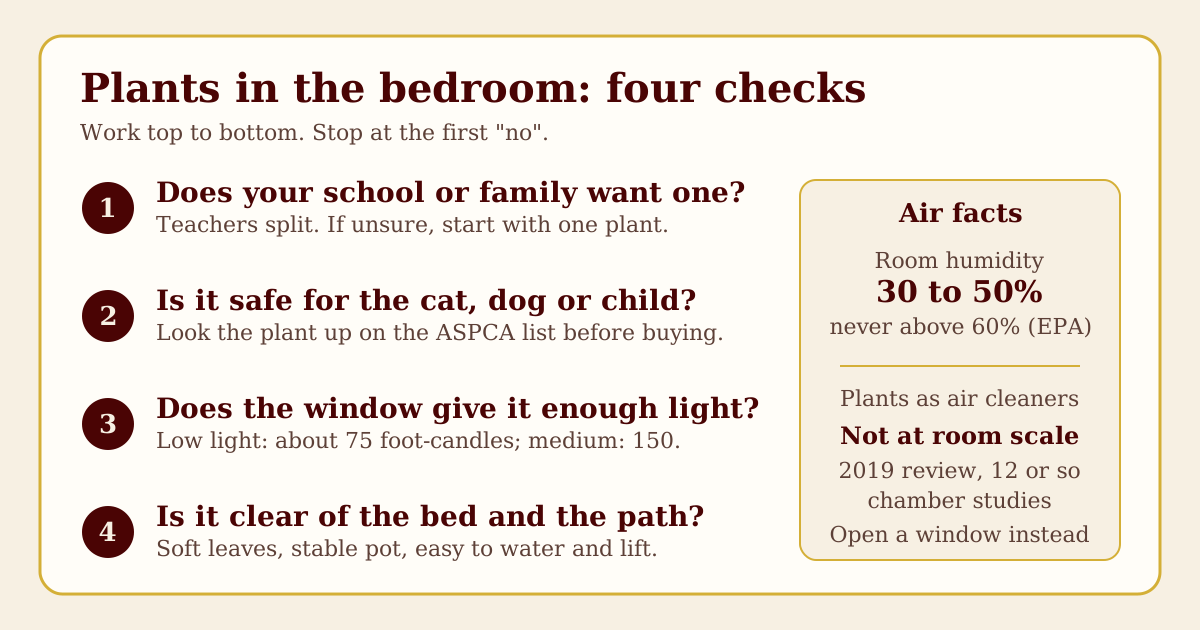
This guide takes the question in the order a buyer meets it. First what the tradition says, and where it splits. Then three factual claims that float around the topic and are easy to check: air cleaning, oxygen at night, and mold. After that, a table of plants you can check for pet safety, rules for placement and number, and three worked bedrooms with their inputs shown.
What the tradition says about plants in the bedroom
Feng shui is a cultural and design tradition, and it does not speak with one voice. On plants in the bedroom there are two broad positions.
The "keep it out" position. Practitioners who hold this view say the bedroom is a yin room: dark, quiet, still, for sleep and recovery. A living plant grows, reaches upward and is associated with the Wood element and yang activity. Placed in the sleeping room, tradition holds, it adds movement to a room that should be settling. Some teachers also point to a practical echo of this: plants need watering, trimming and light, which pulls household upkeep into the room where you rest.
The "one or two is fine" position. Other teachers accept a small number of healthy, soft-leaved plants, usually with conditions: away from the bed, not directly overhead, not crowding the route to the door, and never sick or dying. For these practitioners the objection is less to a plant than to a room that is crowded, damp or neglected. The site's own lucky plants guide describes the same split, and the plants by element guide treats the bedroom as a place to prioritize comfort, allergies and clear surfaces.
Who holds which view. Neither position belongs cleanly to one named school, and this guide does not pin either on a particular author. Both circulate among practitioners and in families. The shared ground is the condition rule: whatever you keep should be alive and cared for. Where a site or teacher gives you a flat "never" or a flat "always", treat it as that person's reading, not a settled rule.
A fair way to use this: if you or your family follow a school that keeps plants out, follow it, and put your plants in the living room or hall. If you follow no school and just like greenery, one carefully placed plant is within the more permissive reading and costs little to test.
Three factual claims, settled with sources
The bedroom plant debate drags in three claims that are not about feng shui at all. They are claims about air, oxygen and moisture, and they can be checked.
Claim 1: plants clean bedroom air
The origin is a pair of 1989 NASA technical memoranda. Wolverton, Douglas and Bounds, NASA-TM-108061 examined benzene, trichloroethylene and formaldehyde and concluded that plants could significantly help remove these organic chemicals. Wolverton, Johnson and Bounds, NASA-TM-101766 described a filter design that combines plants with an activated carbon bed. Those records are abstracts. They do not give, on the page we read, the measured removal rates or the test setup, so we do not quote numbers from them.
The effect for a normal room is a different question. A 2019 review by Cummings and Waring looked at about a dozen studies from roughly three decades and asked how fast plants removed volatile organic compounds compared with how fast buildings already swap their air. According to the Drexel University summary, removal in the chamber studies was "orders of magnitude slower than the standard rate of air exchange in a building." To match a building's air handling, or even a couple of open windows in a house, would take "100 and 1,000 plants per square meter of floor space." Natural ventilation "far outpaces plants."
Put that estimate in a bedroom with arithmetic you can check. A bedroom of 10 feet by 12 feet is 120 square feet, about 11.15 square meters (120 times 0.0929). At the review's 100 to 1,000 plants per square meter, matching the air exchange would take roughly 1,100 to 11,000 plants. That is a ventilation-equivalence comparison from the review, not a number anyone recommends you buy. Its point is scale: one pothos on the dresser does nothing measurable to the air.
Verdict: a plant is not an air purifier. If you want fresher bedroom air, ventilation does the work. That does not make a plant worthless as decoration or as something pleasant to tend. It means you should not buy one for its air.
Claim 2: plants use up oxygen or raise carbon dioxide at night
Plants do respire in the dark: they take in oxygen and give off carbon dioxide, and they stop making oxygen from light when it is dark. That is why the claim sounds plausible. This guide gives no figure for how much carbon dioxide a potted plant adds to a closed bedroom overnight, because we found no primary measurement to cite.
What we can say without a number is limited. A bedroom's air changes through leaks and any open window, and the people sleeping in it are the main source of exhaled carbon dioxide. The sensible reading is that the number of sleepers and the ventilation matter more than one or two potted plants. Treat that as our reading of the physics, not a quoted measurement. If you want to be certain for your room, the practical test is to open a window slightly and see whether you notice a difference. If a room feels stuffy, the fix is air, whether or not plants are present.
Claim 3: humidity and mold from overwatering
This is the claim with the most practical weight. The U.S. EPA says indoor relative humidity should be kept "below 60 percent (ideally between 30 and 50 percent)" and that "the key to mold control is moisture control" (EPA, A Brief Guide to Mold, Moisture and Your Home; EPA Mold Course Chapter 2). EPA also advises drying water-damaged areas and items within 24 to 48 hours and notes that relative humidity can be measured with a moisture or humidity meter (a hygrometer). The EPA guide does not mention houseplants. The link to plants is our inference: wet potting mix, saucers of standing water and spilled water on a windowsill are moisture, and moisture is what mold needs.
So the bedroom rules that follow from the EPA guidance are: water only when the plant needs it, empty saucers after a short time, wipe up spills, keep plants off damp window ledges where condensation forms, and put a cheap hygrometer in the room. If the reading sits above 60 percent, something other than a plant is probably the cause, but a plant that adds water to a damp room is not helping. Anyone with an allergy or asthma should treat a mold smell or visible growth on soil as a reason to remove the plant, not to move it two feet.
Advertisement
What shape and leaf tell you in the tradition
When practitioners read a plant, they usually look at leaf shape. The common contrast is rounded and soft against spiky and upright. Rounded leaves and arching, flowing foliage are generally read as calmer. Upright pointed leaves are read as more active, and some teachers advise keeping them away from the head of the bed or any seat, an idea the site's plants guide describes as a design observation and not a diagnosis. In a bedroom, where the aim is rest, the "calmer" reading is the one that tends to be recommended.
You do not need to accept the symbolism to use the shape rule. A plant with sharp leaf tips near the pillow can scratch a face or an eye if you lean into it, and a tall upright plant beside a bed can be knocked over. Soft foliage is more forgiving on a bedside surface for the same reason it reads as calmer: it is less likely to catch skin, clothing or bedding.
For the snake plant, which is upright, spiky and one of the most common bedroom recommendations on the internet, see the dedicated snake plant placement guide. For the money tree, lucky bamboo and jade, and what their stalk counts and gifts mean, see the lucky plants guide linked above. We do not repeat that here.
Bedroom plants compared: safety, light and leaf shape
The table below uses seven common houseplants. The toxicity column is from each plant's own entry in the ASPCA's toxic and non-toxic plant database, opened 13 November 2026. The botanical name shown is the currently accepted one, with the ASPCA's listing in brackets where it differs, so you can match a plant tag to the database. The leaf column is the traditional reading described above, plus the plain shape of the leaf. Plants not in the table, such as the ZZ plant or rubber plant, should be looked up on the ASPCA database before you buy.
| Plant | Botanical name | Cats and dogs (ASPCA) | Leaf shape and traditional reading |
|---|---|---|---|
| Spider plant | Chlorophytum comosum | Non-toxic to dogs and cats | Long, narrow, arching leaves; flowing, soft |
| Parlor palm | Chamaedorea elegans | Non-toxic to dogs and cats | Feathery, arching fronds; soft, upright growth |
| Boston fern | Nephrolepis exaltata 'Bostoniensis' (ASPCA lists Nephrolepis exalta bostoniensis) | Non-toxic to dogs and cats | Feathery, drooping fronds; soft |
| Pothos | Epipremnum aureum | Toxic to dogs and cats: insoluble calcium oxalates; mouth pain and swelling, drooling, vomiting, trouble swallowing | Heart-shaped leaves on trailing vines; rounded, flowing |
| Peace lily | Spathiphyllum | Toxic to dogs and cats: insoluble calcium oxalates; mouth burning, drooling, vomiting, trouble swallowing | Broad glossy leaves narrowing to a point; between rounded and pointed |
| Jade plant | Crassula ovata (ASPCA lists Crassula argentea) | Toxic to dogs and cats: principle unknown; vomiting, depression, incoordination | Thick, rounded, coin-like leaves; rounded |
| Snake plant | Dracaena trifasciata (ASPCA lists Sansevieria trifasciata) | Toxic to dogs and cats: saponins; nausea, vomiting, diarrhea | Upright, stiff, pointed blades; spiky |
Two notes on the table. First, plant tags still use older names: the snake plant is now classed in Dracaena but is often sold as Sansevieria, and jade is often labeled Crassula argentea. Search the database by common name as well as botanical name. Second, "non-toxic" on the ASPCA list does not mean a pet can eat as much as it likes; eating any plant material can still upset a stomach. It means the plant is not on the toxic list for that species. If a pet has eaten a toxic plant, the ASPCA gives its poison control line as (888) 426-4435, and a consultation fee may apply.
Light, size and watering: read the tag, then check against your window
Mature sizes and watering needs vary by variety and by how a plant is grown, so this guide does not list them as numbers. Use the plant tag or the seller's care sheet for mature height and spread, and do the measuring yourself with the rules below. What we can give you with a source is how to judge your light.
The University of Illinois Extension lighting guide defines low light as about 75 foot-candles, medium as about 150, high or bright as about 300 and direct as about 1,500. It then ties the levels to windows:
| Light level | North window | East or west window | South window |
|---|---|---|---|
| Low (about 75 fc) | A few feet away | 3 to 10 feet away | 15 to 20 feet away |
| Medium (about 150 fc) | Directly in front | A few feet away | 3 to 10 feet away |
| High (about 300 fc) | Not listed | Directly in front | Up to 5 feet away |
This is the most useful table for a bedroom, because beds are usually far from the window. A plant on a dresser 12 feet from a north window is well beyond the few feet the Illinois table gives for low light, and nothing on the tag will change that. Match the plant's stated light need to where you can actually put it, or skip the plant. A bedroom corner that gets no daylight does not suit a living plant, which is a point in favor of the traditions that leave bedroom plants out.
What to check before you pay
- Pet status. Look up the exact plant on the ASPCA database, not a lookalike. Names are confusing: a "lily" can be harmless or dangerous.
- Mature height. Measure the spot, then compare with the tag. A plant that reaches the ceiling above a bed is the wrong choice for tradition and for safety.
- Pot weight and stability. A tall plant in a light plastic pot tips easily. Choose a pot wider at the base than at the top.
- Drainage. A pot with a drainage hole and a saucer you can lift and empty is easier to keep from becoming a moisture source.
- Soil surface. Pass on a plant whose potting mix looks wet and smells musty, or shows white or green growth on the soil.
- Leaf condition. Yellowing, spotted or dropping leaves are a bad sign for any school of feng shui and for you.
Advertisement
Decision rules for the bedroom
No plant, one plant, or a few?
| Situation | Rule |
|---|---|
| Your school or family says no plants in the bedroom | Keep them out. Put them in the living room or hall. |
| You are unsure and want to try | One plant, soft leaves, in a spot with enough light. Live with it for a month. |
| Allergies, asthma or a musty smell | No plants, or one in a dry, ventilated room instead. |
| Room has little or no daylight | No living plant. A living plant needs light; see the Illinois table. |
| Cat or dog sleeps or roams there | Only plants the ASPCA lists as non-toxic, and secured pots. |
| Toddler in the room | See the child's room section below. |
Where to put the one plant
- Away from the bed. Practitioners who allow a plant generally say not directly overhead and not at the head of the bed. A spot near the window or in a far corner is the usual advice.
- Not on the route from the bed to the door. In the dark, a pot on the floor is a trip hazard.
- Not in front of a vent, radiator or air conditioner, where dry or cold air stresses it and where leaves and soil can drop onto the floor.
- Not on a high shelf above the bed. A falling pot is a real risk, and the tradition's objection to hanging weight over a sleeper points the same way. The bedroom sleep environment guide covers the larger layout questions.
How many is too many?
Tradition does not give a number, so use a rule you can test. For a small bedroom, one plant. For a large one, two or three at most. In all cases: none you cannot water without moving furniture, none whose leaves touch the bed, none that block a window you open for air, and none you would have to step around. If you find yourself adding another to fill a bare corner, that corner probably needs a lamp or a chair, not a plant. If your bedroom is awkward in shape, the awkward bedroom layout guide shows where furniture usually goes first.
Artificial and dried plants
Practitioners disagree. Many say an artificial plant lacks the living quality that a real plant stands for in the Wood element, and the plants-by-element guide on this site says the same while allowing a deliberate decorative use where nothing living would survive. Dried flowers and dead branches are the object most often advised against, because they read as lifeless. The plain practical point is dust: artificial and dried plants collect it, and a dusty bedroom is a worse place to sleep for anyone with allergies. If you use an artificial plant, choose a material that looks like what it is, wipe it often and do not use it to cover a damp, dark or unsafe corner.
A child's room
Be stricter here. Choose only plants the ASPCA lists as non-toxic if there is a pet, and keep every plant out of a toddler's reach, because a pot and potting mix are easy to pull over and put in a mouth. The ASPCA database covers pets, not children, so for a child's safety use your pediatrician or a poison control service. For layout see the nursery and child bedroom guide. In a baby's room, many families simply leave plants out until the child is older.
Allergies
Mold in damp soil is the main plant-related allergy risk in a bedroom. Keep the soil from staying wet, empty saucers, and use the EPA's 30 to 50 percent range as your target. If you wake congested and the plant is the only change, move it out for two weeks and compare. Pollen from flowering plants can also trouble some people, so a flowering plant is a bigger test than a foliage plant.
Pets
Cats climb, dogs chew and both knock pots over. Choose from the ASPCA non-toxic entries, use a heavy pot, and place it where the animal cannot reach it from a bed or chest. The pets and home layout guide goes through how animals change the placement choices in a home.
Three worked bedrooms
Each example states its inputs, applies the rules above, and ends with a plan. These are illustrations, not prescriptions.
Bedroom A: the small north-facing room with a cat
Inputs. A 10 by 12 foot bedroom (120 square feet, about 11 square meters). One north-facing window on the wall opposite the door. The bed is on the left wall, its head about 10 feet from the window. A cat sleeps on the bed. The owner follows no particular school and likes greenery.
Applying the rules.
- Light: a north window gives low light, about 75 foot-candles, only a few feet from the glass. Medium light, about 150, is "directly in front" of a north window. Anything at the bed end, 10 feet away, is far past the few feet the table gives for low light.
- Pet: the cat rules out pothos, peace lily, jade and snake plant. The ASPCA non-toxic entries are spider plant, parlor palm and Boston fern.
- Humidity: a small room with one window and a closed door can hold moisture. Add a hygrometer and keep to the EPA's 30 to 50 percent target.
- Tradition: one soft-leaved plant sits inside the permissive reading.
Plan. One parlor palm or spider plant in a heavy pot on a stand directly in front of the window, not near the bed. Do not add plants at the bed end: there is not enough light for them. The cat gets the window sill, so the plant stand needs to be stable.
Bedroom B: the large east-facing room with a couple who overwater
Inputs. A 12 by 14 foot room (168 square feet, about 15.6 square meters). An east window on one wall, and a second possible plant spot by the wardrobe, about 11 feet from the window. A couple with no pets. They have killed several plants by watering too often, and one of them wakes with a stuffy nose.
Applying the rules.
- Light: east windows reach medium light "a few feet away" and high light "directly in front" per the Illinois table. The wardrobe spot, about 11 feet away, is past even the 3 to 10 feet the table gives for low light.
- Air: the stuffy nose and the habit of overwatering together point at moisture and mold risk. The EPA guidance applies directly.
- Tradition: they follow a school that allows one or two plants but not more.
Plan. First, buy a hygrometer and read it for a week. If it sits above 60 percent, deal with that before adding plants. If it is within 30 to 50 percent, one plant by the east window is reasonable. Choose one that tolerates a dry spell, water only when the top of the soil is dry, empty the saucer after each watering and pull the plant out of the room if the nasal symptoms track with it. Do not put a second plant by the wardrobe; the tradition would allow it, but the light will not.
Bedroom C: the child's room, south window, toddler and a dog
Inputs. A 9 by 10 foot room (90 square feet, about 8.4 square meters). A south window. A two-year-old and a family dog who wanders in.
Applying the rules.
- Safety first: both a toddler and a dog are in reach, so any plant must be out of reach and not in the ASPCA's toxic list.
- Light: south windows give medium light 3 to 10 feet away and high light up to 5 feet away, so light is not the limit.
- Tradition: many teachers say less is better in a child's room, and the nursery guide treats the room as a place for rest and play first.
Plan. No plant in this room until the child is older. Put a spider plant, which the ASPCA lists as non-toxic to dogs and cats, in the living area in a hanging basket well above reach, or on a high shelf in a stable pot where the child cannot pull it down. The bedroom keeps its floor and surfaces clear. Revisit when the child understands "don't touch".
Advertisement
Common mistakes
- Buying for air quality. The research does not support it at room scale.
- Putting a plant where there is no light. A bed-end corner 10 feet from a north window is far past the few feet the Illinois table gives for low light.
- Ignoring the saucer. Standing water is a moisture source.
- Assuming "pet safe" means "pet proof". A non-toxic plant can still upset a stomach and a heavy pot can still fall on a paw.
- Crowding. A shelf of struggling plants breaks the one rule every school accepts.
- Following a rule without knowing whose it is. If a site tells you plants in the bedroom are always bad, treat it as one reading among several.
A short buyer's checklist
- Decide whether your school or family keeps plants out. If yes, stop.
- Pick a spot first, then measure its light against the Illinois table.
- Choose from plants you have checked on the ASPCA list if any pet or child is in the home.
- Choose soft foliage if the plant will be within reach of the bed.
- Buy a hygrometer. Aim for 30 to 50 percent and never above 60 percent.
- Use a stable pot with drainage and an empty-able saucer.
- Live with one plant for a month before adding another.
Next step
If you have settled the plant question and want to review the rest of the room, start with the bedroom sleep environment guide. It covers light, noise, bed position and clutter, which affect how a bedroom feels far more than a plant does.
Sources
- NASA NTRS, "A Study of Interior Landscape Plants for Indoor Air Pollution Abatement" (NASA-TM-108061, 1989) and NASA NTRS, "Interior Landscape Plants for Indoor Air Pollution Abatement" (NASA-TM-101766, 1989): abstracts for the 1989 plant studies. Checked November 2026.
- Drexel University, "Study: Actually, Potted Plants Don't Improve Air Quality" (2019): summary of the Cummings and Waring review, including the 100 to 1,000 plants per square meter comparison. Checked November 2026.
- U.S. EPA, A Brief Guide to Mold, Moisture and Your Home and EPA Mold Course Chapter 2: the 30 to 50 percent and below 60 percent humidity guidance, and the moisture-control principle. Checked November 2026.
- University of Illinois Extension, Houseplants: Lighting: foot-candle levels and window distances. Checked November 2026.
- ASPCA toxic and non-toxic plant entries, each opened November 2026: spider plant, parlor palm, Boston fern, pothos, peace lily, jade plant, snake plant. Checked November 2026.
Tradition claims in this article are attributed generally to practitioners and are not tied to a named book or guild. No figure is given for night-time carbon dioxide from plants, because no primary measurement was found to cite.
Editorial note: This article presents feng shui as a cultural and design tradition for education. It does not predict outcomes in health, sleep, money or relationships. The air, humidity and pet-safety sections are general information and do not replace advice from a doctor, a veterinarian, the ASPCA poison control line, a pediatrician, or your lease and building rules.