Short answer
In feng shui tradition, an aquarium belongs in the shared rooms of the house, most often the living room, placed in the north, east, or southeast sector, or near the front door without facing it head on. It does not belong, in the traditional reading, in a bedroom, a kitchen, a bathroom, or the south sector. The classic stocking is nine fish, eight gold or red and one black. The water should move, stay clean and oxygenated, and the tank should be lit and planted rather than bare.
Then the condition that outranks every one of those rules: the fish are alive. A tank is stocked for the adult size of its fish, on a stand and a floor that can carry water at one kilogram per litre, wired so water and electricity cannot meet, and maintained every week for the ten to fifteen years a goldfish can live. A placement that scores perfectly on the bagua and fails on any of those points is a bad placement in every system, including the traditional one, which has always read a neglected, murky tank as worse than no tank at all.
Why fish, of all things
The fish is one of the oldest prosperity symbols in Chinese visual culture, and the reason is a pun. The word for fish, yu (魚), is a homophone of the word for surplus and abundance, yu (餘), the word inside the New Year wish for abundance year after year. Carp appear on textiles, porcelain, and New Year pictures for centuries before anyone kept them in a glass box in the hall.
The aquarium adds a second layer to the symbol: the water itself, alive and moving. Practitioners draw a distinction between draining water, the water that leaves through sinks, baths, and toilets, and what teacher Kathryn Weber calls generating water, the water in ponds, streams, fountains, and tanks, which stays, circulates, and catches the light. A fountain gives you the second kind on its own, and this site's water feature placement guide covers fountains and bowls of still water. An aquarium is the version with residents, which is why it carries the strongest symbolism and also the longest list of obligations.
Nothing in this guide promises that a tank changes income, luck, or health. It reports where the tradition places the tank and what it counts, in the tradition's own terms, and it sets the fish-keeping facts beside the symbolism so a household can honour both at once.
Where tradition puts the tank
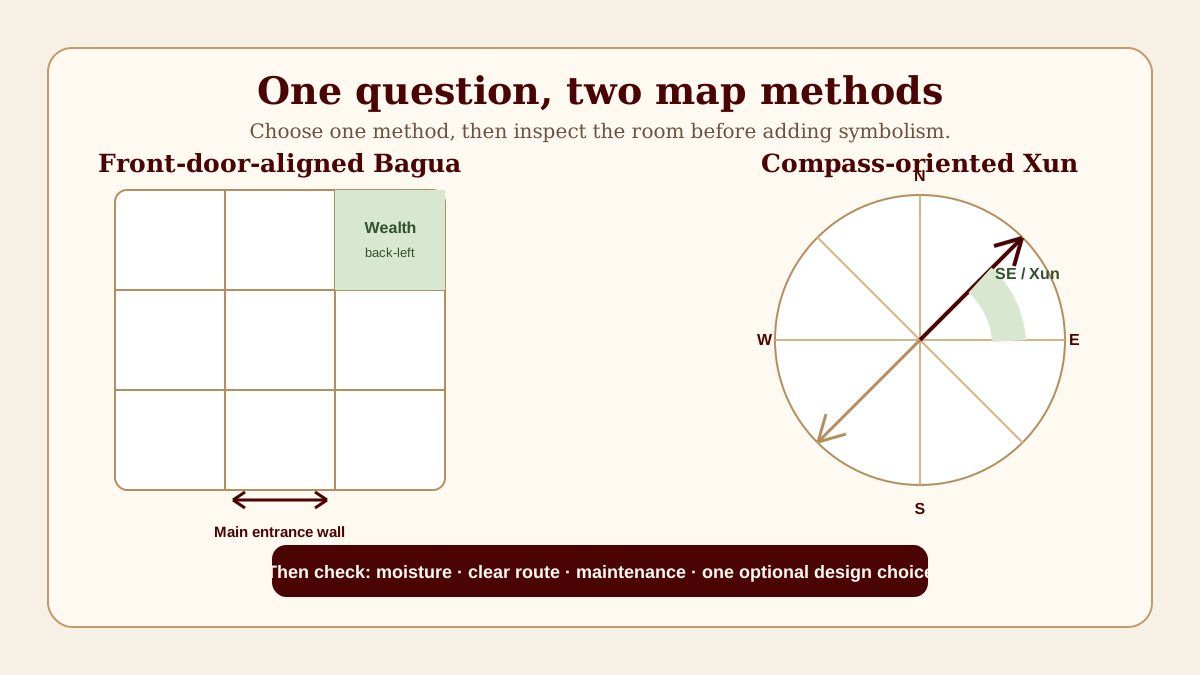
Two systems are in use, and a household should pick one and stay with it for the whole house. Compass school reads the actual directions of your home with a compass, the method in the compass reading guide. The BTB, or bagua-map, school aligns the map to the front door instead, the method in the bagua map room by room guide. The sector names below are the same in both. The wall they land on may differ, and mixing the two systems room by room produces a house that satisfies neither.
| Placement | Trigram and element | How tradition reads it | Practical notes |
|---|---|---|---|
| North sector | Kan, water | The water feature sits in water's own sector, read for career and life path. The least forced placement in the system. | Often the entrance hall or the front room. Check the floor first; halls carry tanks across several joists if the stand runs across them. |
| Southeast sector | Xun, wood | The bagua wealth area. Water feeds wood in the generating cycle, so a tank here is read as watering the wealth sector. | The most requested spot. Living room corners in the southeast frequently hold radiators or direct sun; both argue for the next wall along, same sector if possible. See the wealth corner guide. |
| East sector | Zhen, wood | Read for family and health, with the same water feeds wood logic as the southeast. | A dining or family room wall works well. Keep the tank out of the traffic line between door and table. |
| Near the front door | Sector varies | Water seen on arrival is read as the house receiving what comes in. Practitioners often suggest a tank in sight of the entrance. | Not directly facing the door at close range; one common reading holds that water facing straight out is read as flow leaving. Offset to one side. |
| Where the annual Water Star 1 sits | Changes yearly | Flying star practitioners sometimes place water where the auspicious Water Star 1 flies for the year. | An advanced, yearly-moving layer from the flying stars guide. A tank is heavy to move annually; most households skip this layer or use a small fountain for it instead. |
Height and background get a mention in most practitioner guidance. A tank reads best, in the traditional framing, where it can actually be seen: at seated or standing eye level in a room people use, against a plain wall, with the equipment hidden. A tank exiled to a corridor nobody enters is, symbolically and practically, a tank on its way to being neglected.
Where tradition keeps it out
| Placement | Traditional reading | The practical layer agrees, mostly |
|---|---|---|
| Bedroom | The sleeping room is yin and rest first. A lit, bubbling, moving tank is yang activity, and water in the bedroom is traditionally read as unsettling for rest and for relationships. | Pump hum, timer lights, raised humidity. Most people sleep worse next to a working tank. |
| Kitchen | The stove is the kitchen's fire. Tank water set against it is read as water dousing fire, a clash aimed at the room that represents household nourishment. | Steam, grease film on the water surface, heat swings, and cleaning chemicals stored nearby. The kitchen layout guide covers the stove side of this. |
| Bathroom | A draining-water room. Practitioners read a wealth symbol placed among drains and waste water as pointed the wrong way. | Humidity is constant, space is tight, and the room already has a water plan in this site's bathroom layout guide. |
| South sector | Li is the fire trigram. Water in the south is read as water against fire, the one sector where the element itself is out of place. | South walls in northern homes take the strongest sun. Direct sun overheats small tanks and grows algae, which the care guidance below warns against for separate reasons. |
| Under a beam or a staircase | Beams are read as pressing down on whatever sits under them, and the space under stairs is read as compressed and stagnant. | You also need headroom above a tank to lift the lid, siphon water, and catch a jumping fish's owner reaching in. The ceiling beams guide covers the beam reading in full. |
One disagreement to report plainly: entrance placement. Some teachers like a tank visible from the front door, others warn against a tank facing the door directly, and a few advise against water in the entry at all in small flats where it crowds the door swing. The tradition is a family of schools, not a building code, and this is one of the places the schools split.
Advertisement
How many fish: the count, and the cap on the count
The numbers carry meanings from the same number symbolism used across this site's number guides. Eight is the prosperity digit, tied to the fa homophone covered in the number 8 guide. Nine is the longevity digit, the largest single digit and a homophone of the word for long lasting, covered in the number 9 guide. Six is read as smooth flow. One is read as a single, focused statement, which is why the solitary arowana below is stocked at one.
| Count | How tradition reads it | What it means in a real stocking plan |
|---|---|---|
| 1 | Focus and singularity. The classic count for a single large feature fish. | One arowana, alone by temperament as much as by symbolism. A specialist setup, detailed below. |
| 2 | A pair. The double fish is the traditional emblem of a couple in harmony. | Two fish still need a full-size filtered tank. A pair of fancy goldfish at adult size is a 100 litre plus commitment, not a bowl. |
| 6 | Smoothness and flow, a quieter count used in offices and smaller tanks. | Six small community fish, guppies or similar, suit a mid-size tank better than six goldfish do. Species size decides, not the digit. |
| 8 | Prosperity, the fa association. | Eight gold or red fish is a large adult biomass. Plan the tank around the adults these juveniles become. |
| 9, as 8 gold plus 1 black | The full classic arrangement. Eight gold or red fish supply the bright yang of the group; the one black fish, classically a black moor, is the yin point, read as absorbing setbacks before they reach the household. | Nine adult goldfish is pond thinking. Nine small tropical fish in a suitably large, heated, filtered tank is the version most homes can actually run. |
Now the cap, stated as a rule of the guide: the count yields to the tank, every time. The RSPCA's goldfish guidance sets the floor. Traditional bowls are too small for goldfish and should be avoided; the minimum tank volume is 50 litres; the tank must be sized for the fish at adult size and for the total number kept; and fancy, egg-shaped varieties and slim, active varieties need space judged by their swimming, not by the price tag. Goldfish bought at five centimetres are juveniles of a fish that lives ten to fifteen years, and up to thirty in some varieties, and grows accordingly. Nine of them were never a desktop proposition, and practitioners who stock the classic nine usually do it with small community species, or in tanks of several hundred litres, or in ponds.
There is a sentence in the older feng shui literature that a dead fish has absorbed the household's misfortune. Read it alongside the care section below: a death is a water test first, and a symbol second.
Which fish households actually keep
Goldfish are the default: cheap, hardy by reputation, available everywhere, and the fish the eight and one arrangement was written around. The reputation undersells them. They are heavy feeders and high waste producers, they need efficient filtration and oxygenated water, and the fairground prize bag version of this fish is a welfare failure the tradition itself disowns, since a dull, gasping fish in green water is the opposite of the bright, moving water the symbolism asks for.
Small community fish are how most modern homes run the classic count. Guppies and similar small, colourful species are accepted by practitioners as fully valid for the symbolism (Weber's guidance says so in as many words), they stay small, and nine of them fit a mid-size heated tank with room to spare. Colour does the symbolic work: choose mostly gold, red, and orange fish and one dark fish, and the arrangement reads the same as the goldfish version.
Koi belong to ponds. They are the carp of the paintings, they are social, long lived, and they grow to a size that ends the indoor conversation for all but the largest installations. If the house has a pond, the pond version of this guide is the same placement table read outdoors, with the southeast and north of the garden as the usual candidates.
The arowana is the prestige exception. The Asian arowana's large metallic scales, upturned mouth, and chin barbels give it its dragon fish name, and across Southeast Asia it is kept as a living emblem of luck and wealth. The facts that travel with it: it grows to about 90 cm; it is territorial and kept singly; it jumps, so the tank needs a tight fitting cover; it eats meaty food and is a surface feeder; and it is an endangered species listed in CITES Appendix I, traded legally only as licensed, farm bred fish, each implanted with an identifying microchip. Rules differ by country, and possession by private citizens is prohibited in Florida and New Mexico. It is also, in the traditional framing, stocked in the north, alone, at a count of one. Households drawn to the dragon fish should read the care and the law before the symbolism.
One tank, five elements
Teachers often use a planted aquarium as the teaching example of a complete five element set in a single object, the same cycle set out in the five elements guide. Presented as the teaching device it is:
| Element | In the tank |
|---|---|
| Water | The water itself, moving and filtered |
| Wood | The live plants, and any driftwood |
| Earth | The gravel, sand, and stones of the substrate |
| Metal | The tank hardware and fittings, and the pale and white fish in some lists |
| Fire | The light above the tank, and the red and gold colouring of the fish |
Whether or not a household finds the mapping persuasive, the shopping list it produces is sound aquarium practice: live plants for cover and waste absorption, a real substrate, a proper light on a timer, and hardware sized to the tank. The RSPCA recommends roughly half the tank planted or covered so the fish have shelter, with open water left to swim in, which is also, not coincidentally, the composition that looks like the paintings.
The weight, wiring, and sunlight layer
A litre of water weighs one kilogram. That single fact does more placement work than any sector table, because it converts tank shopping into floor arithmetic.
| Tank volume | Water alone weighs | Before you add |
|---|---|---|
| 60 litres | 60 kg | Glass, substrate, rocks, stand, lights, filter |
| 120 litres | 120 kg | The same list, in larger sizes |
| 200 litres | 200 kg | A filled setup at this size passes the weight of three adults standing in one spot |
| 300 litres | 300 kg | Ground floor or a checked structure is the sensible default |
Working rules that follow from the arithmetic. Use a stand built for aquariums and rated for the filled weight; ordinary furniture is not rated for a permanent load of this size and moisture warps it besides. The setup must be level, because an unlevel tank loads its seams unevenly. On a timber floor, run the stand across the joists rather than along them, so several joists share the load, and put large tanks against a load-bearing wall. Renters should check the lease: many ban large tanks outright, and a 200 litre spill is a damage deposit argument nobody wins.
Electricity gets two habits. Fit a drip loop, a downward loop in every cable below the outlet, so water travelling along a cord drips off the loop instead of running into the socket. Plug the tank's equipment into a ground fault protected outlet (a GFCI in North America, an RCD in much of the rest of the world), the standard protection wherever water and mains power share a cabinet. Both habits are cheap, permanent, and entirely unglamorous, which is the usual shape of the safety advice that matters.
Sunlight is the third constraint, and here tradition and care quietly agree. Keep the tank out of direct sun: the RSPCA advises keeping aquariums away from direct sunlight and windows to limit algae and heat swings, with tank lights on for a maximum of ten hours a day and at least eight hours of darkness at night. The south wall the tradition warns against is, in a northern hemisphere home, usually the sunniest wall in the room.
Care is the maintenance clause of the symbolism
Every practitioner source on this page says some version of the same sentence: a dirty tank reverses the reading. Cloudy water, a clogged filter, and listless fish are described in the tradition as stagnant energy, and in the care literature as a tank failing its animals. Both descriptions prescribe the same week:
- Filtration and air, always on. Goldfish and most community fish need filtered, oxygenated water around the clock. The belief that a goldfish thrives in an unfiltered bowl is a fallacy in the care guidance and a stagnant-water failure in the tradition.
- Weekly partial water changes of 10 to 25 per cent, with a gravel clean, per the RSPCA schedule, replacing with conditioned water at room temperature.
- Water testing while the tank is young. Test ammonia and nitrite every two to three days for the first six weeks while the nitrogen cycle establishes, then every one to two weeks. Goldfish water targets from the same guidance: ammonia under 0.1 ppm, nitrite under 0.2 ppm, nitrate under 50 ppm, pH 6.5 to 7.5, temperature 20 to 24 degrees C.
- Feeding restraint. Once a day, only what the fish finish in under two minutes. Overfeeding is the most common goldfish health problem in the RSPCA's account, and uneaten food fouls the water the symbolism wants clear.
Framed traditionally, maintenance is not separate from the feng shui of the tank. It is the feng shui of the tank, repeated weekly.
A worked example, labelled as one
Hypothetical: a two bedroom flat, living room with a southeast corner that holds the radiator and the room's only full sun window. The household wants the classic nine.
The sector table says southeast first. The room says the southeast corner will cook a tank by midsummer and the stand would sit against a heat source. So the tank moves one wall along to the east sector, the family and growth area with the same water feeds wood reading, against an interior wall, out of the sun line, on a stand running across the joists, four metres from the kitchen door and out of the bedroom entirely.
Stocking follows the cap, not the wish. At 120 litres, nine adult goldfish fail the adult size test, so the classic count is run with small fish instead: eight red and gold guppies and one black molly as the dark point, in a heated, filtered, planted tank. The arrangement, the colours, and the count all match the traditional recipe. The species changed because the room and the volume said so, and that trade is the whole method of this guide in miniature.
Pre-purchase checklist
- Pick your system, compass or bagua map, and mark the north, east, and southeast of the living room on it.
- Strike the rooms tradition excludes and physics dislikes: bedroom, kitchen, bathroom, the sun-blasted south wall, anywhere under a beam you cannot work above.
- Choose the tank size from the fish's adult size and your intended count, using 50 litres as the goldfish floor, not the target.
- Do the weight sum, water at one kilogram per litre plus glass, substrate, and stand, and confirm the stand, the floor, the joist direction, and, if you rent, the lease.
- Confirm the electrics: an outlet in reach, drip loops possible, ground fault protection fitted.
- Buy the tank, stand, filter, and light before any fish. Fill, plant, and cycle the tank, testing through the first six weeks.
- Stock to the count the volume supports, in the classic colours if the tradition matters to you: golds and reds, one black.
- Put the weekly change and the water test on the calendar with dates, not intentions. Ten to fifteen years is the commitment a goldfish represents.
Limits
Three limits keep this in proportion. First, the symbolism is a tradition, reported here as one. No placement in this guide has been shown to change income, health, or luck, and a household that skips the tank entirely loses nothing measurable. Second, the schools disagree at the edges, on entrance placement most of all, and any teacher who presents one arrangement as compulsory is selling certainty the tradition itself does not contain. Third, where the tradition and the animals point in different directions, the animals win, on stocking, on tank size, and on the bowl. The tradition's own sources support that ordering: they ask for bright, healthy, well kept fish, and a symbol that depends on the fish thriving cannot be served by keeping them badly.
For construction, structural, or electrical work beyond a plug and a stand, use qualified trades. Floor capacity questions on older homes belong to a structural engineer, and large or restricted species belong to local law before they belong to a shopping list.
Sources and further reading
- Aquarium placement, the eight gold and one black count, generating water, and the rooms to avoid (Kathryn Weber, Red Lotus Letter): redlotusletter.com
- Fish symbolism, the yu abundance pun, the double fish, the north sector, and fish as shock absorbers (Red Lotus Letter): redlotusletter.com
- Goldfish tank minimums, adult size planning, bowls, water parameters, cycling tests, filtration, and weekly water changes (RSPCA Knowledgebase, updated 2025-10-22): kb.rspca.org.au
- Asian arowana adult size, territorial keeping, tight cover, temperature, CITES Appendix I status, and farm microchipping (Wikipedia, read this run): en.wikipedia.org
- Water weight arithmetic and across-the-joists positioning (The Aquarium Wiki, weight of water): theaquariumwiki.com