Mastery • The Blueprint of Harmony

    The Five Elements (Wu Xing)

    Understanding the cycles of creation and destruction to unlock abundance, health, and harmonious living.

    Last Updated: March 24, 2026

    The philosophy of the **Five Elements**, known as *Wu Xing* in Chinese, is not merely a collection of physical substances but a profound metaphysical framework describing the cycles of growth, transformation, and decay that govern all existence. From the movement of the stars to financial markets and real estate values, the Five Elements serve as the invisible architecture of our reality.

    The Cycle of Creation and Destruction

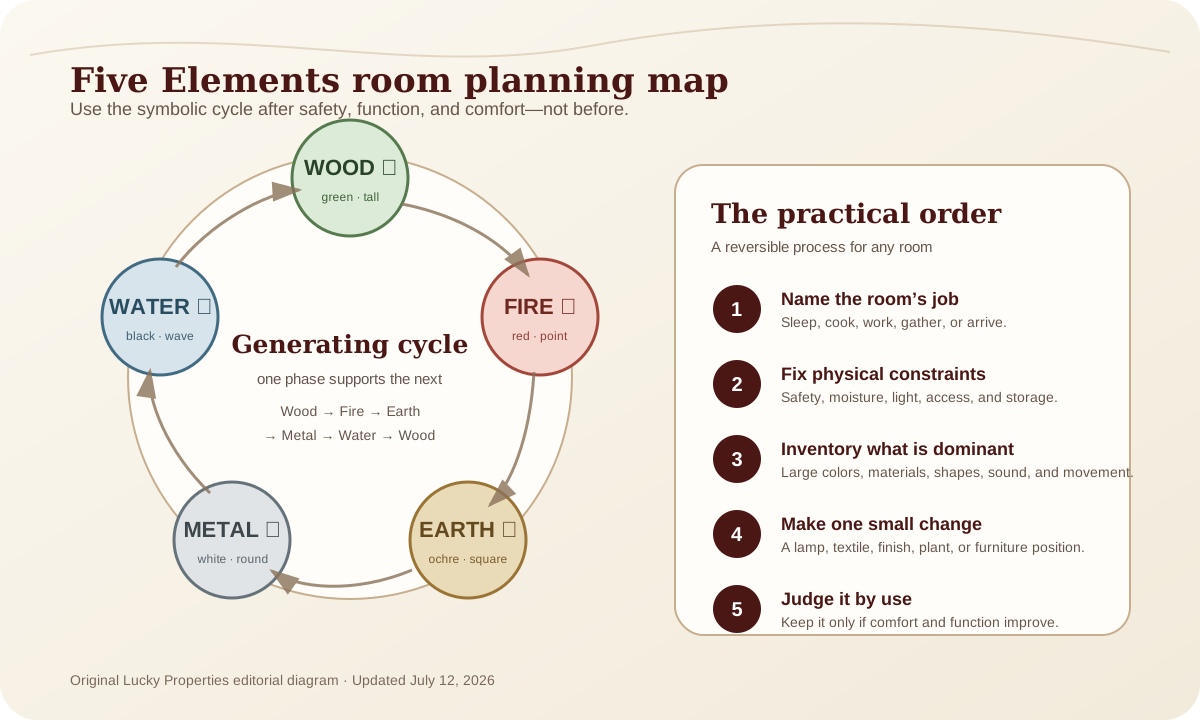
    Energy moves in predictable patterns. There are two primary cycles: the **Generating Cycle** (*Sheng*), where one element nourishes the next, and the **Overcoming Cycle** (*Ke*), where one element controls another.

    • Wood
      Fire
    • Fire
      Earth
    • Earth
      Metal
    • Metal
      Water
    • Water
      Wood

    The Five Elements in Real Estate

    Wood (Mu)

    Wood represents rising energy, growth, and expansion. It corresponds to spring, the morning, and the east. It is the energy of new beginnings, creativity, and career advancement.

    🏠Real Estate & Strategy

    Wood properties are very tall, slender buildings (skyscrapers), or homes surrounded by lush greenery. Use Wood energy to boost vitality and kickstart new projects. However, too much Wood can cause stress and aggressive competition.

    Fire (Huo)

    Fire is the peak of energy—passionate, visible, and dynamic. It corresponds to summer, noon, and the south. It governs fame, reputation, and social status.

    🏠Real Estate & Strategy

    Fire buildings are angular, pointed, or have triangular roofs. Brightly lit spaces and areas of high activity (kitchens, living rooms) are Fire zones. Essential for visibility and recognition, but excess Fire creates burnout and conflict.

    Earth (Tu)

    Earth is grounding, stabilizing, and nurturing. It corresponds to the changing of seasons, the afternoon, and the center/northeast/southwest. It governs trust, stability, and health.

    🏠Real Estate & Strategy

    Earth buildings are square, flat-roofed, and low-rise. They represent stability and permanence. Earth energy is crucial for long-term asset retention and family harmony. Excess Earth leads to stagnation and stubbornness.

    Metal (Jin)

    Metal is the energy of contraction, refinement, and clarity. It corresponds to autumn, the evening, and the west. Metal is not just cold steel; it is the gemstone refined from the rock, the precise logic that cuts through confusion.

    🏠Real Estate & Strategy

    Metal buildings are often round, domed, or arched. They embody prestige and financial power. Metal energy in a home encourages discipline and clarity but too much can create a 'sterile' environment.

    Water (Shui)

    Water is the element of stillness, depth, and flow. It represents winter, night, and the north. It governs wisdom, intuition, communication, and the flow of money (liquidity).

    🏠Real Estate & Strategy

    Water structures are irregular, wavy, or glass-heavy. They promote the flow of ideas and social interaction. Water features are powerful wealth activators, but must be stabilized by Earth to prevent wealth from flowing away.

    Interplay and Balance

    No element works in isolation. An excess of one invariably leads to the deficiency of another. A master Feng Shui practitioner does not simply "add more luck"; they diagnose the elemental chart of a property or a person and introduce the necessary correctives.

    By understanding these five archetypes, you gain the power to read the environment around you. You stop seeing just "decor" and start seeing "energy." You begin to understand why you feel calm in one room and agitated in another.

    "To align with the elements is to swim with the current of the universe."

    Five Elements FAQ

    Common questions about Five Elements theory and application