There is no single best floor or unit number for feng shui, because the number traditions disagree with each other: a unit can read well by digit sum and poorly by sound. Use the numbers as a tie-breaker between homes that already pass the practical checks (sun, view, noise, lift wait, exits, resale). This is part of our house numbers guide.
Last checked: 17 November 2026
| Key fact | Figure or rule | Source |
|---|---|---|
| Vancouver floor numbering | Since about 2015 the city does not allow new buildings to skip floor numbers; its chief building official called the aim life safety | Daily Hive; Urban Toronto |
| Chengdu price study | Resale apartments on floors ending in 8 sold for about 235 RMB more per square metre and 6.9 days faster; no premium for new units | Shum, Sun and Ye (2014) |
| Singapore address format | #floor-unit, so #12-05 is unit 5 on floor 12 | ParcelPath |
| Floor 13 sales, St Petersburg | 54.9% of 13th-floor apartments sold, against 64.8% on floor 12 and 61.8% on floor 14 (new builds, November 2014 data) | Antipov and Pokryshevskaya (2015) |
| Ladder reach (New Zealand) | Type 4 hydraulic ladders reach about 17 m, aerials about 22 m | BRANZ |
On this page
- The question behind the search
- Worked example: #11-167, #12-167 and #13-167
- How to read a Singapore-style unit number
- Buildings with no 4th, 13th or 14th floor
- What research found on floor numbers and prices
- Low, mid or high floor: the practical table
- Checks that matter more than the number
- Common mistakes
- FAQ
- Where to go next
- Sources
The question behind the search
People ask this in two forms: which floor, and which unit number. Floor numbers are shared by everyone on the level, while the unit number is yours alone. Number traditions apply to both, and they do not agree. Cantonese sound plays on 4, 8 and 9 and Mandarin plays on the same digits differently, so a "good" number in one dialect can be neutral in another. Our house number guide explains the main methods and the guide to the number 4 covers why it is avoided.
Worked example: #11-167, #12-167 and #13-167
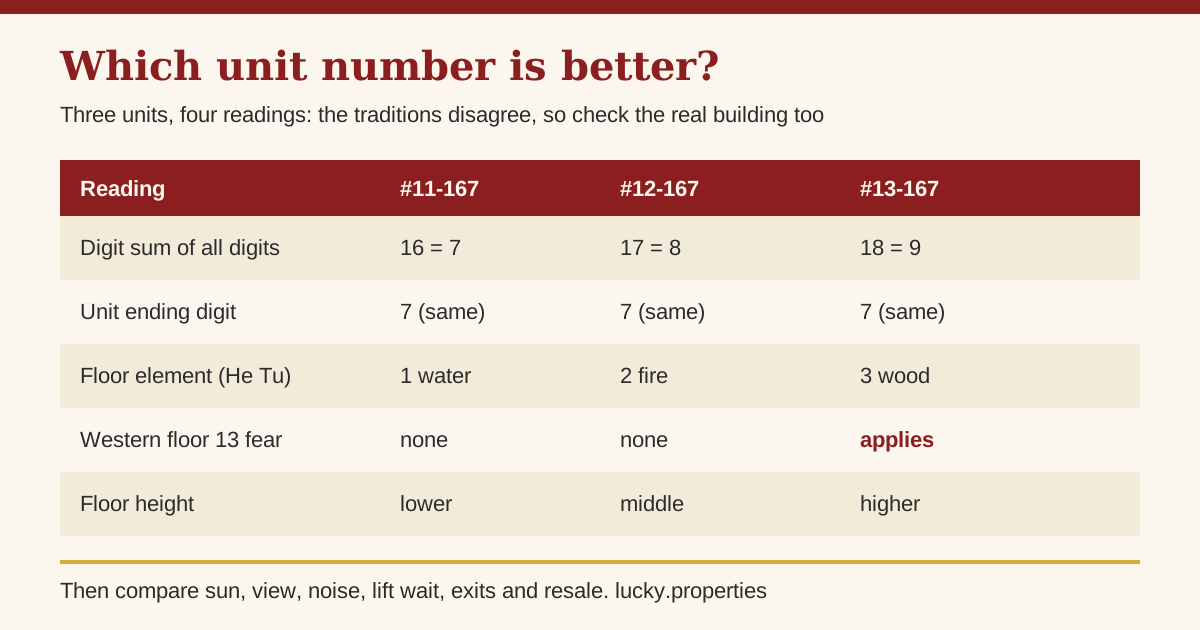
One search we see asks: "in fengshui, for unit number #11-167, #12-167 and #13-167, which is better and which one is inauspicious?" The three units share the same unit number (167) on three consecutive floors, so only the floor differs. Here are four common readings. These are traditions that practitioners use, not tested predictions.
| Reading | #11-167 | #12-167 | #13-167 |
|---|---|---|---|
| Digit sum of every digit, reduced | 1+1+1+6+7 = 16, then 7 | 1+2+1+6+7 = 17, then 8 | 1+3+1+6+7 = 18, then 9 |
| Ending digit of the unit | 7 | 7 | 7 |
| Floor element by last digit (He Tu numbers, as some practitioners use) | 1: water | 2: fire | 3: wood |
| Western floor 13 superstition | none | none | applies |
How the readings pull apart:
- Digit sum. Under the common "reduce to one digit" method, 8 and 9 are often called favourable and 7 neutral, which would put #12 and #13 ahead of #11. Practitioners who instead use 3-digit unit numbers alone get 1+6+7 = 14, then 5, the same for all three floors.
- Ending digit. All three end in 7, so this method cannot separate them. Some practitioners say 7 sounds like "rise" or "energy" in Mandarin; some Cantonese speakers associate it with an unflattering slang word. The sound reading therefore depends on who is reading it.
- Sound of the whole number. 167 sits next to 168, which practitioners say sounds like "road to prosperity" in Cantonese. Being one off does not transfer that meaning. Treat 168 as a different number.
- Floor element. In the He Tu pairing, 1 and 6 are water, 2 and 7 are fire, 3 and 8 are wood. Practitioners who use this compare the floor and unit element with the residents' own element, and the method varies from teacher to teacher, so it cannot rank the three floors without knowing the household.
- Floor 13. This is a Western fear, not a Chinese number tradition. It matters if you or a future buyer care about it, which affects how easily the unit is seen as desirable. A building may also label that level 12A or skip it, so check whether #13 actually exists in this tower.
The honest result: #12-167 is the one most readings leave alone and #13-167 is the only one that carries a known cultural concern, but none is "inauspicious" across all traditions. If these three units were otherwise identical, a buyer who cares about numbers would likely lean to #12. Because they are not identical, move to the checks below.
Related reading: how to see whether a condo suits you at a viewing.
Advertisement
How to read a Singapore-style unit number
In the Singapore format, the number after the # is the floor, then a hyphen, then the unit. So #12-05 is unit 5 on floor 12, not a range or a date. The block number and postal code identify the building; the #floor-unit identifies the door. A three-digit unit such as 167 is a label set by the building and does not tell you how far down the corridor the door sits or which way it faces. Ask for the floor plan and the position of the unit relative to the lift and stairs. Other countries label differently (for example, 1207 for floor 12, unit 7), so read the local convention before applying any number method.
Buildings with no 4th, 13th or 14th floor
Developers sometimes skip numbers they expect buyers to dislike. Urban Toronto reports that lifts in East and Southeast Asian markets may skip the fourth floor and floors ending in four, while Western buildings often omit the 13th, and some mixed-culture buildings skip both.
The rule is not the same everywhere. Vancouver stopped allowing buildings to skip floor numbers around 2015. Its chief building official Saul Schwebs told Daily Hive that the aim of sequential floor and suite numbers is life safety, because skipped floors confuse visitors and first responders who count floors from outside. A 2022 bulletin extended this to sequential suite numbers, and older projects already in development were not forced to comply. Check your own city: ask the building department or the agent whether the tower skips any label, and how the stairwell signs read.
A practical point if you buy on a skipped-floor level: "floor 15" may be the fourteenth storey. Count from the ground when you judge height, view and the walk down.
What research found on floor numbers and prices
Shum, Sun and Ye studied apartment transactions in Chengdu, China, from 2004 to 2006. They reported that resale apartments on floors ending in 8 sold for about 235 RMB more per square metre than those on other floors and sold about 6.9 days faster on average. The premium did not show for newly built apartments, which the authors attribute to standardized developer pricing. The abstract does not report an effect for floors ending in 4. This is one city and one period.
Floor 13 has its own small study. Antipov and Pokryshevskaya (Judgment and Decision Making, 2015) compared new buildings in Saint Petersburg, Russia, with identical floor plans, using data collected in November 2014. The 13th floor had 54.9% of its apartments sold, against 64.8% on floor 12 and 61.8% on floor 14. That measures how fast units sold, not their price, and the sample is 201 floor observations. It shows that numbers can matter to buyers in some markets; it does not say your unit will gain value. For more studies, see our house number resale value studies.
Low, mid or high floor: the practical table
| Floor band | Often cited upsides | Often cited downsides |
|---|---|---|
| Low (1 to 3) | Short walk to exits; shorter lift wait | More street noise and less privacy; less direct sun if blocked by neighbours |
| Middle | Usually a balance of view, quiet and exit distance | Depends on tower; no general rule |
| High | Views, more daylight, less street noise | Longer lift waits and longer stair exit; glass towers add glare and heat concerns |
Fire ladder reach is one sourced fact. BRANZ, the New Zealand building research body, says hydraulic ladders generally reach about 17 m (enough for most 4-storey buildings) and aerials about 22 m (most 5 to 6 storeys), and that in sprinklered buildings early response relies on sprinklers, risers and protected escape routes instead. These are New Zealand figures; check the fire service reach in your city and ask which exits and sprinklers the building has. For glass towers, see feng shui in glass condo buildings.
Checks that matter more than the number
- Sun and view by floor. Visit at the hour you are home most. Note which neighbouring towers block light on your floor and whether the view changes if a lot nearby is built on.
- Noise. Stand in the bedroom with the windows closed and open. Listen to the lift machinery, garbage chute, road and neighbours.
- Lift wait. Time it at morning rush and evening, and count lifts serving your floor.
- Fire-escape access. Walk from the door to both stairwells. Ask about sprinklers and alarm records.
- Position. Note whether the door faces a lift or corridor end; see apartment doors facing the elevator.
- Resale data. Ask the agent for recent sales of the same stack and floor band, and what they sold for compared with neighbouring floors. Ask a lawyer or agent about local rules.
Common mistakes
- Treating one tradition (digit sum, say) as the whole answer when sound or element readings disagree.
- Paying a premium for a number without checking what comparable units sold for.
- Ignoring a skipped floor and miscounting the real height.
- Choosing by number and skipping the noise and lift checks.
FAQ
Which condo floor is best for feng shui?
There is no single answer, because number traditions disagree. Many practitioners avoid floors with a 4 and, in Western-influenced markets, floor 13, and favour numbers with an 8. Whatever the number, practical factors such as sun, view, noise, lift wait and exit access usually decide whether a floor suits you.
Is floor 13 unlucky in feng shui?
Not in the Chinese number traditions. The fear of 13 is Western. If a buyer or later buyer cares about it, it can affect how easily a unit is seen as desirable, so some people check how the building labels that floor. Treat it as a market preference to weigh, not a rule.
Why do some buildings have no 4th or 13th floor?
Developers sometimes skip numbers they expect buyers to dislike: 4 in East and Southeast Asian markets, 13 in Western ones. Skipping is not universal. Vancouver, for example, stopped allowing new buildings to skip floor numbers around 2015, citing life safety for emergency responders.
Do lucky floor numbers raise apartment prices?
One peer-reviewed study of Chengdu apartment sales from 2004 to 2006 found that resale units on floors ending in 8 sold for about 235 RMB more per square metre and about 6.9 days faster, while the premium did not appear for new units. One city and period cannot be assumed to hold elsewhere.
What does #12-167 mean in a Singapore address?
In the Singapore format the number after the # is the floor, then a hyphen, then the unit. So #12-167 is unit 167 on floor 12. The unit number is a label and does not by itself say how far along the corridor the door is, so check the floor plan.
Where to go next
Read the number 4 and tetraphobia if a 4 appears in your floor or unit, to see how deep the avoidance goes and where it does not apply. If you are pricing or making an offer on the unit, lucky numbers in a house price covers whether 8s in the figure help.
Sources
Checked November 2026.
- Daily Hive, "Goodbye, triskaidekaphobia: Why some Vancouver buildings reject unlucky numbers": https://dailyhive.com/vancouver/unlucky-numbers-real-estate-rules
- Urban Toronto, "Explainer: tetraphobia, triskaidekaphobia and floor numbers in buildings" (2022): https://urbantoronto.ca/news/2022/05/explainer-tetraphobia-triskaidekaphobia-and-floor-numbers-buildings
- Shum, Sun and Ye, "Superstition and lucky apartments: Evidence from transaction-level data", Journal of Comparative Economics 42(1), 2014: https://ideas.repec.org/a/eee/jcecon/v42y2014i1p109-117.html
- ParcelPath, Singapore address format: https://parcelpath.com/international-shipping/destinations/asia/singapore/singapore-address-format/
- Antipov, E. and Pokryshevskaya, E., "Are buyers of apartments superstitious? Evidence from the Russian real estate market," Judgment and Decision Making 10(6), 2015: https://dlab.sauder.ubc.ca/sjdm/journal/15/151009/jdm151009.html
- BRANZ, "Firefighting capability and building height": https://www.branz.co.nz/design-build/articles/firefighting-capability-and-building-height
- Sources we wanted but could not open today: the City of Vancouver 2015 floor-numbering bulletin itself (we rely on the news reports above). The sound and element readings are practitioner traditions without a primary source.
Editorial note: Lucky Properties presents feng shui as a cultural and design tradition. This guide is educational. Floor and unit choices also turn on the building's own documents: read the strata or condo disclosure and ask the listing agent before you rely on any reading here.