A price ending in 8 is a cultural preference, not a proven pricing advantage. Some buyers and sellers like 8s and avoid 4s because of how the numbers sound in Chinese, and the research we found on price endings concerns "just below" round numbers instead. Set the figure from comparable sales, then let the digits break a tie. This is part of our property numbers and home value guide.
Last checked: 17 November 2026
| Key fact | Figure or rule | Source |
|---|---|---|
| Address digits in Vancouver | Houses with an address ending in 4 sold at a 2.2% discount, and addresses ending in 8 at a 2.5% premium, in census tracts where the ethnic Chinese share was above the Greater Vancouver average of 18%, or in repeat sales | Fortin, Hill and Huang |
| Price endings in that paper | Mentioned only as earlier research and as anecdote that agents show asking prices ending in a series of 8s; not analyzed | Fortin, Hill and Huang |
| Just-below listings | "Just below" listings get the largest negotiated discount, but their higher initial pricing more than offsets it | Beracha and Seiler, 2014 |
| Round-priced listings | Round-priced homes sell faster and with smaller discounts from list price | Beracha and Seiler, 2015 |
| Study data in Vancouver | 116,939 single-family sales in 13 Greater Vancouver cities, January 2000 to May 2005 | Fortin, Hill and Huang |
On this page
- Why some people want 8s and avoid 4s in a price
- What the research found about price endings
- How search brackets change the picture
- Worked example: is 699,000 a good price
- Offers with 8s: negotiating
- When not to let a number override the comparable sales
- FAQ
- Where to go next
- Sources
Why some people want 8s and avoid 4s in a price
In Cantonese and Mandarin, 8 sounds like a word for getting rich, and 4 sounds like the word for death. Our guides on why 8 is lucky in Chinese culture and why 4 is avoided across East Asia cover the wordplay and its limits. Practitioners and many buyers carry that habit into money: a price with 8s feels auspicious, a price with 4s feels like a risk.
This is a preference of particular communities and families, not a rule that every buyer follows. Many buyers, including many of Chinese heritage, never look at the digits. Treat it as one possible reaction among your buyers, which is exactly why it should not outrank the market.
What the research found about price endings
The Vancouver paper. Fortin, Hill and Huang studied 116,939 single-family house sales in 13 cities in Greater Vancouver from January 2000 to May 2005. Their effect was about address numbers, not prices: addresses ending in 4 sold at a 2.2% discount, and addresses ending in 8 at a 2.5% premium, in census tracts where the ethnic Chinese share was above the Greater Vancouver average of 18%, or in repeat sales. They write that they lack asking-price data. Price endings appear only in footnotes, where the authors cite earlier research on Chinese stock markets and note anecdotally that agents display asking prices frequently ending in a series of 8s. So this paper does not show that an 8 ending raises a sale price. For the address results, see our house number resale value studies.
Just-below pricing. Beracha and Seiler (2014) studied the thousands digit of listing prices and found that "just below" listings, such as 199,900 against 200,000, get the largest negotiated discount, but their higher initial pricing more than offsets it. Their 2015 follow-up reports that round-priced homes sell faster and with smaller discounts from list price, while just-below pricing still produces the highest transaction price relative to estimated value. Both studies are about the left-most digit and rounding, not about lucky digits. We did not find a study of 8 endings in listing prices that we could read in full, so we do not claim one.
Related reading: what a lucky telephone number tells us about paying for digits.
Advertisement
How search brackets change the picture
Listing portals let buyers set a price range in their search, often a maximum, and many people choose round maximums. A home listed just above a common cap can be missed by a buyer who capped there, while one listed just under it appears in their results. This is the logic behind just-below pricing, and it is practical rather than numerological.
Which caps a portal offers, and whether buyers can type any value, differs by site and country, so we give no figures here. Open the portal your agent uses, run a search as a buyer would, and see which round values it offers. Then check where your price falls against them.
Worked example: is 699,000 a good price
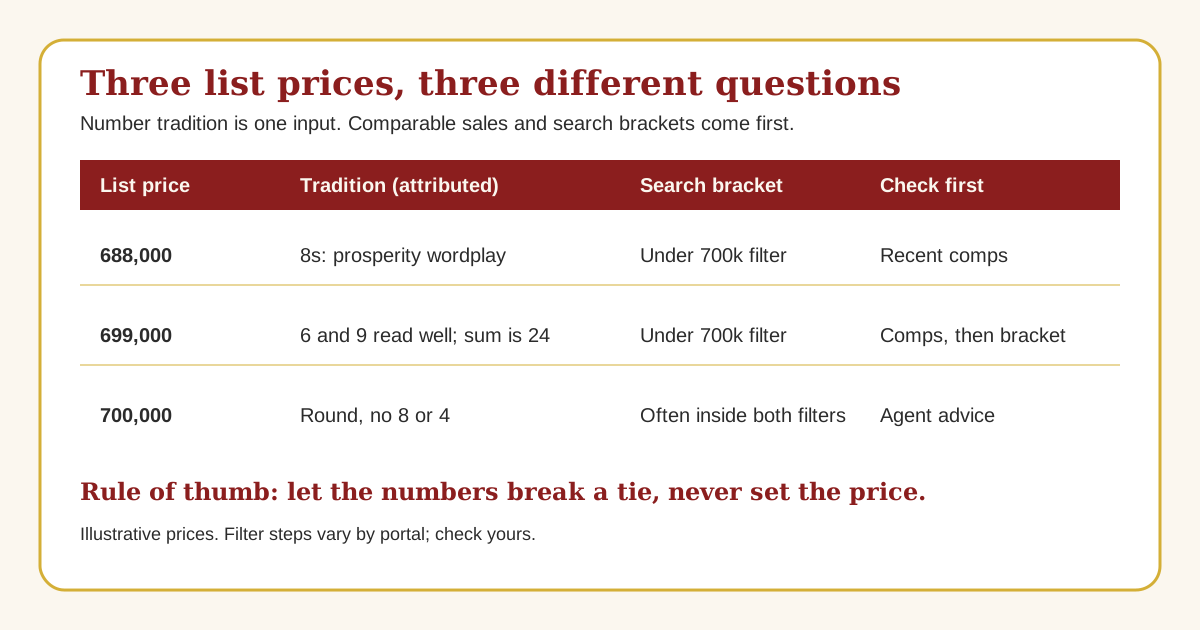
This is a made-up home, used to show the order of thinking. The inputs: a listing price of 699,000, a portal that offers a 700,000 maximum, and a seller who has been told 699,000 is a "good Chinese number."
- Digit by digit, as tradition reads it. 6 is often said to sound smooth or flowing, and 9 to sound like lasting. Two 9s are repeated. Practitioners differ on details, so treat this as one reading.
- The digit sum. 6 + 9 + 9 = 24. Some readers avoid 24 because in Cantonese its sound is linked to "easy death," while others reduce 24 to 6. That is a disagreement inside the tradition, not a test result. See lucky house numbers for how readers sum digits.
- The bracket. 699,000 sits just under 700,000, so it appears in searches capped at 700,000. This is the strongest practical reason to like it, and it would be true if the digits were 691,000.
- The check that matters. Ask your agent for recent comparable sales. If similar homes sold between 680,000 and 700,000, 699,000 is defensible. If they sold near 650,000, no reading of 6 and 9 will make it sell.
The answer to the question people actually asked: 699,000 can be a fine price, but for the bracket and the comparables, with the numbers as a pleasant extra.
Offers with 8s: negotiating
For buyers, the offer is a number you can defend. If your budget and the comparables support 688,000 or 708,000, choosing the one with 8s costs nothing extra. If they support 695,000, do not stretch to 698,000 for an 8.
For sellers receiving an offer with 8s, answer on terms: price, deposit, conditions, closing date and financing. Do not assume a lucky number signals a stronger buyer. In a competing-offer situation, cleaner conditions usually matter more than a pleasant digit. Ask your agent or lawyer how offers are made in your area, since rules differ by country and province or state.
When not to let a number override the comparable sales
- Your agent's comparative market analysis disagrees. Overshooting means weeks on the market, and undershooting gives money away.
- Your lender or budget is the ceiling. A lucky offer your lender will not finance is a failed offer.
- The number would cost conditions. Do not waive an inspection to make a price look cleaner.
- The buyer pool is broad. If most local buyers do not use the tradition, the bracket and comparables decide.
If you are also preparing the home for sale, see feng shui for selling a house. If the digit that bothers you is in the address rather than the price, see how to change your house number for what local addressing offices allow.
FAQ
Should a house list price end in 8?
It is a matter of tradition, not evidence. Some Chinese-speaking buyers and agents like prices with 8s because 8 sounds like prosperity, and avoid 4. The studies we read do not show that an 8 ending raises a sale price, so set the price from comparable sales first and use the ending only as a tiebreaker.
Is 699,000 a good house price to sell for in feng shui?
Practitioners read 6 as smooth and 9 as lasting, so 699,000 reads well digit by digit, though its digit sum is 24, which some readers avoid. The more practical point is that it sits just under 700,000, which keeps the home inside searches capped at 700,000. Check comparable sales before either argument.
Does price research show that 8s help a sale?
We found no study that shows it. The Vancouver study by Fortin, Hill and Huang found an address-number effect, not a price-ending one, and mentions agents using 8s in asking prices only as anecdote. The general research we read concerns prices just below round numbers.
Should a buyer put 8s in an offer?
It is harmless as a tiebreaker if the amount is already justified by comparable sales and your budget. Do not raise an offer to reach an 8, and do not assume a seller will treat it as better. An offer that is lower on paper rarely wins because of its digits.
When should a lucky number not decide the price?
Whenever it conflicts with a comparative market analysis, your lender approval or your budget. A number that overshoots comparable sales can cost weeks on the market, and one that undershoots gives money away. Tradition can decide between two prices you can already defend.
Where to go next
Read house number resale value studies for the full address-number evidence, which is much stronger than anything on price endings.
Sources
Checked November 2026.
- Fortin, N., Hill, A. and Huang, J., "Superstition in the Housing Market" (University of British Columbia, 2012): paper (PDF)
- Beracha, E. and Seiler, M., "The Effect of Listing Price Strategy on Transaction Selling Prices," Journal of Real Estate Finance and Economics 49(2), 2014: record
- Beracha, E. and Seiler, M., "The Effect of Pricing Strategy on Home Selection and Transaction Prices: An Investigation of the Left-Most Digit Effect," Journal of Housing Research 24(2), 2015: record
- Sources we wanted but could not read in full: Allen and Dare (2004) on charm listing prices, and Brown and Mitchell (2008) on 8 and 4 in Chinese stock prices (cited only through the Vancouver paper). We state no figure from them.
Editorial note: Lucky Properties presents feng shui as a cultural and design tradition. This guide is educational. A list price or offer should rest on comparable sales; talk to your agent before letting a number set either one.