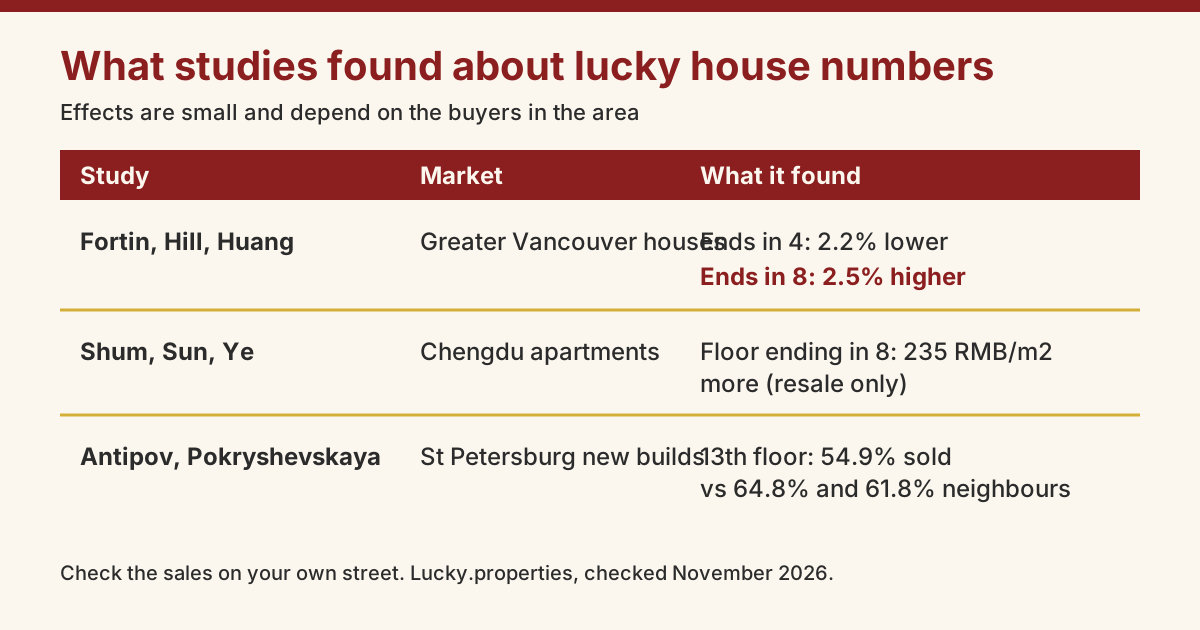
Slightly, in some places. The best-known study, of about 117,000 house sales in Greater Vancouver, found addresses ending in 4 sold at a 2.2% discount and those ending in 8 at a 2.5% premium. The effect appeared in census tracts where the ethnic Chinese share was above the Greater Vancouver average of 18%, or in repeat sales. Studies elsewhere point the same way, and none shows a large effect next to location and condition.
Last checked: 17 November 2026
This page is part of our house numbers guide. It reports what researchers measured, not what tradition promises.
| Key fact | Figure or rule | Source |
|---|---|---|
| Vancouver sample | About 117,000 single-family sales in 13 Greater Vancouver cities, January 2000 to May 2005 | Fortin, Hill and Huang (UBC working paper) |
| Ending in 4 | About 2.2% discount compared with other addresses | Fortin, Hill and Huang |
| Ending in 8 | About 2.5% premium compared with other addresses | Fortin, Hill and Huang |
| Where it appears | Census tracts where the ethnic Chinese share was above the Greater Vancouver average of 18%, or in repeated sales | Fortin, Hill and Huang |
| Chengdu resale | Floors ending in 8 sold for about 235 RMB more per square meter; no premium on new units | Shum, Sun and Ye (2014) |
| St Petersburg new builds (November 2014 data) | 13th floor: 54.9% of apartments sold, against 64.8% for floor 12 and 61.8% for floor 14 | Antipov and Pokryshevskaya (2015) |
On this page
- The main study: Greater Vancouver
- Other studies you can check
- Study comparison table
- What it means for a buyer
- What it means for a seller
- The limits of these studies
- How to check a specific street yourself
- FAQ
- Where to go next
- Sources
The main study: Greater Vancouver
Economists Nicole Fortin, Andrew Hill and Jeff Huang of the University of British Columbia studied single-family house sales in 13 Greater Vancouver cities from January 2000 to May 2005. After cleaning, they had 116,939 observations, including 22,710 repeated sales of the same house.
The headline results, in the paper's own words, are that houses with an address number ending in four sell at a 2.2% discount and those ending in eight at a 2.5% premium, compared with other addresses. In the version we read (dated November 2012, an unpublished working paper), the main regression with a Chinese-share interaction gives about -2.2% for 4 and +2.5% for 8. Dropping repeated sales, the estimates for tracts above the average Chinese share are -2.8% and +3.1%, a rise the authors say is not statistically significant. Without controls for location the figures are about -3.1% and +3.4%.
Where did the effect appear? The authors found it in census tracts where the ethnic Chinese share is above the Greater Vancouver average of 18%, which fits a cultural explanation, or in repeated transactions, which they read as speculative behaviour. In tracts with lower Chinese shares the general effect vanished. The premium for 8 becomes significant at roughly an 11% Chinese share and stays around 2 to 3% as the share rises.
Two other endings were tested. Addresses ending in 88 showed about +6.1%, and 13 about -2.8%, but neither was clearly tied to Chinese neighbourhoods and both estimates are noisier.
The National Association of Realtors published a summary using a mean price of about CAD 400,000 for the area; we do not repeat its dollar conversion because its own rounding does not match the percentages exactly. Work out the figure for a real price yourself: 2.5% of 800,000 is 20,000.
Practitioners of the tradition explain the pattern through the Chinese associations of 4 (it sounds like the word for death) and 8 (it sounds like prosperity). We cover those in why 4 is unlucky in East Asia and why 8 is lucky in Chinese culture.
Advertisement
Other studies you can check
Chengdu, China (Shum, Sun and Ye, Journal of Comparative Economics, 2014). Using apartment transactions from 2004 to 2006, the authors found units on floors ending in 8 on the resale market sold for about 235 RMB more per square meter. The premium disappeared for newly built units, which the authors attribute to uniform developer pricing. Apartments on floors ending in 8 also sold about 6.9 days faster, even new ones. They also report that buyers with more 8s in their phone numbers were more likely to buy on 8 floors, which supports a belief-driven reading.
Singapore (Agarwal, He, Liu, Png, Sing and Wong, IZA Discussion Paper 9899, 2016). The abstract says earlier research shows Chinese buyers pay less for unlucky addresses and more for lucky ones, and this paper finds the preference varies by buyer. It was stronger among older buyers and buyers of new apartments, and weaker among buyers with Western names, senior public-sector employees and buyers in luxury districts. The summary page we could open gives no price percentages, so we state none.
Saint Petersburg, Russia (Antipov and Pokryshevskaya, Judgment and Decision Making, 2015). This study looked at sales share, not price. In new buildings with identical floor plans (34 buildings for floors 6 to 8 and 33 for floors 12 to 14, data collected in November 2014), the 13th floor had 54.9% of apartments sold, against 64.8% on floor 12 and 61.8% on floor 14. Floor 7 sold 68.6%, against 65.8% on floor 6 and 66.5% on floor 8. The sample is small (201 floor observations), but it shows 13 can slow sales of new units even where nothing is discounted.
We did not find or open a study of 13 in US street addresses with figures we could verify, so we state none.
Study comparison table
| Study | Market and years | Numbers | Effect | Caveats |
|---|---|---|---|---|
| Fortin, Hill and Huang | Greater Vancouver houses, 2000 to 2005 | Ending in 4 and 8 | -2.2% and +2.5% | Concentrated in higher Chinese share tracts or repeat sales; working paper version |
| Shum, Sun and Ye | Chengdu apartments, 2004 to 2006 | Floors ending in 8 | About +235 RMB per m2 on resale | No premium on new units |
| Agarwal et al. | Singapore apartments | Lucky and unlucky addresses | Varies by buyer | No magnitudes in the abstract we read |
| Antipov and Pokryshevskaya | St Petersburg new builds, 2014 data | 7 and 13 as floors | 13th floor sold a smaller share | Sales share, not price; 201 observations |
What it means for a buyer
Three practical points follow from the studies.
- A 4 address may be negotiable, and an 8 address may cost more. The Vancouver gap is about 2% either way on average, so on an 800,000 home that is roughly 16,000 against the typical address. That is a reason to ask, not a promise of a discount.
- Think about the resale audience. If you intend to sell in a neighbourhood where many buyers care about numbers, an unlucky number may narrow your buyer pool. If the area has few such buyers, it likely matters little.
- Do not pay a premium just for an 8. The Chengdu result shows the premium can vanish in new units, and Singapore shows many buyers do not care. Compare against similar homes first.
Related reading: if the number is a deal-breaker for your own household, see how to pick lucky house numbers.
You can also test your own address with the house numerology calculator, which shows the tradition's reading of a number, not a price.
If you are looking at a condo, the unit and floor number matter in the same way; see our condo floor and unit number buying guide.
What it means for a seller
- Price from comparable sales, not from the number. The measured effect is around 2% in the study area, which is smaller than the difference between a renovated and a dated kitchen.
- Know who your likely buyers are. If you own a 4 address in an area with a high share of buyers who hold the belief, expect questions about it and ask your agent how similar homes sold.
- Do not change your house number to chase a premium. In many places the municipality assigns addresses, and the studies measured existing numbers, not renamed ones. Ask the local authority; our guide on how to change your house number shows what three official addressing offices allow.
- Be honest in the listing. Do not make claims about luck or fortune; describe the home. Our feng shui for selling a house guide covers presentation and staging, and lucky numbers in a house price covers whether an asking price should end in 8.
The limits of these studies
- Correlation, not proof of cause. The authors control for features of the house and location, but the numbers cannot be assigned at random. Other differences between homes can remain.
- Small effects next to location and condition. A 2% average gap is far smaller than the price difference between two streets or between a renovated and an original home.
- Specific buyers, places and years. The Vancouver data ends in 2005 and the working paper is unpublished in the version we read. Markets and buyers have changed since. Chengdu and Singapore are different markets again.
- Averages hide variation. A study can find a 2.5% average premium and still contain 8 addresses that sold below the street average.
- Not all numbers behave the same. The 13 and 88 estimates were less clear than 4 and 8.
How to check a specific street yourself
- Collect sold prices for the street and nearby streets over the last two to three years from public sales records (in many places the land registry, assessor or property tax office publishes them) or ask a local agent for a comparable sales report.
- Match homes by size, lot, age and condition.
- Mark the addresses ending in 4 and 8 (and 13 if relevant) and compare each with the matched homes.
- Count the sales. If you have fewer than about ten matched sales, treat any gap as an anecdote.
- Ask a local agent whether buyers in that area bring it up. Rules and record access differ by city and country, so check how your local records office works.
Advertisement
FAQ
Does house number affect resale value?
Sometimes, by a small amount, and mainly where many buyers hold the belief. A Greater Vancouver study of about 117,000 house sales found addresses ending in 4 sold at a 2.2% discount and those ending in 8 at a 2.5% premium, in census tracts where the ethnic Chinese share was above the Greater Vancouver average of 18%, or in repeat sales. Location, size and condition move prices far more.
Does house number 4 lower resale value?
In the Vancouver data, yes by about 2.2% on average, but only in the areas and sales described above. In census tracts with a low Chinese share the general effect disappeared. Treat it as a possible small discount with a particular audience, not a rule for every street.
Is 13 an unlucky house number for price?
The evidence is thin. The Vancouver paper reports about a 2.8% lower price for addresses ending in 13 overall, but that estimate was not tied to Chinese neighbourhoods and is noisier. A Saint Petersburg study of new apartments found the 13th floor sold a smaller share of units, but it measured sales share, not price.
Do lucky numbers like 8 raise what a house sells for?
The Vancouver study found about a 2.5% premium for addresses ending in 8. A Chengdu study of resold apartments found units on floors ending in 8 sold for about 235 RMB more per square meter, and the premium did not appear in new units. These are averages, not a guaranteed premium for your home.
How can I check a specific street myself?
Pull recent sold prices from public records or a local agent for the street and nearby streets, compare homes of similar size and condition, and see whether 4 or 8 addresses sold differently. With only a handful of sales the result is weak evidence, so ask a local agent how buyers in that area respond.
Where to go next
Read lucky house numbers in feng shui next if you want to see how the tradition reads a specific number, and what to do if you already own an unlucky one.
Sources
Checked November 2026.
- Fortin, N., Hill, A. and Huang, J., "Superstition in the Housing Market," University of British Columbia working paper, November 2012 version: https://econ.cms.arts.ubc.ca/wp-content/uploads/sites/38/2013/05/pdf_paper_nicole-fortin-supersitition-housing-market.pdf
- National Association of Realtors, "The Effect of Superstition on Housing Prices" (summary): https://d7.nar.realtor/blogs/economists-outlook/the-effect-of-superstition-on-housing-prices
- Shum, M., Sun, W. and Ye, G., "Superstition and lucky apartments: Evidence from transaction-level data," Journal of Comparative Economics 42(1), 2014 (figures from the IDEAS record): https://ideas.repec.org/a/eee/jcecon/v42y2014i1p109-117.html
- Agarwal, S., He, J., Liu, H., Png, I., Sing, T.F. and Wong, W.-K., "Superstition, Conspicuous Spending, and Housing Markets: Evidence from Singapore," IZA Discussion Paper 9899 (abstract page): https://econpapers.repec.org/RePEc:iza:izadps:dp9899
- Antipov, E. and Pokryshevskaya, E., "Are buyers of apartments superstitious? Evidence from the Russian real estate market," Judgment and Decision Making 10(6), 2015: https://dlab.sauder.ubc.ca/sjdm/journal/15/151009/jdm151009.html
- Sources we wanted but could not open today: the full text of the Shum, Sun and Ye paper and the Agarwal et al. PDF, so we state no figures from them beyond the pages cited; the published journal version of the Fortin, Hill and Huang paper.
Editorial note: Lucky Properties presents feng shui as a cultural and design tradition. This guide is educational. Study results describe past markets; for a price on a real home, ask a local agent or appraiser.