The short version
Short answer: The most expensive license plate in the world is a white rectangle that reads "P 7". It sold in Dubai in April 2023 for AED 55 million, roughly US$15 million, at a charity auction run by Emirates Auction, and Guinness World Records certifies it as the most expensive car registration plate ever sold. It broke a record that had stood for fifteen years, set in Abu Dhabi in 2008 when the plate "1" sold for AED 52.2 million. Hong Kong runs a smaller but fierce version of the same market: its record is the single letter "W" at HK$26 million in 2021, and its classic lucky number "28" made HK$18.1 million back in 2016. This page documents the verified top of the market, explains why governments are the ones selling, and separates the record prices from what a normal lucky plate actually costs.
If the symbolism is what you came for, start with the lucky numbers culture guide and the number 8 guide. If you are wondering whether the same money chases phone numbers, it does: see lucky telephone numbers.
The verified records
Every figure below was checked against the reporting named in the sources section. Charity-auction prices include generosity by design, so read them as the documented ceiling of the market, not as asking prices.
World: the UAE owns the podium
| Plate | Place | Price | Year | Notes |
|---|---|---|---|---|
| P 7 | Dubai, UAE | AED 55 million (about US$14.97M) | 2023 | Guinness-recognised world record; Most Noble Numbers charity auction; proceeds to 1 Billion Meals Endowment |
| 1 | Abu Dhabi, UAE | AED 52.2 million (about US$14.2M) | 2008 | Held the world record for 15 years; Emirates Auction |
| AA9 | Dubai, UAE | AED 38 million | 2021 | Charity auction sale, reported in UAE market coverage |
| AA8 | Dubai, UAE | AED 35 million | 2022 | Most Noble Numbers charity auction |
| D 5 | Dubai, UAE | AED 33 million (about US$8.9M) | 2016 | Bought by businessman Balwinder Sahani, who said a single digit had always been his dream |
Why does the Emirates dominate? Three reasons stack. The plate system itself creates rarity: a category letter plus very few digits means single-digit plates are genuinely scarce. The culture of the region treats a low number as a public rank, legible to everyone at every red light. And the state auction houses, Emirates Auction and Dubai's RTA, turned allocation into events, often tied to Ramadan charity campaigns, where a winning bid is simultaneously a donation announcement.
Hong Kong: letters, luck, and the Lotteries Fund
Hong Kong has auctioned traditional marks since 1973 and personalised marks since 2006, run by the Transport Department. The top of its market mixes single letters (prized for initials and word associations) with classic lucky numbers.
| Plate | Price | Year | Notes |
|---|---|---|---|
| W | HK$26 million (about US$3.3M) | 2021 | Hong Kong record; single letter; 119 bids from a HK$5,000 base |
| R | HK$25.5 million | 2023 | Second highest; associated in reporting with racing and good fortune |
| D | HK$20.2 million | 2024 | Linked in reporting to "dragon" and "dollar" |
| 28 | HK$18.1 million | 2016 | Reads in Cantonese as "easy prosperity" (jat ji faat); the classic lucky-number plate |
| 18 | HK$16.5 million | 2008 | "Certain prosperity" reading |
Notice the mix. Hong Kong's top five is mostly letters, because a single letter is the scarcest thing the system sells. But the beloved entry is 28, the one that sounds like money arriving easily, which is the whole lucky-number story in a single lot. For the belief system behind 28 and 18, the number 8 guide is the explainer.
Advertisement
Why governments sell luck
It is worth pausing on the strangeness: in Dubai, Hong Kong, and much of China, the state is the monopolist of meaningful numbers, and it has learned to sell the meaning. The mechanics differ. Dubai's RTA and Emirates Auction run scheduled plate auctions across categories, from ordinary two-digit plates to the Most Noble Numbers charity galas. Hong Kong's Transport Department holds its Lunar New Year auction as a civic ritual, proceeds to the Lotteries Fund. Chinese premium phone and plate numbers leak into court auctions when debtors' assets are seized, which is how some of the strangest documented sales happened (see the telephone numbers guide for a RMB 2.25 million phone number sold by a Beijing court).
The charity frame matters to prices. When proceeds feed a Ramadan food endowment or a welfare fund, bidders are buying the plate, the headline, and the donation receipt at once. Analysts of these markets treat charity results as a ceiling with air in it: the same plate in a private sale usually changes hands for less.
What makes a plate "lucky" at auction
Reading across the documented sales, the premium patterns repeat:
- Fewer characters win. One digit beats two; one letter beats a word. Scarcity is the asset.
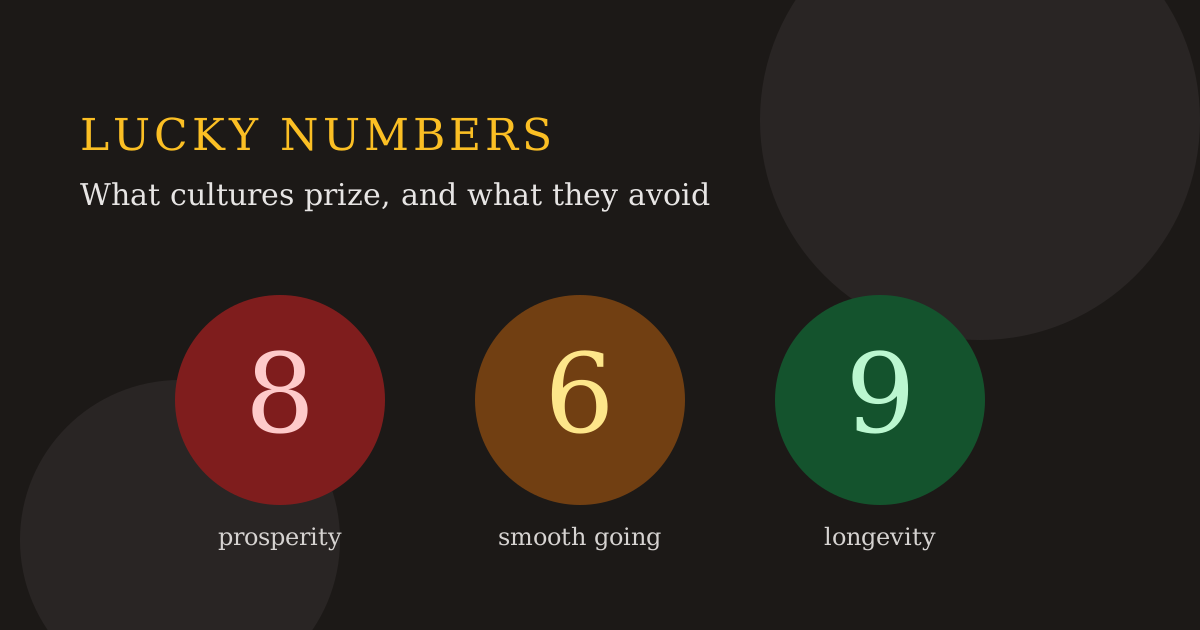
- 8s and prosperity phrases lead in Chinese-influenced markets (88, 168, 518, 28), and 9s follow for longevity.
- Sequences and mirrors (123, 8888, 2002, birthdays) carry personal rather than cultural value and price accordingly.
- 4s discount. In markets where 4 reads as death, plates heavy in 4s are the bargain bin, and some buyers hunt them precisely because they are cheap and they do not share the belief. Our tetraphobia guide covers the flip side.
- The plate must read at speed. Auction veterans note that a plate's value is what a stranger absorbs in two seconds at a junction: one digit, one letter, one joke. That, more than any numerology, is what P 7 and W have in common.
The ordinary end of the market
It would be a shame if the records scared off the actual hobby, because lucky plates are mostly not this. In most of the US, Canada, the UK, and Australia, a personalised plate with your lucky number, wedding date, or house-number echo costs a modest annual or one-off fee, with true rarities (single digits, short marks) held back or auctioned separately. The sensible way in:
- Check your jurisdiction's personalised plate program first, not the resale market; the state fee is the floor price.
- If you want a specific lucky digit, search released and expiring marks before paying a reseller premium.
- In belief-driven markets, expect asymmetry: 8-rich combinations cost more and resell more easily; 4-rich ones are cheaper to buy and slower to sell. Buy the one you like living with.
- Keep documents clean: in auction systems like Dubai's and Hong Kong's, the mark is a transferable right with paperwork, and clean transfer history protects whatever value it has.
And if the number you truly care about is the one on your front door rather than your bumper, the same traditions apply at a gentler price: the lucky house numbers guide walks through address numerology, and the pillar hub connects it all in lucky numbers around the world.
How to read a plate auction result like a dealer
Three habits separate people who understand these headlines from people who repeat them.
Ask whether charity was in the room. The giant UAE and Hong Kong results happen at charity auctions, where the winning bid is part purchase, part public donation, part press release. The same plate in a quiet private transfer generally changes hands for less. When you see a record price, ask what fraction of it was generosity performing itself, because that fraction evaporates on resale.
Ask what exactly was sold. In the UAE you are buying a transferable right attached to a category letter and a number; in Hong Kong a registration mark you hold indefinitely; in China sometimes a number entangled with debts and bills that transfer with it. The asset shapes the price. A "cheap" plate with clean paperwork beats a famous one with encumbrances, which is why dealers ask for transfer history before they ask for the digits.
Ask who else can read it. A plate's premium lives in the two seconds a stranger sees it. One digit reads instantly. A clever phrase that needs decoding at a red light reads slowly or never. That is why 7, W, 28, and 1 sit on the podium: they are finished communicating before the light turns green.
The rest of the world runs calmer versions of the same theatre. Britain's DVLA auctions personalised registrations and runs a vast resale market of cherished plates. US states sell vanity plates at set fees, with the shortest and wittiest combinations claimed early and traded informally. Australia auctions heritage plates, and its NSW 1 result (AUD 11.5 million in 2024 market reporting) shows the single-digit fever is not a Gulf monopoly. Wherever a government lets drivers choose their numbers, a ladder forms with meaning at the top and price following it up.
Sources
- Guinness World Records, "Dubai driver drops nearly $15 million on most expensive license plate ever" (May 2023): http://www.guinnessworldrecords.com/news/commercial/2023/5/dubai-driver-drops-nearly-15million-on-most-expensive-license-plate-ever-746334
- Carscoops, "Most Expensive License Plate Ever Sells For $15 Million In UAE" (April 2023), on the P 7 sale, the 2008 Abu Dhabi "1" record, and the 2016 D 5 sale: https://www.carscoops.com/2023/04/most-expensive-license-plate-ever-sells-for-15-million-at-auction/
- The HK HUB, "Hong Kong Number Plate With Unusual Letter 'D' Sells For HK$20.2M" (2024), with the territory's top-five record table: https://thehkhub.com/hong-kong-number-plate-with-unusual-letter-d-sells-for-hk20-2m-us2-5m/
- Hong Kong Transport Department auction results as reported by RTHK and The Standard (2021 "W" at HK$26 million; 2023 "R" at HK$25.5 million), summarised at hksar.org.
- Driven Properties, Dubai plate market roundup (AA9 AED 38 million, 2021; AA8 AED 35 million, 2022), reported figures: https://www.drivenproperties.com/blog/dubai-license-plate-1