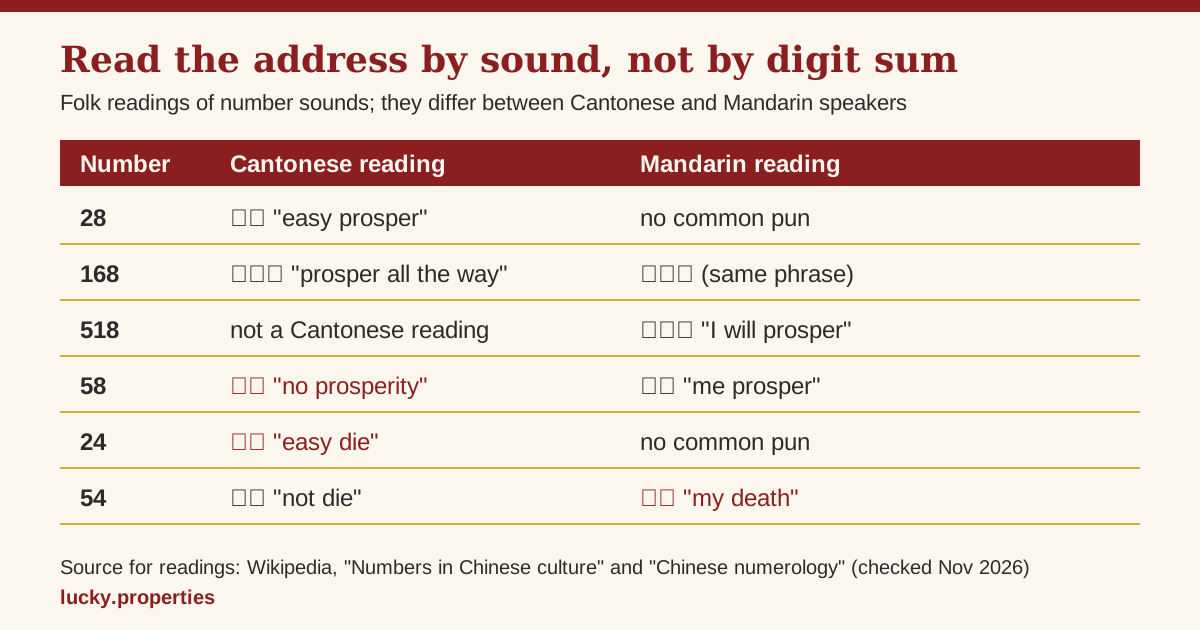
Many Chinese buyers read a house number by sound: each digit is said aloud in Cantonese or Mandarin, and the digits in a row are heard as a phrase. On that reading 28 is "easy prosper", 168 is "prosper all the way", 24 is "easy die" (Cantonese only) and 58 splits by language. This is a folk language tradition, and it often disagrees with the digit-sum method.
Last checked: 17 November 2026
| Key fact | Figure or rule | Source |
|---|---|---|
| 28 | In Cantonese, heard as 易發 "easy prosper" | Wikipedia, Numbers in Chinese culture |
| 168 | Heard as 一路發 "prosper all the way" | Wikipedia, Chinese numerology |
| 24 | In Cantonese, heard as 易死 "easy die" | Wikipedia, Numbers in Chinese culture |
| 58 | Mandarin 吾發 "me prosper"; Cantonese 唔發 "no prosperity" | Wikipedia, Chinese numerology |
| 518 | Mandarin 我要發 "I am going to prosper" | Wikipedia, Numbers in Chinese culture |
| 13 | No widely used Chinese pun found; some Hong Kong buildings skip the 13th floor | Wikipedia, Chinese numerology |
| Resale effect (Vancouver) | About -2.2% for endings in 4 and +2.5% for endings in 8, in tracts above the 18% average Chinese share or in repeat sales; about -2.8% for 13 (noisier) | Fortin, Hill and Huang (UBC working paper) |
This page is part of our house numbers guide. It covers the sound method only. For the digit-sum method (adding the digits down to a single number from 1 to 9) read lucky house numbers and feng shui; for the single digits themselves see why 8 is lucky and why 4 is unlucky in East Asia.
On this page
- How the sound method works
- Reference table of common combinations
- Where sound and digit sum disagree
- Cantonese or Mandarin: whose ear counts
- How much weight buyers give it
- Deed number or unit number
- A checklist before you decide
- FAQ
- Where to go next
- Sources
How the sound method works
Chinese languages have many words that sound alike, so a number can be heard as a different word. The method has three steps:
- Say each digit aloud in the language of the person who will judge it.
- Join the sounds in order, as you would speak them, and listen for a known word or phrase.
- Judge the whole string, not the digits. 28 is not "2 plus 8": in Cantonese it is said "ji6 baat3", which sounds close to "ji6 faat3", 易發 "easy prosper".
The single-digit puns are the building blocks. Wikipedia's article on numbers in Chinese culture records that 8 (八) sounds like 發 "prosper" in both Mandarin and Cantonese, that 2 is homophonous in Cantonese with 易 "easy", that 4 is nearly homophonous with 死 "death" especially in Cantonese, and that 5 sounds like 吾 "me" in Mandarin but like 唔 "not" in Cantonese. Everything else in the table below is built from these.
Practitioners are clear that this is a pun tradition, not a classical feng shui calculation. Our number 8 page and the internet number slang page explain the same sound logic in other settings.
Reference table of common combinations
The first two columns show how the digits are actually said; the third shows the phrase they are heard as. The characters and meanings come from the sources listed at the end. The romanisations (Jyutping for Cantonese, pinyin with tone marks for Mandarin) are our own transcription, so check them with a native speaker before using them in print.
| Number | Said in Cantonese | Said in Mandarin | Heard as | Usual reading |
|---|---|---|---|---|
| 28 | ji6 baat3 | èr bā | 易發, Cantonese ji6 faat3 | "Easy prosper": a Cantonese reading; no common Mandarin pun |
| 168 | jat1 luk6 baat3 | yī liù bā | 一路發, Cantonese jat1 lou6 faat3, Mandarin yī lù fā | "Prosper all the way": welcome in both |
| 518 | ng5 jat1 baat3 | wǔ yāo bā (1 is often said yāo when reading out numbers) | 我要發, Mandarin wǒ yào fā | "I am going to prosper": a Mandarin reading |
| 58 | ng5 baat3 | wǔ bā | Cantonese 唔發 m4 faat3; Mandarin 吾發 wú fā | Negative in Cantonese ("no prosperity"), positive in Mandarin ("me prosper") |
| 24 | ji6 sei3 | èr sì | 易死, Cantonese ji6 sei2 | "Easy die": avoided by some Cantonese speakers; no common Mandarin pun |
| 54 | ng5 sei3 | wǔ sì | Cantonese 唔死 m4 sei2; Mandarin 吾死 wú sǐ | Positive in Cantonese ("not die"), negative in Mandarin ("my death") |
| 13 | sap6 saam1 | shí sān | none found | Mainly a Western unlucky number |
Two cautions on this table. First, popular articles often list more puns (for example 14 as "certain death"). We could not find a reference source for 14, so we do not state it as fact: it is a folk claim some practitioners repeat. Second, a combination is a whole phrase. 168 is welcome; 167 or 169 is a different sound and gets none of its meaning, a point our condo unit number guide also makes.
Advertisement
Where sound and digit sum disagree
The digit-sum method adds the digits until one digit from 1 to 9 remains, then reads that digit. The sound method ignores the sum. Here are three addresses worked both ways, with the inputs shown.
| Address | Digit sum | Sound reading (Cantonese) | Sound reading (Mandarin) | Do the methods agree? |
|---|---|---|---|---|
| 24 Maple Street | 2 + 4 = 6 | 易死, "easy die" | no common pun | No: the sum gives a single digit with no link to the sound, and Cantonese speakers may still avoid it |
| 58 Oak Avenue | 5 + 8 = 13, then 1 + 3 = 4 | 唔發, "no prosperity" | 吾發, "me prosper" | Split: the sum lands on 4, the sound is negative in Cantonese and positive in Mandarin |
| 168 Cedar Road | 1 + 6 + 8 = 15, then 1 + 5 = 6 | 一路發, "prosper all the way" | 一路發, "prosper all the way" | Not in a useful way: the sum is 6, the sound is a full phrase |
(The street names are invented examples to show the arithmetic; they are not real listings.)
What this shows: the two methods answer different questions. The digit sum describes a character for the home as a whole in modern numerology (see the house numbers guide for what each result is said to mean). The sound method predicts how a particular group of buyers will react when they hear the address. For resale, the sound method is usually the one that matters, because it describes buyers rather than the house.
Related reading: the lucky house numbers guide is the better starting point if you want one meaning for your own home to live with.
Cantonese or Mandarin: whose ear counts
Several readings depend on the language. Wikipedia's article on Chinese numerology notes, for example, that 54 means "not die" in Cantonese but "my death" in Mandarin, and that in Teochew culture 4 is regarded as a lucky number. The 58 and 24 and 28 readings above work the same way.
In practice:
- Ask which language the likely buyers or the family speak. A Cantonese-speaking household and a Mandarin-speaking household can score the same address differently.
- A buyer who speaks another language (Teochew, Hokkien, Shanghainese) may use a third reading. We do not list them because we did not find a source we could cite.
- Many buyers care little. The tradition is personal, and plenty of people of Chinese heritage ignore it.
How much weight buyers give it
Measured evidence is limited and concerns endings in 4 and 8 more than whole combinations. Our resale value studies page summarises it. In the Greater Vancouver study by Fortin, Hill and Huang (UBC working paper), single-family houses with an address ending in 4 sold at about a 2.2% discount and endings in 8 at about a 2.5% premium, in census tracts where the ethnic Chinese share was above the Greater Vancouver average of 18%, or in repeat sales. The same paper reports about +6.1% for endings in 88 and about -2.8% for 13, but neither was clearly tied to Chinese neighbourhoods and both estimates are noisier.
We did not find an open study that measures 28, 58 or 168 as separate cases, so we do not state a price effect for them. If a seller or agent quotes one, ask for the data.
A practical reading: the sound of a number is a small adjustment in the right market, not a reason to overpay. Weigh it after location, condition, light and price. Our lucky numbers around the world hub shows the same beliefs in other cultures.
Deed number or unit number
Two numbers can matter in one purchase:
- The street number on the deed or title. This is the address on the legal record and on mail. It is hard to change; a municipality assigns it, and changing it usually needs an application. See how to change a house number if you are considering it.
- The unit or suite number inside a building. This is often what buyers react to in a condo, and it sits beside the floor number. A suite 2808 on floor 28 stacks the sounds; our condo floor and unit number guide covers how to read floor and unit together.
Ask which number appears on the listing, the lease or title and the front door. Rules about numbering differ by city and country, so confirm with your local municipality or land registry before relying on any change.
A checklist before you decide
- Write down the full number and say it aloud in Cantonese and in Mandarin (or ask a speaker).
- Look up each reading in a reference you can trust; do not rely on one listing page.
- Separate "I like it" from "my likely buyer will like it".
- Check whether the number is the deed number, the unit number or both.
- Compare with similar homes nearby; if price and condition favour you, a disliked number can be a negotiating point.
- Treat the digit-sum meaning as personal and the sound meaning as a market factor.
FAQ
What does a house number mean in Chinese culture?
Many Chinese buyers read each digit by its spoken sound and then hear the digits in a row as a phrase. 28 is heard as "easy prosper" in Cantonese and 168 as "prosper all the way". This is a language pun, not a rule from classical feng shui texts, and the same number can sound different in Cantonese and Mandarin.
Is house number 24 unlucky?
In Cantonese, 24 is heard as "easy die" (易死), so some Cantonese-speaking buyers avoid it. In Mandarin the same number carries no common pun. Whether it matters depends on who your buyers are, so treat it as a resale question, not a danger.
Is house number 58 lucky or unlucky?
It depends on the language. In Mandarin 58 can be heard as "me prosper" (吾發). In Cantonese the 5 is heard as "not", so 58 reads as "no prosperity" (唔發). A Mandarin-speaking buyer and a Cantonese-speaking buyer can reach opposite verdicts on the same address.
What does house number 168 mean?
168 is read as 一路發, "prosper all the way", in Cantonese and Mandarin alike. It is one of the most welcome combinations. A neighbouring number such as 167 or 169 does not inherit the meaning.
Is house number 13 unlucky in Chinese culture?
The unease about 13 is mainly Western, and Chinese-language references we checked give no widely used pun for it. Hong Kong buildings do sometimes skip the 13th floor. One Vancouver study found addresses ending in 13 sold about 2.8% lower, with a noisy estimate.
Does the sound of a house number change its price?
Studies find small effects, mostly for 4 and 8 and mostly where Chinese buyers are numerous. A Greater Vancouver study found about a 2.2% discount for an ending in 4 and a 2.5% premium for an ending in 8, in census tracts above the 18% average Chinese share or in repeat sales. Specific combinations like 28 or 58 are not separately measured in the studies we could open.
Where to go next
Read the house number resale value studies next: it shows what the numbers are actually worth in sale prices, and how far to trust them. To work through a number for your own address, use the house numerology calculator.
Sources
All checked November 2026.
- Wikipedia, "Numbers in Chinese culture" (sound puns for 0 to 9; 24, 28, 58, 168, 518; omitted floors at 39 Conduit Road, Hong Kong): https://en.wikipedia.org/wiki/Numbers_in_Chinese_culture
- Wikipedia, "Chinese numerology" (168, 28, 24, 58, 54; Cantonese and Mandarin differences; Hong Kong buildings skipping 13 and 4): https://en.wikipedia.org/wiki/Chinese_numerology
- Fortin, N., Hill, A. and Huang, J., "Superstition in the Housing Market," University of British Columbia working paper, November 2012 version (endings in 4, 8, 88 and 13; figures as summarised on our resale studies page): https://econ.cms.arts.ubc.ca/wp-content/uploads/sites/38/2013/05/pdf_paper_nicole-fortin-supersitition-housing-market.pdf
- Sources we wanted but could not open today: a university or dictionary page confirming the 14 pun, and any study pricing 28, 58 or 168 as separate endings. We state no figures or readings from them. Jyutping and pinyin in the table are our own transcription.
Editorial note: Lucky Properties presents feng shui as a cultural and design tradition. This guide is educational. Sound readings vary by dialect and family custom, so ask the people whose reading matters to you.