Feng shui questions can come from any buyer, and you cannot tell from a name or a face who will ask them. The usual list is short: which way the house faces, the house number, what the front door lines up with, and what is nearby. The lawful way to sell is to present the home the same way to everyone, answer these questions honestly, and never target, sort or steer buyers by national origin, race or ancestry.
Rules last checked: 23 November 2026
We wrote this for sellers and agents, and it is not a method for finding a "type" of buyer. The general seller plan is in feng shui for selling a house, and more on buying and selling is in our real estate and home buying guides.
| Topic | Rule or figure | Source |
|---|---|---|
| US Fair Housing Act protected classes | Race, color, religion, sex, disability, familial status and national origin (not verified since November 2026) | US Department of Housing and Urban Development (HUD) |
| Discriminatory advertising | The Act bars ads that state a preference or limitation based on a protected class (not verified since November 2026) | Fair Housing Act, 42 U.S.C. 3604(c) |
| NAR Code of Ethics, Article 10 | REALTORS must not deny equal professional service or be party to a plan to discriminate on protected grounds, national origin included (not verified since November 2026) | National Association of REALTORS |
| Canada | Human rights law is mostly provincial, so the protected grounds and wording vary by province | Provincial human rights codes |
| What the research says about house numbers | Our resale value page sets out the studies and their limits | House number resale value studies |
On this page
- The fair housing line first
- What buyers who follow feng shui commonly ask about
- The property facts sheet
- Numbers: price, address and floors
- What you can fix, and what you can only disclose
- Language, documents and communication
- Listing and marketing missteps
- FAQ
- Before the first showing
The fair housing line first
In the United States, the Fair Housing Act makes it illegal to treat buyers differently because of race, color, religion, sex, disability, familial status or national origin (not verified since November 2026). The same law bars advertising that states or implies a preference. The NAR Code of Ethics, Article 10, holds REALTOR members to the same standard in their professional service (not verified since November 2026). Canada handles this through provincial human rights codes, so check your province's wording.
In practice that means four things for a seller or agent:
- Do not guess who a buyer is from a name, a language or an appearance, and do not change your pitch because of the guess.
- Do not steer. Do not recommend or discourage neighbourhoods, listings or showings by national origin, and do not write a listing that names the buyer you want.
- Do not exclude. A buyer who asks about feng shui gets the same showing, the same price and the same terms as everyone else.
- Describe the home, not the buyer. "Faces south, 8 steps to the front door, house number 88" describes a property. "Perfect for Chinese families" describes a preferred buyer and is the kind of line a fair housing complaint is built on.
We treat feng shui here as a set of features that many buyers ask about, whoever they are. Plenty of buyers of every background care about light, layout and a quiet street, and some buyers of Chinese heritage do not care about feng shui at all.
Advertisement
What buyers who follow feng shui commonly ask about
The tradition gives buyers a ready set of questions, and practitioners name these as the usual first checks:
| Question | What the tradition says | The plain-fact version |
|---|---|---|
| Which way does the house face? | Facing and the sitting direction shape the reading (see facing vs door direction) | A compass reading, plus where the sun lands in the main rooms |
| What is the house number? | 8 sounds like wealth and 4 like death in Chinese, so 8 is liked and 4 is avoided | The address as it is. You cannot lawfully change it to suit a buyer |
| What does the front door line up with? | A straight line from front to back door is said to let energy rush through (front and back door alignment) | Whether the door, hall and back door sit on one line |
| Do stairs face the front door? | Practitioners say stairs facing the door send energy out (stairs facing the front door) | Where the staircase starts and where it ends |
| What is across the street or nearby? | Roads pointing at the door, cemeteries, hospitals and power lines are traditional concerns | What the survey, the street map and the disclosure form show |
| Where are the kitchen, bathrooms and bedrooms? | Stove, bathroom and bed positions each have rules | A floor plan with each room labelled |
| What floor is the unit on? | Floors with 4 are avoided and 8 is liked in many East Asian markets (see why 4 is avoided) | The floor number as built |
None of these is a legal question, but several touch real disclosure and value issues, so answer them straight.
The property facts sheet
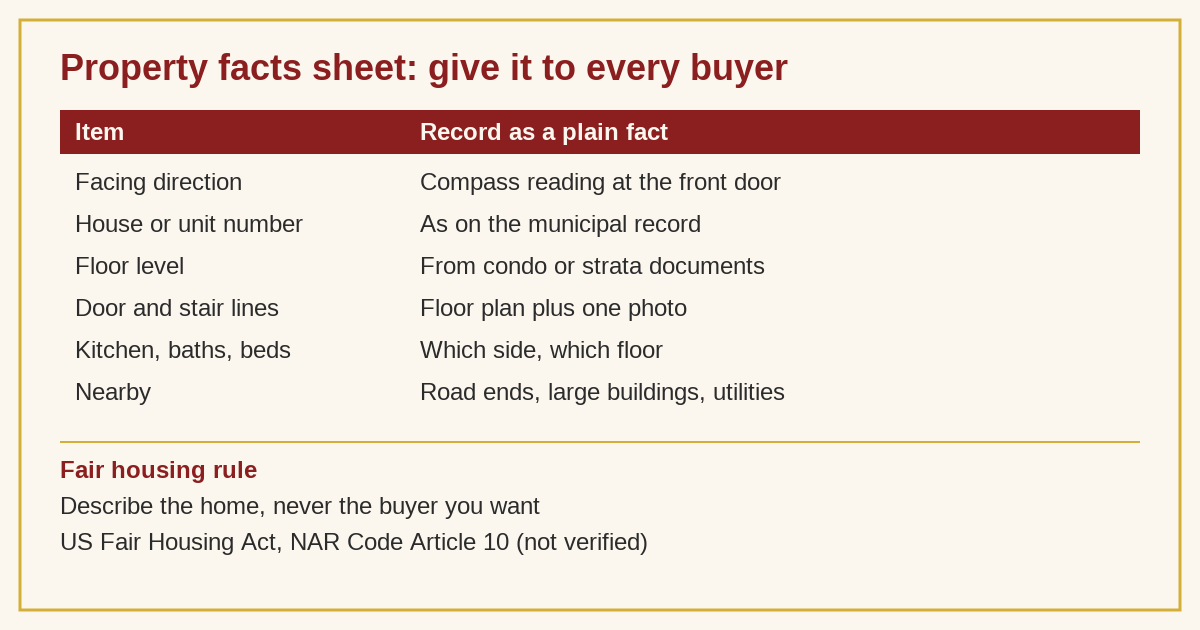
The fairest and most useful tool is a one-page sheet of neutral facts that you give to every buyer who walks in. It saves the seller from improvising and keeps the answers the same for everyone.
| Item | What to record | How |
|---|---|---|
| Facing direction | Direction the front door faces, and the direction of the back of the house | Stand at the front door facing out and read a compass app, then note it is a phone reading |
| House or unit number | As on the municipal record | Copy from the listing and tax record |
| Floor level | The unit's floor, for condos and apartments | From the strata or condo documents |
| Door lines | Front door to hall to back door, stairs relative to the front door | Floor plan and one photo |
| Kitchen and bathrooms | Which side of the house, which floor | Floor plan |
| Nearby | Road ends, intersections, large buildings, utilities visible from the lot | Walk the block and note what you see |
| Lot shape | Regular or irregular, corner lot or not | Survey |
| Known issues | Anything you must disclose under your state or provincial rules | Your disclosure form |
Everything on that sheet is a fact about the property. Hand it to everybody and you have answered the feng shui question without profiling anyone.
For the staging, room by room, see feng shui for selling a house.
Numbers: price, address and floors
Many buyers who follow the tradition like 8s and avoid 4s. The preference shows up in three places:
- List price and offers. A price ending in 8 is allowed for every buyer and is a cultural preference, not a proven advantage. See lucky list price and offer numbers for how far the evidence goes.
- The address. You cannot lawfully change a municipal address to flatter a buyer, and you should not hide a 4 in it. Give the address as it is.
- Floor numbers. Some buildings skip 4 or 14 in elevator labels. If yours does, say so factually when asked.
Set the price from comparable sales first and let the digits break a tie. Our how to price a home to sell guide shows the comparable-sales method.
What you can fix, and what you can only disclose
Split the list into three groups before the first showing:
- Fixable cheaply: a cluttered entry, a mirror facing the front door, a door that sticks, a dark hall, a stove that is hard to reach. See the seller's 10-day plan and the pre-sale checklist.
- Not fixable: facing direction, lot shape, street position, the building next door. These are facts to state, not defects to hide.
- Legally material: anything your state or province requires you to disclose, such as known defects. Rules differ by jurisdiction. California, for example, says in Civil Code 1710.2 that a seller need not disclose a death on the property that happened more than three years before the offer. A more recent death is then something to treat as a possible material fact (not verified since November 2026). Other states handle it differently. Ask your agent or lawyer what applies where you live, and do not answer "no" to a question you must answer honestly.
Never tell a buyer a feng shui cure has "fixed" a feature. Say what you did and let them judge.
Language, documents and communication
A translated floor plan, a bilingual summary or an interpreter at a showing is a service you can offer any buyer who needs it. Offer it on request or to everyone, never selectively. Contracts and disclosures stay in the form your jurisdiction requires, so buyers should have them reviewed by their own lawyer or agent. Don't give legal or financial advice along the way, and don't ask about immigration status, country of origin or the source of funds beyond what your lender or lawyer requires of every buyer.
Listing and marketing missteps
- Writing "great feng shui" or "lucky" in the listing as a selling claim. Nobody can verify it, and it describes a belief, not the property.
- Naming the buyer you hope for in the listing or agent notes.
- Placing ads only in media aimed at one national-origin group instead of adding them to your usual marketing, which can signal a preference. Advertising in another language is fine when the same listing also runs in your usual channels.
- Re-staging only when a buyer you assume follows feng shui comes to view. Stage once, for everyone.
- Renaming, renumbering or hiding the real address, floor or lot facts.
- Promising that a cure, a number or a compass direction will bring a buyer wealth, health or love.
Advertisement
FAQ
Is it legal to market a home to Chinese buyers?
Not by naming them. The US Fair Housing Act bars advertising that states a preference or limitation based on national origin, and it bars treating buyers differently on that basis (not verified since November 2026). You may describe the property's features, including its facing and its number, and welcome every buyer equally. Check your state, province and brokerage rules.
Do I have to disclose feng shui features?
Feng shui is not a legal category, so there is no disclosure rule for it as such. Disclosure rules cover material facts such as defects, and some places add deaths on the property or nearby conditions. Answer buyer questions honestly and use your local disclosure form.
Should I change my house number or price to end in 8?
You cannot lawfully change a municipal address for this purpose. A price ending in 8 is allowed for every buyer, but the evidence that it adds value is thin, so price from comparable sales first.
Can I ask a buyer if they follow feng shui?
Do not guess or profile. A neutral open question offered to every buyer, such as "Is there anything about layout or orientation that matters to you?", treats everyone the same and lets buyers raise what they care about.
What is the single most useful thing a seller can do?
Prepare a one-page facts sheet for the property, stage the home once for every visitor, and answer questions with facts. That covers the feng shui questions without separating buyers into groups.
Does feng shui actually affect resale value?
The tradition says it does, but the research is mixed and mostly about numbers rather than layout. Our resale value studies page sets out what is known and what is not.
Before the first showing
Use the table above to write your one-page facts sheet this week. Then read feng shui for selling a house to plan the room-by-room prep.
Sources
Checked November 2026. Where a rule here is marked "not verified since November 2026", read the current text at the source before you rely on it.
- Fair Housing Act (Title VIII of the Civil Rights Act of 1968), 42 U.S.C. 3601 and following, including 3604(c) on advertising, US Department of Housing and Urban Development.
- Code of Ethics and Standards of Practice, Article 10, National Association of REALTORS.
- California Civil Code section 1710.2, disclosure of a death on the property, State of California.
- Human rights codes of each Canadian province, provincial governments.
- Our own house number resale value studies page for the research on house numbers.
Editorial note: Feng shui is presented here as a cultural and design tradition. Fair housing, disclosure and contract questions depend on your location, so confirm them with a licensed agent or real estate lawyer.