Short answer
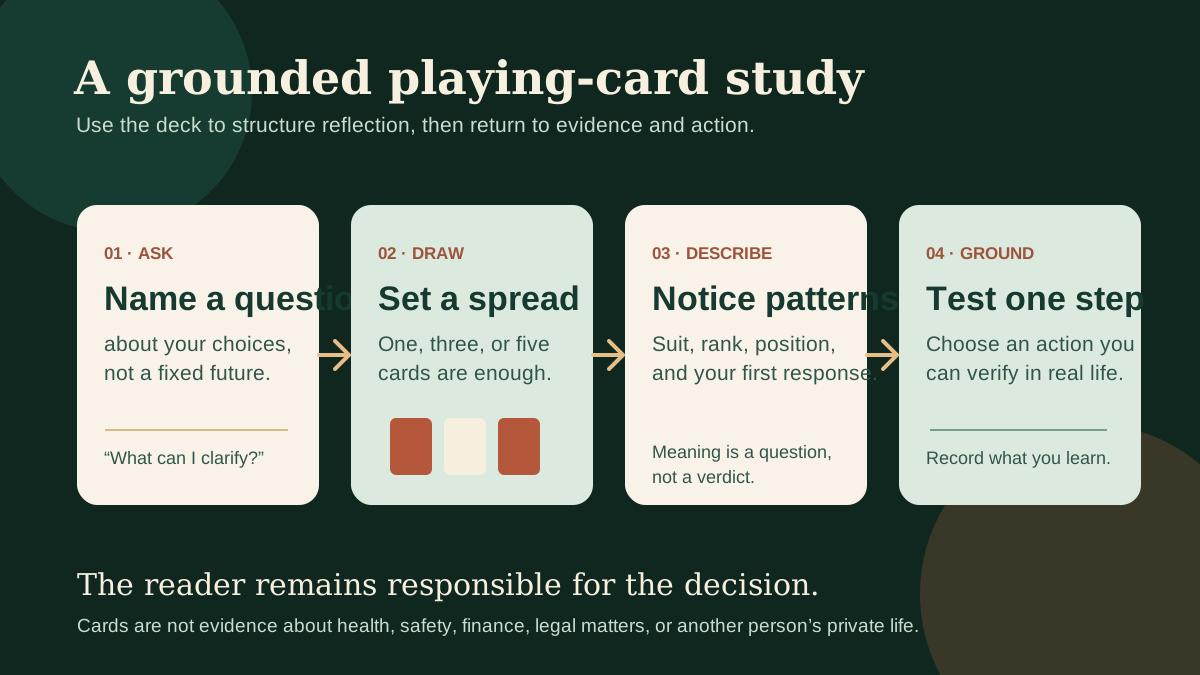
You can begin a playing-card reading with the deck you already own. Remove the jokers, choose one consistent set of suit and rank associations, ask a question about your own choices, draw one or three cards, and write what you notice before interpreting anything. End with one small action you can test in real life.
That is cartomancy: the use of playing cards in divinatory traditions. It can be a meaningful cultural, creative, or spiritual practice. It is not a way to verify the future, diagnose health, choose an investment, solve a legal problem, or know what another person secretly thinks. The strongest beginner practice makes the reader more observant and more responsible—not more dependent on the deck.
What cartomancy is—and why there is no single correct card meaning
Cartomancy is a broad name for reading cards as symbols. It includes practices with ordinary playing cards, tarot, Lenormand-style decks, oracle cards, and regional systems with their own histories. A standard pack of playing cards has travelled through games, trade, print culture, and fortune-telling traditions; it was not made as one universal codebook.
The historical record is more interesting than the claim that every card has one eternal answer. The Victoria and Albert Museum’s tarot history distinguishes early card games from later divinatory uses, and the British Museum’s Etteilla deck documents a late eighteenth-century cartomancy tradition. Those sources show that card reading has real cultural history. They do not turn any modern reading into evidence about someone’s destiny.
Different teachers may assign different meanings to the same card. A French 32-card practice, a 52-card English-language practice, a system inspired by tarot’s Minor Arcana, and a personal journal method may all use hearts, clubs, diamonds, and spades differently. The beginner mistake is not choosing one system; it is changing systems until a draw gives a reassuring answer.
Use this guide as a study system, not as a claim to represent every tradition. It gives each card two things:
- A repeatable symbolic prompt: suit + rank + spread position.
- A reality check: an action, conversation, research step, or boundary outside the cards.
| A playing-card practice can be | A playing-card practice cannot be |
|---|---|
| A way to pause and name a question | Proof that a future event will happen |
| A traditional or personal symbolic language | A diagnosis, treatment plan, or crisis response |
| A prompt for journaling and creative thinking | Evidence of a partner’s feelings, fidelity, or intentions |
| A ritual that helps you attend to a choice | Financial, legal, housing, immigration, or safety advice |
| A shared activity when everyone consents | Permission to override consent or observable facts |
That boundary makes readings safer and more useful. If a draw makes you feel pressured to spend, leave, confront, delay help, or fear someone, stop the reading. Name the actual issue and use appropriate support.
Set up a deck you can learn from
For a first month, use a standard 52-card deck with no jokers. Keep the cards in the same condition and use the same deck when you practise. This is not because a deck needs mystical preparation; consistency makes it easier to recognise patterns in your own notes.
You need only four things:
- A complete deck (ace through king in each suit).
- A notebook, loose index cards, or a private notes app.
- Ten unhurried minutes.
- A question you are willing to meet honestly.
If a table ritual helps you focus, clear a small surface, silence notifications, make tea, or take a few breaths. No purchase, incense, candle, crystal, or elaborate “cleansing” routine is required. Do not burn anything indoors to solve a question about air, mood, or safety. A practice should reduce pressure, not create another obligation.
Choose your rule for jokers and reversals
Leave the jokers out for now. Some traditions give them special meanings; others do not use them. Adding them before you know your base system makes it hard to tell what you are studying.
Also decide whether upside-down cards count. For this guide, they do not. A playing card’s orientation is easy to disturb while shuffling, and you already have suit, rank, position, and neighbouring cards to consider. After a month, you may add a reversal rule if it genuinely helps your journal practice. Complexity is not proof of depth.
Start with four suits as four kinds of attention
The suit map below is a simple English-language cartomancy vocabulary. Other traditions differ; write that fact at the top of your journal. The terms are deliberately broad, because a card should open a question rather than announce a life event.
| Suit | Common visual association | Study prompt in this guide | What not to claim |
|---|---|---|---|
| Hearts ♥ | Feeling, affection, connection | What emotion, relationship need, or conversation needs care? | That someone loves you, will return, or is faithful |
| Diamonds ♦ | Value, exchange, resources | What time, money, skill, access, or practical resource is involved? | That money, a job, or a purchase is guaranteed |
| Clubs ♣ | Effort, work, movement, communication | What action, practice, project, or message could move this forward? | That success, promotion, or a specific result is destined |
| Spades ♠ | Limits, thought, friction, endings | What boundary, uncertainty, difficult fact, or assumption deserves attention? | That harm, illness, betrayal, or disaster will occur |
These associations are prompts, not an emotional ranking. A spade is not automatically “bad,” and a heart is not automatically “good.” A heart can point to a conversation you are avoiding. A spade can point to a boundary that protects your time. The question and the position matter.
Advertisement
Add rank as movement, not a fortune-cookie definition
Instead of memorising fifty-two fixed predictions, use the ranks as stages in a small story. This original framework works with any suit.
| Rank | Reflection verb | Questions to ask |
|---|---|---|
| Ace | Begin | What has just appeared? What is the smallest honest start? |
| 2 | Relate | What is paired, compared, negotiated, or out of balance? |
| 3 | Build | What needs a third perspective, skill, or support? |
| 4 | Stabilise | What needs structure, rest, a routine, or a clearer container? |
| 5 | Test | What tension, change, or competing need is asking for attention? |
| 6 | Adjust | What can be repaired, shared, simplified, or brought back into proportion? |
| 7 | Examine | What is uncertain, hidden, incomplete, or worth researching? |
| 8 | Practise | What repeated action, boundary, or skill could help? |
| 9 | Integrate | What has become clearer? What is almost ready to review? |
| 10 | Complete | What needs closure, handoff, gratitude, or a decision? |
| Jack | Explore | What beginner energy, message, curiosity, or experiment is present? |
| Queen | Care | What needs stewardship, discernment, listening, or maintenance? |
| King | Direct | What responsibility, decision, or standard needs to be owned? |
For example, a Five of Diamonds in an “information I am missing” position might prompt: “What resource pressure or value conflict is shaping this choice?” It does not mean that you will lose money. A Queen of Spades in a “boundary” position could invite careful discernment: “What limit would let me think clearly?” It does not label anyone cold or dangerous.
The framework may feel less dramatic than a list of predictions. That is its advantage. It keeps interpretation flexible enough to be honest.
Ask a question that returns agency to you
Before you shuffle, write the question. A useful card question is narrow, present-focused, and within your influence. It describes your decision, observation, communication, or next experiment.
| Future-demanding question | Better cartomancy question | Grounded action outside the cards |
|---|---|---|
| “Will they come back to me?” | “What do I need to understand about my communication or boundary?” | Notice the facts, ask directly if appropriate, respect their answer. |
| “Will I get rich?” | “What information would help me make a more responsible money decision?” | Review a budget, disclosures, or qualified financial advice. |
| “Will I pass the exam?” | “What study habit would most improve my preparation this week?” | Make a study plan, practise questions, ask for help. |
| “Am I sick?” | “What symptoms or concerns should I record before seeking care?” | Contact a clinician or urgent service when needed. |
| “Should I move?” | “What practical facts and personal priorities do I need to compare?” | Check affordability, access, safety, contracts, and inspections. |
| “Is my friend lying?” | “What evidence do I have, and what respectful conversation is possible?” | Ask directly rather than treating a draw as proof. |
If you cannot rewrite the question without asking the deck to control another person or forecast a high-stakes outcome, do not use a reading for that decision. Cards are not a substitute for consent, evidence, or timely help.
Your first spread: one card, three lenses
One-card readings are excellent training because they remove the pressure to turn a large spread into a dramatic story. Use a one-card draw when you have ten minutes and a question such as, “What should I pay attention to while I prepare for this conversation?”
- Shuffle in any safe, ordinary way. Overhand shuffling, cutting, or a gentle table mix are all fine.
- Draw one card and write its suit and rank before looking for a meaning.
- Use three lenses: suit, rank, and your situation.
- Write one sentence beginning “I notice…” and a second beginning “I could test…”
- Put the card away. Do not draw again simply because the answer feels inconvenient.
Worked example: Eight of Clubs
Imagine you asked, “What could help me prepare more steadily for a course?” and drew the Eight of Clubs.
- Suit: Clubs in this guide invite attention to work, movement, communication, or practice.
- Rank: Eight asks about repetition and a skill that improves through a routine.
- Situation: You have a course and may be tempted to study only when panic arrives.
- Interpretation: “I notice that steady practice may matter more than a perfect plan.”
- Experiment: “I could block three 25-minute study sessions this week and record what actually gets in the way.”
The card did not predict a grade. It helped you turn an anxious question into a behaviour you can observe.
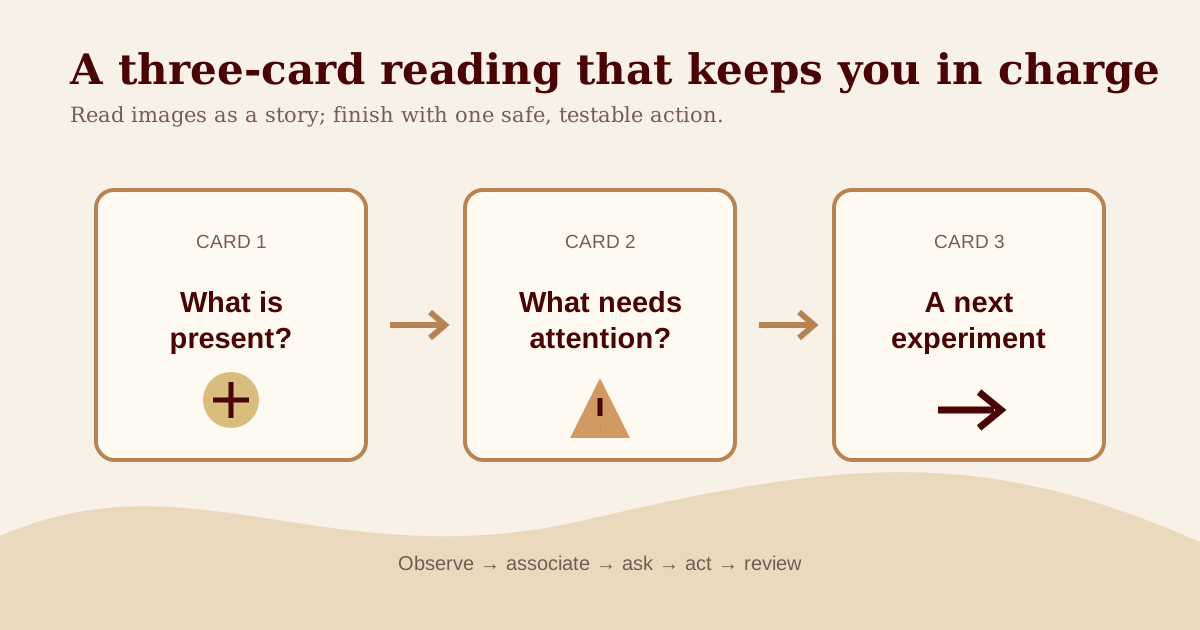
The three-card spread: context, tension, experiment
Once one-card notes feel familiar, draw three cards from left to right. Use these positions:
- Context: What is already active or visible?
- Tension: What needs closer attention, clarification, or care?
- Experiment: What modest next action can I test?
This differs from a Past–Present–Future spread on purpose. The third card is not a forecast. It asks you to choose a proportionate action and review it later.
How to read combinations without forcing a prediction
Read each card alone first. Then look for a relationship:
| Pattern | A useful question |
|---|---|
| Same suit appears twice | What area—feeling, resources, effort, or limits—has more weight in this situation? |
| Ranks climb upward | Is the situation moving from a small beginning toward a review or completion? What evidence supports that? |
| Ranks repeat | Is one kind of task repeating: building, testing, practising, or setting a boundary? |
| Hearts beside Spades | Where do feeling and a limit need to coexist rather than compete? |
| Diamonds beside Clubs | What resource would make an action more realistic? |
| Court card beside a numbered card | What kind of care, exploration, or direction would help a practical stage of the work? |
Treat every combination as an invitation to ask, not a code to decode. You can write two possible interpretations and choose the one that produces the safer, more specific real-world action.
Worked example: preparing for a difficult choice
Question: “How can I approach a change in my living situation with more care?” Draw: Two of Hearts, Seven of Diamonds, King of Spades.
Context — Two of Hearts. The study prompts connection, comparison, and an emotional conversation. You might notice that your decision affects another person or that you are trying to decide alone when a discussion is needed.
Tension — Seven of Diamonds. The study prompts an incomplete resource picture. Rather than calling this “bad money luck,” list what is missing: lease terms, moving cost, commute time, repairs, access needs, savings, or help from friends.
Experiment — King of Spades. The study prompts responsible direction around a limit. A grounded action might be: “Make a one-page decision sheet with the facts I need, and do not sign or announce anything before I have them.”
This is a successful reading because it leads back to housing facts, not because the cards “knew” where you should live. For a practical companion, use the home-buying checklist and any qualified local advice relevant to your decision.
The four-column journal that makes practice useful
A journal is the difference between learning a symbolic language and repeatedly asking for reassurance. After every reading, make four columns:
| Card record | Visible details | Possible prompt | Grounded follow-up |
|---|---|---|---|
| Date, question, spread position, card | What suit, rank, colour, pattern, and first reaction did you notice? | What two non-predictive interpretations could fit? | What one safe action will you take, and what happened when you reviewed it? |
Keep the “possible prompt” column plural. Two options protect you from declaring the first story to be true. In the follow-up column, record observable outcomes: “I asked for the contract,” “I booked a study session,” “I apologised,” “I learned the cost was higher,” “Nothing changed because I did not take the action.”
After five readings, review the journal for your patterns instead of looking for magic. Do you repeatedly ask about the same relationship? Are you avoiding a conversation? Do diamonds make you anxious because money is tight? Does every spade become a catastrophe in your notes? Those observations can lead to a much more valuable question than “What does this card predict?”
A seven-day beginner practice
Day 1 — Learn the deck as an object. Sort the cards by suit and rank. Notice symbols, colours, and the style of the court cards. Do not interpret.
Day 2 — Practise the suit prompts. Draw four cards, one from each suit. Write a question each suit might ask about a current low-stakes situation.
Day 3 — Practise the rank verbs. Pull three numbered cards. Use the rank table to write a beginning, tension, or routine prompt without attaching it to a future outcome.
Day 4 — Make one question better. Take an anxious prediction question and rewrite it as a question about your choices. Do not draw until the rewrite feels honest.
Day 5 — Try one card. Use the three lenses and choose one small action.
Day 6 — Try three cards. Use context, tension, experiment. Keep the final position as an action, not an answer about the future.
Day 7 — Review. Revisit the action. What happened? What evidence changed your view? This review is part of the reading, not an optional extra.
Read with other people only when it is welcome
Cards can be a warm shared activity, but consent is not a decorative add-on. Ask before reading for someone. Explain the approach: “I use cards as reflection prompts, not predictions. Would you like to try a question about your own choices?” Accept no quickly and kindly.
Never use a spread to pronounce on someone’s health, pregnancy, sexuality, trauma, loyalty, private messages, mental health, immigration status, legal rights, or future. Do not record or share their cards without permission. If they bring up abuse, coercion, self-harm, a medical concern, financial emergency, or immediate danger, stop the reading and focus on appropriate real-world help.
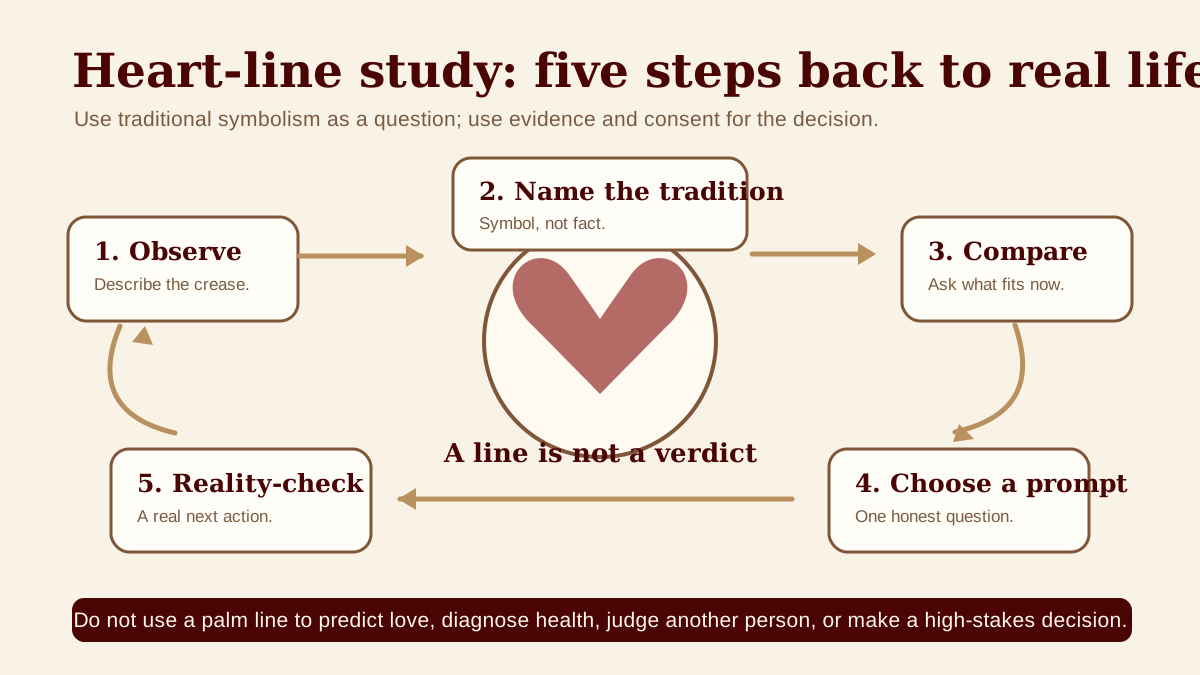
For relationship questions, cards are not a replacement for listening. The heart-line study guide uses the same principle: symbolic traditions can prompt reflection, but they cannot decide what another person feels. For a practical shared-space conversation, the couples’ bedroom layout guide focuses on lighting, routes, storage, and consent.
Common beginner traps
Treating spades as a bad omen
Spades often carry the strongest online warnings. In this guide, they ask about a limit, difficult fact, thought pattern, or boundary. That can be uncomfortable and still be useful. A spade is never evidence that illness, loss, betrayal, or danger is coming.
Pulling clarifier after clarifier
If you keep drawing until a spread feels soothing, you are no longer practising interpretation; you are chasing certainty. Set a limit before you begin: one card or three cards, one journal entry, one action. You may read again next week after you have lived the action.
Mixing every system you find online
One site may map clubs to fire; another may map them to work; another may copy tarot meanings. Choose one named method for a month. You can compare traditions later, with clear notes about where each association came from.
Reading about a third party
Uncertainty about another person can feel unbearable. It is still not consent to investigate them with cards. Shift from “What are they hiding?” to “What do I need to ask, observe, or decide about my own boundary?”
Letting a draw delay help
Do not use cards to decide whether symptoms need care, whether you should leave an unsafe situation, whether a contract is sound, whether to make an investment, or whether to contact emergency support. Handle the real decision first. The cards can wait.
Where to go next
When you are comfortable with a playing-card system, compare it with the broader three-card reading guide. It explains how tarot, oracle, and story-card imagery can be read through observation and a testable next step. The browser-based Reading Lab offers a low-stakes symbolic practice without asking you to claim a future.
If your interest is cultural study, the responsible face-map guide and BaZi Four Pillars guide explain their own vocabularies and boundaries. Each tradition has its own history; none gives a reader permission to make medical, financial, romantic, or character judgments about another person.
Frequently asked questions
Which playing-card deck is best for a beginner?
Use a complete, readable deck you are happy to handle often. A plain deck makes it easy to see suits and ranks. Avoid a novelty deck with hard-to-read symbols until you know the basic structure. The best deck is one you can keep consistent while you learn.
What does an ace mean in cartomancy?
Meanings vary across traditions. In this study system, an ace is a beginning: a new question, a first piece of information, or a small action. Combine it with the suit and the spread position. It is not a guaranteed new relationship, job, payment, diagnosis, or event.
Can I use playing cards instead of tarot?
Yes. Playing-card cartomancy and tarot are related through broader card-reading history but are not identical systems. A standard deck has four suits and thirteen ranks, while a common tarot deck has 78 cards with additional Major Arcana imagery. Start with the deck you own and avoid pretending its cards have meanings it does not show.
Are card meanings the same in every country or tradition?
No. Card-reading traditions vary by language, period, region, teacher, and deck size. That is why a journal should name the system you are using. Consistency is more useful than mixing a dozen incompatible lists.
What if a reading makes me anxious?
Stop. Put the cards away, write the actual concern in plain language, and choose a real support: a conversation, evidence gathering, a qualified professional, or emergency help when needed. A card is an image, not an emergency message.
Keep the reader in charge
The practical value of cartomancy is not certainty. It is the pause between a question and a reaction. Use the deck to notice a theme, write more than one possible interpretation, and choose one action that reality can confirm or change. The cards can be part of the ritual; the responsibility remains yours.