Short answer
The heart line - often called the love line in popular palmistry - is the uppermost major crease that runs below the fingers across the palm. In different palmistry traditions, it has been associated with emotion, affection, and the way a person relates to connection. It cannot predict a marriage, breakup, partner, health condition, number of children, or future event. The useful way to study it is to locate it carefully, describe what you see without labels, compare one traditional interpretation as cultural context, and choose a real-world relationship action based on evidence and consent.
People often search for a heart-line reading when a relationship feels uncertain. That makes the usual online answer tempting: a break means heartbreak, a fork means two lovers, a short line means someone cannot love, or a tiny mark means illness. Those claims can be frightening and can give a line more authority than the people involved in a relationship.
Palmistry has a long and varied history as a divinatory and interpretive practice. The U.S. National Library of Medicine’s collection includes seventeenth-century chiromancy material, and the Wellcome Collection holds a historical manuscript that joins palmistry with other fortune-telling traditions. Those records show that hand reading has been a cultural practice. They do not make it a medical test or a reliable forecast.
This guide treats the heart line as a study object and conversation prompt. It gives you something better than a dramatic prediction: a repeatable way to notice a question you already have and decide what evidence or conversation would actually help.
First, find the line - not the story
Hold one hand palm-up in daylight or under even indoor light. Relax the fingers. The heart line is usually the highest of the three large creases running across the palm, below the finger bases and above the head line. It commonly starts toward the outer edge beneath the little finger and travels toward the index or middle finger.
Hands do not all show the same map clearly. Creases vary by skin, movement, work, age, lighting, injury, and the way a hand is held. Some palms have a single transverse crease where popular diagrams separate the head and heart lines. Do not force a label onto a crease just because an image online says every hand should look the same.
Start with these neutral observations:
| Observe | Write, don’t interpret yet |
|---|---|
| Location | Is this the highest long crease below the fingers? Where does it seem to begin and end? |
| Route | Does it look mostly straight, gently curved, faint, segmented, or difficult to trace? |
| Visibility | Is the line easiest to see in one light or when the hand is relaxed? |
| Comparison | What differs, if anything, between your two hands? |
| Context | What question made you look at this line today? |
That last question matters most. “I am wondering how to raise a difficult topic with my partner” is a question you can work with. “Will my relationship end?” is understandable, but a palm line cannot answer it. Rewrite the second question into something you can observe or discuss.
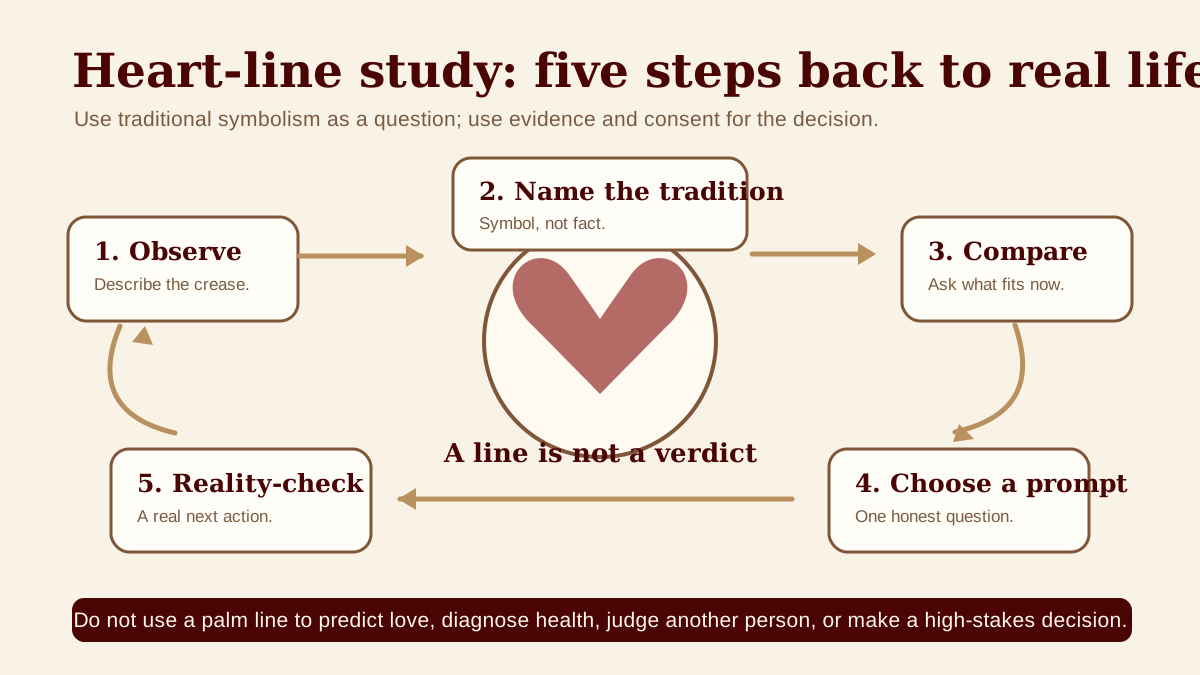
The five-step heart-line observation loop
Use this original Lucky Properties method whenever you meet a traditional claim about a mark, a line, or a hand shape.
1. Observe
Describe the crease as if you were preparing a drawing for someone else. Avoid emotional adjectives such as “bad,” “damaged,” “lucky,” or “cold.” A neutral note might say: “The upper line looks faint near the little-finger side and curves up before the index finger.”
2. Name the tradition
Identify the claim as a traditional reading, not a fact about a person. For example: “Some Western palmistry books associate a line ending nearer the index finger with idealism in affection.” Or: “Some popular Chinese palm-reading guides call this the love line and connect it to attitudes toward relationships.” Traditions differ; translations and schools differ too.
3. Compare, don’t confirm
Ask whether the tradition gives you language for a present question, rather than proof of a hidden trait. “Idealism” might lead to a useful reflection on expectations. It does not establish that you are demanding, loyal, romantic, selfish, emotionally unavailable, or destined for a particular kind of relationship.
4. Choose one prompt
Turn the reading into a question you could answer directly. Examples:
- What expectation have I not said aloud?
- Where do I need more information instead of reassurance?
- What boundary would make this relationship feel more respectful?
- What kind conversation am I avoiding because I want certainty first?
- What would I tell a friend to check before drawing a conclusion?
5. Reality-check the next action
Choose something outside the palm: talk with the person involved, review a shared plan, apologize, ask for clarification, pause before messaging, or seek qualified support when the situation is serious. If the question involves safety, coercion, health, money, housing, legal rights, or self-harm, skip the reading and use real help immediately.
The loop keeps the line in its proper place: a cultural image that may stimulate reflection, never a verdict.
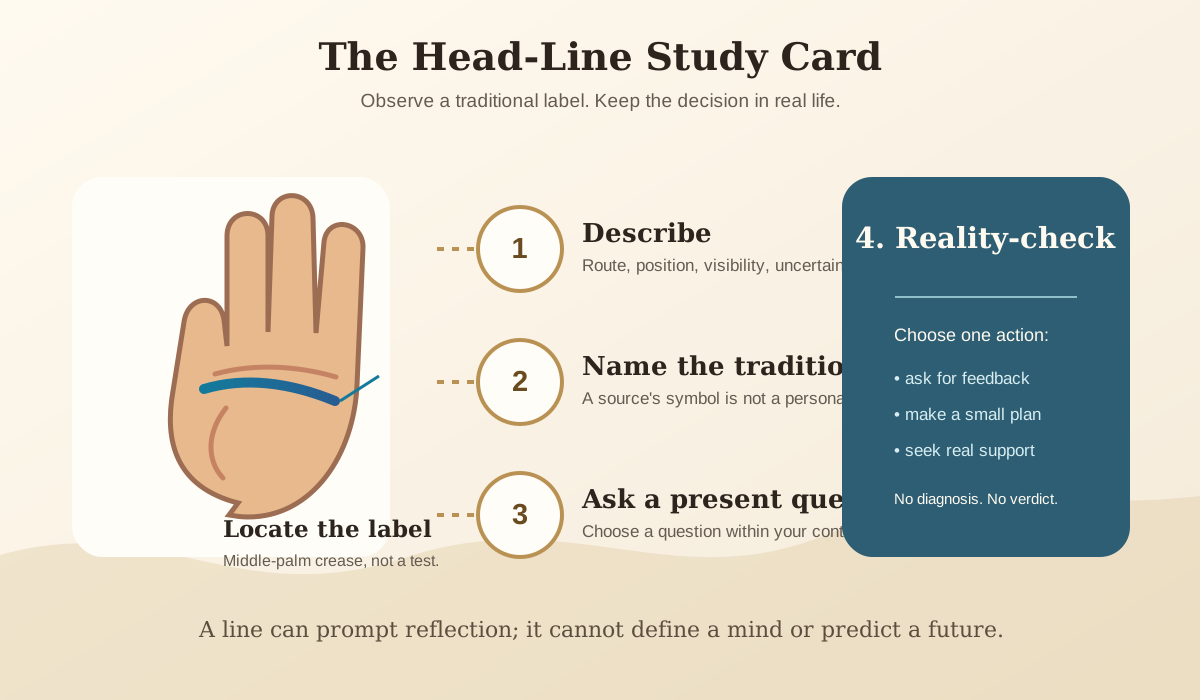
The head-line study guide applies the same five-part method to the middle palm crease, where online readings often drift into unsupported claims about intelligence, personality, and mental health.
Advertisement
What traditions commonly associate with the line
Palmistry systems are not one universal method. In English-language Western chiromancy, many writers focus on the line’s endpoint, curvature, depth, and branches. In popular Chinese palm-reading material, the heart line is likewise connected with love and emotional expression, but the terminology and detailed claims vary. The common thread is symbolic association with feeling and connection - not a confirmed biological or psychological measurement.
Here is a cautious translation of common themes into study prompts:
| Feature someone notices | Traditional theme often attached | Better question to ask |
|---|---|---|
| Ending nearer the index finger | Idealism or high hopes | What do I need from a relationship, and have I made that clear? |
| Ending nearer the middle finger | Reserve or practicality | When do I use practicality to avoid naming a feeling? |
| Gentle upward curve | Expressiveness or warmth | How do I prefer to give and receive affection in daily life? |
| Relatively straight course | Restraint or steadiness | Which forms of care feel meaningful to me even when they are quiet? |
| Fork or small branch | Holding more than one consideration | What trade-off am I trying to balance? |
| Faint, irregular, or hard-to-follow area | Complexity or a period of change in some readings | What is actually uncertain right now, and what information would reduce uncertainty? |
The middle column is a record of a tradition, not an assessment. The right-hand column is the reason to study it: it converts a vague, potentially scary claim into a question you can answer with experience and conversation.
Three myths that deserve a firm no
“A broken line predicts heartbreak or divorce”
No. A mark cannot forecast a relationship event or another person’s behavior. Even palmistry writers who use breaks as symbols disagree about what they mean. A break can remind you that change and uncertainty exist in every relationship. It cannot tell you the cause, timing, or outcome of a conflict.
“Short means cold; long means loyal”
No. A crease length is not a capacity-for-love test. It cannot measure attachment, kindness, empathy, sexuality, fidelity, or emotional maturity. If a description feels cruel or flatters you too perfectly, that is a sign to step back from it.
“The heart line reveals heart health, stress, or mental health”
No. Some historical palmistry texts blended character and bodily claims, which is one reason modern readers need boundaries. A hand line cannot diagnose cardiovascular symptoms, trauma, anxiety, depression, autism, intelligence, or a personality disorder. Use a clinician or qualified mental-health professional for health questions; use a trusted person or support service for relationship distress.
Reading your own hand versus reading another person
Self-study can be a private way to notice your hopes and fears. Reading someone else’s hand is different because an interpretation can land as a judgment. Ask first. Explain the limit first. Let them choose the question. Stop if they look uncomfortable.
Never use palmistry to claim that someone is dishonest, infertile, unfaithful, mentally ill, violent, unintelligent, weak, or “meant” to be with or without someone. Do not photograph another person’s hand or upload it to a tool without their meaningful consent. A playful reading is not permission to turn a body into evidence.
For a safer shared activity, try this script: “This is a traditional symbol, not a fact about you. Would you rather use it as a prompt about what you value in connection, or skip it?” That creates room for curiosity without pressure.
A worked example: from a fork to a conversation
Imagine that you notice a fork near the end of your heart line. A quick search might call it a sign of two relationships, divided love, or a future marriage. Instead, run the observation loop.
- Observe: “The line appears to divide into two faint ends near the index and middle fingers.”
- Name: “Some palmistry sources connect endings or forks with balancing emotional and practical concerns.”
- Compare: “I have been trying to balance family expectations with the pace my partner and I want.”
- Prompt: “What has each of us assumed instead of discussed?”
- Reality-check: “We will set aside twenty minutes this week to compare expectations about time, money, or family boundaries.”
The value came from the conversation, not from the fork. If the relationship contains fear, control, threats, or safety concerns, use appropriate support rather than a symbolic exercise.
How to make a simple heart-line study record
Keep the note short enough that you will actually use it. Here is a six-line worksheet:
Date and hand observed:
Neutral description of the line:
Traditional theme I encountered:
Question I want to understand:
Evidence I already have:
One respectful next action:
Do not track “predictions” and then reinterpret ordinary events as proof. That habit creates a story that cannot be tested. Track the action you chose and whether it improved clarity, respect, or communication. This gives the practice a useful feedback loop.
Use the guided Palm Study
The Reading Lab’s Palm Study lets you select a line, read a brief traditional lens, and choose a reflection prompt. It is designed for exactly this purpose: find a line, learn the symbolism, and leave with a real-world question rather than a forecast.
If your relationship question is shared, you may also find the Chinese zodiac compatibility guide useful as a cultural comparison exercise. Keep that guide in the same category as this one: it can create a conversation, but it cannot decide who is right for you. For a practical shared-space question, the couples bedroom layout guide turns “harmony” into lighting, storage, access, and consent choices.
Sources and limits
This guide treats palmistry as a historical and cultural practice, not as science or medicine. Historical context: National Library of Medicine, The Treasury of Palmistry and Wellcome Collection’s chiromancy and physiognomy manuscript. For an example of current popular Chinese heart-line coverage and the kinds of deterministic claims this page does not adopt, see Your Chinese Astrology’s heart-line guide. Never use this page to assess a medical symptom, diagnose a person, decide a high-stakes relationship issue, or judge someone without consent.
What to read next
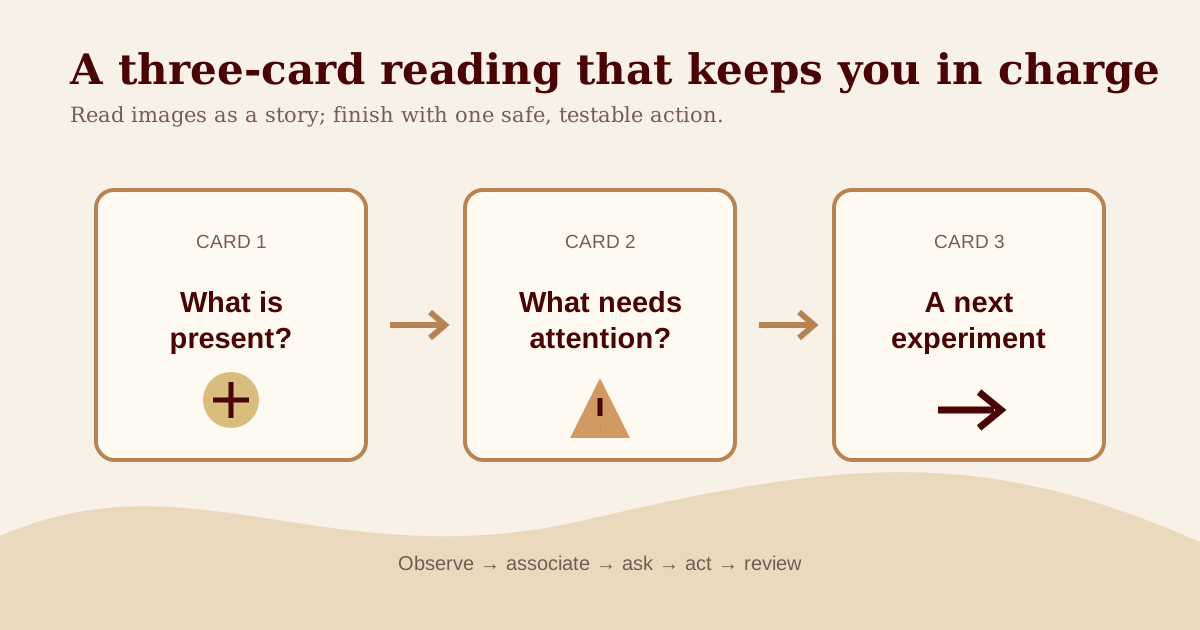
Continue with the guided Palm Study if you want to practise locating a line and choosing a reflection prompt. If you prefer a random symbolic exercise, the three-card reading guide teaches a structured way to turn a card draw into a grounded next step.