Short answer
BaZi, often translated as Four Pillars or Eight Characters, is a Chinese calendrical and interpretive tradition that arranges a birth year, month, day, and hour into four stem-and-branch columns. Beginners usually start with the Day Master, then learn the Five Element relationships and the Ten Gods vocabulary. A chart can be a meaningful cultural study or reflection tool. It cannot establish a person’s intelligence, health, compatibility, career fit, financial prospects, moral character, or future.
The best way to begin is to learn the chart’s grammar before reading a verdict into it. Check the birth data, distinguish the four columns, identify the Day Master as the reference point used by many modern systems, and translate each label into a question you can reflect on—not an instruction about money, love, medicine, work, or another person.
What BaZi is—and what it is not
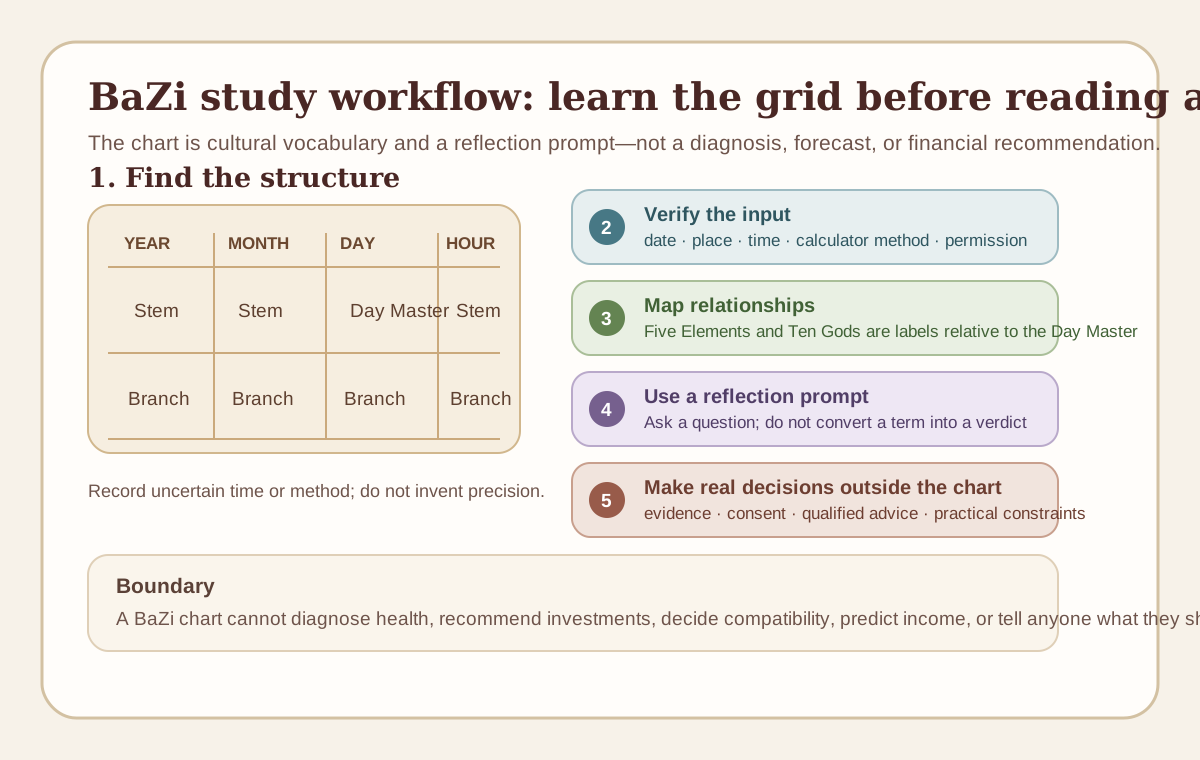
BaZi (八字, “eight characters”) uses four pillars: Year, Month, Day, and Hour. Each pillar is commonly shown with a Heavenly Stem on top and an Earthly Branch below, yielding eight principal characters. Calculators may also display hidden stems, element counts, seasonal context, luck pillars, stars, or long narrative reports. Those additions are interpretations layered onto the core grid, not independent facts about a person.
The phrase “Four Pillars of Destiny” can encourage a mistaken expectation that a chart is a fixed report about a life. It is better understood as the name of a cultural divination and calendrical system. A BaZi chart cannot diagnose health conditions, choose investments, decide whether someone should marry or leave a job, identify a child’s ability, or predict harm. Do not use it to judge, hire, date, exclude, pressure, or advise someone else.
This guide uses the system for cultural learning. It does not give personalised readings. If a birth time is uncertain, say that it is uncertain; do not fabricate precision to make a report sound authoritative.
The chart at a glance
| Column | Common name | What appears in the grid | A careful way to study it |
|---|---|---|---|
| 1 | Year pillar | One stem above one branch | Learn how the chart is placed in a cyclical calendar; do not reduce a person to a zodiac animal |
| 2 | Month pillar | One stem above one branch | Notice seasonal and calendar context used by the tradition; do not treat it as career advice |
| 3 | Day pillar | One stem above one branch | Locate the Day Master, the usual reference point for elemental relationships |
| 4 | Hour pillar | One stem above one branch | Understand that time accuracy affects the output; do not invent an hour or forecast later life |
The Day Master is the Heavenly Stem in the Day column in many modern BaZi learning paths. Cosmic Tao’s beginner guide and MyBazi’s Day Master overview both use that starting point. Their shared structure is useful for a learner: you need a reference point before a relationship label means anything. It is not proof that a stem measures a person.
Your chart is not a personality test
The same chart language is sometimes packaged as a Chinese version of a personality quiz. That is a poor use of the system. Charts do not account for upbringing, culture, disability, education, housing, relationships, opportunity, trauma, choices, or changing circumstances. A label can be a prompt to ask a better question; it is not an explanation of why someone behaves as they do.
Use this sentence whenever a report sounds too certain: “This is a traditional relationship label, not evidence about a person.”
Step 1: verify the input before reading the output
A chart begins with date, time, and place. Those details are sensitive personal information. Use only your own data or data you have permission to handle. Do not upload a child’s, partner’s, employee’s, client’s, or friend’s birth details to a site just because you are curious.
Before you generate a chart, record these items:
| Input | Why it matters in a calculator | What to do if it is uncertain |
|---|---|---|
| Date of birth | Calendar conversion depends on it | Use the documented official date and note any calendar conversion |
| Place of birth | Time zone and local time may affect a result | Enter the actual place, not where the person lives now |
| Birth time | The Hour Pillar may change with the time | Mark the time as unknown rather than guessing |
| Method | Tools may use solar terms, local time, or other conventions | Save the method and avoid comparing incompatible outputs |
| Purpose | A study exercise needs less data than a personal consultation | Keep the question modest and avoid high-stakes decisions |
Two calculators can produce different charts because they use different time zones, solar-term boundaries, clock-time rules, or settings. That is a cue to inspect methods, not to choose the output that sounds most flattering. The Ba-Zi.ai beginner guide notes that birth time affects whether an Hour Pillar is present; use that limitation openly.
Privacy check before using an online BaZi tool
Birth date, time, and location can be identifying in combination. Read the tool’s privacy notice, avoid entering someone else’s data, and do not post a full chart on a public forum if the person has not agreed. A chart screenshot can reveal more than a zodiac sign. If you only want to learn the system, use a fictional example or the blank grid below.
Advertisement
Step 2: learn the Five Elements as relationships, not diagnoses
BaZi uses the Five Elements—Wood, Fire, Earth, Metal, and Water—and Yin/Yang polarities to organise relationships among chart characters. The generating and controlling cycles are traditional conceptual tools. They are not scientific models of bodies, jobs, investment markets, or psychological traits.
| Relationship from the Day Master | Traditional shorthand | A neutral learning question | Do not convert it into |
|---|---|---|---|
| Same element | Companion | What does this tradition call things that resemble the reference point? | A verdict on friends, siblings, or competition |
| Element produced by the Day Master | Output | How does the system name expression or production relative to the reference point? | A measurement of creativity or a child’s ability |
| Element controlled by the Day Master | Wealth | How does the system group resources and exchange in symbolic language? | Financial, property, trading, or career advice |
| Element that controls the Day Master | Authority | How does the system describe structure, pressure, or responsibility? | Legal, medical, workplace, or moral judgment |
| Element that produces the Day Master | Resource | How does the system group support, learning, or replenishment imagery? | A claim about education, parents, or health |
The word Wealth is especially easy to over-read. In Ten Gods terminology it names a relationship category, not a portfolio recommendation or a promise of income. A “wealth star” does not tell you which assets to buy, whether to lend money, whether a property will rise, whether to start a business, or whether someone will become rich. For financial decisions, use licensed or qualified help appropriate to your location and situation.
A visual way to learn the cycles
Draw five circles and connect Wood to Fire, Fire to Earth, Earth to Metal, Metal to Water, and Water to Wood for the generating sequence. Then draw the traditional controlling sequence: Wood–Earth, Earth–Water, Water–Fire, Fire–Metal, Metal–Wood. Label each arrow “traditional relationship,” not “cause.”
That one-page exercise helps explain why a Ten God category is always relative to the Day Master. It does not make an element a medical profile or a life plan.
Step 3: understand the Ten Gods vocabulary
The Ten Gods (十神) are labels created by combining a Five Element relationship with Yin/Yang polarity. They are not religious beings, despite the English word “God.” They are not ten personality types. The Ori Blueprint’s guide makes the useful beginner point: the labels are relationships back to the Day Master, not standalone identities.
| Ten God pair | Traditional name | Relationship family | Study prompt |
|---|---|---|---|
| 比肩 / 劫財 | Friend / Rob Wealth | Companion | How does the tradition distinguish sameness and competition? |
| 食神 / 傷官 | Eating God / Hurting Officer | Output | How are expression and production named in this vocabulary? |
| 正財 / 偏財 | Direct Wealth / Indirect Wealth | Wealth | What does the translation hide about the original relationship category? |
| 正官 / 七殺 | Direct Officer / Seven Killings | Authority | How do traditional titles frame rules, pressure, and formal structure? |
| 正印 / 偏印 | Direct Resource / Indirect Resource | Resource | How is support, learning, or replenishment described? |
Translations can sound dramatic. “Rob Wealth” is not an instruction to avoid a person, “Seven Killings” is not a violence assessment, and “Hurting Officer” is not a disciplinary diagnosis. Keep the original term and translation together when you study, then write a neutral note about its relationship family. This prevents a word choice from turning into a prediction.
A blank-chart reading worksheet
Use this original Lucky Properties worksheet with a fictional chart or your own chart only. It teaches the reading order without asking the chart to decide your life.
| Pass | What to mark | Question to write down |
|---|---|---|
| 1. Structure | The four pillar headings and the stem/branch positions | Can I identify the grid without interpreting it? |
| 2. Reference | The Day Master | What is my reference point for the next labels? |
| 3. Element map | Which elements appear in the visible stems | Which relationships does the chart’s vocabulary use? |
| 4. Ten Gods | One label at a time relative to the Day Master | Am I treating the label as a category rather than a trait? |
| 5. Context | Time accuracy, calendar method, and missing data | What is uncertain or not represented? |
| 6. Reflection | One real-world question outside the chart | What evidence, conversation, or professional advice belongs here? |
The worksheet works because it slows the process down. Many beginner reports race from “Wood Day Master” to a conclusion about career, health, love, or money. This method does the opposite: it shows what the chart actually contains, where an interpretation begins, and where the chart needs to stop.
Worked fictional example: learn the grammar without a verdict
Imagine a fictional chart whose Day Master is a Yang Wood stem. A beginner can use the Five Elements table to map the traditional relationship categories: Wood is Companion, Fire is Output, Earth is Wealth, Metal is Authority, and Water is Resource. That is all the example proves.
It does not prove the fictional person should work with land, avoid metal industries, invest in Earth-related assets, marry a particular element, take risks, or worry about health. Those are extra stories that a chart cannot verify.
Instead, use a reflection that has an observable answer: “What is one resource I need for the current project?” The answer might be time, a source, a meeting, a budget, an accessible workspace, or a break. The traditional Resource label can be a metaphor for asking that question. The plan still needs ordinary evidence and action.
How to read an online BaZi report without being overwhelmed
Generated reports often place dozens of labels beside a chart: favourable elements, useful gods, hidden stems, combinations, clashes, noble people, stars, luck pillars, and annual influences. A long report can feel more credible simply because it is long. Slow down and separate three kinds of information.
| What the report shows | What to do with it | What not to do |
|---|---|---|
| Calendar structure | Check whether the four pillars match the inputs and method you recorded | Assume the output is accurate because it has Chinese characters |
| Traditional label | Look up the term, its translation, and its relationship to the Day Master | Treat a dramatic name as a warning, diagnosis, or instruction |
| Personal conclusion | Ask whether the report is making an evidence-free claim about money, health, love, work, or a future event | Make a high-stakes choice because the wording sounds tailored |
Start with no more than three terms in one session. A sensible order is: Day Master, one Five Element relationship, and one Ten God label. Make a small glossary card for each: Chinese term, English translation, relationship family, source, and a plain-language question it raises. For example, a card for 正財 (Direct Wealth) can say: “Traditional Ten God label in the Wealth family; not an income prediction; prompt: what real-world resource or exchange needs organised records?”
This study method has an important benefit: it makes uncertainty visible. If a site does not explain its calendar conversion, uses unexplained scores, or claims it knows your income, illness, soulmate, or legal outcome, you have a reason to stop rather than search for a more flattering answer. A respectful cultural study does not require fear, urgency, secrecy, or a purchase to be useful.
A fifteen-minute first study session
- Use a fictional chart or your own data with a documented source and method.
- Draw the 2-by-4 grid and label Year, Month, Day, and Hour.
- Circle the Day Master only; do not interpret every symbol at once.
- Identify one element relationship using the reference table above.
- Translate one Ten God term into neutral language and write what it does not prove.
- Finish with a real question outside the chart: a source to read, a person to ask, a budget to review, or a practical next step.
Stop there. Learning the grammar over several sessions is more valuable than collecting a page of predictions in one evening.
Timing, luck pillars, and the danger of false precision
Many BaZi reports add ten-year luck pillars, annual layers, clashes, combinations, and stars. These systems can be fascinating subjects for historical and cultural study. They also create the greatest risk of false precision because the report sounds tailored to a particular year, job, relationship, illness, or financial choice.
Do not use timing layers to:
- buy, sell, borrow, lend, trade, or choose an investment;
- delay care, treatment, or an urgent safety action;
- decide whether a partner, employee, child, or colleague is trustworthy;
- make an immigration, legal, property, education, or employment decision;
- claim that a future event is certain.
If a timing report makes you anxious, stop reading it. Write down the real decision and the information you need from the relevant people or professionals. A calendar or chart can be a private ritual; it should never become a source of coercion.
How to use a BaZi reflection responsibly
Use the chart only after the real question is clear. A good reflection question is specific, reversible, and based on evidence you can gather.
| Instead of asking… | Try asking… | Useful next step |
|---|---|---|
| “Will I become wealthy?” | “What financial question needs a budget, contract review, or qualified advice?” | Gather records and speak with an appropriate professional |
| “Is this person right for me?” | “What values, boundaries, and conversations matter in this relationship?” | Discuss them directly; do not use a chart as a verdict |
| “Will I be healthy this year?” | “Do I have symptoms, care needs, or routines that deserve professional attention?” | Contact a qualified health professional when needed |
| “Is this my career?” | “What skills, constraints, interests, and opportunities can I test?” | Research, talk to mentors, or run a small experiment |
| “Is this a bad year?” | “What practical risks and supports should I review?” | Make a contingency plan from real information |
This approach respects a reader’s interest in Chinese metaphysics without turning it into instruction that can harm them or another person.
BaZi and the Chinese zodiac are not the same thing
The zodiac year animal is one familiar entry point to Chinese calendar culture. BaZi uses a fuller grid of year, month, day, and hour pillars. A Snake, Rat, Horse, or other animal label is not a complete BaZi chart, and it is not a reliable compatibility score.
If you enjoy zodiac symbolism, use the Chinese zodiac love-compatibility guide as a conversation starter. It explains the animal cycle and its limits without reducing a relationship to a match score. For date vocabulary and 12 Officers, read the Tong Shu study guide before treating an annual or daily label as personal advice.
BaZi questions
What are the Four Pillars in BaZi?
They are the Year, Month, Day, and Hour columns. In a standard display, each column has a Heavenly Stem and Earthly Branch, giving eight principal characters. The display is a calendrical structure; it is not a proven assessment of a person.
What is a Day Master?
In many BaZi learning systems, it is the Heavenly Stem in the Day Pillar and serves as the reference point for element relationships and Ten Gods. It is not a personality type, diagnostic result, or explanation of a person’s life.
What are the Ten Gods?
They are traditional relationship categories calculated in relation to the Day Master, combining Five Element and Yin/Yang relationships. Despite the name, they are not religious deities and should not be read as fixed traits or predictions.
Does a BaZi chart show wealth or career success?
No. “Wealth” is a traditional relationship category, not financial guidance or evidence of future income. Use actual financial information and qualified advice for money decisions; use skills, conditions, applications, and conversations for career decisions.
Can BaZi predict health or relationship outcomes?
No. A chart cannot diagnose, predict illness, evaluate compatibility, or make a relationship decision. Speak with a qualified clinician about health concerns and with the people involved about relationship questions.
Sources, limits, and next steps
The blank-chart worksheet, fictional example, and responsible-reflection table are original Lucky Properties editorial tools. They are designed to make the system easier to study without making claims the system cannot prove.
- Cosmic Tao: how to read a BaZi chart — a current beginner sequence: pillars, Day Master, elements, then Ten Gods.
- MyBazi: Day Master overview — an example explanation of the Day Master as a reference point for relationship categories.
- The Ori Blueprint: Ten Gods guide — a modern explanation that cautions against treating a Ten God as a fixed personality type.
- Ba-Zi.ai: practical beginner guide — an example of how birth-time precision affects the four-pillar output.
What to read next: Open the BaZi study tool only when you understand what information you are entering and what the output does not establish. For a design application of Five Elements that begins with light, comfort, and room use, read the Five Elements balancing guide.