Short answer
Mian Xiang (面相), often translated as Chinese face reading, is a historical symbolic tradition with named areas and life-theme associations. It can be studied as cultural material and a vocabulary for reflection. It should not be used to infer a person’s character, health, intelligence, ability, fertility, honesty, wealth, employability, relationship value, or future from their face.
That boundary is the whole point of a responsible study. A face map can show how an older tradition organized symbolism; it cannot turn appearance into evidence about a real person. The moment a diagram is used to judge someone, it stops being a learning tool and becomes an unfair shortcut.
What this guide teaches—and what it does not
| This guide can help you | This guide cannot do |
|---|---|
| Locate historical map labels on a diagram | Diagnose a health concern or interpret a skin change |
| Understand that different traditions use symbolic life themes | Predict money, marriage, children, longevity, career, or luck |
| Compare historical vocabulary with a modern ethical lens | Assess honesty, intelligence, personality, capability, or moral worth |
| Create a private reflection prompt | Evaluate a partner, candidate, employee, tenant, student, customer, or stranger |
Physiognomy has appeared in many cultures. The Wellcome Collection’s history of physiognomy notes that linking appearance with moral virtue can create bias and inaccuracy. That history is important: a practice can be culturally meaningful and still be unsafe as a method for judging people.
Start with the map, not a person
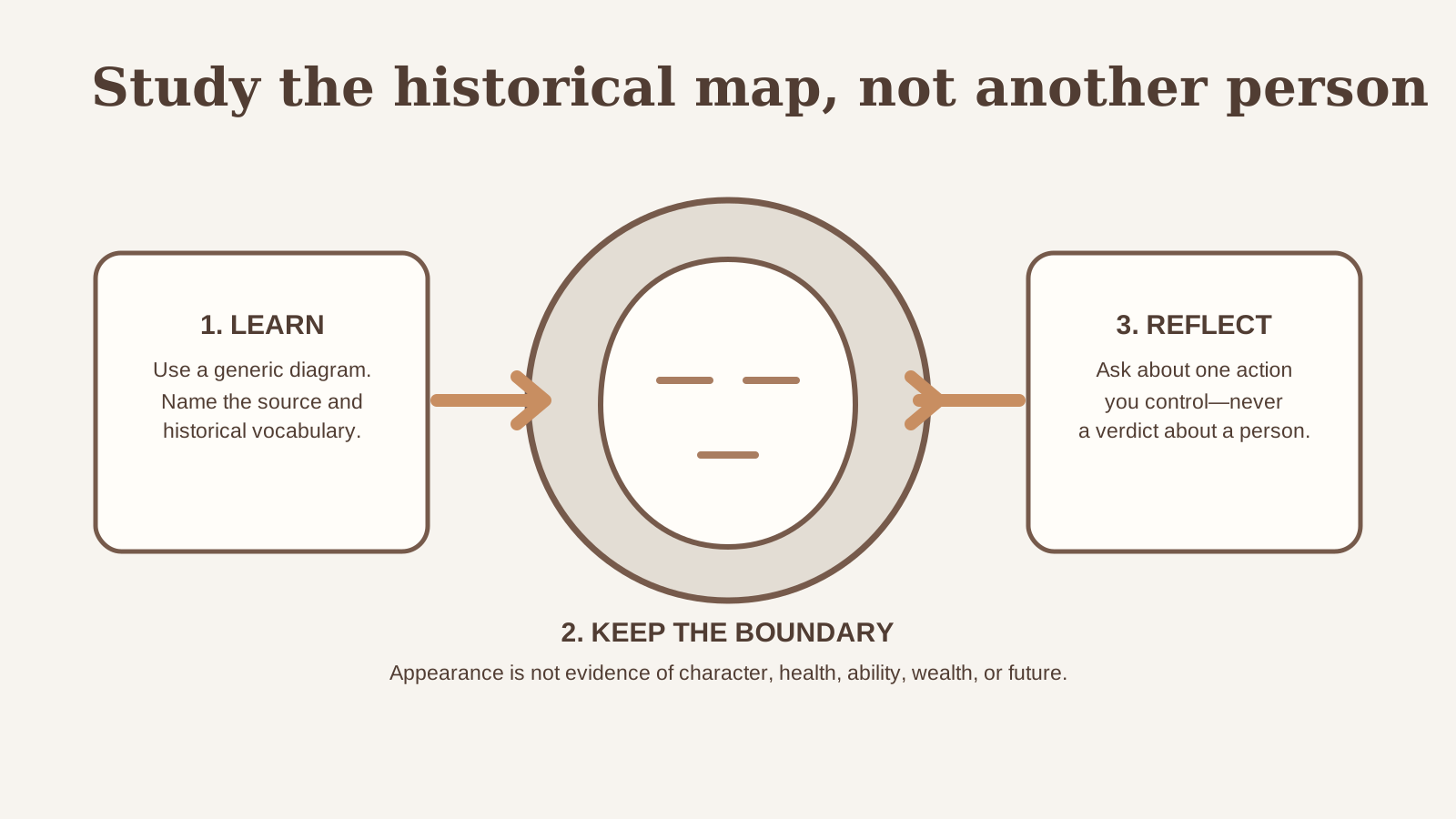
The safest way to learn Mian Xiang is to use a generic illustration or a historical diagram. Do not begin by analysing a friend, partner, child, colleague, public figure, or a photograph. A map is a learning object; a person is not an object to decode.
The traditional “Twelve Palaces” are often named for broad life themes. Titles can sound decisive in English, so translate them carefully:
| Historical map label | Study it as | Do not treat it as |
|---|---|---|
| Life Palace | A broad symbolic centre in a historical diagram | A verdict on vitality, fate, or lifespan |
| Wealth Palace | A resource-and-stewardship theme in the map | A measure of income, savings, generosity, or financial judgment |
| Career Palace | A planning or public-life theme | Evidence of competence, status, or employability |
| Marriage Palace | A relationship-theme label | A prediction about partnership, compatibility, or fidelity |
| Children Palace | A family-theme label | A fertility assessment or forecast about children |
| Health Palace | A historical symbolic name | Medical information of any kind |
If an interpretation makes you feel compelled to judge a real person, return to the diagram and the boundary column. The map is not a test.
Advertisement
A three-step method for cultural study
1. Name the source and the context
Ask where the diagram, book, teacher, or website comes from. Is it presenting a specific lineage, a modern entertainment version, a translated chart, or a blend of several traditions? Does it say what it cannot establish? A source that promises to reveal health, wealth, honesty, or destiny is not giving you a reliable assessment; it is asking you to accept an unsupported conclusion.
The Wellcome Collection describes physiognomy as a historically influential but questionable practice of evaluating character from appearance. That is a useful lens for reading older texts with both curiosity and care.
2. Learn the vocabulary without attaching it to a face
Make a study card for each label: its Chinese term if you have a credible source, its approximate location on a generic map, the historical theme associated with it, and one sentence about its limit. For example:
Wealth Palace — study note: A traditional map label often placed around the nose area and linked to resource symbolism. It is not evidence of money, generosity, business judgment, or future income.
This preserves the cultural vocabulary without turning it into a personality test.
3. Turn the theme into a self-directed prompt
If you enjoy reflective practice, direct the question toward a choice you control. Keep it concrete and reversible.
| Map theme | A responsible prompt | An unhelpful leap |
|---|---|---|
| Resources | “What is one financial task I have been avoiding?” | “This person will be wealthy or irresponsible.” |
| Communication | “What conversation needs more care or clarity?” | “Their mouth proves they are dishonest.” |
| Rest and care | “What support or appointment should I arrange?” | “A facial area says I have a medical condition.” |
| Relationships | “What boundary or appreciation could I express?” | “Their face predicts whether this relationship will last.” |
| Public life | “What skill or project would I like to develop?” | “Their forehead determines intelligence or career.” |
The prompt is optional. It is not divination, therapy, diagnosis, or a substitute for action.
Why micro-expressions are not a wealth audit
Micro-expressions are sometimes used as a fashionable label to make face-reading claims sound scientific. A fleeting expression, a face at rest, or facial symmetry cannot establish a person’s future, income, character, or trustworthiness. Do not combine an old symbolic map with scientific-sounding language to make a stronger claim than either can support.
If you need to understand someone, use consent, conversation, reliable references where appropriate, and evidence relevant to the decision. If you need a medical opinion, see a qualified clinician. If you are concerned about a changing mole, lesion, or other skin feature, consult an appropriate medical professional rather than a face-reading chart.
Consent and social boundaries
Even a playful reading can become invasive when the other person has not asked for it. These rules keep the practice respectful:
- Do not read a stranger or a photograph without clear permission.
- Do not comment on a person’s face as evidence of a trait, identity, health condition, attractiveness, or prospects.
- Do not make a reading part of hiring, dating, housing, teaching, caregiving, conflict, or financial decisions.
- Do not tell someone that a feature predicts misfortune, illness, fertility, a child’s future, cheating, or financial failure.
- If someone says no, move on without debate.
The guided Face-Map Study is designed for this reason: it uses a historical map and reflection prompts instead of analysing a real person’s appearance.
A practical study session
Set a timer for fifteen minutes. Use a generic map, notebook, and one source you can identify.
- Write the source title, date, and cultural context.
- Choose one map label and copy its location and historical theme in neutral language.
- Add one clear limitation: “This does not predict or diagnose anything about a person.”
- If you want a reflection, phrase it as an action you control this week.
- Stop before the exercise turns into a judgment of your own or another person’s face.
This makes the tradition studyable without building anxiety or bias around it.
Common questions, answered plainly
Can a face map tell me about health?
No. A historical “Health Palace” label is not a clinical assessment. Seek medical advice for symptoms, injuries, mental-health concerns, or a changing skin feature.
Can I use Mian Xiang for dating or hiring?
No. It is not a fair or reliable way to decide whether someone is compatible, honest, competent, or safe. Use direct communication, consent, relevant evidence, and the appropriate professional process instead.
Why study it at all?
It can be valuable as a way to understand a historical Chinese symbolic tradition, compare translations, and consider how visual maps carry social values. It may also help a reader recognise and reject appearance-based claims that use cultural language to sell fear or certainty.
Is this the same as a facial expression?
No. A momentary expression can communicate something in a specific context, but it does not grant permission to infer someone’s character or future. A traditional face map is another, distinct historical framework; neither should be used as a personal verdict.
Sources and what to read next
- Wellcome Collection: the history and bias of physiognomy — context on the longstanding link made between appearance and character.
- Wellcome Collection: Drawing the Human Animal — historical examples and a critical account of physiognomy.
- Wellcome Collection: a seventeenth-century chiromancy and physiognomy manuscript — an archival example of the historical overlap between face maps, palmistry, astrology, and fortune-telling.
Continue with the Chinese Face Reading learning hub for a generic map and its FAQ, or use the Reading Lab for a guided, non-personal map study. For a separate cultural system, the Chinese zodiac compatibility guide explains how to keep sign-based reflection separate from claims about another person.
Editorial note: Lucky Properties presents face-reading traditions as historical and cultural material. This guide is not medical, psychological, legal, financial, relationship, employment, housing, educational, or safety advice. Do not use facial appearance to assess a person. Seek qualified professional advice for a specific concern.