Short answer
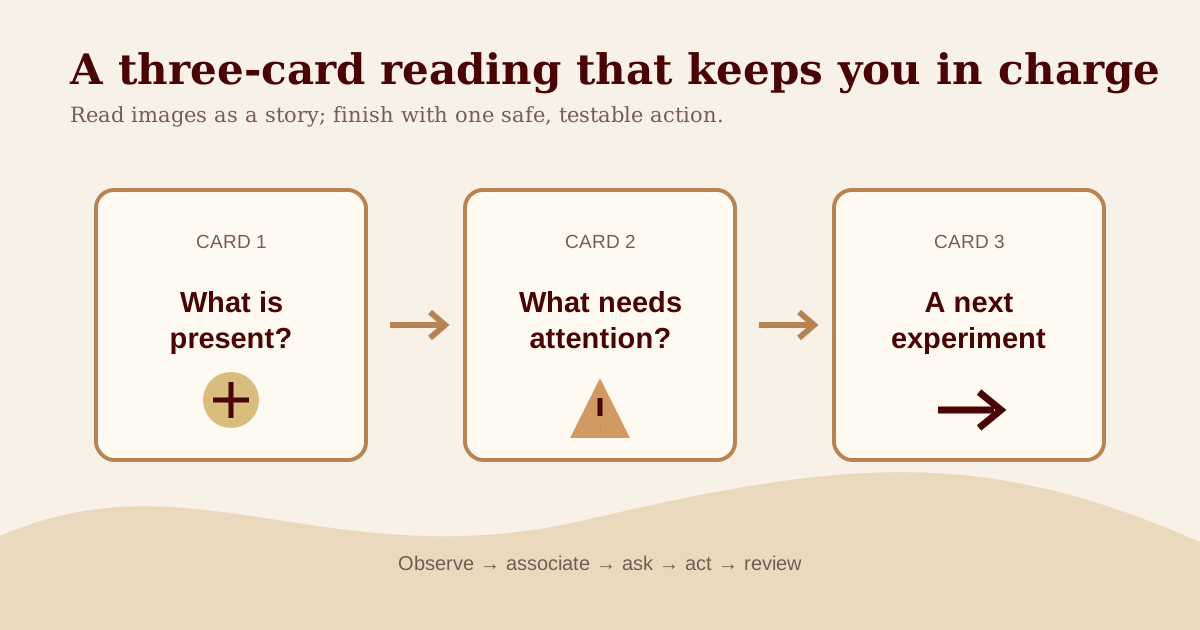
Card reading is easiest to learn when you treat the cards as a structured way to notice a situation, not as a machine for announcing a fixed future. Begin with one clear, low-stakes question. Draw three cards. Give each card a position—what is present, what needs attention, and a next experiment—then read the images, the guidebook, and your own circumstances together. Finish by choosing one action you can verify in real life.
That method works with a tarot deck, an oracle deck, a deck of story cards, or a small deck you make yourself. It leaves room for symbolism and personal ritual while avoiding the most common trap: letting a random draw make a medical, legal, financial, safety, housing, or relationship decision for you.
What a card reading is—and what it is not
Cards have been used for games, art, storytelling, and divination in different places and periods. Tarot began in fifteenth-century Italy as a family of playing-card games; its later use in occult and divinatory systems developed over time. The Victoria and Albert Museum’s history of tarot traces the later rise of decks designed specifically for cartomancy, while the British Museum collection holds an Etteilla cartomancy deck from that tradition.
That history matters because it makes a beginner’s practice more interesting and more honest. A card can carry artistic, cultural, spiritual, and personal meaning without becoming evidence about another person’s thoughts or a guarantee about what happens next.
Use this distinction:
| A card reading can be | A card reading is not |
|---|---|
| A creative prompt for journaling | A diagnosis or treatment plan |
| A way to name a tension you have avoided | Proof of another person’s feelings, honesty, fidelity, or intentions |
| A ritual that makes time for reflection | Legal, financial, investment, housing, or safety advice |
| A visual language for discussing choices | A substitute for evidence, consent, repair, or professional help |
| A personal or cultural practice | A promise of luck, love, money, pregnancy, health, or a specific future event |
This is not a diminished way to read. It gives you more agency. A useful reading should make you more observant and more capable of choosing, rather than more frightened, dependent, or certain about something you cannot know.
Choose the deck you can actually learn from
Beginners sometimes buy an elaborate deck because the box promises instant answers, then feel lost when every card has layers of symbolism. Choose a deck you will open often and a guidebook you can understand.
Tarot decks
Most modern tarot decks contain 78 cards: 22 Major Arcana cards and 56 Minor Arcana cards. The Minor Arcana are usually divided into four suits, often called Wands, Cups, Swords, and Pentacles (or Coins). Different decks vary in imagery, card order, titles, cultural references, and interpretations. The deck’s companion book is part of the system; read it before importing meanings from a random website.
Tarot can reward long study, but you do not need to memorize all 78 cards before doing a three-card practice. Start by describing what you see. Is the figure moving or still? Is there a threshold, tool, animal, weather pattern, colour, number, or relationship between figures? What is your first emotional response? Then compare your observation with the guidebook.
Oracle decks
Oracle decks have no universal number of cards or fixed structure. One deck may use plants, archetypes, animals, affirmations, ancestors, places, or abstract images. That flexibility makes oracle decks approachable, but it also means the creator’s guidebook is especially important. Look for a deck whose images and language feel respectful, legible, and relevant to the kind of reflection you want.
Playing cards and story cards
Cartomancy can use an ordinary playing-card deck, but its traditions and correspondences vary. A standard deck is not a shortcut to one authoritative system. If you want to study cartomancy, choose a source that names its tradition and practice consistently.
Story cards are often the simplest choice for a reflective practice. Lucky Properties’ Reading Lab uses a small symbolic deck for a situation, tension, and next-experiment prompt. The draw is random on purpose: it offers a fresh angle, not a command.
Ask a question that gives you room to act
The quality of a reading begins before you shuffle. Questions that demand certainty tend to produce anxious interpretations: “Will they leave me?” “Will I get the job?” “Am I sick?” “Should I invest everything?” No card can responsibly answer those questions.
Turn a future-demand into a present-focused question instead.
| Instead of asking… | Try asking… | A grounded next step might be… |
|---|---|---|
| “Will this relationship last?” | “What conversation would help me understand our needs more clearly?” | Schedule a calm check-in; notice whether both people can speak freely. |
| “Will I get the job?” | “What can I improve in my application or interview preparation?” | Ask for feedback, research the role, or practice one answer. |
| “Will this investment make money?” | “What information am I missing before I make this financial decision?” | Read disclosures and consult an appropriately qualified adviser. |
| “Is this symptom serious?” | “What support or appointment should I arrange?” | Contact a clinician or urgent service when appropriate. |
| “Does my friend secretly dislike me?” | “What facts do I have, and what direct conversation is appropriate?” | Ask respectfully; do not use a draw as evidence about them. |
| “What should I do with my life?” | “What is one small experiment that could teach me more this week?” | Try a class, conversation, application, or protected hour of practice. |
Good questions are specific enough to guide attention and open enough to allow surprise. They describe your own choices, not another person’s inner life. If the issue is high-stakes, use the card practice only after you have named the real-world support you need.
Advertisement
The three-card spread that teaches you how to read
Many beginner guides recommend three cards because the format is small enough to hold in your mind. The common Past–Present–Future layout is one option, but beginners often treat the third position as a prophecy. Use this alternative first:
- What is present? What part of the situation is already visible, active, or asking to be acknowledged?
- What needs attention? What tension, assumption, missing information, or habit deserves care?
- A next experiment. What modest action, conversation, boundary, research step, or routine could you test?
The third position is not “what will happen.” It is an invitation to act with more awareness. This makes the spread useful even if you do not believe cards have predictive power.
Set up the reading
You need a deck, a surface, a notebook or notes app, and ten quiet minutes. If ritual helps you focus, straighten the table, silence notifications, light a lamp, or take three breaths. Do not use an open flame around pets, children, fabrics, or an unsafe surface. A ritual should make the practice more attentive, not more elaborate or expensive.
Write your question before drawing. Put the three position labels on the page. Shuffle in any way that does not damage the deck: overhand, riffle, table mix, or simply cutting the pack. There is no universal correct shuffle. Decide before the draw whether you will use reversed cards. For a first practice, read every card upright; it gives you one less variable.
Lay the cards from left to right. Take a photo if you want to revisit the spread later. Then wait before opening the guidebook.
First pass: describe, do not interpret
For each card, write only observations for one minute. Name objects, colours, gestures, direction of gaze, numbers, landscape, weather, and the relationship between figures. Avoid loaded language such as “this means betrayal” or “this is a warning.” If you see a tower, write “a tall building, lightning, falling figures, dark sky.” If you see a cup, write “vessel, water, offered object, two hands.”
This stage matters because it separates the image from the story you are about to tell. It also teaches you the deck’s visual language over time.
Second pass: add the position
Now ask how the observed image changes inside its position. A card showing a closed door in what is present may point to a fact you are avoiding. The same image in what needs attention may prompt you to check whether you are assuming there is no way forward. In a next experiment, it might suggest making a boundary, gathering information, or choosing not to rush.
The position is part of the meaning. A card does not arrive with one permanent sentence attached to it.
Third pass: consult the guidebook
Read the official guidebook entry. Underline one phrase that fits the image and one that does not. If a guidebook says “change,” ask what kind: a change in schedule, a change in interpretation, a change in a room, a change in a conversation, or a change in expectations? Do not automatically choose the most dramatic version.
Your interpretation should be able to survive contact with the facts of your life. If it cannot, it is simply a poetic idea—and that is okay. Write it as poetry, not evidence.
Read the three cards as a relationship, not three fortune cookies
A three-card spread gains meaning from sequence and contrast. Read from left to right, then look for repeated visual cues.
| Notice | Questions to ask |
|---|---|
| Repeated colours | Does this colour make the spread feel active, quiet, warm, cold, urgent, or settled? Is that quality already present in the situation? |
| Repeated direction of movement | Are figures moving toward, away from, or past one another? Where do you feel pulled to rush or withdraw? |
| A shift from crowded to open images | What could create more room: time, information, storage, a boundary, a conversation, or rest? |
| A repeated tool or element | What resource appears more than once—words, money, hands, water, fire, a path, a container? How is it used differently? |
| A major contrast | Does one card introduce a useful counterweight to the other two? What assumption does it challenge? |
Then tell the spread as a short conditional story: “I am noticing ___. The tension may be ___. This week I can test ___.” Avoid “The cards say I must…” The first sentence keeps you in charge of the reading.
An original four-step interpretation method
Use the IMAGE method whenever a card feels confusing:
| Step | Do this | Example |
|---|---|---|
| I — Inventory | List only visible details. | “A person holds a lantern on a path; the sky is dark.” |
| M — Meaning options | Write two or three possible associations, including a mundane one. | “Seeking clarity; moving carefully; needing better light on an actual route.” |
| A — Ask | Turn the association into one question about your own choices. | “What information would make this decision less dark or rushed?” |
| G — Ground | Choose one action that is safe, proportionate, and verifiable. | “Make a list of questions before I sign anything.” |
| E — Evaluate | Revisit in a week; record what happened rather than forcing a match. | “The questions revealed a missing cost; I asked for documentation.” |
The mundane option is important. A lantern can be spiritual symbolism, but it can also remind you to turn on a light, ask for facts, or move more slowly. Good interpretation makes room for both without claiming either as fate.
Example reading: a difficult conversation
Suppose your question is: “How can I approach a difficult conversation with more care?” Your cards show an image of a bridge, an image of a storm, and an image of a small lamp.
What is present — Bridge. You notice two shores and a narrow crossing. The image suggests connection but also effort. Your grounded interpretation: there is a relationship worth approaching, but you may be assuming the distance can be crossed in one dramatic talk.
What needs attention — Storm. You notice wind, dark clouds, and movement. Rather than deciding that conflict is inevitable, ask what makes the conversation feel stormy: an unspoken request, bad timing, unresolved hurt, text messages, alcohol, exhaustion, or fear of being misunderstood.
A next experiment — Lamp. A lamp does not eliminate the night; it helps a person see the next few steps. Choose a small action: write the purpose of the conversation in one sentence, ask for a time to talk, use one “I” statement, or decide what boundary you need if the conversation becomes unsafe.
The cards did not reveal whether the other person will apologize, stay, or leave. They helped turn a vague fear into a plan you can test. That is a successful reading.
How to use reversals without getting overwhelmed
Some readers interpret a card that lands upside down as reversed; others read every card upright. Both approaches exist. A reversal is not automatically the opposite or a disaster.
If you want to add reversals, choose one consistent rule for a month:
- Blocked expression: the card’s familiar theme may be difficult to access.
- Internal expression: the theme may be private, delayed, or felt inwardly.
- Excess or imbalance: the theme may be overused, rushed, or taken too far.
- Alternative viewpoint: turn the card and ask what assumption is being challenged.
Write the rule at the top of your journal. If a reversal only makes you anxious, go back to upright readings. Complexity is not the same as depth.
Read for yourself and others with consent
Reading for yourself can be a private notebook practice. Reading for another person adds responsibility. Ask whether they want a reflective exercise, a traditional reading style, or simply a chance to tell a story prompted by images. Do not pressure a reluctant person to participate. Do not photograph their cards or share a reading without permission.
Keep the question within their agency. “What support would help you with this transition?” is more respectful than “What is your partner hiding?” “What do you want to understand about this job change?” is better than “Will you be fired?”
If someone raises abuse, coercion, self-harm, medical symptoms, legal trouble, financial emergency, or an immediate safety issue, end the card practice and focus on appropriate help. A deck is not a crisis service. You can be warm without pretending to be qualified.
A seven-day card-reading practice
Do not memorize a deck in one weekend. Build a relationship with its images.
Day 1: Meet the deck. Browse every card without trying to learn meanings. Choose three images you like, three that confuse you, and three you dislike. Write why.
Day 2: One-card observation. Draw one card and make a visual inventory. Do not look up its meaning until you have written ten details.
Day 3: Guidebook comparison. Read the guidebook for yesterday’s card. Note one association you noticed independently and one you would not have considered.
Day 4: One useful question. Rewrite a future-demanding question into a question about your choices. Draw one card, then use the IMAGE method.
Day 5: Three positions. Use the three-card structure in this guide. Keep the third position as an experiment, not an outcome.
Day 6: Read the story aloud. Explain the spread in three sentences to yourself. Listen for certainty words—“will,” “must,” “definitely”—and replace them with “may,” “I notice,” or “I could test.”
Day 7: Review. Revisit the action you chose. What did you learn? Keep a note of the evidence. A reading journal becomes more valuable when it records what you did, not only what you drew.
Common beginner mistakes
Pulling more cards until the answer feels comforting. A redraw can be part of play, but endless clarifiers often turn uncertainty into noise. Set a limit before you start: three cards, one guidebook check, one next step.
Treating a dramatic image as a literal event. A tower, coffin, devil, storm, snake, or weapon can trigger a strong reaction. Pause and describe the image. Check the deck’s history and guidebook. Ask what ordinary concern it helps you name. You never have to continue a reading that feels distressing.
Reading a third party without consent. It is tempting to use cards to resolve uncertainty about someone else. That is not informed knowledge. Choose a question about your own boundary, communication, or observation instead.
Making a high-stakes choice from the draw. A card should never decide whether to seek medical help, sign a contract, make an investment, leave a home, report danger, or stay in a relationship. Use the reading to identify what information or support you need, then seek it.
Copying meanings without looking. Memorized keywords are a starting point. The image, position, question, deck tradition, and your real context matter. If every card becomes the same generic prediction, the practice has stopped teaching you anything.
Where to go next
Use the Reading Lab’s three-card story game when you want a gentle, browser-based practice with a ready-made symbolic deck. Its positions match this guide: what is present, what needs attention, and a next experiment.
If your reading is about a shared home or relationship, pair reflection with practical support. The couples bedroom layout guide turns “balance” into clear routes, light controls, storage, and consent. The Chinese zodiac compatibility guide explains how to enjoy a traditional compatibility lens without treating it as a verdict about another person.
Frequently asked questions
What does it mean if I draw the same card repeatedly?
Repeated cards can make a theme memorable, but they do not prove a supernatural message. Check whether the card returns because of the way you shuffle, whether you are looking for a familiar story, and what concrete question it keeps raising. Record the draw, then choose a different real-world observation rather than escalating the reading.
Can I make my own card meanings?
Yes—especially with a story or oracle deck—but name the source of each meaning. You might have a guidebook meaning, a traditional association, your own visual observation, and a journal association. Keeping those separate makes your practice clearer and lets it evolve without pretending every interpretation is universal.
Should I cleanse or charge my cards?
Some readers use smoke, moonlight, sound, cloth, or a simple reset ritual. Others simply shuffle, reorder, or store the deck carefully. Choose a practice that is safe, respectful, and meaningful to you. Do not burn materials indoors to solve an air-quality problem, and do not treat a ritual as a required purchase.
How often should I read cards?
Read as often as the practice remains curious and useful. Daily draws can build visual fluency; a weekly three-card spread may leave more time to test your action. If you notice the practice increasing anxiety, compulsive checking, or avoidance of real decisions, take a break and return to ordinary supports.
Keep the reader, not the cards, in charge
The strongest beginner reading ends with a sentence that belongs to you: “I noticed this, I will test that, and I will revise my view when the evidence changes.” Cards can make a private question visible. They cannot remove your responsibility to care for yourself, respect other people, or make decisions from real information.