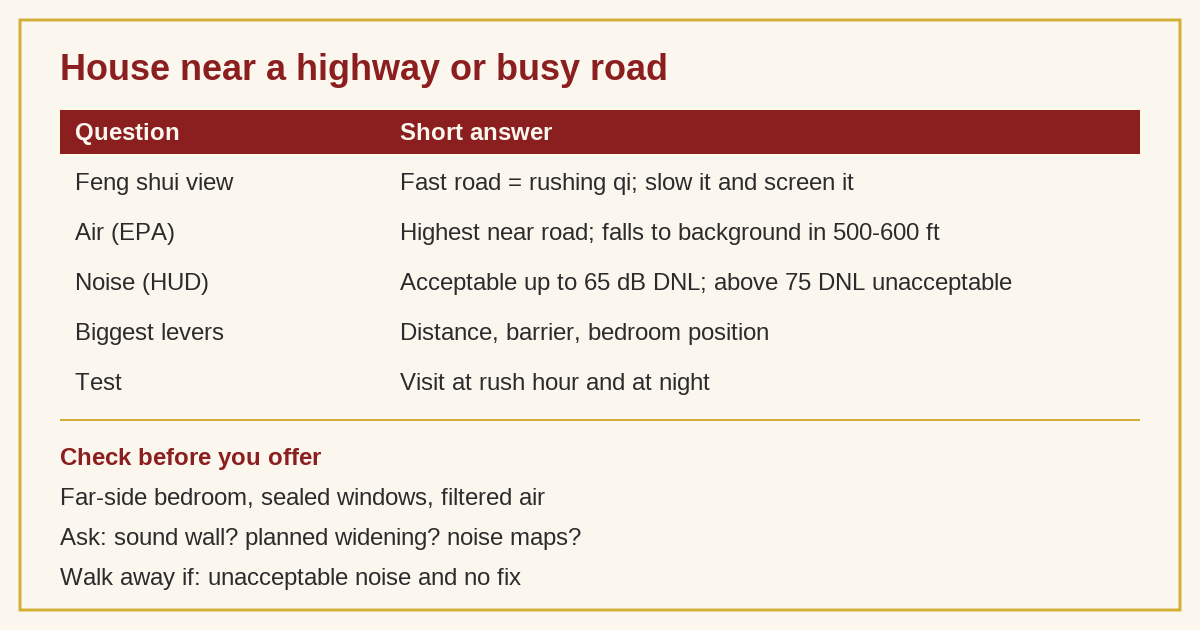
Feng shui reads a house near a highway or busy road as exposed to fast, rushing qi that never settles, and practitioners suggest distance, a barrier and a calm entrance. The EPA adds a practical point. Traffic pollution is highest next to the road and falls to background within about 500 to 600 feet. Day to day, what matters most is the noise and which side of the house you sleep on.
Checked against sources: 23 November 2026
Here we look at highways and arterial roads beside or in front of a house; the rest of our real estate and home buying guides take the other neighbours in turn. A road that ends at your door is a different problem, covered in feng shui T-junction house. Trains and aircraft have feng shui house near train tracks and feng shui house under a flight path.
| Air and noise | Figure or rule | Source |
|---|---|---|
| People near major roads (US) | More than 45 million live, work or attend school within 300 feet of a major road, airport or railroad | EPA |
| Pollution with distance | Highest on or just downwind of a road; generally falls to background within 500 to 600 feet | EPA |
| Health effects named | Asthma onset and worsening, heart disease, reduced lung function, impaired lung development in children, preterm and low birthweight births, childhood leukaemia, premature death (effects studied, not proven for every person) | EPA |
| Most at risk | Children, older adults, people with cardiopulmonary disease, people of low socioeconomic status | EPA |
| HUD noise, acceptable | Day-night average sound level (DNL) not exceeding 65 dB | 24 CFR 51.103 |
| HUD noise, normally unacceptable | Above 65 dB up to 75 dB | 24 CFR 51.103 |
| HUD noise, unacceptable | Above 75 dB | 24 CFR 51.103 |
| Extra attenuation | 5 dB above 65 to 70; 10 dB above 70 to 75 | 24 CFR 51.103 |
On this page
- What feng shui says
- Air quality near a road
- Noise and the HUD thresholds
- Score the house against the road
- Fixes that work and fixes that do not
- Safety, access and resale
- When to walk away
- FAQ
- Your two visits
- Sources
What feng shui says
In Form School, qi is meant to move gently, like a slow meandering stream, and to gather in front of a house. A straight, fast road is said to carry rushing qi, sometimes called a "killing breath", that sweeps past or at the house without settling. Practitioners say the worst case is a road that runs straight at the front door, which is the situation in our T-junction guide, and the next worst is a highway running close across the front. A house set back behind trees or a rise is judged better, and so is the inside of a curve compared with the outside (more in corner lots, cul-de-sacs and slopes).
The traditional remedies are about slowing and screening: a hedge, a wall or a row of trees between road and house, a front garden path that bends instead of running straight to the door, and a sturdy front door set well back. Practitioners often say a fountain or a mirror at the gate deflects the rush, but those are folk remedies. Only distance and a physical barrier change your real exposure.
Advertisement
Air quality near a road
The EPA states that pollutant concentrations are highest on or just downwind of a roadway and generally fall to background within 500 to 600 feet, with the exact distance depending on traffic, wind, terrain and the pollutant. It lists asthma onset and worsening, heart disease, reduced lung function, impaired lung development in children, preterm and low birthweight births, childhood leukaemia and premature death among the effects studied, and says children, older adults, people with heart and lung disease and low-income people face higher risk. It also notes that road noise may contribute to some of these problems.
The EPA says sound walls, cut sections and roadside vegetation can reduce traffic pollutants just downwind of a road, with the effect depending on size and type, and that air filtration in mechanical ventilation systems can reduce indoor pollutants. Our sources are the EPA's archived August 2014 fact sheet (EPA/420/F-14/044) and a snapshot of its near-roadway page. Both predate 2026, so look for newer EPA guidance.
For a buyer, the distance from the road and the side you sleep on count for more than the word "highway" on a map. A house 50 feet from a six-lane road is in a different position from one 500 feet away behind a berm.
Noise and the HUD thresholds
HUD's environmental noise standard (24 CFR 51.103) gives a clear ladder in day-night average sound level (DNL): acceptable up to 65 dB, normally unacceptable above 65 and up to 75 dB, and unacceptable above 75 dB. For sites between 65 and 70 dB it calls for 5 dB of added attenuation, and for 70 to 75 dB, 10 dB. The standard is applied about 2 metres (6.5 feet) from the building on the side facing the main noise source. It governs HUD-assisted projects, not private sales. Still, it is a public benchmark for how loud is too loud.
DNL is an average with a night penalty, so a quiet day can hide a noisy night. Test the house at rush hour and again late at night with the windows closed and open.
Picking the quietest wall for the bed is covered in our bedroom sleep environment guide.
Score the house against the road
We made this sheet as a planning aid; it is not an official standard. Give each line 0, 1 or 2.
| Check | 0 | 1 | 2 |
|---|---|---|---|
| Distance from the road to the nearest bedroom wall | Over 500 ft | 100 to 500 ft | Under 100 ft |
| Barrier between road and house | Sound wall or dense berm | Hedge or fence | None |
| Bedroom faces | Away from the road | Side | Toward the road |
| Windows | Sealed and double glazed | Older but tight | Single pane or leaky |
| Ventilation | Filtered mechanical system | Standard HVAC | Open-window only |
| Road widening or new lanes planned | No | Unknown | Yes |
Worked example with stated inputs: a bungalow 150 feet from a highway (1), a wooden fence only (1), bedroom on the far side (0), tight double glazing (0), standard HVAC (1) and no plan for widening (0). The total is 3 out of 12, which a better air filter and a hedge can make workable. At 8 or more, several problems stack up, and you should ask for a lower price or pass.
Fixes that work and fixes that do not
- Work: moving the bed to the far side, better windows, a filter in the HVAC, a hedge or solid barrier, a front path that does not point at the road, a closed front door area with a porch.
- Partly: dense planting. The EPA says vegetation can help, but how much depends on its type and size, so don't expect silence.
- Do not: a mirror or bagua gadget on the gate with no barrier behind it. It may suit the tradition, but it does nothing about air or sound.
Safety, access and resale
On a busy road, feng shui and common sense agree about children and pets: fence the garden and keep the gates latched. Ask the local transport authority about planned widening or new on-ramps, which can change noise and exposure after you buy. We found no source that puts a number on the price effect near highways. Your agent's comparable sales will show what it is locally. When it is time to sell, feng shui for selling a house explains how to present a busy-road home.
When to walk away
- Bedrooms on the road side, under 100 feet away with no barrier, that are still noisy at night with the windows closed.
- Someone in the household with asthma or heart or lung disease, and no way to filter the air.
- A road-widening plan you cannot get clear answers about.
- A price that gives no discount against quieter comparable houses.
FAQ
Is it bad feng shui to live near a highway?
Practitioners say a fast road carries rushing qi that does not settle, and that the worst case is a road running straight at the door. They suggest distance, a hedge or wall, a bent path to the door and a sturdy entry. It is a tradition, and the main practical issues are air and noise.
How far from a highway is safe for air quality?
The EPA says traffic pollutants are highest on or just downwind of a road and generally fall to background within 500 to 600 feet, varying with traffic, wind and terrain. Children, older adults and people with heart or lung disease face higher risk.
How loud is too loud near a busy road?
HUD's standard treats a day-night average of 65 dB or less as acceptable, above 65 up to 75 as normally unacceptable and above 75 as unacceptable. It applies to HUD-assisted projects, but it makes a fair benchmark. Test at rush hour and late at night.
What helps most if I buy near a busy road?
Put the bedroom on the far side, upgrade the windows, add a filter to the ventilation and build a barrier. The EPA says sound walls, cut sections and vegetation can reduce nearby pollution and that ventilation filters can improve indoor air.
Do houses near highways sell for less?
We found no source that gives a price effect, so we quote none. Ask your agent for comparable sales on the same road and on quieter streets.
Your two visits
Go once at rush hour and once at night, with a notebook. Sketch where the nearest bedroom wall sits against the road, then work through our feng shui home buying checklist.
Sources
Checked November 2026.
- Near roadway air pollution and health: frequently asked questions (EPA, archived 2014 fact sheet EPA/420/F-14/044)
- Near roadway air pollution and health frequent questions (EPA, archived page)
- 24 CFR 51.103 Criteria and standards (HUD, via Cornell LII)
We use the HUD noise standard, which governs HUD-assisted projects, only as a benchmark. None of the sources we read gave a price effect near highways.
Editorial note: We treat feng shui as a cultural and design tradition. Confirm legal, financial, health and inspection questions with a licensed professional.