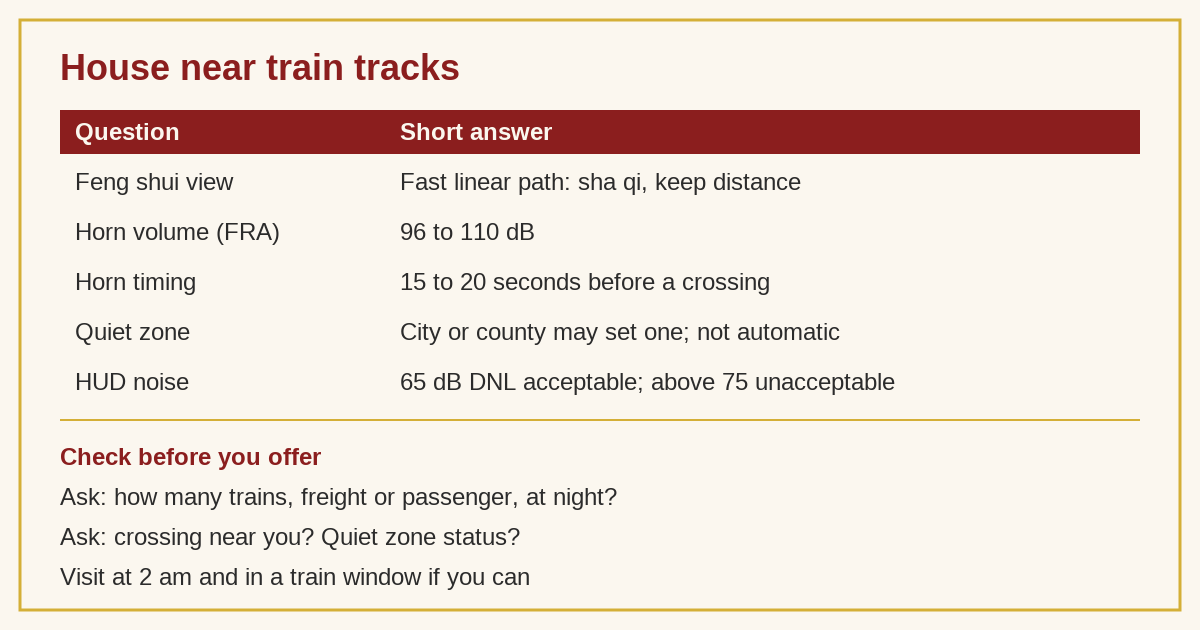
Feng shui reads a house near train tracks as sitting on a fast, straight line that carries sha qi (harsh energy). For a buyer, the issues are horns, night trains, vibration and blocked crossings. US rules set the horn volume at 96 to 110 decibels and the warning at 15 to 20 seconds before a crossing, unless the local authority has set up a quiet zone.
Rules checked: 23 November 2026
The rules below are for US houses beside railways and near road-rail crossings. A busy road is handled in feng shui house near a highway and aircraft in feng shui house under a flight path, both part of our real estate and home buying guides.
| Rule | Figure or rule | Source |
|---|---|---|
| Train horn volume | Maximum 110 decibels, minimum 96 decibels (49 CFR 229.129) | FRA |
| Horn timing | At least 15 and no more than 20 seconds before a public highway-rail grade crossing | FRA |
| Fast trains | Over 60 mph: no more than one-quarter mile in advance of the nearest crossing | FRA |
| Quiet zone | A rail segment with one or more crossings where horns are not routinely sounded | FRA |
| Who sets a quiet zone | A public authority, such as a city or county, after mitigating the added risk | FRA |
| Horns still allowed | In emergencies and to comply with other rules, such as warning people or animals | FRA |
| Residential noise (HUD) | Acceptable up to 65 dB DNL; above 75 dB unacceptable | 24 CFR 51.103 |
On this page
- What feng shui says
- The horn rule in plain words
- Quiet zones
- Noise benchmarks and vibration
- Viewing checklist
- Remedies that help
- Rail-side mistakes to avoid
- FAQ
- Count the trains, then call the city
- Sources
What feng shui says
Form School practitioners say qi should move slowly and gather. A railway is a long, straight, fast and heavy line, the sort of shape the tradition calls a source of sha qi. A house facing the track end-on, or sitting right beside it, is considered more exposed than one at an angle or set back behind trees. The background is in our sha qi guide. Practitioners also tend to rank a track in front of the door as worse than one at the back, since the entrance is meant to receive gentle qi.
The traditional remedies screen and soften: dense planting along the rail side, a solid fence, a front path that curves, and a bedroom on the far side of the house. As it happens, the same steps help with noise and the view.
Advertisement
The horn rule in plain words
The Federal Railroad Administration (FRA) says locomotive horns must sound at a maximum of 110 decibels and a minimum of 96 decibels (49 CFR 229.129). Engineers must start the horn at least 15 and no more than 20 seconds before reaching a public highway-rail grade crossing. For trains over 60 mph, the horn must not sound more than one-quarter mile before the nearest crossing, even if that gives under 15 seconds of warning.
So if a public crossing is within earshot, you will hear the horn for every train, day and night, at a volume designed to carry. Houses near the crossing hear it loudest. Further down the line, away from any crossing, the sound is wheel and engine noise instead: quieter, but constant.
Quiet zones
A quiet zone is a stretch of line with one or more consecutive crossings where horns are not routinely sounded. Only a public authority, such as a city or county, can set one, and it must first reduce the added crossing risk, for example with the supplemental safety measures the FRA describes. The FRA also says horns may still sound in emergencies and to comply with other rules, for instance to warn people or animals on the track.
Before you count on one, check three things.
- Ask the city or county whether the crossings near the house are in an established quiet zone and what its status is. Don't take the seller's word for it.
- The authority can change or end a quiet zone. We have not read the rules for how that happens, so we don't describe them.
- A quiet zone removes routine horns, not wheel and engine noise or vibration.
To see where this check sits in a full viewing, use our feng shui home buying checklist.
Noise benchmarks and vibration
HUD's environmental noise standard (24 CFR 51.103) uses a day-night average sound level (DNL): acceptable up to 65 dB, normally unacceptable above 65 and up to 75, and unacceptable above 75. It needs extra attenuation of 5 dB above 65 to 70 and 10 dB above 70 to 75, measured about 2 metres from the building on the noisy side. It applies to HUD-assisted projects, not private sales, though it still works as a public yardstick.
We have not verified any source that sets vibration limits for houses near rail lines, so we give no figure. At a viewing, look for hairline cracks in plaster, brick and foundations, check whether a glass of water ripples or light fixtures rattle, and ask the owner.
Viewing checklist
| Check | What to note |
|---|---|
| Public crossings within earshot | Count them and ask about quiet zone status |
| Train count, day and night | Ask neighbours and the railroad; freight and passenger differ |
| Night trains (midnight to 6 am) | Matters more for sleep than anything else on this list |
| Blocked crossings | How often a stopped train blocks the road you need |
| Vibration | Rattle in windows, cracks in plaster or foundation |
| Bedroom position | Whether a bedroom window faces the track |
| Fence and planting | What stands between the track and the house |
| Dangerous goods and derailment history | Ask the railroad; check local emergency planning pages |
Remedies that help
- Put the main bedroom on the side away from the track and keep the track side for the kitchen, garage or storage.
- Upgrade the windows and doors on the track side. Ask a contractor for rated sound reduction rather than relying on a general claim.
- Plant dense evergreens and build a solid fence. They hide the track and block a little sound.
- If a quiet zone is possible, ask the city about starting the process. The FRA says that step belongs to the public authority.
Rail-side mistakes to avoid
- Viewing a house in the daytime when trains are less frequent.
- Assuming an existing quiet zone will last forever.
- Judging noise by the horn alone and forgetting vibration and blocked crossings.
- Counting on a mirror or bagua gadget to stop noise.
FAQ
Is a house near train tracks bad feng shui?
Practitioners read a railway as a long, fast, straight line that carries sha qi, and say a house facing the track end-on is more exposed than one set at an angle or behind trees. They suggest screening, a curved path and moving the bedroom away. This is tradition, not a measured effect.
How loud are train horns?
The FRA says locomotive horns must sound between 96 and 110 decibels, starting 15 to 20 seconds before a public highway-rail crossing. For trains over 60 mph the horn must not sound more than one-quarter mile before the crossing.
What is a train quiet zone?
A quiet zone is a stretch of line with one or more consecutive crossings where horns are not routinely sounded. Only a public authority such as a city or county can set one, after reducing the added crossing risk. Horns can still sound in emergencies.
How do I check if a house is in a quiet zone?
Ask the city or county, not the seller, whether the crossings near the house are in an established quiet zone. And don't assume it will last forever.
What should I check at a viewing near train tracks?
Visit at night, count public crossings within earshot, ask how many trains pass, look for cracks and rattles that suggest vibration and check which side the bedroom faces.
Count the trains, then call the city
Go at night, and ask the neighbours and the railroad how many trains pass. Next, ask the city about quiet zone status at the nearest crossing. Your notes on the bedroom can then go beside our bedroom sleep environment guide.
Sources
Checked November 2026.
- Train horn rule and quiet zones (Federal Railroad Administration)
- 24 CFR 51.103 Criteria and standards (HUD, via Cornell LII)
The FRA rule applies in the US only. We could not find a Canadian source, so Canadian rules are not covered, and none of the sources we read gave vibration limits or a price effect near railways.
Editorial note: Lucky Properties writes about feng shui as a cultural and design tradition. Confirm legal, financial, health and inspection questions with a licensed professional.