Short answer
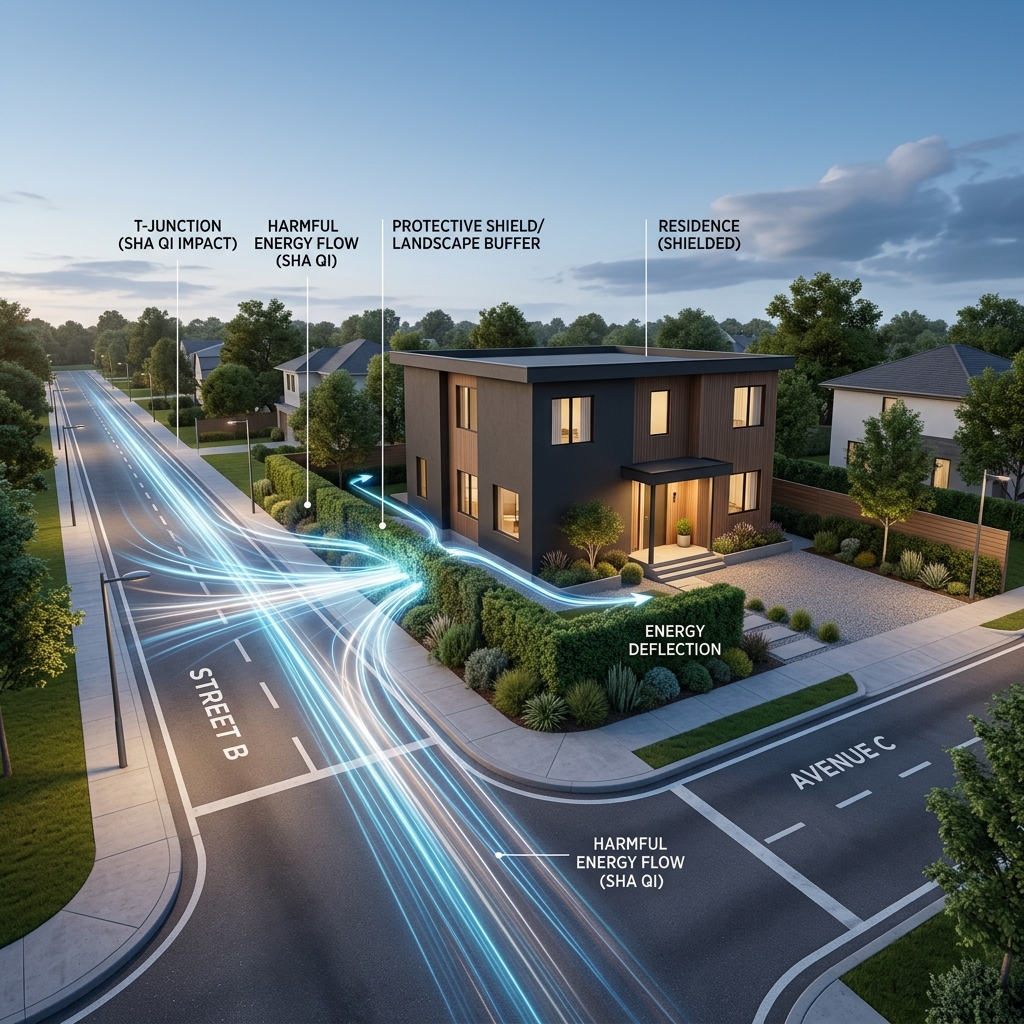
A T-junction house is not automatically unlucky, unsafe, or a bad purchase. In Form School Feng Shui, a street that appears to run directly toward a home is often called a road rush or, in some traditions, a “poison arrow.” Treat that image as a prompt to inspect the site carefully. It does not predict illness, financial loss, a crash, or a relationship outcome.
The practical questions are more useful: How quickly do vehicles approach? Where do headlights land? Can people see when leaving the driveway? Is there traffic noise, splash, drainage, or a privacy problem? Do the setbacks, fencing rules, utilities, and landscape plan allow a sensible response? A home that answers those questions well may suit you. A home that fails them needs a real property or road-safety response, not a symbolic cure.
What a T-junction is—and what it is not
Picture a capital T. The property that sits beyond the top bar, directly in line with the stem, is the example most people mean. From that approach, drivers, headlights, sound, and views can be aimed toward the house. A corner lot near an intersection, a pie-shaped cul-de-sac lot, or a home one or two houses away may have very different conditions.
Form School Feng Shui pays close attention to visible landform, movement, approaches, and what a person experiences on arrival. Roads are often compared with waterways: a slow, curving approach can feel different from a long, straight line that ends at a façade or gate. That is a cultural design lens. It becomes valuable when it makes you look at the site rather than when it substitutes a dramatic prediction for an inspection.
Do not use the label as a proxy for the questions that actually vary from property to property:
- A short residential lane with a stop sign is different from a high-speed collector road.
- A house set far back and above the road is different from one close to a curb at the end of a long, downhill approach.
- A driveway around the side of the house creates different sightline questions from one facing the oncoming street.
- Mature trees, fences, grade, streetlights, buses, delivery traffic, snow storage, and nearby schools can change the lived experience more than the shape on a map.
The Federal Highway Administration treats adequate sight distance as a core part of safe intersection and driveway operation. It also lists landscaping, trees, walls, signs, parked vehicles, and grades among the things that can obstruct visibility. That is why the first T-junction “cure” is observation—not planting a screen or putting an object at the property line.
The Lucky Properties field audit
Use this worksheet during a viewing. It is deliberately not a luck score. It helps you collect the conditions that make a home calmer, safer, and easier to use. Bring a notebook, phone camera, and a second person if possible. Do not stand in the roadway or place anything in traffic to test a sightline.
| Check | What to observe | Evidence to collect | Decision it informs |
|---|---|---|---|
| Road approach | Straight-line distance, grade, lane count, traffic control, visible speed | A daytime photo from the sidewalk or lawful public viewpoint | Whether the “road rush” is substantial or mostly a map label |
| Turning and stopping | Where cars brake, turn, queue, reverse, or accelerate | Ten-minute count at a busy time and a quiet time | Noise, glare, conflict, and access expectations |
| Headlights | Which windows, rooms, and outdoor areas receive turning beams | A nighttime visit or seller/agent disclosure question | Curtains, room use, privacy, and whether the home feels comfortable after dark |
| Driveway and walking route | View when backing out, pedestrian path, curb cuts, parked cars | Photos from driver-height only while safely on private property | Whether access needs a qualified review |
| Sound and vibration | Braking, engine acceleration, trucks, buses, horns, surface defects | Two minutes of notes indoors and outside with windows closed and open | Window, room-layout, or purchase trade-offs |
| Water and grade | Where rain, snowmelt, road splash, and debris travel | Look for staining, drains, catch basins, low points, and erosion | Drainage questions for a qualified inspector or local authority |
| Screen and setback | Property line, utilities, easements, trees, fence height, local rules | Survey, listing documents, utility markings, municipal requirements | Whether a hedge, fence, or wall is feasible at all |
| Future change | Development, transit, school, construction, road redesign, speed management | Ask the local road authority or planning office; read public notices | Whether today’s quiet street will stay quiet |
This is the original value of the guide: a reader can compare two homes using the same observations rather than trying to decide from a single aerial image or a fortune-style verdict.
For a complete viewing record that also covers the entrance, rooms, water, inspection questions, and personal trade-offs, start with the Feng Shui house-buying checklist. Keep the T-junction notes as one part of that wider decision, not the whole decision.
Advertisement
Start with the road, not the remedy
1. Visit more than once
A Sunday afternoon can hide a school pickup queue, a morning commuter pattern, a delivery route, a stadium event, or a winter snow-storage problem. If the purchase is serious, visit at a time when you would actually use the home: morning departure, after-work arrival, and after dark. Listen from the living room and the bedroom that faces the road. Notice whether you can have a conversation outdoors, whether every turn sends light across a window, and whether the property still feels private with curtains open.
NHTSA notes that speed affects stopping distance and crash severity. That does not prove a specific home is at unusual risk; it explains why approach speed, traffic control, grade, and driver behavior deserve more weight than a symbolic label. If you see repeated speeding, risky turns, missing signs, or a road condition that seems dangerous, record the date and location and contact the relevant road authority. Do not assume a decorative object on private land controls traffic.
2. Check the sightline from the real exit
The most important view may not be from the front door. It may be from the driver’s seat at the driveway, the point where a child reaches the sidewalk, or the side gate used for bins. Park legally and, without blocking traffic, see what a driver and pedestrian can actually see. A tall hedge, opaque fence, wall, parked vehicle, or large planter may make the house feel protected while making a turn less safe.
Use this simple distinction:
- Privacy screen: helps block a direct view or low-angle headlights from entering a yard or window.
- Sight triangle: needs to remain clear enough for road users to see one another at a driveway or intersection.
- Security feature: needs professional, site-specific design. A boulder, wall, gate, or tree is not a DIY vehicle barrier.
Those categories overlap, which is why internet advice that says “plant a dense hedge directly in the line of the road” is incomplete. Before altering a front yard, identify the local rules, property boundary, underground services, drainage route, and driver visibility. FHWA guidance likewise warns that landscaping and other obstructions can affect sight distance. A local transportation or municipal reviewer is the right authority for the final call.
3. Look at light as a room-planning problem
Turning headlights are often the most immediate reason a T-junction home feels exposed at night. Do a night visit if you can. Ask which rooms receive the beams, how often, and whether current window treatments are part of the sale. A bedroom with occasional glare has a different solution from a living room whose curtains stay closed every evening.
Start with reversible, low-risk options:
- Adjust curtains, blinds, or a window lining without blocking a required escape window or creating a cord hazard.
- Change the room’s focal point so the glare is not the last thing you see from a bed or sofa.
- Use an exterior shade or planting only after confirming the sightline, ownership, and maintenance requirements.
- Consider a different house if the light exposure changes how you would use the rooms every day.
The bedroom sleep-environment audit shows how to separate glare, noise, temperature, and access from symbolic bedroom rules. The same principle applies here: solve the observable source before buying décor.
4. Treat noise and water as building questions
A property at the end of a street can collect more than visual attention. You may hear acceleration, braking, delivery vehicles, snow plows, or people waiting at a stop sign. Water can also follow curbs, low points, and compacted driveways. Neither issue is “bad qi” to be fixed with an object.
Ask about window age, wall construction, drainage maintenance, flooding history, driveway slope, sewer backups, municipal drainage systems, and insurance disclosures. Photograph stains, grading, catch basins, damaged curbs, or water marks and take them to the appropriate inspector, contractor, insurer, or local authority. Do not cover an existing drainage issue with a raised bed, wall, or boulder before you know where water needs to go.
Traditional language, kept in proportion
The “poison arrow” term can sound alarming. It is a traditional metaphor for a sharp, direct feature aimed at a person, door, or home: a road, roofline, or long corridor may be described this way in different schools. It is not a medical, financial, or engineering diagnosis.
Use it carefully:
| Traditional observation | Useful modern question | Claim not supported by the observation |
|---|---|---|
| A road points toward the house | Does the approach create speed, glare, sound, poor privacy, or a poor view? | That the house causes illness, conflict, or money loss |
| The front door is in the road’s visual line | Is the entry easy to find, safe to approach, and comfortable to use? | That a door direction guarantees prosperity or failure |
| The approach feels too fast or exposed | Can setback, grade, room use, window treatment, or lawful landscape design make it more comfortable? | That a mirror, colour, or charm guarantees protection |
| A yard needs a screen | What is permitted without blocking sightlines, drainage, utilities, or accessibility? | That a hedge or boulder is a traffic barrier |
The Feng Shui Society’s overview of the practice is a useful reminder that Feng Shui is about the relationship between people and environment. That relationship can guide attention and design judgment. It should not be used to invent certainty about a home’s future.
A decision framework for buyers
Do not ask only, “Can this be cured?” Ask, “Would I choose this home after pricing the conditions honestly?” The answer changes with budget, climate, household routines, mobility, local market, and the alternatives available.
Green: investigate, but the site may be workable
The street is low-speed or quiet; there is a meaningful setback; the driveway and walking routes have clear visibility; headlights do not dominate main rooms; drainage looks sound; and a modest, permitted privacy treatment would improve comfort. In this case, the T-junction label may be a preference issue rather than a dealbreaker.
Amber: price and professional review matter
Traffic varies sharply by time; headlight glare reaches a bedroom or living room; driveway visibility is limited; the front yard needs a careful landscape plan; or drainage and snow storage are uncertain. Obtain records and advice before removing conditions. A home inspector, landscape professional, surveyor, traffic authority, or other qualified professional may be appropriate depending on the concern.
Red: do not let a symbolic remedy distract you
Walk away or pause for expert advice when you see a clear, present safety or property problem: repeated near misses, a driveway with poor usable visibility, a damaged retaining condition, ongoing water entry, an obstructed emergency route, a proposed project that will substantially change access, or work that cannot be approved under local requirements. The correct response may be engineering, municipal action, insurance, or choosing another property—not a Feng Shui purchase.
If you already live in a T-junction home
Start with the smallest reversible change that addresses a real experience. You may not need a renovation.
| Experience | First thing to test | Check before making it permanent |
|---|---|---|
| Headlights cross a room | Better-fitting interior shade or a change to the room’s nighttime seating/bed layout | Window operation, escape route, cord safety, rental rules |
| The entry feels exposed | Improve lighting, house-number visibility, door hardware, and a clear path | Do not increase glare for drivers or neighbours |
| Road noise is distracting | Identify whether the sound enters at windows, doors, vents, or a room layout | Ventilation, fire safety, building rules, realistic acoustic benefit |
| You want privacy planting | Map the view to block and choose a modest, maintainable plant plan | Sightline, property line, utility locate, mature size, drainage, permits |
| Water runs toward the house | Document its path and maintenance history | Qualified drainage advice before adding soil, walls, or hardscape |
Avoid grand claims and irreversible “cures.” A tall wall can create maintenance and sightline problems. A large boulder can damage utilities or create an impact hazard if poorly located. A water feature adds electrical, structural, maintenance, child-safety, and climate considerations. A convex Bagua mirror may be meaningful within a household tradition, but it does not manage traffic or replace visibility and safety work. Keep any symbolic choice private, respectful, and secondary to the physical site.
A worked comparison: two homes with the same label
Home A sits 35 metres from a quiet residential approach that ends at a signed T. The driveway is on the side, the main bedroom faces the rear, and a low existing fence does not obstruct visibility. The front room receives headlights a few times after dark. The buyers can test a better shade, check the fence rules, and decide whether the remaining exposure is acceptable.
Home B sits close to the end of a long, downhill approach used by through traffic. The driveway faces the road, vehicles brake sharply nearby, glare enters the main bedroom, and a tall privacy hedge would restrict the view leaving the drive. The same “T-junction” phrase hides a larger set of trade-offs. This buyer needs records, professional input, and a realistic comparison with other homes—not a promise that landscaping will neutralize the conditions.
Neither example predicts a future. The difference is the evidence available for a decision.
Before you spend money
If a landscape, wall, gate, window, or driveway change is still worth exploring, write down the actual problem and the constraint it must respect. Use the project brief below when speaking with a qualified local professional.
| Project brief | Your note |
|---|---|
| Problem observed | ___ |
| Exact location and time observed | ___ |
| Evidence collected | photos / video / notes / disclosure / authority response |
| People affected | driver / walker / child / neighbour / sleeper / delivery access |
| Property constraints | boundary / easement / utility / drainage / strata or HOA / rental rule |
| Non-negotiable safety requirement | ___ |
| Reversible option first | ___ |
| Professional or authority to ask | ___ |
For budget planning, compare the cost of a clearly scoped, permitted project with the value of choosing another home. A general home-improvement calculator can help model costs, but it cannot determine property safety, local approval, or resale value. For a broader parcel view, use the Feng Shui lot-shape analysis and record the site facts alongside the traditional interpretation.
What to read next
- Feng Shui lot-shape analysis: compare boundaries, slopes, missing corners, drainage, and unusual parcels without treating a shape as destiny.
- Front door facing direction guide: measure a threshold carefully and choose a practical, maintainable colour palette after access and visibility checks.
- Front-yard Feng Shui guide: plan a welcoming approach that respects light, privacy, planting maturity, drainage, and the real route to the door.
- Bedroom sleep-environment audit: solve light and noise in a bedroom without making health claims about the layout.
Editorial note: Lucky Properties presents Feng Shui as a cultural and design-oriented way to observe a home. This guide is educational. It is not road-safety, engineering, legal, inspection, insurance, or real-estate advice. Where a condition affects safety, drainage, property boundaries, or permitted work, consult the appropriate qualified local professional or authority.