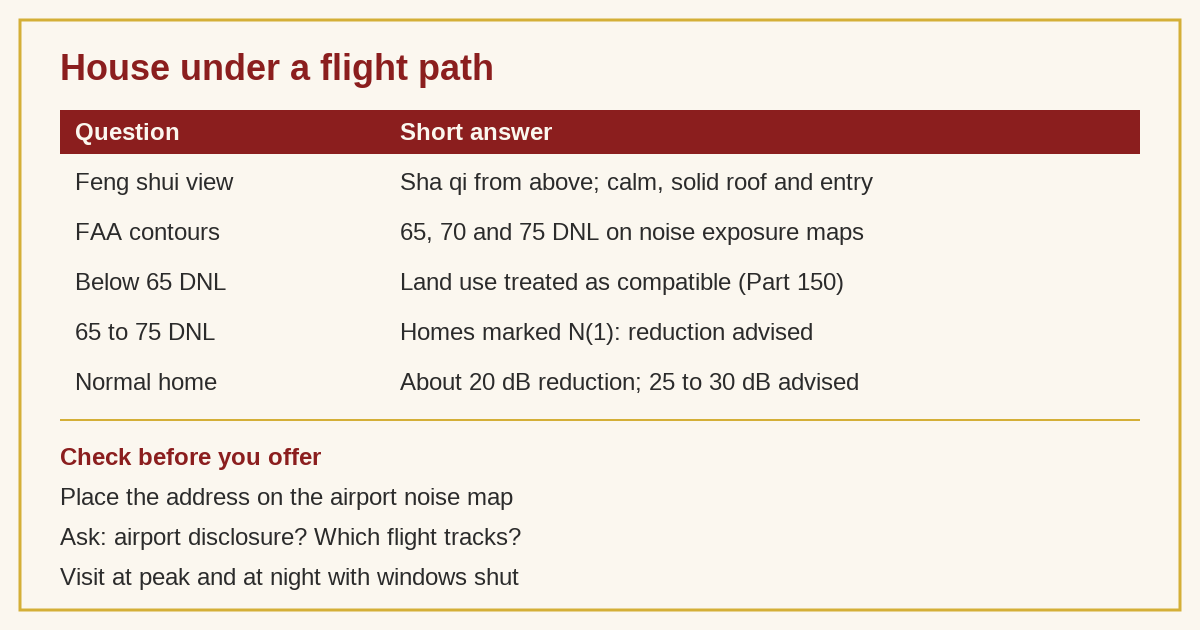
Feng shui reads a house under a flight path as having its qi disturbed from above, and practitioners answer with a calm, solid entry and a sheltered bedroom. The buying decision itself turns on noise. US airports map day-night average noise in contours at 65, 70 and 75 dB, and below 65 dB land use is treated as compatible.
Rules last read: 23 November 2026
What follows applies to US houses near airports or under approach and departure paths, and sits with our other real estate and home buying guides. Road and rail noise have their own pages: feng shui house near a highway and feng shui house near train tracks.
| Noise rule | Figure or rule | Source |
|---|---|---|
| Noise exposure map contours | Yearly day-night average sound level (YDNL) contours at 65, 70 and 75 dB | 14 CFR Part 150 Appendix A |
| Night penalty | Nighttime levels (10 pm to 7 am) get a 10 dB penalty in the calculation | 14 CFR Part 150 Appendix A |
| Compatible land use | Treated as compatible below 65 dB | 14 CFR Part 150 Appendix A |
| Residential, 65 to 75 dB | Marked "N(1)": not compatible unless sound reduction is built in | 14 CFR Part 150 Appendix A |
| Recommended reduction | At least 25 dB (65 to 70 band) and 30 dB (70 to 75 band) of noise level reduction where homes must be allowed | 14 CFR Part 150 Appendix A |
| Normal construction | Expected to provide about 20 dB of reduction | 14 CFR Part 150 Appendix A |
| Local decision | The table is not a federal determination, and local authorities decide what uses are allowed | 14 CFR Part 150 Appendix A |
| HUD acceptability | Acceptable up to 65 dB DNL; normally unacceptable above 65 up to 75; unacceptable above 75 | 24 CFR 51.103 |
On this page
- What feng shui says
- What the 65 DNL contour means
- Reading the noise exposure map
- Sound insulation
- Disclosure and questions to ask
- Scoring sheet
- Four ways buyers get airport noise wrong
- FAQ
- Your first two checks
- Sources
What feng shui says
Form School looks at what surrounds a house, and the tradition holds that qi settles in a protected, calm place. Traditional texts say little about aircraft. What you read online is modern practitioners stretching older ideas to fit: noise and movement overhead disturb the stillness a home should have, and an open sky with nothing sheltering the roof leaves the house exposed. Their answer is more cover, in the form of a solid roof line, mature trees, a sheltered main bedroom and a calm entry. Most also say the house's position relative to the approach counts, and that a flight path crossing the front is worse than one off to the side. Our sha qi guide explains the general idea.
That is a design lens. The choices that save you money are about decibels, windows and disclosure.
Advertisement
What the 65 DNL contour means
An airport that studies its noise under the FAA's Part 150 rules draws contours of yearly day-night average sound level (YDNL, usually called DNL) at 65, 70 and 75 dB. DNL is a yearly average with a 10 dB penalty added for night hours. A few loud night flights therefore count for far more than the same flights by day.
Under Part 150 Appendix A, land uses are treated as compatible below 65 dB. For ordinary residential use, the table marks the 65 to 70 and 70 to 75 dB bands as "N(1)" and 75 to 80 dB and above as "N". A footnote covers the case where a community decides homes must be allowed anyway. Building codes and approvals should then require noise level reductions of at least 25 dB in the 65 to 70 band and 30 dB in the 70 to 75 band. Normal residential construction, it notes, can be expected to provide about 20 dB. The table also says plainly that it is not a federal determination of acceptable land use. Local authorities decide.
HUD's standard (24 CFR 51.103) draws the same line. Up to 65 dB is acceptable, above 65 up to 75 dB is normally unacceptable, and above 75 dB is unacceptable. For sites at 65 to 70 and 70 to 75 dB it requires 5 and 10 dB of additional attenuation. The rule covers HUD-assisted projects, not private sales, but its 65 dB line matches the one used in aviation planning.
Put the numbers together. Inside the 65 dB contour, the guidance asks for at least 25 dB of reduction (30 dB in the 70 to 75 band), and normal construction gives about 20 dB, so ordinary windows and walls probably fall short. Outside the contour the house is still not silent. DNL is an average, and one loud overflight can wake you.
Our feng shui home buying checklist includes airport noise among the outside checks.
Reading the noise exposure map
The map in a Part 150 study must show the runways, flight tracks, the 65, 70 and 75 dB contours, airport boundaries and the land uses inside them, and it must be overlaid on a land use map detailed enough to show streets. Many airports publish theirs. Find the current noise exposure map (the airport authority's website is the place to start), put the house on it and note which band it falls in. Not every airport has done a Part 150 study, and some maps are out of date, so do not assume there is one. Even a good map is only one input. Listen to the flights yourself.
Sound insulation
We found no primary source giving a price or rating for soundproofing a house, so we quote none. For flight noise, contractors commonly propose better windows and doors, sealed gaps, more attic insulation, and mechanical ventilation so the windows can stay shut. Before you offer, get the manufacturer's rated sound reduction and a written quote. Some airports run sound insulation programs. Ask the airport authority whether the address qualifies for one.
Disclosure and questions to ask
Disclosure rules vary by state and province. Some US states require a notice about nearby airports in the sales documents. The one statute we found, California's, has not been verified, so we describe no wording or distance from it. Ask your agent and a local real estate lawyer what applies where you are, and put these questions to the seller directly:
- Is the house inside any airport noise contour or influence area?
- Do flights pass over at night, and how often?
- Has the seller received any notice about the airport, a new runway or new flight procedures?
- Is there a sound insulation program, and was the house enrolled?
Scoring sheet
We made this sheet as a planning aid; it is not a standard. Score each line 0, 1 or 2. A higher total means more noise risk.
| Check | 0 | 1 | 2 |
|---|---|---|---|
| Address on the airport's noise exposure map | Outside 65 dB | 65 to 70 dB | 70 dB or more |
| Night flights audible with windows shut | No | Occasionally | Often |
| Windows and doors | Rated sound insulation | Modern double glazed | Old or leaky |
| Bedroom position | Away from the flight track | Side | Under the flight track |
| Seller disclosure or notice | Clear and complete | Partial | None or evasive |
| Planned runway or procedure changes | None known | Unknown | Yes |
Take a house at the edge of the 65 to 70 dB band (1) with occasional night flights (1), modern double glazing (1), the bedroom on the far side (0), a clear disclosure (0) and no known changes (0). It scores 3 out of 12, which is workable if the window upgrade fits the budget. At 8 or more, either pass on the house or ask for a lower price.
Four ways buyers get airport noise wrong
- Viewing on a quiet day, when the wind has sent the planes elsewhere.
- Hearing "outside the 65 dB line" as "quiet", when the line is an annual average.
- Counting on a feng shui mirror or charm to deal with noise.
- Assuming the seller's disclosure covers the airport without asking.
FAQ
Is it bad feng shui to live under a flight path?
Traditional texts say little about aircraft. Modern practitioners hold that noise and movement overhead disturb the stillness a home should have, and they suggest cover: mature trees, a solid roof line and a sheltered bedroom. Read it as a design lens, not a measured effect.
What does the 65 DNL line mean?
Under the FAA's Part 150 rules airports map yearly day-night average sound level at 65, 70 and 75 dB, and land uses are treated as compatible below 65 dB. For homes, the 65 to 75 dB bands are marked as not compatible unless sound reduction is built in. Local authorities decide what is allowed.
How much noise does a normal house block?
Part 150 Appendix A says normal residential construction can be expected to provide about 20 dB of noise level reduction, while it advises reductions of at least 25 and 30 dB where a community decides homes must be allowed.
Must a seller disclose airport noise?
That depends on the state or province, and we have not verified a statute to describe. Ask your agent and a local real estate lawyer, and ask the seller directly about contours, night flights and any notices.
How do I find the noise map for an airport?
Check the airport authority's website for its Part 150 noise exposure map and find the address on it. Not every airport has a current study, so visit at peak times and at night with the windows shut as well.
Your first two checks
Find the address on the airport's noise exposure map. Then go back at the busiest hour and again at night, with the windows shut, and make notes alongside our bedroom sleep environment guide.
Sources
Checked November 2026.
- 14 CFR Appendix A to Part 150, Noise Exposure Maps (via Cornell LII)
- 24 CFR 51.103 Criteria and standards (HUD, via Cornell LII)
We have not verified California's airport disclosure statute, so no wording or distance from it appears here. None of the sources we read covered Canadian noise rules, sound insulation costs or an effect on price.
Editorial note: Feng shui is presented here as a cultural and design tradition. Confirm legal, financial, health and inspection questions with a licensed professional.