For an agent, feng shui is part of serving clients, not a sales tool. Learn enough of the vocabulary to answer questions calmly. Prepare every listing so any buyer sees a clear, well-lit home, and write down the neutral property facts. Then keep to fair housing rules: never assume who follows feng shui, never steer, and never promise that a cure brings luck.
Legal references checked: 23 November 2026
We wrote this for licensed agents and brokers. Sellers should start with feng shui for selling a house, and buyers with our real estate and home buying guides.
| Rule | What it requires | Source |
|---|---|---|
| Fair Housing Act | Bars discrimination in sales and rentals based on race, color, religion, sex, disability, familial status and national origin (not verified since November 2026) | US Department of Housing and Urban Development (HUD) |
| Advertising | The Act bars ads stating a preference or limitation based on a protected class (not verified since November 2026) | 42 U.S.C. 3604(c) |
| NAR Code of Ethics, Article 10 | Members must not deny equal professional services, or be party to a plan to discriminate, on protected grounds (not verified since November 2026) | National Association of REALTORS |
| State and local law | Many states and cities add protected classes beyond the federal list | Your state real estate commission |
| Feng shui claims | There is no evidence that a cure produces a specific financial or health result, so present it as a cultural tradition | See our selling guide's research section |
On this page
- What agents actually need to know
- Fair housing: the rules that come first
- Listing prep that helps every buyer
- Words to use and words to avoid
- A neutral conversation script
- If you offer feng shui as a service
- Habits that put agents at risk
- FAQ
- Turn the seven steps into your checklist
What agents actually need to know
You do not need to be a practitioner. About a dozen ideas will let you follow what a client means and keep you from saying something silly. These come up most often:
- Facing direction and the position of the front door (see facing vs door direction).
- Front to back door alignment and stairs facing the front door (alignment, stairs).
- Number meanings: 8 sounds like wealth in Chinese and 4 like death, which shapes how some clients feel about addresses, floors and prices (why 8 is lucky, why 4 is avoided).
- Bed, stove and entrance positions in the home (bed direction, stove and sink).
- Clutter and light: the advice practitioners agree on most, and the advice you already give sellers.
The tradition has many schools, and they disagree. When a client quotes a rule you do not know, say "I am not a practitioner, but I can note it and find out what the property facts are". It is honest, and it keeps you safe.
Advertisement
Fair housing: the rules that come first
In the US, the Fair Housing Act protects against discrimination based on race, color, religion, sex, disability, familial status and national origin (not verified since November 2026), and Article 10 of the NAR Code of Ethics extends equal professional service to the same list and a few more (not verified since November 2026). Your state may add other classes. In Canada, human rights law is set by each province.
When feng shui comes up, five rules apply:
- Never infer a client's beliefs from their name, language, appearance or neighbourhood. Feng shui is followed by people of many backgrounds, and many people of Chinese heritage do not follow it.
- Never steer. Do not show or withhold listings, areas or buildings because of what you presume about a client's background or beliefs. Let clients tell you their criteria, then apply those criteria to every property.
- Do not write listings that describe the buyer. Describe the property: its facing direction, house number, floor, layout and light.
- Treat every client's criteria alike. A buyer who asks for "south facing, not on a T-junction" is applying a criterion, the same as one who asks for a big yard.
- Do not refuse or discourage a service because of a client's national origin or religion, and do not create a different process for them.
When unsure, ask your managing broker or your brokerage's compliance contact before the listing goes live.
Listing prep that helps every buyer
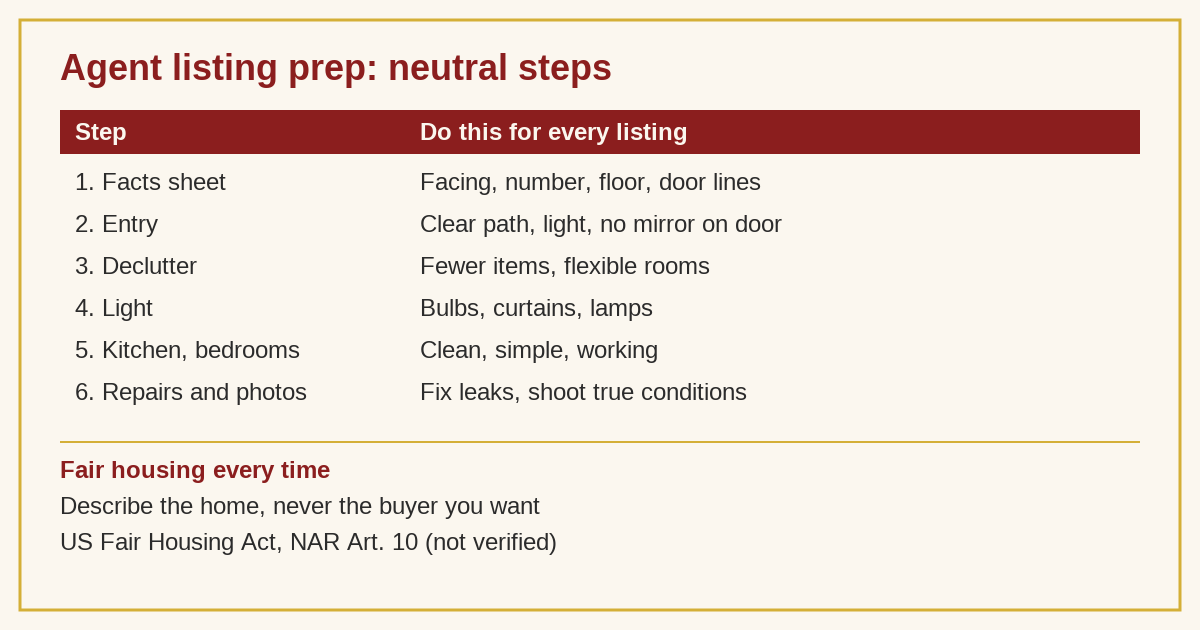
These steps come from the tradition, but they are also ordinary staging, which is why you can safely use them on every listing. The full seller plan is in feng shui for selling a house.
| Step | What to do | Why it works for everyone |
|---|---|---|
| 1. Facts sheet | Record facing direction, house number, floor, door lines and what is nearby | Answers repeated questions the same way for every buyer |
| 2. Entry | Clear the path and door, fix lighting, remove a mirror that faces the door | It sets the first impression and is safer |
| 3. Declutter | Remove excess furniture and personal items | Rooms read as larger and more flexible |
| 4. Light | Replace dead bulbs, open curtains, add lamps to dim corners | Photos come out brighter |
| 5. Kitchen and bedrooms | Keep them clean and simple, with every appliance working | Buyers weigh these heavily in showings |
| 6. Repairs | Fix leaks, sticking doors and broken fixtures | Fewer surprises at inspection |
| 7. Photos | Shoot in daylight and show the true condition | An honest listing wastes fewer showings |
For one room worked through in detail, see staging the living room to sell.
Words to use and words to avoid
| Say | Avoid |
|---|---|
| "South-facing front door, 8 steps from the street" | "Great for Chinese buyers" |
| "Bright, open living area, cleared entry" | "Perfect feng shui" as a guarantee |
| "House number 88" (as the actual address) | "Lucky house, you will get rich" |
| "Quiet street, no through traffic" | "Away from certain communities" |
| "I can find the facts on that" | "Your family will like it because..." |
Describing the facing direction is a fact. Calling a house lucky is a claim you cannot support.
A neutral conversation script
Ask every new client the same question: "Is there anything about layout, orientation or surroundings that matters to you in a home?" Then listen. A client who brings up feng shui can hear this: "I can note that, and I will give you the facing, door lines and what is nearby for each property we look at. A consultant can advise you on the tradition itself." You say the same thing to everyone, you assume nothing, and you stay out of metaphysical advice.
If you offer feng shui as a service
Some agents partner with a practitioner or take a course. If that is you:
- Do not present feng shui as a guaranteed result, and do not state outcomes for wealth, health or love.
- Check your brokerage rules and local licensing on any additional services or fees, and disclose any referral relationship.
- Offer it to every client or to none, never only to the clients you think would want it.
- Never use a feng shui "cure" to cover a material defect. A mirror does not fix a leak.
- Do not claim credentials you do not hold.
Habits that put agents at risk
- Assuming a client follows feng shui, or assuming they do not.
- Calling a home "lucky" in the listing remarks to sell it.
- Dodging a property fact that sounds negative, such as a T-junction or stairs facing the door, instead of answering honestly.
- Letting a cure stand in for disclosure or repair.
- Treating feng shui as a niche for one group of clients.
FAQ
Do real estate agents need to know feng shui?
No, but knowing the basics helps you understand client questions, prepare listings clearly and avoid missteps. You do not need to give feng shui advice. Gather the facts clients ask about and refer them to a qualified practitioner for interpretation.
Can I mention feng shui in a listing?
It is safest to describe the property's facts, such as facing direction, layout and light, instead of using feng shui as a selling claim. Never describe the preferred buyer. Check your brokerage policy and local rules before you publish.
Is it discriminatory to market to buyers who follow feng shui?
Marketing aimed at a protected class, or that uses terms tied to national origin or religion, can violate fair housing law (not verified since November 2026). Describing property features that buyers of any background may care about is different. When in doubt, ask your broker.
What should I do if a client asks about the feng shui of a property?
Give the neutral facts, such as facing, door lines and what is nearby. Say that you are not a practitioner, and suggest a qualified consultant to interpret them. Do not guarantee any outcome.
Should I stage differently for buyers who follow feng shui?
Do not stage for a presumed audience. Stage once for every buyer: a clear entry, good light, tidy rooms and honest photos. Most feng shui prep advice overlaps with ordinary staging.
Can an agent charge for feng shui advice?
That depends on your licence rules and your brokerage policy. Ask your managing broker or regulator before you offer it as a paid service, and disclose any referral fee.
Turn the seven steps into your checklist
Write a one-page listing-prep checklist from the seven steps above and use it on your next listing. After that, read feng shui for selling a house for the room-by-room plan to share with your seller.
Sources
Checked November 2026. The rules marked "not verified since November 2026" may have changed, so read the current text at the source before relying on them.
- Fair Housing Act (Title VIII of the Civil Rights Act of 1968), 42 U.S.C. 3601 and following, US Department of Housing and Urban Development.
- Code of Ethics and Standards of Practice, Article 10, National Association of REALTORS.
- Your state real estate commission rules on advertising and licensed services.
- Human rights codes of each Canadian province, provincial governments.
Editorial note: Feng shui is presented here as a cultural and design tradition. Fair housing and licensing questions depend on your jurisdiction, so confirm them with your managing broker or a real estate lawyer.