In feng shui, an exterior color is chosen from the direction the house faces. Each direction belongs to an element, and each element has a color family: south fire (reds), north water (deep blue, black), east and southeast wood (greens), west and northwest metal (white, grey), southwest and northeast earth (terracotta, ochre). The practical work is fitting that family to your roof, climate, siding and HOA.
Most pages on this topic stop at the color list. A homeowner repainting a real house needs more: which colors are already fixed, how much of the house each color can cover, whether the siding will tolerate a dark shade, how the color will look on the sunniest wall, and what to do when the "right" color is one you dislike or your association bans. This guide gives the tradition first, attributed to its schools, and then the decisions a painter or siding installer will actually ask you to make.
Last checked: 13 November 2026
| Fact | Figure or rule | Source |
|---|---|---|
| Cool roof effect | A clean white roof reflecting 80% of sunlight stays about 50°F cooler than a grey roof reflecting 20% on a typical summer afternoon | ENERGY STAR, citing Lawrence Berkeley National Laboratory |
| Colored cool roofs | Newer coatings and materials give high reflectance in colors other than white | ENERGY STAR |
| LRV scale | 0 to 100; real paint reaches about 94 for the whitest whites and about 5 for the blackest blacks | Composite Paint |
| Paint on vinyl or cellular PVC | Generally limited to LRV 55 or higher, and no darker than the original color | Green Building Advisor |
| Reflected sunlight on siding | Siding darkness is "at most, a secondary factor"; reflected sunlight from concave double-pane glass is the main cause of distortion | Polymeric Exterior Products Association |
| Paint buildup | Once paint reaches about 1/16 inch (roughly 16 to 30 layers), one or more extra coats may trigger cracking and peeling | National Park Service, Preservation Brief 10 |
| Changing only the trim | Near that thickness, changing only the accent colors on limited trim can be an acceptable compromise | National Park Service, Preservation Brief 10 |
What the tradition says about exterior colors
Feng shui is a cultural and design tradition with several schools, and they do not agree on exterior color. It helps to know which school a rule comes from before you spend money on it.
Compass school (including Eight Mansions). Practitioners say each of the eight compass sectors has an element, and a house or door facing that sector can wear colors of that element. This is the source of the common chart: south fire, north water, east and southeast wood, west and northwest metal, southwest and northeast earth. Our front door colors by facing direction page uses the same mapping, and this guide keeps it identical so the two never disagree.
The generating and controlling cycles. Within the five elements, tradition holds that wood feeds fire, fire makes earth, earth bears metal, metal enriches water and water nourishes wood. This is the generating cycle, and a color from the feeding element is usually accepted as a supporting color for a direction. The controlling cycle runs the other way: water checks fire, fire checks metal, metal checks wood, wood checks earth and earth checks water. Some practitioners advise keeping the dominant color away from the element that controls the direction's element. Others treat that as optional. Our five elements balancing guide lays out both cycles.
Form school. Form school pays less attention to a color chart and more to the setting. The question is whether the house stands out, disappears or fights its surroundings: a stark white house under dark pines, a black house on an open treeless lot, a bright facade between muted neighbors. Practitioners of this approach say a house should sit comfortably in its landscape and street. That reading is easy to turn into a practical rule: look at what surrounds the house and choose colors that sit between "vanishes" and "shouts."
Folk custom. Popular lists add lucky colors from Chinese and other customs; see the complete lucky colors guide. They are customs, not rules a school requires.
None of this predicts an outcome. Tradition does not hold that a paint color sells a house faster or protects health, and this guide does not claim it. Treat the chart as one input beside the roof, climate, budget and rules.
Step 1: Fix what cannot change
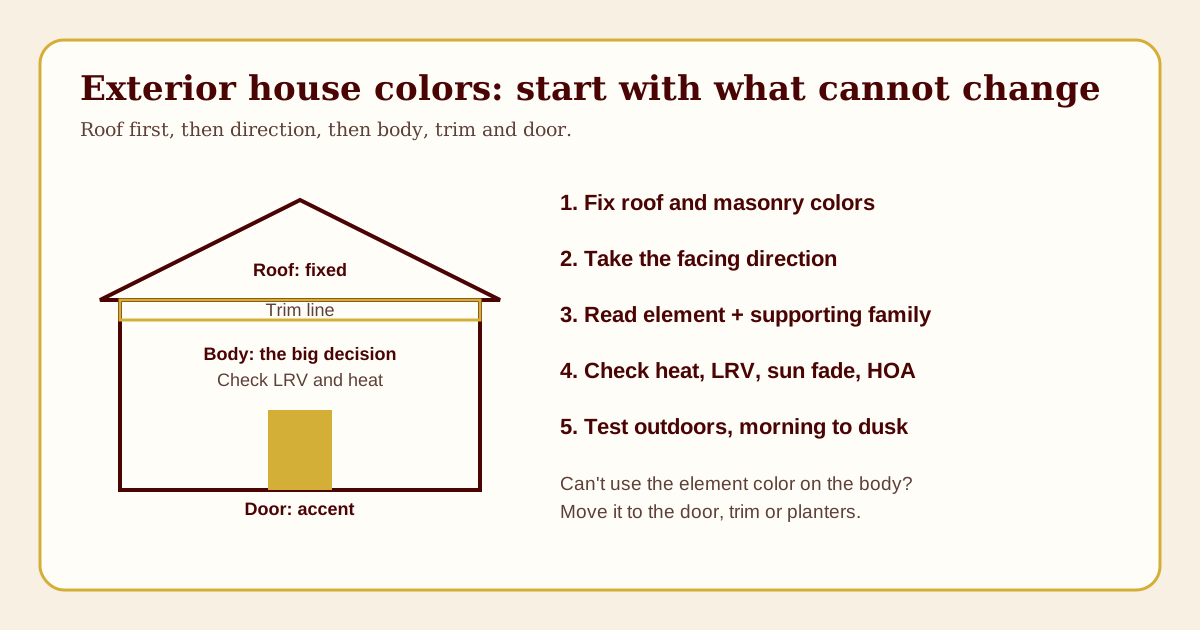
Before you choose any color, list the surfaces you will not replace. They set the palette more strongly than any chart.
- Roof. Re-roofing is a major expense, so the roof is almost always the starting point. Note its color family and whether the shingles are speckled.
- Masonry. Brick, stone and stucco-over-block are costly to paint and hard to restore once coated. Treat them as fixed.
- Window frames. White, black, bronze or tan frames are a fixed trim color.
- Hardscape and neighbors. Driveway, walkway and mature planting are part of what a visitor sees first.
Photograph each in the same light. What remains is your real decision list: body (if paintable), trim, shutters, soffit and fascia, gutters and door. On a brick house that may be only trim, door and shutters. Practitioners routinely put the element color there when the walls are fixed.
Step 2: Take the facing direction correctly
Most mistakes here are measuring mistakes, not color mistakes. Our house facing versus door direction guide explains why the facade and the main door can differ, and which one each method uses. Our compass reading guide covers the steps: hold the compass level, move away from steel and wiring, take three readings and record the sector.
Each of the eight directions owns 45 degrees, so a house near a boundary can reasonably use either palette. Choose whichever is easier to carry out and treat the other as an acceptable bridge. Decide once which reading you use, facade or door, write it down and use the same one for every color decision.
The facing direction table
This table combines the site's direction-to-element mapping (the same one used on the front door page) with the supporting family from the generating cycle and a practical note for a repaint. The "controlling family" column is our own inference, not a rule quoted from a school: we applied the controlling cycle to each direction's element to show which family some practitioners keep to accents. Our front door page does not list colors to avoid, and many practitioners ignore this column for exteriors.
| Facing | Element in tradition | Color family | Supporting (generating) family | Controlling family (our inference) | Practical note |
|---|---|---|---|---|---|
| South | Fire | Red, coral, orange, warm brights | Wood: deep greens, warm browns | Water: deep blue, black | Strongest sun in the northern hemisphere, so check a red's fade rating before using it on the body. A muted brick red on the body or red only on the door keeps a repaint small. |
| Southwest | Earth | Terracotta, ochre, sandy yellow, warm neutrals | Fire: soft warm reds, warm oranges | Wood: strong greens | Warm neutrals are the easiest family to use on the whole house. Afternoon sun means heat as well as fade. |
| West | Metal | White, light grey, silver and gold finishes | Earth: sand, ochre, warm neutrals | Fire: bright reds | Takes the hot afternoon sun, so light colors help. Pale metal colors suit hot-climate siding. |
| Northwest | Metal | White, grey, metallics | Earth: sand, ochre, warm neutrals | Fire: bright reds | Same family as west. Often a side wall, so the door and trim carry most of the choice. |
| North | Water | Deep blue, navy, black, dark teal | Metal: white, light grey | Earth: heavy yellows, ochre-browns | Least direct sun, so dark colors run cool and fade slowly, but shade invites mildew. Test dark paint in shade, where it reads darker. |
| Northeast | Earth | Terracotta, warm yellow, stone neutrals | Fire: soft warm reds, warm oranges | Wood: strong greens | Morning sun and winter shade. Warm stone neutrals read well in low light. |
| East | Wood | Green, leaf tones, warm brown | Water: deep blue, black accents | Metal: stark white, grey, metallic | Gentle morning sun. Greens look bluer in shade and yellower in sun, so sample both. |
| Southeast | Wood | Green, teal-green, warm wood tones | Water: deep blue, black accents | Metal: stark white, grey, metallic | Strong sun on part of the day. Deep greens hold up better than pale ones. |
Two reading notes. These are color families, not paint chips: a sage and a forest green both belong to wood. And the controlling-family column is the least settled part: it is our application of the cycle, such families are often fine as trim or accent, and many practitioners ignore the controlling cycle for exteriors.
Advertisement
Step 3: Divide the colors: body, trim and accent
A house wears three kinds of color. The body is the large surface, the trim frames the openings, and the accents are small and replaceable: door, shutters, planters, house numbers, porch light, mailbox.
The tradition gives you freedom here. Nothing in the compass school requires the walls to carry the element color; practitioners routinely put it on the door and a few smaller features. A practical split is:
- Body: a color that suits the roof, the setting and the climate. If you want to use the direction's element color, choose a muted, mid-value version.
- Trim: a light or contrasting color that frames the windows and ties them to the roof or masonry. Trim is a good place for the supporting-element family.
- Accent: the element color at full strength, in a small area you can repaint in an afternoon.
To see how little area an accent covers, take a worked example. A one-story house measures 40 ft by 28 ft with 9 ft walls. The perimeter is 2 x (40 + 28) = 136 ft, so the gross wall area is 136 x 9 = 1,224 sq ft. Allow roughly 150 sq ft for windows and doors (an assumption for this example; measure yours). That leaves about 1,074 sq ft for the body. A front door measuring 3 ft by 6 ft 8 in is about 20 sq ft, which is under 2% of the body area (20 / 1,074 = about 1.9%). A strong color on that door reads as an accent. The same color on the walls is a very different commitment: more paint, more fade, more neighbors with opinions.
That arithmetic is why "element on the door" is so common: a few hours, a quart of paint, easy to reverse. The front door page linked in the next step goes deeper.
The National Park Service's guidance on repainting adds a practical point. It notes that when paint is already near a critical thickness, changing only the accent colors on limited portions of the trim can be an acceptable compromise that avoids adding more paint to the siding, and that extreme changes in color may need more than one coat to hide the old color and show the new one fully (National Park Service, Preservation Brief 10, checked November 2026). That is written for historic woodwork, but the physics is the same on any painted wood: a dark-to-light switch costs more coats.
Step 4: LRV, heat and the siding you actually have
What LRV tells you
Light reflectance value (LRV) is a number from 0 to 100 that says what share of visible light a dried paint film reflects. Real paint never reaches either extreme: the whitest whites sit near 94 and the blackest blacks near 5 (Composite Paint, "LRV explained", checked November 2026). Most paint makers print LRV on the back of a color chip or in the online color detail, so it costs nothing to read.
LRV is a rough guide to heat, not a measurement of it. It describes visible light only, while a building also absorbs and reflects infrared. But within one product line, a lower LRV generally means a surface that absorbs more sunlight. That is why LRV is the number siding manufacturers and paint makers use to set limits on dark colors.
Cool roofs and the roof as a fixed color
ENERGY STAR describes a cool roof as one that lowers the roof surface temperature by reflecting sunlight and releasing heat as infrared. Citing the Lawrence Berkeley National Laboratory Heat Island Group, it says a clean white roof reflecting 80% of sunlight stays about 50°F cooler than a grey roof reflecting only 20% on a typical summer afternoon. It adds that lighter-colored roofs tend to have the best reflectance, but newer coatings and materials give high reflectance in other colors too (ENERGY STAR, "Cool Roofs", checked November 2026).
The page gives no steep-slope threshold and refers readers to the Cool Roof Rating Council for ratings, so this guide states none. If you are replacing the roof, compare the solar reflectance on the rating label, not a color name. If not, the roof is a fixed color and the walls should sit well beside it. In a cold climate the heating benefit of a dark roof can matter more; ask your local energy office.
Vinyl and cellular PVC siding
Vinyl siding is the material most exposed to a dark-color mistake. Vinyl and similar plastic cladding expands and softens with heat. Green Building Advisor reports that paint on vinyl or cellular PVC trim is usually limited to an LRV of 55 or greater, and that the paint should be no darker than the product's original color, to avoid expansion problems from absorbed heat. It also notes that dark vinyl shades exist but a true black is generally unavailable (Green Building Advisor, "How to Choose Black Siding", checked November 2026).
So, for a vinyl-sided house:
- Do not assume you can repaint vinyl in any color. Ask the siding maker for its written guidance on repainting and read the warranty.
- If you are installing new siding, choose from the manufacturer's color range, since those colors are tested on that product.
- If the element color for your direction is dark (north: deep blue or black; east or southeast: deep green), use it on a fiber-cement, wood or metal door and trim, not on vinyl walls.
Reflected sunlight: a hazard that has nothing to do with color
A common belief is that dark siding is what melts siding. The Polymeric Exterior Products Association's technical note on concentrated sunlight says otherwise. It states that most cases of distortion result from the partial collapse of double-pane insulating glass, which can bend inward into a concave surface that concentrates reflected sunlight. It adds that low-E glass reflects a greater share of sunlight than normal glass, especially in the infrared, and that the siding's darkness "appears to be, at most, a secondary factor," with both light and dark colors affected (Polymeric Exterior Products Association, "Effect of Concentrated Sunlight on Polymeric Siding", checked November 2026). It also says the temperatures needed for significant distortion are not routinely reached.
So if a low-E window faces a vinyl wall across a narrow gap, a light color does not make it safe. Ask your siding maker and window supplier.
Advertisement
Step 5: Sun, orientation and fade
Paint fades where the sun hits it. In the northern hemisphere the south wall gets the most direct sun across the year, the west wall takes the hot afternoon sun, the east wall gentle morning sun and the north wall the least. Reverse north and south in the southern hemisphere.
- Fading shows first where the sun hits hardest, on south and west walls. The tradition asks for red on a south-facing house. A muted or deeper red suits the wall; keep full-strength red for the door, where a repaint is cheap.
- Shade has its own failure. On a north wall, mildew appears where sun does not dry the surface. NPS advises addressing shade and moisture and using mildew-resistant primer and finish coats, and warns that new paint over an unresolved moisture problem will simply fail (National Park Service, Preservation Brief 10, checked November 2026).
- Chalking. NPS says to clean chalk off with a detergent solution and repaint with a non-chalking paint. Check a paint's weathering performance before putting a dark color on a sunny wall.
Step 6: Sample outdoors, on the house, across a full day
A chip under store light tells you almost nothing about a facade. Paint two or three finalists on boards at least about two feet across, tape them to the actual wall beside the trim, roof edge and masonry, and look at morning, midday, late afternoon, dusk and on a cloudy day. On a north wall the shade reads colors darker and cooler. View from the street too, at the distance a visitor sees the house. Hold each board against the shingles: the pair should look planned, not accidental. If it looks accidental, change the wall color, not the roof.
HOA rules, heritage districts and what you may paint
Everything above assumes you may paint the house any color. Many properties cannot.
- Homeowners associations often have an approved palette or a request process. Read the covenants, not a summary, and note whether the rule covers walls, trim and door separately.
- Heritage districts may regulate colors, especially on the street face. NPS guidance for historic buildings says a color change that is not a restoration should be appropriate to the style and setting of the building, restoration colors should rest on a paint analysis, and fading alone is not sufficient justification to repaint (National Park Service, Preservation Brief 10, checked November 2026).
- Condo and townhouse boards often control everything outside your door.
- Rentals. A planter, a mat and house numbers may be your only exterior color decisions. Our guide to feng shui for renters with no renovation covers the inside.
Get approval in writing before you buy paint, name the product and color code, and keep a copy. If a color is rejected, ask whether door, shutters or planters are within your control.
When the right color is one you dislike, or one the HOA bans
The tradition has built-in routes through this.
- Use the supporting family. South-facing: wood greens instead of red. North-facing: whites or greys instead of black. West-facing: sands instead of white. East-facing: deep blue instead of green.
- Shrink the color. Wrong for the whole house can still be right on the door, shutters, trim or window boxes.
- Change depth, not hue. A muted brick red, a deep teal or a warm stone is the same family at lower intensity.
- Use materials and plants. A wood-toned door, a brass number plate or a stone planter carries an element without paint. Green planters at the door are a wood accent under nearly any rule set; see the lucky plants guide.
- Accept the mismatch. Tradition grades the element, not your taste. Choose what you can maintain and defend to your association.
Three worked houses
Each example states the inputs. Colors are families, not paint codes, and none is a prediction.
House A: north-facing brick with a fixed red-brown roof
Inputs. A one-story house, 40 ft by 28 ft, faces north. The brick is mid red-brown and unpainted, and the roof is red-brown shingles. The windows have white vinyl frames. The owner can paint the door, shutters, soffit and fascia, gutters and porch ceiling. No HOA.
Step by step.
- Fixed colors: red-brown brick, red-brown roof, white window frames.
- Facing: north, water. Color family: deep blue, navy, black, dark teal. Supporting family: metal, white and light grey.
- Brick and roof already read warm. A navy or black body is not possible, and painting the brick is not on the table. So the water family goes on the small surfaces.
- Choose a white or warm grey trim to match the window frames: this is the supporting metal family and ties the windows to the soffit and gutters.
- Choose a deep navy door. North gets the least direct sun, so a dark door fades slowly, and the door is not vinyl, so heat is not a problem.
- A north facade stays damp longer: use mildew-resistant primer and paint, as NPS advises.
House B: west-facing vinyl-sided house in a hot climate
Inputs. A two-story house faces west. The siding is vinyl in a light tan with white trim, the roof is mid grey and due for replacement in two to three years. The owner wants a color change and has a dark charcoal in mind. The climate is hot, with strong afternoon sun on the front.
Step by step.
- Fixed colors: tan vinyl siding (for now), grey roof, white trim.
- Facing: west, metal. Color family: white, light grey, silver and gold finishes. Supporting family: earth, sand and warm neutrals. Dark charcoal is not in the family, and dark colors are the risk on vinyl.
- Check the siding: if the owner repaints the vinyl, the reported limit is LRV 55 or higher and no darker than the original. A charcoal is far outside that, so the siding either stays tan or is painted a light sand, a color the manufacturer's guidance has to confirm.
- West walls take the hottest afternoon sun in summer. A pale body helps. A lighter warm grey or pale sand on the body suits both the metal family and the heat.
- For the roof, wait for the replacement and compare rated products by their printed solar reflectance.
- If the owner still wants charcoal, put it on a fiber-cement or metal front door and the porch ceiling, not on vinyl.
House C: townhouse where only the door and trim can change
Inputs. A townhouse in an association faces southeast. The body is beige siding, the roof and masonry base are association-controlled, and the rules allow the owner to repaint the front door and the trim around it, from an approved list. The owner has not yet read the list.
Step by step.
- Fixed colors: the beige body and the association's roof and base. They are not the owner's to judge.
- Facing: southeast, wood. Color family: green, teal-green, warm wood tones. Supporting family: water, deep blue and black accents.
- Read the approved list for the door. If it includes a green, use it. If it includes only neutrals, a stained wood-tone door is in the wood family without a hue.
- If the list has no green or wood tone, use the supporting water family: a deep blue door, if approved.
- Where paint is not allowed, add green planters, a wood-toned number plate and a doormat. Put any request in writing and keep the approval.
Advertisement
Common mistakes and edge cases
- Ignoring the roof. A color that fights the roof reads as an error whatever the chart says.
- Painting dark vinyl. Check the maker's limits first.
- Too many coats. NPS warns that once buildup reaches about 1/16 inch, roughly 16 to 30 layers, one or more extra coats may trigger cracking and peeling, so heavy old paint may need removal.
- Mixing facing readings. Use the facade reading or the door reading, not both.
- Corner lots. If a house has two street faces, read the main entrance and treat the other as secondary.
- Apartments and condos. If you control only your door, that is the whole decision. See the apartment door facing guide.
- Children and pets. Keep sample pots shut and out of reach, and read the label for ventilation and cure times.
- Selling soon. A neutral, well-kept exterior is the safe choice; see feng shui for selling a house and the interior companion, feng shui colors by room.
What to look for when you choose paint, siding and a contractor
- The LRV on the chip or online color page, written beside each finalist.
- The siding maker's written repainting limits and fade warranty.
- A painter's written scope naming prep, primer, coats and which surfaces are covered.
- If you replace the roof, a rated product: ENERGY STAR refers readers to the Cool Roof Rating Council for ratings.
If you are buying and the exterior is dated, weigh the repaint against the other items on the home buying checklist.
Next step
Choose your direction, mark the fixed colors on a sheet, and then decide the one thing you can change in an afternoon: the door. Our front door colors by facing direction page goes through finishes, glossy versus matte, and a paint-day routine for that single surface, which is the lowest-risk place to try your element color before you commit the walls.
Sources
- ENERGY STAR, "Cool Roofs": definition of a cool roof, the 80% versus 20% reflectance comparison (about 50°F cooler, citing Lawrence Berkeley National Laboratory), and the note on colored cool-roof coatings. Checked November 2026.
- Polymeric Exterior Products Association, "Effect of Concentrated Sunlight on Polymeric Siding": reflected sunlight from concave double-pane and low-E glass as the main cause of distortion, and darkness as a secondary factor. Checked November 2026.
- Composite Paint, "LRV explained": the 0 to 100 definition of light reflectance value and the practical limits near 94 and near 5. Checked November 2026.
- Green Building Advisor, "How to Choose Black Siding": LRV 55 or greater and no darker than original for painting vinyl or cellular PVC, and dark siding and thermal movement. Checked November 2026.
- National Park Service, Preservation Brief 10, "Exterior Paint Problems on Historic Woodwork": accent-only changes, paint buildup, mildew, chalking, moisture, color choice for historic buildings and paint history. Checked November 2026.
- Tradition claims (direction-to-element mapping, generating and controlling cycles, form school's attention to setting) are attributed generally to compass-school and form-school practice and match this site's front door colors and five elements pages. We did not open a museum or university source on the five phases for this page, so no figures are attributed to one.
Editorial note: This article presents feng shui as a cultural and design tradition for educational purposes. It does not predict or promise outcomes, and a paint color does not replace the advice of a licensed contractor, your siding manufacturer's written instructions, your homeowners association covenants, local heritage-district rules or any building code that applies to your property. Confirm approvals and product limits in writing before you buy.