Owners rarely change an unlucky house number, because the address is assigned by the local government and relabeling it can break mail and emergency response. What they do instead is read the number another way, choose a sign whose material and color suit it, and make sure the sign is large and legible. Tradition supplies the choices; the code decides the size.
Last checked: 17 November 2026
| Key fact | Figure or rule | Source |
|---|---|---|
| Minimum size, model residential code | Numbers at least 4 inches high with a stroke of at least 1/2 inch, contrasting with the background (2012 IRC text) | City document hosting 2012 IRC R319 |
| Characters allowed | Arabic numbers or alphabetical letters, plainly legible and visible from the street or road fronting the property | City document hosting 2012 IRC R319 |
| Fire department, single-family home | 4 in. high, 1/2 in. stroke, high contrast, solid flat surface, not on clear glass, above main entrance or approved alternate | City of Chico Fire Department |
| Fire department, multi-unit | Building numbers 6 to 8 in. high depending on type (12 in. for facades 30 ft or taller or over 250 ft from the curb); multifamily building number must be illuminated | City of Chico Fire Department |
| Reflective or lit numbers | Described as best for night and smoky conditions; numbers painted on a curb do not meet the requirement | Fire Safe Marin |
| Who assigns the number | Local governments, not the USPS | USPS (see our change guide) |
This page is part of our house numbers guide. The meaning of each digit is in the lucky house numbers guide, so this page does not repeat it. It covers what to do when you live at a number you dislike and how to put the sign up properly.
On this page
- Why owners do not simply change the number
- Remedies from the tradition
- Element remedies by number
- Sign material, color and style
- Rules for the sign itself
- HOA and condo rules
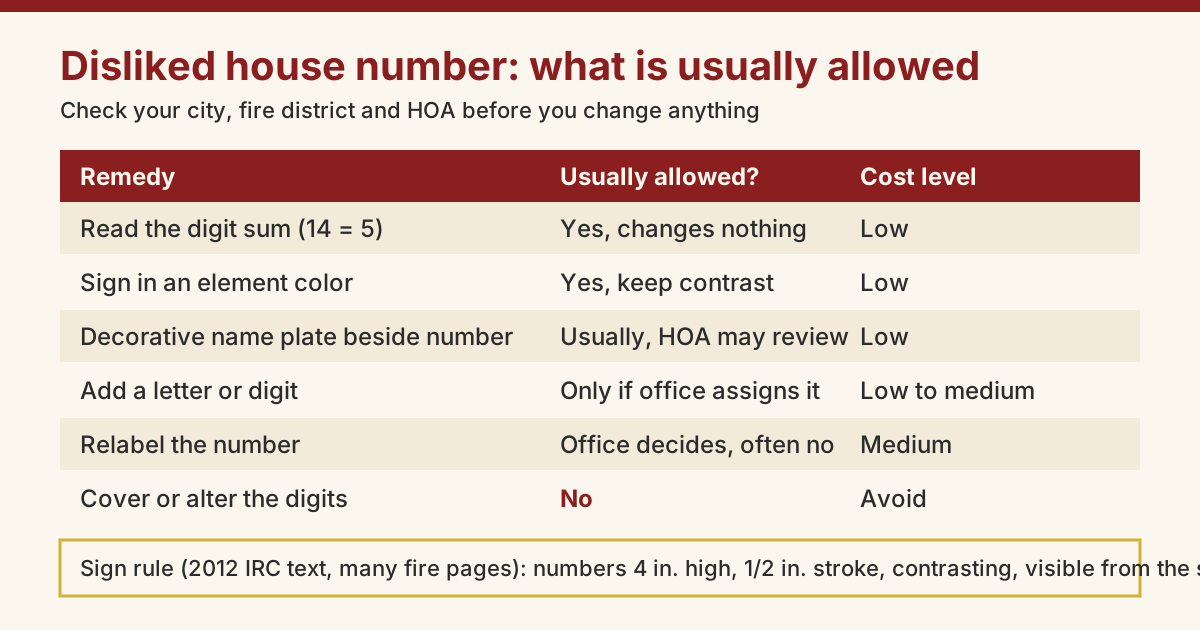
- Decision table: which remedies are allowed
- Worked example: house 14 and condo unit 404
- Common mistakes
- FAQ
- Where to go next
- Sources
Why owners do not simply change the number
The number on your home is a record. In the United States, the USPS says local governments assign addresses, not the Postal Service. The number links to mail, emergency dispatch, property tax and utilities, so an office that sees a luck request as a convenience for one owner and a risk for everyone else often says no. Our guide to changing your house number reads real county and city pages, with fees and an after-change checklist.
That is why most remedies below leave the official number alone and change what you do around it.
Remedies from the tradition
These come from feng shui and numerology practitioners. They are cultural practices, not tested methods, and none promises money, health or luck.
Read the number by its sum. Many practitioners reduce an address to a single digit by adding its digits. House 14 becomes 1 + 4 = 5; 40 stays 4; 44 becomes 8; 404 becomes 8. Methods differ on letters, zeros and whether to keep 11 or 22, so write down which one you use. Some owners find that a feared digit sits inside a different total, and treat that as the reading of the home. It changes how you read the number, not what is on the door.
Add a digit or letter under the number. Some homeowners ask whether a suffix such as an A or a half number is possible. This is allowed only where the addressing office assigns it. An unofficial addition can send a delivery or an ambulance to the wrong door, and it should match the number on record. Ask in writing first.
Balance with an element. Practitioners pair each digit with one of the five elements and then choose a sign color and material to support or soften it (next section). Schools disagree on which direction of the cycle to use, so treat any single rule as one school's view.
Put the effort into the entrance. Practitioners commonly treat the front door and approach as where a home takes in energy. A clear path, good light and a well-kept door matter more to many of them than the digit. See front door colors by direction.
Do not hide or replace the number. Covering a 4 with a sticker, or putting a different "lucky" number on the wall as if it were the address, defeats the purpose of the sign and may break the rule that it be legible and correct.
Related reading: for why some buyers in East Asia avoid 4 and what that does to sale prices, see the number 4 guide and the house number resale studies.
Advertisement
Element remedies by number
A common modern pairing links digits to elements through the Lo Shu square: 1 water, 2 earth, 3 wood, 4 wood, 5 earth, 6 metal, 7 metal, 8 earth, 9 fire. Practitioners then use the productive cycle (water feeds wood, wood feeds fire, fire feeds earth, earth feeds metal, metal feeds water) and the controlling cycle (wood breaks earth, earth blocks water, water douses fire, fire melts metal, metal cuts wood) to choose a sign.
| Element | Typical colors | Typical materials | Digits |
|---|---|---|---|
| Wood | Green, teal | Wood, bamboo pattern | 3, 4 |
| Fire | Red, orange | Painted red, warm light | 9 |
| Earth | Yellow, brown, sand | Stone, ceramic, brick | 2, 5, 8 |
| Metal | White, gray, gold | Brass, steel, aluminum | 6, 7 |
| Water | Black, deep blue | Glass, dark finish | 1 |
How owners use it differs. One school supports the number's own element, so a 4 gets green or wood. Another weakens an element it considers excessive. We do not claim either works. The practical filter: whatever you choose must still contrast with the wall, so a green sign on a green wall fails the contrast rule below.
Sign material, color and style
Choose by function first and tradition second:
- Contrast beats element. Dark numerals on a light flat surface, or the reverse, read at distance. Gloss and polished metal can glare; the Chico fire page asks for numbers that highly contrast with a solid colored flat surface, does not allow polished metal numbers and does not allow numbers on clear glass.
- Lighting helps. Fire Safe Marin describes reflective or illuminated numbers as best at night or in smoke.
- Decorative name plates are extra. A house name, a symbol or an element tile can sit beside the number if it does not crowd it. It is not a substitute for the number.
- Weather and fixing. A sign that fades, peels or is hidden by a shrub fails when it matters most. Check it once a year.
Rules for the sign itself
The model residential code is the International Residential Code, section R319. The 2012 text hosted by a city document applies to new buildings and says: numbers at least 4 inches high with a stroke at least 1/2 inch wide, contrasting with the background, Arabic numbers or alphabetical letters, placed plainly legible and visible from the street or road fronting the property. Later editions and local amendments may differ, so ask your city which edition and amendments apply. We could not open ICC's own page today, so we cite the posted 2012 text only.
Fire departments often go further. Two real pages:
- City of Chico Fire Department (California Fire Code section 505.1, as adopted). Single-family homes: 4 in. high, 1/2 in. stroke, high contrast on a solid flat surface, not on clear glass, above the main entrance or an approved alternate location, plainly visible from the street. Individual buildings sharing a street address: 6 in., 3/4 in. stroke. Apartment and commercial main addresses: 8 in., 1 in. stroke (12 in. and 1 1/2 in. where the facade is 30 feet or taller or more than 250 feet from the curb). Polished metal numbers are not allowed. Suite and apartment unit numbers are posted next to the door, at least 4 in. with a 1/2 in. stroke. Multifamily building numbers must be illuminated.
- Fire Safe Marin. Numbers must be visible and legible from the street, at least 4 inches tall, on a contrasting background; reflective or lit numbers are best at night or in smoke; numbers painted on a curb do not meet the requirement.
Placement checklist: on the house, not only the mailbox; facing the street; clear of trees, lights and railings; lit if your fire authority asks. If your home sits far back from the road, ask the fire district whether a second sign at the driveway is required.
HOA and condo rules
If you belong to a homeowners association, the covenants may say what size, color and finish a number sign can have, and an architectural review may be needed before you change it. We could not open a sample HOA guideline today, so we state no specific HOA figure. The safe sequence: read your covenants, ask in writing, then confirm that the approved sign still meets the fire code. Where the two conflict, the fire code is the one you cannot waive.
In a condo, the corridor unit plaque and the building number are normally the board's or manager's, not yours. What you control is inside your unit and on your own door within house rules.
Decision table: which remedies are allowed
| Remedy | What it changes in the tradition | Allowed? (code, city, HOA) | Cost level |
|---|---|---|---|
| Read the digit sum | How you read the number | Always, it changes nothing physical | Low |
| Sign in a supporting element color or material | Sign energy by element | Yes if size, contrast and placement rules are met; HOA may review style | Low |
| Add a decorative house name beside the number | A second symbol of the home | Usually yes if the number stays clear; HOA may review | Low |
| Illuminate the sign | Light at the entry | Allowed and often encouraged; check wiring rules and HOA | Medium |
| Add a letter or digit | Different total | Only if the addressing office assigns it | Low to medium, plus fees |
| Relabel the number | Replaces the number | Only through the addressing office; often refused for luck | Medium, plus fees and updates |
| Cover or alter the digits | Hides the digit | No: breaks the legibility rule and can mislead responders | Not recommended |
| Entrance work (path, light, door color) | Entry energy | Yes; HOA may review exterior changes | Low to medium |
Worked example: house 14 and condo unit 404
House at 14 (inputs: single-family, no HOA, owner-controlled sign). Digit sum 1 + 4 = 5, an earth number. The 4 is wood. An owner who dislikes the 4 can read the home as a 5, pick a sign in an earth or supporting tone, and make the numerals at least 4 inches high with a stroke at least 1/2 inch, contrasting, above the door or at an approved position, per the model code and Chico-style fire pages. Asking the city for 14A is a request, not an entitlement. Many owners also fix the entry light and door color.
Condo unit 404 (inputs: corridor plaque set by the building, unit door, HOA-style house rules). Digit sum 4 + 0 + 4 = 8, an earth number. The two 4s do not change the sum, which some owners find reassuring. The plaque is not theirs to alter. Owners commonly choose a welcome mat and door-side item inside the rules, and do not stick anything over the plaque. If the number is a dealbreaker, the time to decide was before the offer; see the condo floor and unit number guide.
For checking your own number against the tradition, the house numerology tool calculates the sum.
Advertisement
Common mistakes
- Putting a sticker or a different number over the real one. The number on the sign should match the record.
- Choosing the element color over contrast, so the number cannot be read from the street.
- Mounting the sign only on the mailbox, where it is hidden from emergency vehicles.
- Adding a suffix without the addressing office, so mail and 911 data do not match.
- Treating a remedy as a promise. The tradition does not test outcomes.
- Changing a sign in an HOA community without approval.
FAQ
How do you fix an unlucky house number?
You usually do not change the number. Owners work around it: they read the number a different way (by its digit sum), choose a sign in a material and color that the tradition pairs with the number, and put their effort into the entrance. Changing the official number is a decision for your local addressing office, and many refuse for luck reasons.
Is there a feng shui cure for house number 4?
Practitioners describe a few, such as a sign in a supporting element color or reading 4 inside a larger sum (14 reduces to 5, 40 to 4, 44 to 8). None is tested, and none promises an outcome. The number is still the official one, so the sign must show it plainly.
Can I add a letter or digit to my house number?
Only if your addressing office assigns it. An unofficial suffix can send mail and emergency crews to the wrong place, and the displayed number should match the number on record. Ask the office in writing before you put anything on the sign.
How big do house numbers need to be?
The 2012 International Residential Code text posted by one city says numbers must be at least 4 inches high with a stroke at least half an inch wide, contrast with the background, be Arabic numerals or letters, and be visible from the street. Your city or fire district may require more, so check its page.
Can my HOA stop me from changing my house number sign?
Often yes for style, size, color and placement, because many associations review exterior changes. A sign can also still have to meet the fire code. Read your covenants, ask the association in writing and keep the approval.
Where to go next
Read how to change your house number if the number truly cannot stay: it shows what real addressing offices say, what they charge and what to update afterward.
Sources
Checked November 2026.
- 2012 International Residential Code section R319, as posted by a city (bcnv.org)
- City of Chico Fire Department, Standard for Premises Identification, rev. 1-10-2024
- Fire Safe Marin, Install high-visibility address numbers
- USPS, Where Can I Find New Construction and Street Address Information
Sources we wanted but could not open today: ICC's own IRC R319 page, a Spokane Valley fire district addressing guide, the City of Santa Rosa addressing document and a sample HOA address-number guideline. We state no figures from them. Element pairings and remedies are tradition, not tested.
Editorial note: Lucky Properties presents feng shui as a cultural and design tradition. This guide is educational. Any change to the number sign must still meet your city's and fire department's address rules.