No. Nothing in law, mortgage lending or insurance treats a house numbered 13 differently, and the one large sales study that tested it found no price effect once location was controlled for. The number does put off some Western buyers, so it can mean a smaller pool of offers. In Cantonese-speaking areas it is often read as lucky.
Last checked: 26 November 2026
| Key fact | Figure or rule | Source |
|---|---|---|
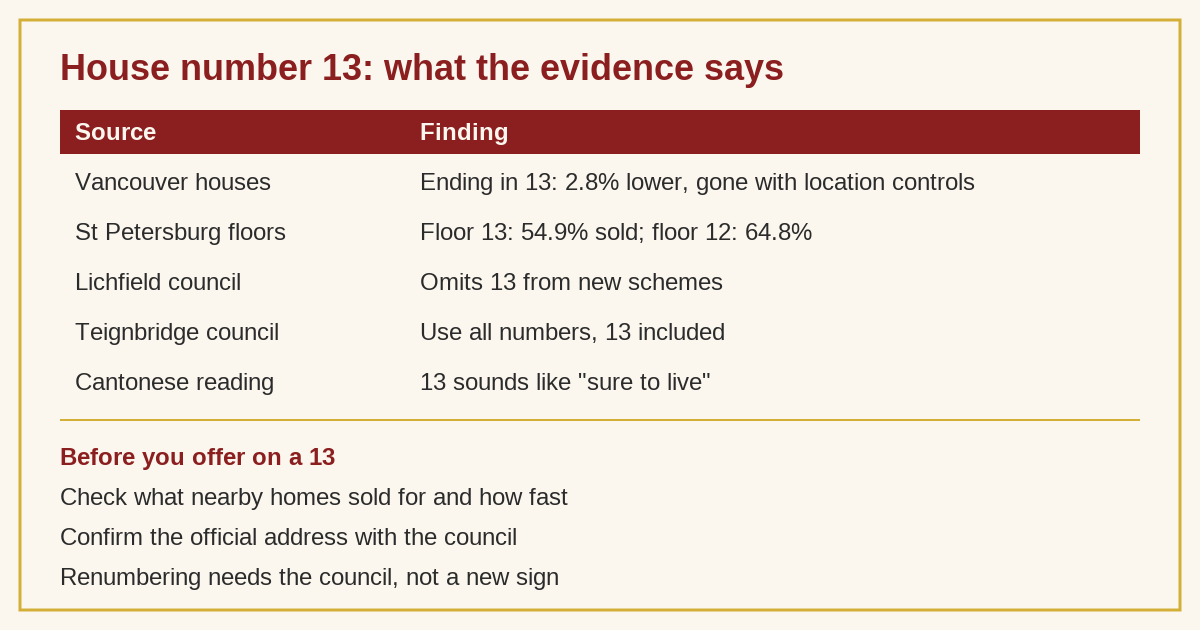
| Vancouver house sales, 2000 to May 2005 | Addresses ending in 13: about 2.8% lower with no location controls; 0.1% lower and not significant with census tract and street controls. 658 of 116,939 sales ended in 13 | Fortin, Hill and Huang, UBC working paper |
| Saint Petersburg new apartments, November 2014 | Floor 13: 54.9% of apartments sold, against 64.8% on floor 12 and 61.8% on floor 14. Price was not analysed | Antipov and Pokryshevskaya, Judgment and Decision Making, 2015 |
| Lichfield District Council guidance | 13 is left out of numbering schemes by procedure | Lichfield DC, Street naming and numbering guidance, para 10.2 |
| Teignbridge District Council guidance | All numbers must be used in sequence including 13; an application to exclude it may be considered | Teignbridge DC, Guidelines for street numbers |
| Cantonese reading | 13 sounds like words meaning sure to live; 14, sure to die | Wikipedia, Triskaidekaphobia |
On this page
- Where the dislike of 13 comes from
- Which streets and councils skip 13
- What sales data shows, and what it does not
- How 13 reads in Chinese tradition
- Western numerology: 1 + 3 = 4
- Before you buy a 13
- If you already own a 13
- Questions about living at a 13
- Sources
Where the dislike of 13 comes from
Every popular story about why 13 is unlucky has a named source, and most of them are younger than people assume. The German writer Johann August Ephraim Götze linked 13 to the Last Supper in 1774. English-language writers in the 1890s repeated that Judas was the thirteenth to sit down, though the Bible does not give a seating order. The Norse tale of Loki as an uninvited thirteenth guest was told in 1968 by Douglas Hill, and the Prose Edda has no such dinner. The Knights Templar link, through their arrest on Friday 13 October 1307, is newer still: Wikipedia's summary of the sources says it was invented early in the 21st century and spread by The Da Vinci Code.
So the fear is real as a habit and thin as history. If you want the wider story, including Friday the 13th and why Italy dreads 17 instead, the guide to lucky 7 and unlucky 13 covers it.
Which streets and councils skip 13
Skipping 13 is a local decision, and councils disagree. Two English district councils make a useful pair because their published guidance points in opposite directions.
Lichfield District Council says that 13 is often followed, after people move in, by a request to renumber, "which usually creates a number 11A". Its procedure is to omit 13 from the numbering scheme. Teignbridge District Council says the opposite: "All numbers must be used in the proper sequence including number 13", though it adds that an application to exclude 13 may be considered. Teignbridge also notes that the law allows numbers followed by letters, such as 16A and 16B.
Neither rule is typical of everywhere, so check the one that applies to your street. London has plenty of examples where the older numbering stands: Wikipedia lists Fleet Street, Park Lane and Oxford Street among the London streets with no number 13.
The result for a buyer is simple. A street with a missing 13 is not a sign of anything wrong with the neighbourhood, and a 13 on a street that kept it is not a sign that the street was planned carelessly.
Advertisement
What sales data shows, and what it does not
Two studies come up in nearly every discussion of 13 and property. They measure different things, and neither covers a US street address.
Vancouver houses. Nicole Fortin, Andrew Hill and Jeff Huang of the University of British Columbia studied 116,939 single-family sales in 13 Greater Vancouver cities between January 2000 and May 2005. Their table shows 658 sales at addresses ending in 13, which includes 113, 213 and so on, not only a plain 13. With no location controls, those addresses sold for about 2.8% less. Once the authors added census tract and street controls, the gap shrank to 0.1% and was not significant. They also found no extra effect in Chinese neighbourhoods; in their words, the unluckiness of 13 "did not get any traction" there. On a house selling for $800,000, 2.8% would be $22,400, but the result did not hold up under the second test, so it is better read as "possibly nothing" than as a discount to expect.
Saint Petersburg apartments. Evgenii Antipov and Elena Pokryshevskaya used November 2014 data from new buildings with identical floor plans. Floor 13 had 54.9% of its apartments sold, against 64.8% on floor 12 and 61.8% on floor 14. That is a sales-share result for floors in a building, and the paper says it did not analyse price. Wikipedia's summary of this paper and a second Russian study, by Burakov, says the effect disappeared when developers offered a discount of 10% or more.
A fuller table of both studies, plus the studies of 4 and 8, is in the house number resale value guide.
We did not find or open a study of 13 in US street addresses, so no US figure is stated here.
How 13 reads in Chinese tradition
Chinese number readings usually start from sound, and the sound depends on the dialect. In Cantonese-speaking areas, including Hong Kong and Macau, 13 is considered lucky because it sounds like words meaning "sure to live", while 14 sounds like "sure to die" (Wikipedia, Triskaidekaphobia). Wikipedia's article on Chinese numerology gives a split reading for the 3 alone: it sounds like 生 (life), which is good, and also like 散 (to split or scatter), which is not. And it calls 1 neither auspicious nor inauspicious.
So a Cantonese practitioner may read a 13 as fine or even good, and in the same breath worry about a 14, 24 or 44. The same article describes a Hong Kong tower at 39 Conduit Road whose floors jump from 68 to 88, with about 43 numbers left out, including 14, 24, 34, 54 and 64. The floors that disappear there are not the 13th.
That does not make 13 a recommended number. It means the Western alarm is not shared, and a buyer from that background may care more about what is next to the 13, such as an 8 or a 4, or about the stairs and the road, than about the number itself. Two-digit house numbers in Chinese tradition goes through the pairs.
Western numerology: 1 + 3 = 4
Western numerologists reduce a house number by adding its digits until one is left. For 13 that gives 1 + 3 = 4, so practitioners read a house at 13 as a 4 home, which they usually describe as practical, steady and built to last. Some also treat 13 as a "karmic debt" number, and numerologists do not agree on which reading takes priority.
One caution for anyone who lives between two traditions. The digit-adding method is Western, and the Chinese sound-based reading does not use it. A 4 home in Western numerology is a reassuring idea, while 4 is the number many Chinese-speaking buyers avoid. If you are weighing that, the guide to 4 and tetraphobia shows how far the avoidance reaches.
Before you buy a 13
Buying is where the number matters least and the street matters most. These checks take little time.
- Look at recent sales on the same street and note whether the 13 sold slowly or below its neighbours. One street tells you more than any study.
- Ask the agent whether buyers raised the number during showings. If the house has sat, the number could be one reason among several, such as price or condition.
- Check the official address, not just the sign on the door. Mismatches between the house, the listing and the council record cause real trouble with deliveries and emergency calls.
- If you or your partner dislike the number, decide before you offer. A number that bothers you daily is a cost, even when a study finds no price effect. Remedies for an unlucky house number lists the gentle ones, such as a name plate or a house name beside the number.
- If you hold a Chinese tradition, read the number as sound in your own dialect and look at the whole address, including the street number and any unit.
If you already own a 13
Mail, delivery drivers, emergency services, utilities and insurers use the official address your council assigns. A sign that says 12A does not change that record. Hanging a different number on the door can send an ambulance to the wrong place.
Lichfield's guidance, for one, gives the final decision to its Corporate Geographical Information Manager. Renumbering is normally considered only when changes cause or are likely to cause problems for the emergency services, and needs all affected occupiers to ask or more than two-thirds of the street to agree. Other places set different rules. How to change your house number walks through who to ask and what changes after.
The House Numbers and Home Value hub lists the guide for each number.
Building and addressing rules vary by place. Ask your local addressing office or building department, and talk to a licensed real estate professional before you price or buy because of a number.
Questions about living at a 13
Is house number 13 bad?
Only in the sense that some Western buyers dislike it. No law, lender or insurer treats a 13 differently, and the one large sales study that tested addresses ending in 13 found a 2.8% lower price that vanished once location was controlled for. In Cantonese-speaking areas the number is often read as lucky.
Why do some streets have no number 13?
Because the council or developer that numbered the street chose to leave it out. One English council's guidance says 13 is omitted from new schemes because it is often followed by a request to renumber, which tends to produce an awkward 11A. Another council in the same country says every number, 13 included, must be used in sequence unless an application to exclude it is approved.
Does a house numbered 13 sell for less?
Evidence is thin. A study of 116,939 single-family sales in Greater Vancouver (2000 to May 2005) found addresses ending in 13 about 2.8% lower, but only before the authors controlled for census tract and street. With those controls the gap was about 0.1% and not significant. A Saint Petersburg study of new apartments found floor 13 sold a smaller share of units, and did not look at price. No study of 13 in US street addresses was found.
Can I change my house number from 13 to 12A?
Sometimes, but not on your own. The council or the post office that assigns addresses decides, and the rules differ by place. One English council's guidance considers renumbering mainly when emergency services have a problem, and then needs the agreement of all affected occupiers or more than two-thirds of the street. Ask your local addressing office.
Is 13 lucky in Chinese tradition?
In Cantonese-speaking areas such as Hong Kong and Macau, 13 is often considered lucky because it sounds like words meaning sure to live, while 14 sounds like sure to die. The reading rests on Cantonese sound, so a buyer who speaks another Chinese language may not share it.
What does 13 reduce to in numerology?
Western numerologists add the digits, 1 + 3 = 4, and read a 13 house as a 4 home, which they usually describe as practical and steady. Some also treat 13 as a karmic debt number, but there is no single standard. The reduction is a Western method and is not part of the sound-based Chinese reading, where 4 is the number many people avoid.
Sources
Checked 26 November 2026.
- Lichfield District Council, "Street naming and numbering detailed guidance" (paragraphs 4.2, 10.2, 10.10, 11.1, 11.2, 12.1)
- Teignbridge District Council, "Street naming and numbering: Guidelines for street numbers"
- Fortin, N., Hill, A. and Huang, J., "Superstition in the Housing Market" (UBC working paper; published in Economic Inquiry 52(3), 2014)
- Antipov, E. and Pokryshevskaya, E., "Are buyers of apartments superstitious? Evidence from the Russian real estate market," Judgment and Decision Making 10(6), 2015
- Wikipedia, "Triskaidekaphobia" (origin accounts, London streets without a 13, Cantonese reading, the 10% discount finding from the Russian studies)
- Wikipedia, "Chinese numerology" (readings of 1 and 3, 39 Conduit Road)
- Not verified against a primary source: the Western numerology reading of 13 as a 4 home and as a karmic debt number is a practitioner tradition, and we did not open a numerology text for it. We also did not open Wikipedia's own sources for the origin stories.
Editorial note: Lucky Properties presents numerology and feng shui as cultural and design traditions. This guide is educational and does not predict wealth, health or relationships. Addressing and permit rules differ by place; confirm them with your local authority.