The Goat is the eighth animal of the Chinese zodiac, and its year is next. 2027 is a Fire Goat year, Ding Wei, opening on February 6, 2027, and it is the first Goat year since 2015. That is the news peg for this guide, but the sign itself is the subject: the years, the five element variants, the temperament as the tradition prints it, and the compatibility map against all eleven other animals. The Goat also carries the zodiac loveliest piece of wordplay, San Yang Kai Tai, three goats that open good fortune, and that story gets its own section below.
A word on how to read this page before the tables start. Everything here is reported as zodiac tradition, the way teachers, almanac writers, and compatibility authors present it. A birth-year animal is a calendar label with centuries of commentary attached, not a measurement of a person. The guide keeps that frame throughout, and the limits section at the end says where the tradition stops.
Are you a Goat?
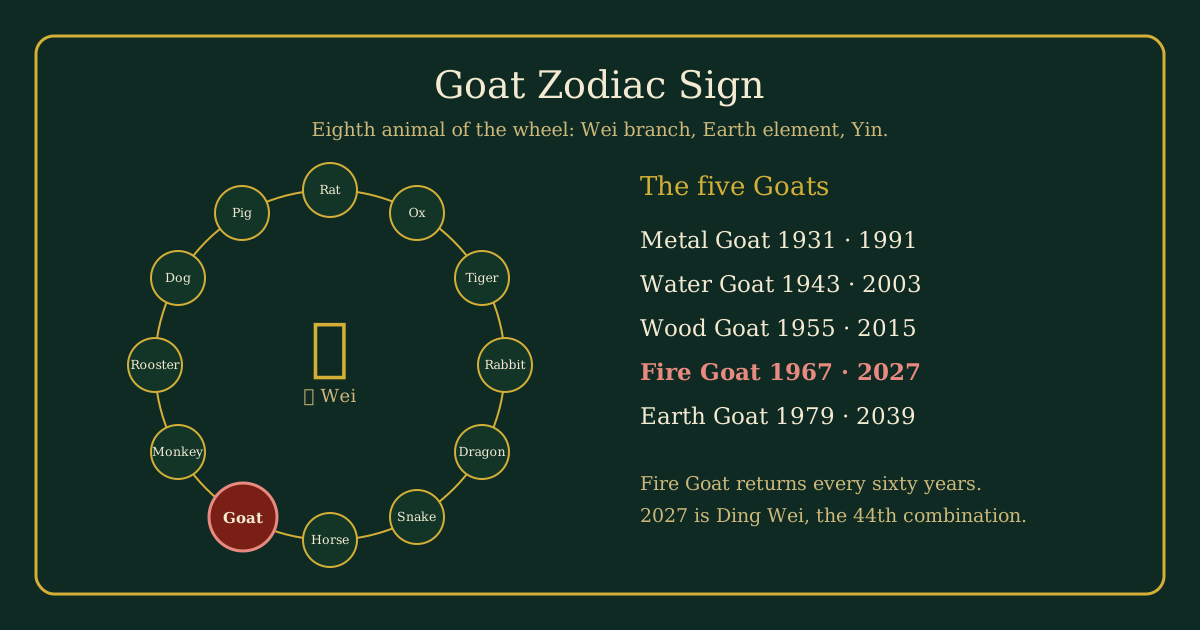
The Goat comes around every twelve years, and each return carries one of the five elements in turn, on a sixty-year cycle. The table below gives every Goat year from 1907 to 2039 with its exact lunar range, its stem-branch name, and its element. The dates follow the English Wikipedia Goat (zodiac) entry, which prints the same ranges, and the stem names follow the standard sexagenary cycle, cross-checked against the same ranges in the TravelChinaGuide Goat profile.
| Goat year | Lunar range | Stem-branch | Element |
|---|---|---|---|
| 1907 | Feb 13, 1907 - Feb 1, 1908 | Ding Wei | Fire |
| 1919 | Feb 1, 1919 - Feb 19, 1920 | Ji Wei | Earth |
| 1931 | Feb 17, 1931 - Feb 5, 1932 | Xin Wei | Metal |
| 1943 | Feb 5, 1943 - Jan 24, 1944 | Gui Wei | Water |
| 1955 | Jan 24, 1955 - Feb 11, 1956 | Yi Wei | Wood |
| 1967 | Feb 9, 1967 - Jan 29, 1968 | Ding Wei | Fire |
| 1979 | Jan 28, 1979 - Feb 15, 1980 | Ji Wei | Earth |
| 1991 | Feb 15, 1991 - Feb 3, 1992 | Xin Wei | Metal |
| 2003 | Feb 1, 2003 - Jan 21, 2004 | Gui Wei | Water |
| 2015 | Feb 19, 2015 - Feb 7, 2016 | Yi Wei | Wood |
| 2027 | Feb 6, 2027 - Jan 25, 2028 | Ding Wei | Fire |
| 2039 | Jan 24, 2039 - Feb 11, 2040 | Ji Wei | Earth |
Two catches decide whether the table gives you the right animal. The first is the January and February boundary. The zodiac year turns at Lunar New Year, not on January 1, so a birth in January or early February usually belongs to the previous animal. A baby born on February 10, 2015 is a Horse, not a Goat; a baby born on February 20, 2015 is a Goat. The birth-year chart on this site prints the cutover dates year by year for exactly this check.
The second catch is the school split. Most popular writing draws the line at Lunar New Year. Some BaZi schools draw it at Lichun, the Start of Spring solar term, which falls around February 4. The two lines can disagree by up to a fortnight, so a birth in late January or the first days of February can be a Horse under one school and a Goat under the other. For most birthdays it makes no difference. Near the boundary, check both, and know which line the source you are reading used. The Fire Goat 2027 guide works the 2027 boundary in full, where the two lines fall two days apart, February 4 and February 6.
One more distinction the table invites, because it confuses more readers than any other point in the zodiac. The Goat is an Earth sign in every Goat year, by its branch. The year element in the table comes from the stem, and it changes each return. A Metal Goat is a Metal year on an Earth animal, not a Metal animal. The elements guide on this site works through the three layers that get tangled here: the branch element that never changes, the stem element that gives the year its name, and the nayin sound element that sits underneath both.
The five Goats
Five elements, five Goat variants, each returning every sixty years. Compatibility writers print a short character note for each one, and the notes below are those published descriptions, reported as such. The one-line version, as several references print it: Metal Goats are the most principled, Water Goats the most self-sacrificing, Wood Goats the most approachable, Fire Goats the most hardworking, and Earth Goats the most reliable.
Metal Goat: 1931, 1991, and 2051
Xin Wei. Metal on Earth, a year element the branch element creates, since Earth creates Metal in the generating cycle. The tradition reads Metal Goats as the most principled of the five: kind-hearted and ambitious, soft on the outside but tough inside, responsible, and fond of doing things step by step. TravelChinaGuide credits them with building a career of their own and valuing principles and integrity, and lists the same firmness turning stubborn and inflexible when a principle is crossed. A Metal Goat born in 1991 is 35 in 2026; one born in 1931 is 95.
Water Goat: 1943, 2003, and 2063
Gui Wei. Water on Earth, the year element the branch element controls, since Earth dams and directs Water. The tradition reads Water Goats as the most self-sacrificing: gentle in character, not seeking the spotlight, responsible, and loyal to friends, with a self-sacrificing spirit that the references describe as their defining trait. TravelChinaGuide adds that their early years may be difficult, but middle age is stable and old age comfortable and joyful. A Water Goat born in 2003 is 23 in 2026.
Wood Goat: 1955, 2015, and 2075
Yi Wei. Wood on Earth, the year element that controls the branch element, since Wood draws on Earth and breaks it up. The tradition reads Wood Goats as the most approachable: polite, compassionate, willing to help friends, working diligently, and enjoying a life of abundance and harmony, with loving parents and obedient children in the old phrasing. The Wikipedia Goat entry adds a sharper note for this variant, that Wood Goats love peace and are helpful and trusting, but can also be clinging and resistant to change. A Wood Goat born in 2015 is 11 in 2026.
Fire Goat: 1907, 1967, 2027, and 2087
Ding Wei. Fire on Earth, the year element that feeds the branch element, since Fire generates Earth. The tradition reads Fire Goats as the most hardworking of the five: warm-hearted, serious, steady, and hardworking, straightforward and loyal, always ready to help friends. TravelChinaGuide adds one caution that belongs to this variant alone: Fire Goats need to be careful about financial risks caused by being unable to turn down requests from relatives or friends to act as a guarantor. A Fire Goat born in 1967 is 59 in 2026, and the next Fire Goat year, 2027, opens on February 6 that year.
Earth Goat: 1919, 1979, 2039, and 2099
Ji Wei. Earth on Earth, stem and branch the same element. The tradition reads Earth Goats as the most reliable: steady, thoughtful, and meticulous, acting cautiously and rarely making mistakes, practical in life and suited for stable careers, with later years prosperous and peaceful in the old phrasing. An Earth Goat born in 1979 is 47 in 2026, and the next Earth Goat year, 2039, opens on January 24 that year.
Where the Goat sits on the wheel
The Goat is eighth of twelve, between Horse and Monkey, with the Earthly Branch Wei, 未. Its fixed element is Earth, its polarity Yin. The branch never changes, whatever the year element says. A Goat born in a Metal year is still an Earth sign by branch, and the year table above is a list of Earth animals wearing five different year elements.
The position comes with two stories, and the Goat is unusual in having both. The first is the race. In the Jade Emperor race, the legend this site retells animal by animal in the race guide, the Goat, the Monkey, and the Rooster found a raft on the near bank and worked it across as a crew. The Goat, in most tellings the steadiest of the three, kept the raft balanced. The Monkey worked the poles and cleared debris. The Rooster scanned ahead for rocks and shallows and called directions. When the raft reached the far bank, the three stepped ashore in order: Goat eighth, Monkey ninth, Rooster tenth. Where the Rat won alone by trickery, these three won together by cooperation, and the tradition reads their friendship into their zodiac relationships. Goat, Monkey, and Rooster people are said in folk readings to work well as a team, and the race is cited as the reason.
The second story is older and kinder. TravelChinaGuide retells the legend that in the distant past there was no grain in the mortal world, because grain grew only in the heavenly fields and the Jade Emperor would not share it. A divine sheep came down, saw people surviving on wild vegetables and grass, and took pity. It returned to heaven, waited until the guards were asleep, took seeds of five grains in its mouth, rice, wheat, and beans among them, brought them to the mortal world, and taught people how to plant. The same year people harvested rich crops and held a ceremony to thank the divine sheep. The Jade Emperor found out and ordered the sheep slaughtered. The next year grass grew on the spot where it had died, and then lambs appeared, and from then on sheep multiplied in the mortal world, living on grass and giving their meat and milk to humans. When the Jade Emperor later chose the twelve zodiac animals, people remembered the divine sheep kindness and recommended it, and the Emperor, still somewhat unwilling, accepted the sheep into the zodiac. Treat both stories the way the tradition treats them: as legends that explain the order and the character, not as history.
The branch also owns a slice of the day and the year. The Goat double-hour, Wei hour, runs from 1:00 pm to 3:00 pm, the early-afternoon block. TravelChinaGuide records the folk explanation for the pairing: the eighth period is when sheep are said to urinate most frequently, and their urine was held to cure a certain disease, so people associated the eighth period with the sheep, and the animal took the eighth position in the ranking as well. The Goat lunar month is the sixth lunar month, and the season the references assign the sign is summer. In BaZi work the hour branch is the fourth pillar of a chart, so a person born between 1:00 pm and 3:00 pm carries Goat in the hour pillar as well, and the birth-hour guide on this site works through all twelve double-hours and what the tradition reads into each one.
Advertisement
Goat, sheep, or ram
No other zodiac animal has a naming problem as persistent as this one, and the guide settles it early because every reader trips over it. The Chinese word is yang, 羊, and it covers goats and sheep alike, more precisely the whole Caprinae subfamily. The specific words exist, shanyang for goat and mianyang for sheep, but the zodiac character is the general one, so English versions call the eighth animal the Goat, the Sheep, or the Ram, and all three are the same animal in the same eighth position. Vietnamese calls the sign mui, unambiguously goat. Japanese calls it hitsuji, sheep. Korean, Mongolian, and Philippine usage runs to ram or sheep. Inside China there is a regional lean, with the animal more likely to be thought of as a goat in the south and a sheep in the north. The site uses Goat, following the animal the English Wikipedia entry and the TravelChinaGuide profile both lead with, and notes the other names where they matter.
The naming looseness is also the reason the Goat carries the zodiac warmest piece of language. In ancient scripts the character for sheep, yang, was used interchangeably with the character for auspiciousness, xiang, 祥, and the Goat character also sits inside the character for beauty, mei, 美, and the character for kindness, shan, 善. The Chinese commonly regard the sheep as an auspicious animal, and the year of the sheep heralds a year of promise and prosperity in the folk reading. That is the language layer. The pun layer is below.
San Yang Kai Tai: the three goats
The phrase every Goat year brings back is San Yang Kai Tai, 三羊开泰, usually rendered as may the three goats bring grandeur your way, or three goats open good fortune. It is a visual pun on the I Ching, the Book of Changes, and it works because the words sound the same. Three goats is san yang, 三羊. Three yang lines is also san yang, 三阳. Hexagram 11 of the I Ching, Tai, 泰, which the tradition glosses as grandeur or great peace, is built from three solid yang lines at the bottom and three broken yin lines at the top. Three yang lines rising from the earth after the long winter is the image of spring returning, and the hexagram is read as the first month of the lunar year, a new beginning ensured by the balance of yin and yang. A picture of three goats contains three yang, and the picture cues the whole saying.
The China Story yearbook introduction for the 2015 Goat year sets the mechanism out plainly: the hexagram augurs greatness, the three yang lines pave the way to grandeur, and the saying has long served as a New Year greeting, especially popular during goat years because three goats and three yang lines are both pronounced san yang. A paper on punning rebuses in Chinese visual culture puts it the same way: the sheep may represent xiang, auspiciousness, or it may represent yang, the male force, in the punning rebus San Yang Kai Tai, and the saying signifies that spring returns to the earth and everything under the sun looks fresh and will have a prosperous future.
In feng shui shops the motif appears as three goat figures, often shown on a mountain, sold as a charm for the arrival of spring, a time of growth and renewal, and for rising fortune after hardship. The guide reports the motif as folk practice, not as a mechanism. What the phrase actually proves is narrower and more interesting: a calendar animal, a sound in the language, and a hexagram share one syllable, and three hundred years of New Year greetings grew out of the coincidence. That is the Goat sign in miniature, a gentle animal carrying a large piece of the culture vocabulary.
Temperament in tradition
The site own zodiac data gives the short version, and it matches what the references print: the Goat represents mildness, goodness, and creativity. Strengths: gentle, compassionate, creative, resilient. Weaknesses: indecisive, timid, pessimistic. That four-and-three list is the spine. The fuller picture, as compatibility writers fill it in, runs as follows.
Goats are gentle, kind, and deeply loyal to family and friends. TravelChinaGuide adds the detail the other references repeat: among the twelve zodiac animals, the sheep is the only one that kneels while nursing, and the tradition reads that as a picture of filial devotion. Outwardly soft and modest, Goat people are said to possess a quiet inner strength that shows itself when protecting loved ones or standing up for what matters. Soft outside, tough inside is the phrase the references keep returning to. A Goat walks into a family crisis, says little, and holds the household together while louder people argue about what to do. That is the stock scene in the writing, and it is worth reporting because it recurs in reference after reference.
The shadow side is the same gentleness seen from the other side: overly sensitive and hesitant when making decisions, prone to pessimism, likely to withdraw when faced with pressure or conflict, and apt to miss good opportunities while weighing them. TravelChinaGuide puts the trade-off plainly: the cautious nature helps Goats avoid mistakes, and it also costs them chances. The tradition advice for Goat people is always the same shape: keep the gentleness, and find people and routines that supply the push the sign does not supply for itself. The work section below follows that advice into careers. None of it is a claim about any real Goat-born person. It is a character sketch the tradition has carried for centuries, and the test of it is whether readers recognise the sketch, not whether the sketch proves anything.
Compatibility with all eleven animals
The Goat relationship map comes from two sources that have to be kept apart: the branch relations, which are geometry, and the temperament writing, which is opinion. The branch relations are fixed. Goat trine allies are Rabbit and Pig. Goat secret friend is Horse. Goat clash opposite is Ox. Goat harm partner is Rat. Goat destruction partner is Dog. Goat is a member of the Ox-Dog-Goat punishment trio, so the punishment pattern needs an Ox or a Dog in the chart alongside the Goat to activate. Everything else is a pair with no named branch relation, which the tradition reads as neutral ground where temperament does the work.
| Partner | Branch relation | The tradition reading |
|---|---|---|
| Rat | Harm | The quietest friction and the pairing teachers warn about most after the clash. Rat is also the secret friend of the Goat opposite, Ox, and the clash guide on this site flags the opposite friend as the hardest pairing in the old matchmaking notes. Support that arrives in a form that creates a problem of its own. |
| Ox | Clash, six places apart | The classic opposition, and a same-element clash: both branches are Earth, so the tension is positional, not elemental. The steady plough against the sensitive artist, routine meeting feeling. |
| Tiger | No named relation | The odd one. No branch friction, yet TravelChinaGuide lists Tiger among the least compatible on temperament: Tiger bravery, decisiveness, and appetite for risk against Goat gentleness, hesitation, and love of peace, with Tiger bluntness hurting the sensitive Goat and Goat indecision frustrating the impatient Tiger. |
| Rabbit | Trine ally, San He | Best match. Shared feeling-triangle temperament: gentleness, artistry, and warmth. Rabbit romantic nature and Goat tenderness are read as a warm marriage in the compatibility writing. |
| Dragon | No named relation | Quiet pair. The lists say little about it beyond the absence of friction, which is itself the reading: nothing in the branch system stands between them. |
| Snake | No named relation | Moderate in the popular charts. TravelChinaGuide calls it a moderate match: Snake rationality and reserve help the Goat make wiser decisions, but Snake coolness may unsettle a sensitive Goat. |
| Goat | Same sign | Double gentleness. The punishment trio needs an Ox or a Dog to activate, so two Goats in one chart do not trigger it on their own. Goat is not a self-punishment branch, so the doubled-sign reading is the sign turned up, not a verdict. |
| Horse | Secret friend, Liu He | Best match. The closest single complement in the system, and the pairing TravelChinaGuide ranks first: Horse energy brings out the Goat hidden potential, Goat patience calms Horse impulsiveness, and the two share values and life goals. |
| Monkey | No named relation | Moderate in the popular charts, and the race story adds a warmer note. TravelChinaGuide calls it moderate: Monkey wit and energy bring joy, yet Monkey lack of focus may cause misunderstandings. The raft crew of the legend is cited in folk readings as a reason Goat, Monkey, and Rooster people work well as a team. |
| Rooster | No named relation | Moderate in the popular charts, with the same race-story note as Monkey: the third member of the raft crew, scanned ahead and called directions, and folk readings credit the trio with teamwork. |
| Dog | Destruction | Hard match. The branch tables list Dog as a destruction partner for Goat, and Dog is also the third member of the Ox-Dog-Goat punishment trio. TravelChinaGuide lists Dog among the least compatible. |
| Pig | Trine ally, San He | Best match. The Sheep feels unusually comfortable and at ease with the Pig, free from any need to scheme or compete, and Pig family feeling is read as the pair building a warm home together. |
The site own zodiac data agrees with the table shape: best matches Rabbit, Horse, and Pig; worst matches Ox, Rat, and Dog. The two rows to handle carefully are Tiger and Rat. A reader who finds a popular chart calling Goat and Tiger a hard match and the branch tables showing no relation between them has found a real disagreement between two layers of the tradition, not an error in either list. The temperament judgment is built for couples. The branch system is built for charts. The trines guide and the harms and punishments guide on this site set out both layers and show how to stack them, and the love compatibility guide turns the stack into questions a couple can actually discuss. Read the branch tables for the system. Read the love guide for the relationship.
Advertisement
Work in tradition
The careers the tradition attaches to the Goat follow directly from the temperament: work that rewards artistry, patience, and care for people. The list compatibility writers print most often, from the ChineseZodiac.com Goat careers guide, is fine artist and sculptor, fashion designer and textile artist, music composer and performing musician, elementary school teacher and early childhood educator, landscape architect and garden designer, pastry chef and artisan food creator, art therapist and creative counsellor, and children book illustrator and author. The through-line is making things with the hands and the heart together, in rooms where people feel safe.
The same writers list the work Goats struggle in, and it is the mirror image: high-pressure corporate roles built on fast decisions and open conflict, sales floors that reward aggression, and any job where the day is a contest. Earth Goats, the most reliable variant, are credited with handling structured careers better than the other four. Fire Goats are credited with needing the steadiest ground under them, which is consistent with the element portraits above. TravelChinaGuide adds the practical note that Goats thrive in nurturing environments where they can express creativity while helping others, and that their collaborative spirit suits team work and community roles.
Treat the list as the tradition job board, not a career counsellor. It describes where the sign stock character fits the shape of a job, and it says nothing about any real person skills, training, or prospects. A Goat-born trial lawyer who loves the contest is not a contradiction of the system. The system was never a test.
Goat-born figures
The people below were born in Goat years, with the birth month falling inside the lunar range in the year table above. The list is factual: name, birth year, and the Goat variant that year carries. It is not a claim that the sign made them who they were.
| Person | Born | Goat year |
|---|---|---|
| Rupert Murdoch | March 1931 | Metal Goat |
| Mick Jagger | July 1943 | Water Goat |
| Bill Gates | October 1955 | Wood Goat |
| Steve Jobs | February 1955 | Wood Goat |
| Julia Roberts | October 1967 | Fire Goat |
The list leans, as such lists do, toward people who built things slowly and held them, which is the Goat sketch in its most flattering form: two founders who built companies over decades, a singer still performing past eighty, an actress whose career spans four decades, a media owner who bought newspapers for half a century. It also includes two Wood Goats, Gates and Jobs, born eight months apart in 1955, which is the twelve-year cycle doing its ordinary work: same stem-branch, same element, two very different lives, and a rivalry the whole industry watched.
Lucky associations, and why the lists disagree
No section of a zodiac profile generates more confident lists, and none deserves more caution. Published Goat lucky lists disagree with each other, sometimes on the same item, and a guide that prints one of them as the answer is hiding the disagreement. The table below prints three lists side by side, with sources named, so the disagreement is visible.
| Association | English Wikipedia, Goat (zodiac) | TravelChinaGuide Goat profile | This site, zodiac data |
|---|---|---|---|
| Lucky numbers | 2, 3, 4, 7, 9; avoid 6, 8 | 2, 7; unlucky 4, 9 | 6, 9 |
| Lucky colours | Green, red, purple; avoid gold, brown | Red, green, purple; unlucky gold, brown, black | Gold, white |
| Lucky flowers | Carnation, primrose | Carnation, primrose, jasmine | Not listed |
| Lucky directions | Not listed | South, northwest, east; unlucky west | Northwest |
Read the table row by row and the pattern is plain. The two number lists agree on exactly two numbers, 2 and 7, and contradict each other on 4 and 9, which one list calls lucky and the other calls unlucky. The colour lists agree on green, red, and purple, and both tell readers to avoid gold, which is the colour this site own data gives the Goat. The site numbers, 6 and 9, are the two numbers the outside lists reject most firmly: Wikipedia says avoid 6, and TravelChinaGuide says 9 is unlucky. Jasmine is the one flower the second list adds. Northwest is the one direction all three lists that name one share.
There is no canonical list to appeal to. Almanac traditions vary by region, by school, and by publisher, and the lists get copied, recombined, and reprinted until their disagreements look like errors in one source rather than what they are: different traditions. This site own colours guide gives Goat years its own palette, and that is the palette this site uses consistently. A reader choosing colours for a New Year outfit or a wedding has a better basis in that consistency than in any single outside list. A reader choosing numbers for a lottery ticket has no basis at all, and no list on this page should be used as one.
A worked example, labelled hypothetical
The person below is invented for this guide. The birth month is chosen to sit clear of the New Year boundary, and the point is the order of the checks, which is the same order a traditional reader works in.
The person. A hypothetical birth in May 1991.
Step 1, find the animal and the element. 1991 is a Goat year, running February 15, 1991 to February 3, 1992, and May sits safely inside it. The stem is Xin, Metal, so this is a Metal Goat: a Metal year on an Earth animal. The element portrait above applies: the most principled variant, soft on the outside but tough inside, building step by step.
Step 2, the trine and secret friend. Goat trine allies are Rabbit and Pig, the feeling triangle. Goat secret friend is Horse. In the tradition reading, the person shares a temperament with Rabbit and Pig people and finds the closest single complement in Horse.
Step 3, the friction sweep. Goat clash opposite is Ox. Goat harm partner is Rat. Goat destruction partner is Dog. None of those relations describes this person alone; they describe pairs, and they matter when another person animal enters the picture. For this one person, the sweep to run is the punishment check: Goat is a member of the Ox-Dog-Goat trio, but the pattern needs an Ox or a Dog elsewhere in the chart, in a luck pillar, or in a passing year, so a single Goat in the year pillar does not activate it. Goat is not a self-punishment branch, so there is no doubled-sign check to run.
Step 4, the year cycle. A Goat person meets their own animal every twelve years: 2003, 2015, 2027, 2039. Those are the ben ming nian years, covered in the ben ming nian guide. 2027 is one of them, and it is also a Fire Goat year, so a 1991 Metal Goat meeting 2027 meets their own animal in its Fire form. The tradition treats that as a year to move carefully in. It does not treat it as a prediction.
The reading. Worked through all four steps, the hypothetical person is a Metal Goat with feeling-triangle allies, a Horse secret friend, three named friction partners for pairing checks, and a ben ming nian in 2027. What that describes, in the tradition own language, is a calendar position and the commentary centuries of writers have attached to it. What it does not do is describe the invented person, whose life the example never touches, or predict anything about any real person born in May 1991, whose full chart would add month, day, and hour branches that change every answer here.
Advertisement
Ben ming nian: the Goat own year
2027 is a ben ming nian year for Goat people, and it arrives in its strongest form, since the returning animal is a Fire Goat. In the tradition, the customs are the familiar ones: red clothing and accessories worn through the year, a lower profile on big decisions, and attention to the Tai Sui side of the same year, since the year Grand Duke is the Goat itself. The ben ming nian guide covers the customs, the red-underwear tradition, and the Tai Sui afflictions in full, and the Fire Goat 2027 guide picks up the story where 2026 ends, on February 6, 2027. For the year feng shui side, the Flying Stars 2027 guide carries the annual chart forward.
Limits, stated plainly
The lists in this guide were checked three ways before they were printed: against the wheel geometry itself, where trines must sit four apart and the clash, harm, and destruction relations must agree row by row with this site own clash and harms guides; against the year table in the English Wikipedia Goat (zodiac) entry, which gives the same lunar ranges and elements; and against the site own zodiac data, whose best and worst matches for Goat agree with the table above. Where published lists disagree, on lucky numbers and colours, the disagreement is printed rather than resolved.
The harder limit is the standing one for this pillar. No evidence shows that a birth-year animal, an element variant, or a pairing measures anything about a real person or a real relationship. The systems describe patterns inside their own geometry, a calendar that acquired a psychology over centuries of commentary, and the descriptions are consistent because the geometry is consistent, not because the psychology has been tested. The San Yang Kai Tai story is the clearest example in this guide of what the tradition actually is: a sound in the language, a hexagram, and a picture of three goats, held together by a pun that three centuries of New Year greetings kept alive. Two people are not a pair of branches, and no table on this page should be used to hire, fire, choose, or refuse anyone.
Sources and further reading
The Goat-year table with lunar ranges and elements follows the English Wikipedia entry Goat (zodiac), read for this guide, which prints the same ranges from 1907 to 2099; the stem-branch names follow the sixty-year cycle as printed in the same entry cycle and in the Fire Goat 2027 guide on this site. The goat-or-sheep naming, the yang and xiang character note, the Wood Goat character note, and the lucky-number, colour, and flower lists follow the same Wikipedia entry. The five element Goat portraits, the divine sheep grain legend, the Wei hour folk explanation, the kneeling-while-nursing detail, the famous Goat-born people with birth months, and the second lucky list follow the TravelChinaGuide Goat profile, read for this guide. The San Yang Kai Tai mechanism follows the China Story yearbook introduction for the 2015 Goat year and the niyibin paper on punning rebuses in Chinese visual culture, both read for this guide. The career list follows the ChineseZodiac.com Goat careers guide, read for this guide. The branch relations for Goat, trine Rabbit and Pig, secret friend Horse, clash Ox, harm Rat, destruction Dog, and the Ox-Dog-Goat punishment trio, follow this site trines guide, clash guide, and harms and punishments guide, which share the wheel and must agree row by row. The race story follows this site Jade Emperor race guide. The site own Goat data, strengths, weaknesses, best and worst matches, and luck cures, comes from the site zodiac data file.