Every animal on the zodiac wheel has two kinds of friends in the tradition, and popular charts blur them into one green tick. The first kind is your trine: two other animals who are supposed to think the way you do. The second kind is your secret friend: one animal, unlike you in method, who is supposed to steady you. The systems have separate names, separate geometry, and separate logic. San He, 三合, the three harmonies, builds the trines. Liu He, 六合, the six harmonies, builds the pairs. A reader who keeps the two apart can read any compatibility chart printed anywhere and see which system each line came from. A reader who merges them gets a score with no workings behind it.
This guide prints both systems in full, with the branch characters and the wheel positions so every entry can be checked by counting. It then sets the two affinity systems beside the three friction systems this site has already covered, the six clashes, and the harms, punishments, and destructions, works one pair of supposed birth years through every check in order, and closes with the limits. Everything below is reported as zodiac tradition, the way teachers and compatibility writers present it, not as a finding about any reader.
The wheel positions you need
Both systems are geometry before they are psychology. Twelve Earthly Branches in a fixed order, one animal per branch. Count places around this table and every list in the guide falls out.
| No. | Branch | Animal | Fixed element |
|---|---|---|---|
| 1 | 子 zi | Rat | Water |
| 2 | 丑 chou | Ox | Earth |
| 3 | 寅 yin | Tiger | Wood |
| 4 | 卯 mao | Rabbit | Wood |
| 5 | 辰 chen | Dragon | Earth |
| 6 | 巳 si | Snake | Fire |
| 7 | 午 wu | Horse | Fire |
| 8 | 未 wei | Goat | Earth |
| 9 | 申 shen | Monkey | Metal |
| 10 | 酉 you | Rooster | Metal |
| 11 | 戌 xu | Dog | Earth |
| 12 | 亥 hai | Pig | Water |
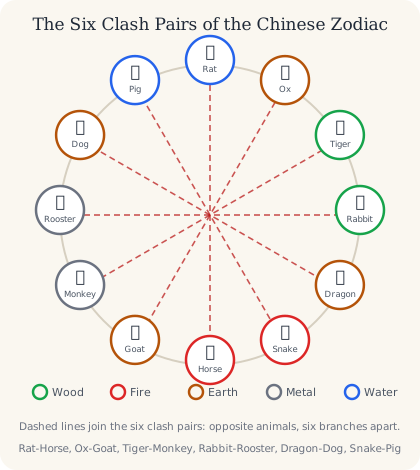
Three distances on this wheel generate almost the whole relationship map of the zodiac. Four places apart is a trine step. Six places apart is a clash, the subject of the clash pairs guide. The secret-friend pairs follow a pairing list of their own, set out in their section below. Hold the table in view and none of the lists needs to be memorised. They can be re-derived, which is a better test of a list than repeating it.
One caution belongs at the start, because it changes every answer a reader takes from this page. The animal is fixed by the lunar year, and the lunar year turns at Chinese New Year, not on January 1. A birth in January or early February belongs to the previous animal until the New Year arrives, and some chart schools draw the line at the solar term Lichun instead. The birth-year chart on this site prints the cutovers. Find the animal first, with the boundary handled, then use the tables.
San He: the four trines
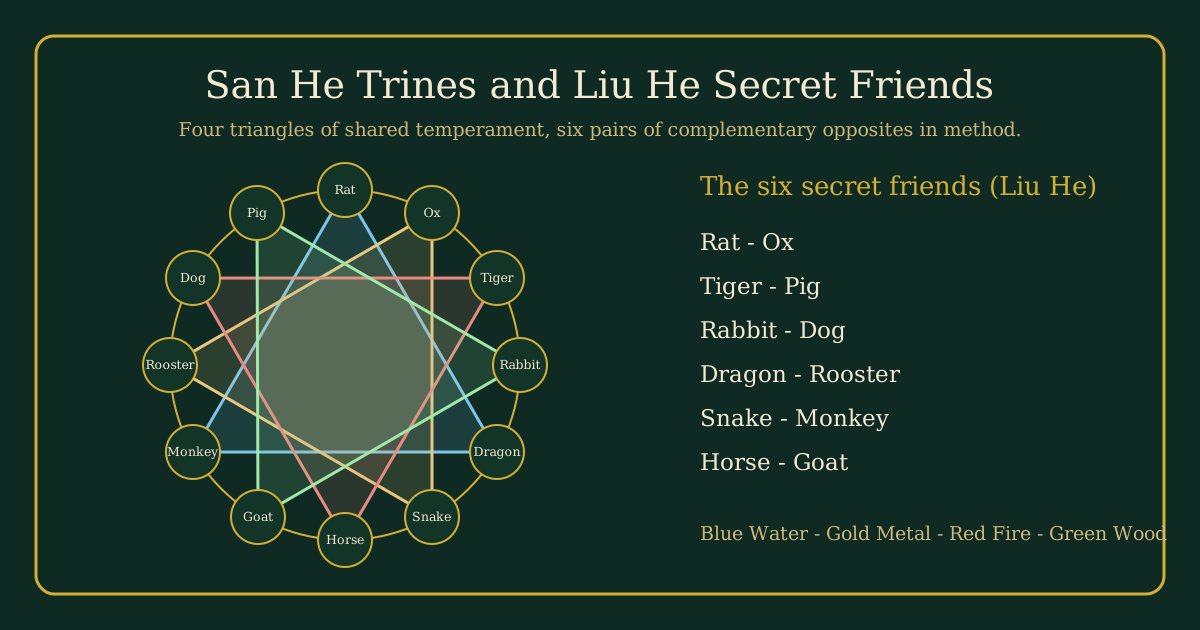
Step four places around the wheel from any animal and you land on a trine partner. Step four more and you land on the second one. Step four more and you are home. Twelve places, three animals, one equilateral triangle. There are exactly four such triangles, and they partition the wheel: every animal belongs to one trine and no animal belongs to two.
| Trine | Animals | Branches | Combined element, in San He teaching | The tradition character note |
|---|---|---|---|---|
| 1st | Rat, Dragon, Monkey | 子, 辰, 申 | Water | The thinking triangle: strategy, vision, and method |
| 2nd | Ox, Snake, Rooster | 丑, 巳, 酉 | Metal | The working triangle: endurance, calm, and precision |
| 3rd | Tiger, Horse, Dog | 寅, 午, 戌 | Fire | The action triangle: courage, drive, and loyalty |
| 4th | Rabbit, Goat, Pig | 卯, 未, 亥 | Wood | The feeling triangle: gentleness, artistry, and warmth |
The combined element column needs one sentence of unpacking, because it surprises readers who have met the fixed elements in the wheel table. A trine mixes fixed elements on the surface: the Water trine holds a Water Rat, an Earth Dragon, and a Metal Monkey. In San He teaching, the three branches of a trine are read as three stages of a single element, its birth stage, its peak stage, and its storage stage, and the trine takes that element name. Water is born in Monkey, peaks in Rat, and is stored in Dragon. Fire is born in Tiger, peaks in Horse, and is stored in Dog. Wood is born in Pig, peaks in Rabbit, and is stored in Goat. Metal is born in Snake, peaks in Rooster, and is stored in Ox. So a trine is not three animals who happen to share a label. Inside the system, it is one element photographed at three moments of its cycle, and that is the stated reason the tradition expects the three to recognise each other. The elements guide on this site covers the fixed element layer and the sixty-year stem layer that sit alongside this one.
The Water trine: Rat, Dragon, Monkey
Compatibility writing describes this as the group that thinks first. Rat is read as the strategist of the wheel, private, quick, planning several moves out. Dragon is read as the visionary, working at the largest scale in the room. Monkey is read as the method finder, the tinkerer who turns a plan into a mechanism. Put the three descriptions side by side and the shared trait is mental speed applied at different ranges: Rat at close range, Monkey at the workbench, Dragon at the horizon. The friction the tradition assigns the group is the obverse of the same trait. Three fast minds can compete, and Dragon and Monkey are both read as proud. The group is also the one whose members carry the widest spread of fixed elements, Water, Earth, and Metal, which is why the combined-element teaching above does real work here: the affinity claim rests on the stage cycle, not on surface sameness.
The Metal trine: Ox, Snake, Rooster
The second trine is read as the group that finishes things. Ox is endurance, the animal of steady load-bearing work. Snake is calm under pressure, contained, watching before it moves. Rooster is precision, the eye for the detail everyone else walked past. The shared trait the tradition names is follow-through: all three are read as private workers who judge a thing by whether it holds up. The assigned friction is rigidity. Three members who each trust their own standard can deadlock politely for years, and Snake and Rooster are both read as slow to concede an error. Note the age texture of this trine, because it shows up in real families: its members are born four and eight years apart, so a Snake parent, a Rooster teenager, and an Ox child are a common household shape, and compatibility writers have made much of that pattern. The pattern is arithmetic, not evidence, and it is reported here as the writers report it.
The Fire trine: Tiger, Horse, Dog
The third trine is read as the group that moves first and protects what it loves. Tiger is courage and appetite for the open contest. Horse is drive and visibility, the fastest animal on the wheel in every telling. Dog is loyalty with a guard post: protective, watchful, slow to trust and slower to leave. The shared trait is commitment at full volume. Where the Water trine is supposed to out-think a problem and the Metal trine to out-last it, the Fire trine is read as meeting it head-on and in company. The friction matches: heat. Tiger and Horse are both read as quick to flare, and Dog adds a moral certainty that can turn a disagreement into a verdict. Traditional matchmaking treats this trine as the most loyal of the four and the loudest, and both halves of that sentence are doing the same work.
The Wood trine: Rabbit, Goat, Pig
The fourth trine is read as the group that feels first. Rabbit is gentleness and retreat, the animal that survives by sensing early and moving quietly. Goat is artistry and sympathy, read across the tradition as the wheel most artistic temperament. Pig is warmth and generosity, the enthusiast who feeds the room. The shared trait is attunement: all three are read as registering other people moods before their own, and preferring a settled room to a won argument. The assigned friction is avoidance. A Rabbit, Goat, Pig team can postpone a hard conversation past the point where it would have helped, and Pig generosity with Rabbit diplomacy can paper over a problem that needed naming. The peacemaker label this trine carries in English compatibility writing is the same observation in shorter form.
Advertisement
Liu He: the six secret friends
Liu He works at a different scale. Not a triangle, a pair. Six pairings cover the twelve animals, each animal exactly once, and in zodiac tradition each animal one partner in this list is its secret friend: the match that is not obvious from temperament, because the two are unlike, and is read as close precisely because each supplies a method the other lacks.
| Secret-friend pair | Branches | Fixed elements | The pairing, in tradition terms |
|---|---|---|---|
| Rat and Ox | 子, 丑 | Water and Earth | Quick mind, steady hands. Rat plans and scans; Ox carries the plan at a pace that does not quit. The most cited pair in the whole list. |
| Tiger and Pig | 寅, 亥 | Wood and Water | Bold front, soft landing. Tiger pushes into the open; Pig openness and good humour are read as taking the edge off Tiger intensity. |
| Rabbit and Dog | 卯, 戌 | Wood and Earth | Sensitivity, guarded. Rabbit registers every shift in a room; Dog loyalty is read as the guard that lets Rabbit relax. |
| Dragon and Rooster | 辰, 酉 | Earth and Metal | Big picture, fine print. Dragon works at vision scale; Rooster precision is read as catching what the vision missed. |
| Snake and Monkey | 巳, 申 | Fire and Metal | Cool head, fast hands. Snake calculates in private; Monkey improvises in public. The closest pair in the list, and the most complicated, for reasons set out below. |
| Horse and Goat | 午, 未 | Fire and Earth | Drive, steadied. Horse runs; Goat is read as the companion whose gentleness turns a sprint into a journey the pair finishes together. |
Why secret? The English label follows the Chinese usage, where these pairs are also called the hidden or dark harmony in some teaching lines, as against San He, which writers call the bright or open harmony. The contrast is structural. A trine is visible from across the room: three animals of one temperament recognise each other at once. A secret-friend pair is not visible that way. Rat and Ox do not look alike, do not move alike, and on a temperament chart would not be grouped, and that is the point the tradition is making: the bond it describes is complementarity, not resemblance. Traditional matchmakers are reported to have prized a secret-friend match for exactly this reason in family negotiations, where it read as a pair that could run a household from two directions at once. That is a report about the custom, not a recommendation, and the limits section below applies to it in full.
There is also a chart-level use of Liu He that the matchmaking use borrows its authority from, and a careful guide should separate the two. In BaZi branch work, Liu He is a combination relation between two branches inside one person four pillars, or between a chart and a passing luck pillar or year: the paired branches are read as binding together and, in some schools, as generating an element between them. That is a technical relation inside a chart a reader has cast. The secret-friend list takes the same six pairings and applies them to two people by birth year alone. Same list, much thinner instrument. The BaZi guide on this site shows what the full chart adds around a branch relation like this one.
The full map: one animal, every relation
Put the two affinity systems next to the friction systems and each animal has a complete address book. Two trine allies, one secret friend, one clash opposite, one harm partner, and a place in the punishment patterns. The master table below gives the two affinity columns and the clash in full; the harm and punishment columns are worked pair by pair in the harms and punishments guide, and printing them twice would add bulk without adding checks.
| Animal | Trine (San He) | Trine element | Secret friend (Liu He) | Clash opposite |
|---|---|---|---|---|
| Rat | Dragon, Monkey | Water | Ox | Horse |
| Ox | Snake, Rooster | Metal | Rat | Goat |
| Tiger | Horse, Dog | Fire | Pig | Monkey |
| Rabbit | Goat, Pig | Wood | Dog | Rooster |
| Dragon | Rat, Monkey | Water | Rooster | Dog |
| Snake | Ox, Rooster | Metal | Monkey | Pig |
| Horse | Tiger, Dog | Fire | Goat | Rat |
| Goat | Rabbit, Pig | Wood | Horse | Ox |
| Monkey | Rat, Dragon | Water | Snake | Tiger |
| Rooster | Ox, Snake | Metal | Dragon | Rabbit |
| Dog | Tiger, Horse | Fire | Rabbit | Dragon |
| Pig | Rabbit, Goat | Wood | Tiger | Snake |
Four checks a reader can run on this table, each in under a minute, and together they verify almost the whole structure.
First, symmetry. Every relation in the table reads the same from both ends. If Rat lists Dragon as a trine ally, Dragon lists Rat. If Dragon secret friend is Rooster, Rooster secret friend is Dragon. A compatibility chart found anywhere that breaks this symmetry has a copying error in it.
Second, the partition. Follow the trine column and the twelve animals sort into four clean sets of three with no animal left over and none used twice. Follow the secret-friend column and they sort into six clean pairs. Lists that partition cleanly are the lists as the tradition hands them down; a chart with thirteen animals accounted for, or one animal in two trines, is wrong on its face.
Third, the non-overlap. No animal secret friend is one of its trine allies, and no animal secret friend is its clash opposite either. The secret friend always sits somewhere structurally quiet: for Rat, the Ox sits one place away, adjacent on the wheel, a position no other named system uses. This is the fact behind the FAQ answer above: a pair of people can score on San He or on Liu He, never both.
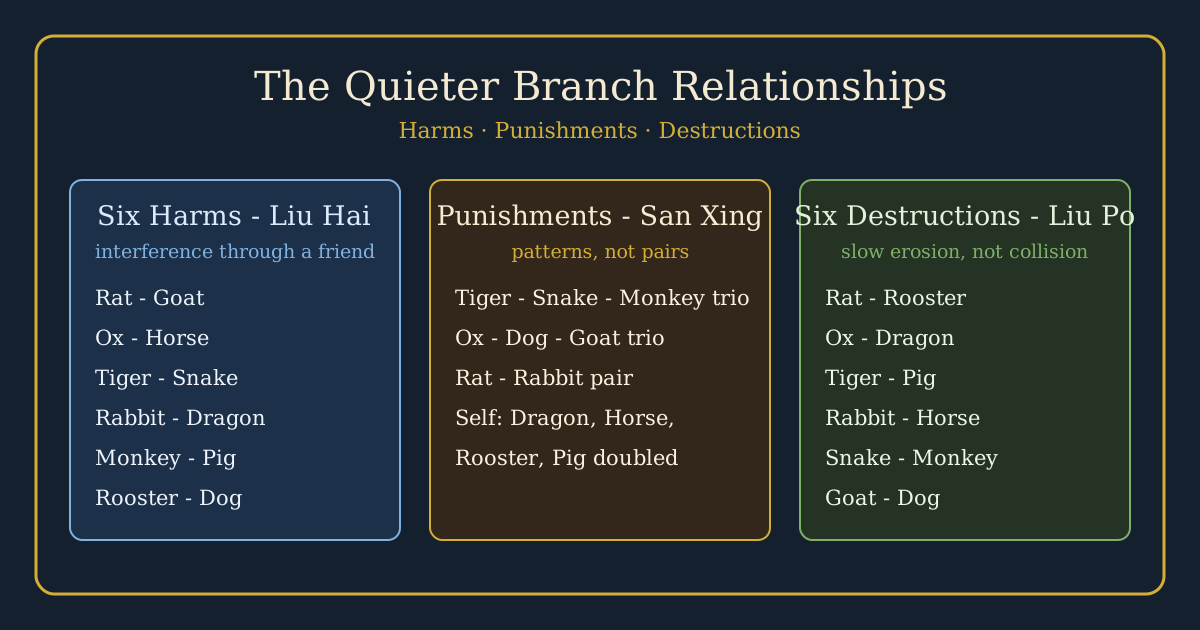
Fourth, the stacking exception. Scan the Snake row and the Monkey row. Snake secret friend is Monkey, and Snake clash is Pig, nothing unusual. Then check the punishment patterns in the harms guide: Snake and Monkey are two of the three members of a punishment trio, and the pair is also listed among the destructions. One pair carrying a harmony label, a destruction label, and a shared punishment membership is unique in the system. Any account of secret friends that presents the list as six uncomplicated blessings has skipped the row that matters most.
A worked example, labelled hypothetical
The two people below are invented for this guide. The birth years are round, the months are chosen to sit clear of the New Year boundary, and the point is the order of the checks, which is the same order a traditional reader works in.
The pair. Person A is a hypothetical birth in May 1988. Person B is a hypothetical birth in September 1993.
Step 1, find the animals. 1988 is a Dragon year and May sits safely after that year New Year, so Person A is a Dragon. 1993 is a Rooster year and September sits safely after its New Year, so Person B is a Rooster. Both lookups are checkable on the birth-year chart. Had either birth fallen in January or February, this step would have needed the exact New Year date before anything else could proceed.
Step 2, the trine check. Dragon belongs to the Water trine, with Rat and Monkey. Rooster belongs to the Metal trine, with Ox and Snake. Different trines. In tradition terms, the pair does not share the same-temperament affinity: a Dragon read as working at vision scale and a Rooster read as working at detail scale arrive at problems from different ends. No score either way yet. The systems are read as a stack, not a single gate.
Step 3, the secret-friend check. Dragon secret friend is Rooster, and Rooster secret friend is Dragon. The pair is a Liu He pair, the exact match this system names. In the tradition reading, this is the headline result for these two animals: unlike methods, read as complementary, Dragon scope covered by Rooster precision. A traditional matchmaker would mark this pair at this step and then keep checking, which is the part popular charts skip.
Step 4, the clash check. Dragon clashes with Dog. Rooster clashes with Rabbit. Neither partner is the other clash opposite, so no clash stands between the year animals. The check takes ten seconds against the master table and it is the check that separates a stacked reading from a one-list reading, because a secret-friend result does not cancel a clash when one is present. Here, none is.
Step 5, the harm and punishment sweep. Dragon harm partner is Rabbit and Rooster harm partner is Dog, per the harms guide table, so no harm stands either. For punishments, Dragon is a self-punishment branch, which needs a second Dragon to activate, and Rooster is also a self-punishment branch, needing a second Rooster. One of each stands in this pair, so no punishment pattern completes. The sweep comes back clean.
The stacked reading. Worked through all five steps, the hypothetical pair carries one affinity, the secret-friend bond, and no friction relation between the year animals. Inside the tradition, that is about as tidy a year-animal result as the system produces. What it describes, in the tradition own language, is two unlike temperaments read as covering each other. What it does not do is describe the two people, who are invented, or predict anything about any real Dragon and Rooster, whose charts, in a full reading, would add month, day, and hour branches that could introduce every relation this sweep just cleared. The example teaches the method. It reads nobody.
A contrast makes the stacking point concrete. Swap Person B for a hypothetical birth in 1992, a Monkey year. Dragon and Monkey are trine allies, so step 2 now returns an affinity and step 3 returns none, since Dragon secret friend is Rooster and Monkey secret friend is Snake. Same Person A, two tidy results, two different systems, two different traditional descriptions: same-temperament ease in one case, complementary contrast in the other. That difference is the whole subject of this guide, and it is invisible on any chart that prints a single percentage.
How this differs from the love compatibility chart
Readers land on this guide from two directions, and the second needs a direct answer. The site love compatibility guide already covers zodiac compatibility for couples. This guide is not a second version of it. The division of labour is this.
The love compatibility guide is a method for a couple: it takes the branch relations, this material included, and turns them into questions two people can actually discuss, with the warnings a relationship context needs. This guide is the reference for the two affinity systems themselves: the full lists, the geometry that generates them, the combined-element teaching, the stacking behaviour, and the chart-level uses in BaZi work that have nothing to do with romance. San He and Liu He also get applied, in the tradition, to business partners, to team building in folk practice, to a parent and child, and to the branches inside a single person chart, none of which a love chart touches. Read this page for the systems. Read the love guide for the couple. The ben ming nian guide covers the neighbouring case neither page handles, your own animal returning as the year.
Limits, stated plainly
The lists in this guide were checked three ways before they were printed: against the wheel geometry itself, where trines must sit four apart and the whole set must partition the twelve animals; against compatibility references read for this guide, which print the same four trines with the same combined elements and the same six secret-friend pairs; and against this site own clash and harms guides, whose tables share the wheel and must agree row by row. Where teaching lines disagree, on whether San He or Liu He ranks higher, and on how much of the chart-level Liu He meaning survives the move to two-person matchmaking, the disagreement is reported rather than resolved.
The harder limit is the standing one for this pillar. No evidence shows that a birth-year animal, a trine, or a pairing measures anything about a real person or a real relationship. The systems describe patterns inside their own geometry, a calendar that acquired a psychology over centuries of commentary, and the descriptions are consistent because the geometry is consistent, not because the psychology has been tested. Two people are not a pair of branches. What the affinity lists genuinely offer is a vocabulary some households enjoy for a real conversation: are we alike in pace, or unlike in a way that helps, and what do we do about the places where we differ. Asked that way, the question survives the frame. Asked as a verdict on a partner, a colleague, or a child, it does not, and no table on this page should be used to hire, fire, choose, or refuse anyone.
Sources and further reading
The four trines with their combined elements, Water for Rat, Dragon, and Monkey, Metal for Ox, Snake, and Rooster, Fire for Tiger, Horse, and Dog, and Wood for Rabbit, Goat, and Pig, and the four or eight year age-gap observation, follow the San He compatibility reference at yourchineseastrology.com, read for this guide, and agree with the trine table printed in this site clash pairs guide, which follows the English Wikipedia Chinese zodiac entry for branch order, fixed elements, and trine group numbers. The six secret-friend pairs were cross-checked across three compatibility references read for this guide, which enumerate the same six pairings, and against the harmony list in the clash guide. The Snake and Monkey stacking, harmony pair, destruction pair, and shared punishment trio, follows the branch tables in this site harms and punishments guide and the references it cites. Character notes for each trine are the tradition stock descriptions as compatibility writers print them, reported as such.