The year the period ruler comes to the centre
Every Flying Stars year has a presiding number, the star that flies into the centre palace and sets the chart. For 2027 that number is 9, the Purple Fire star. Nine is not a neutral visitor. Since February 2024 the twenty-year count has been in Period 9, the stretch of the cycle that tradition assigns to star 9 itself, so the 2027 chart puts the ruling star of the age in the ruling seat of the year. Practitioners have a shorthand for it: a double 9 year.
The chart takes effect at Li Chun on February 4, 2027, and runs to Li Chun in February 2028. It belongs to the Fire Goat year, which this site's 2027 Fire Goat guide covers from the zodiac side. This guide covers the house side: how the 2027 chart is built, what each of the nine palaces holds, which rooms that puts in play, and what a household that follows the system actually changes in the last days of January. The mechanics guide explains the machinery in full. What follows is the machinery applied to one year, with the arithmetic left visible so the chart can be checked rather than taken on trust.
Deriving the 2027 chart, step by step
An annual chart is not a matter of interpretation. Given the year, the centre star follows a fixed rule, and the other eight stars follow a fixed path. Two published charts for the same year that disagree are not two schools. One of them is wrong, and the derivation below is how to tell which.
Step 1: the centre star. Add the year's digits and reduce to one digit, then subtract from 11. For 2027: 2 + 0 + 2 + 7 = 11, and 11 reduces to 1 + 1 = 2. Then 11 - 2 = 9. The centre star for 2027 is 9.
Cross-check the rule against a year already lived. For 2026: 2 + 0 + 2 + 6 = 10, which reduces to 1, and 11 - 1 = 10, read as 1 once the count wraps past 9. The 2026 centre star is 1, which is what every 2026 chart printed. The rule holds at both ends of the changeover this guide is about.
Step 2: the flight. From the centre, the stars count upward, wrapping from 9 back to 1, along the Lo Shu flight path: centre, northwest, west, northeast, south, north, southwest, east, southeast. Starting at 9 in the centre, the path gives the whole 2027 chart in one pass:
| Step | Palace | Count | 2027 star |
|---|---|---|---|
| 1 | Centre | 9 | 9 Purple |
| 2 | Northwest | 9 + 1, wraps to 1 | 1 White |
| 3 | West | 2 | 2 Black |
| 4 | Northeast | 3 | 3 Jade |
| 5 | South | 4 | 4 Green |
| 6 | North | 5 | 5 Yellow |
| 7 | Southwest | 6 | 6 White |
| 8 | East | 7 | 7 Red |
| 9 | Southeast | 8 | 8 White |
Step 3: read it against last year. The same path from the 2026 centre star 1 gives northwest 2, west 3, northeast 4, south 5, north 6, southwest 7, east 8, southeast 9. Two checks fall out of that. The 5 Yellow sat in the south in 2026 and sits in the north in 2027, which matches this site's annual afflictions guide, written from the afflictions side. And every star has moved exactly one palace backward along the path, which is what a centre star dropping by one, from 1 wrapping to 9, has to produce. A chart that fails either check has an error in it.
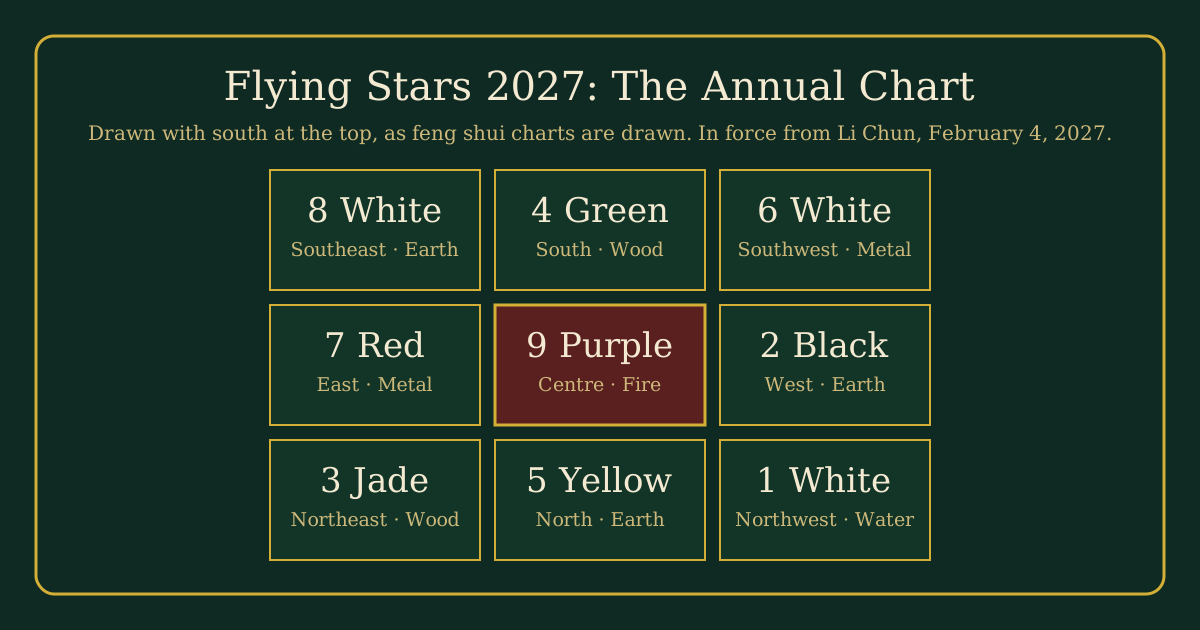
Drawn as a grid, with south at the top the way feng shui charts are conventionally drawn, the 2027 chart is:
| Southeast 8 White | South 4 Green | Southwest 6 White |
|---|---|---|
| East 7 Red | Centre 9 Purple | West 2 Black |
| Northeast 3 Jade | North 5 Yellow | Northwest 1 White |
The south-at-top drawing surprises readers meeting it for the first time, because Western maps put north at the top. The convention comes from the compass tradition itself, in which the practitioner faced south. Keep it in mind when plotting the chart on a floor plan: the grid is placed by compass direction, never flipped to match the page.
The nine palaces at a glance
| Sector | Star | Element | What tradition reads there | Standing in Period 9 |
|---|---|---|---|---|
| Centre | 9 Purple | Fire | Celebration, visibility, good news, the tone of the year | The period ruler, at full standing |
| Southeast | 8 White | Earth | Wealth, accumulation, property | Past its period; schools split on its weight |
| South | 4 Green | Wood | Study, writing, romance | A working star, read gently |
| Southwest | 6 White | Metal | Authority, mentors, steady help | A working star; shares the sector with Tai Sui in 2027 |
| Northwest | 1 White | Water | Career movement, travel, new starts | Rising; the coming star after 9 in most readings |
| North | 5 Yellow | Earth | Disruption, accident, the year's heavy seat | Difficult in every period |
| West | 2 Black | Earth | Illness, in the traditional wording | Difficult; doubled by the San Sha in 2027 |
| Northeast | 3 Jade | Wood | Arguments, disputes, legal friction | Difficult; doubled by the Sui Po in 2027 |
| East | 7 Red | Metal | Conflict, theft, loss, sharp words | A faded power star, read as difficult since Period 7 ended |
Two notes belong under this table. First, the readings in the fourth column are the tradition's own associations, printed so a reader can follow what a practitioner means by them. They are not measured effects, and no controlled study shows a compass sector shaping a household's year. Second, the fifth column is where real disagreement lives inside the tradition. Every school agrees on the seats. Schools differ on how much force a star past its period still carries, and the 8 White is the live case: a Period 8 wealth star, two years into Period 9, still worked hard by some lineages and politely retired by others. This guide reports both gradings where they matter and follows neither as fact.
Advertisement
The centre and the four working sectors
Centre: 9 Purple, Fire. The centre palace is not a room so much as the house read as a whole, and a presiding 9 sets the year's register in the tradition's telling: visibility, recognition, celebration, and the fire associations of speed and display. In practical terms, households that follow the system read a centre 9 as a year to keep the middle of the home clear, lit, and in use rather than stacked with storage, on the reasoning that the year's presiding star should not be buried under boxes. The centre is also where the chart's one structural warning sits. Fire feeds earth in the five-element generating cycle, and the two difficult earth stars of 2027, the 5 Yellow and the 2 Black, are read as fed rather than calmed by a strong fire year. That is the tradition's internal logic for why a double 9 year is described as bright and demanding at the same time.
Southeast: 8 White, Earth. The southeast takes the star tradition links to wealth, and it does so in the sector the bagua map already marks as the wealth corner, which is why 2027 southeast advice is everywhere this season. Strip the claims back to what the system itself says: a well-kept, well-used southeast is the year's preferred seat for the desk, the accounts, the work that accumulates. What no version of the tradition can supply is a result. The Period question in the table above also lands here. A household following a lineage that still works the 8 will use the southeast hard. A household following a lineage that retired it in 2024 will treat the southeast as an ordinary good corner and put its effort into the 9 and the 1. Both are describable as orthodox. Pick the grading your own practice uses and stay consistent for the year.
South: 4 Green, Wood. The 4 is the scholar's star in the traditional labelling, tied to study, writing, examinations, and, in a second strand of the same tradition, to romance. A south-facing study, a child's homework desk in a south room, a writer's corner: 2027 puts the year's study star behind them. The practical reading is modest, and should stay modest. If a household was already choosing which of two rooms becomes the study, the chart is the tiebreaker the system offers. The 4 is a wood star in a fire year and a fire sector, wood feeding fire, which the tradition reads as the study star spending itself into visibility: work done in the south in 2027 is work that gets seen, in the system's phrasing.
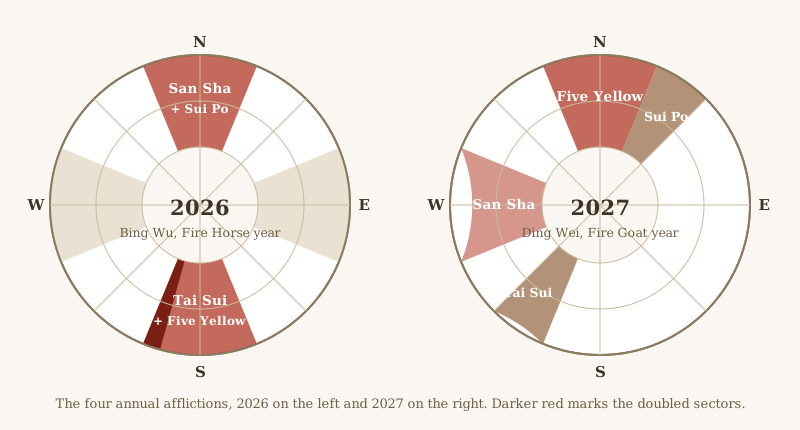
Southwest: 6 White, Metal. The 6 carries authority, mentors, and what older texts call heavenly help: the senior person, the useful introduction, the institution that answers. In 2027 the southwest holds that star and, from the separate afflictions count, the Tai Sui of the Goat year. The pairing produces the year's most specific piece of etiquette. The afflictions guide gives the full rule; in short, tradition respects the Tai Sui sector rather than avoiding it: no digging, drilling, or renovation there during the year, and no sitting with the sector directly faced for long stretches. A southwest living room in 2027 is therefore a room to use calmly and leave structurally alone, with the 6 White read as steady support for the people using it. The two systems do not contradict each other here. One says the sector has a helpful visitor; the other says a senior official is also present, so behave accordingly.
Northwest: 1 White, Water. The 1 is the year's cleanest working star in most current gradings: a water star linked to career movement, travel, and new beginnings, and widely read as the rising star of the coming cycle, the one that follows 9 in force once Period 9 matures. Its 2027 seat, the northwest, is the sector the bagua map gives to mentors and travel, so star and sector agree again. A northwest home office or a northwest desk is the placement households ask about most after the southeast, and the system's answer is the plain one: the northwest is a good place in 2027 to do the work that is meant to move. As with the southeast, the chart supplies a preference, not a promise.
The four quiet sectors
North: 5 Yellow, Earth. The north takes the year's heaviest reading. The 5 Yellow is the star every lineage grades as difficult: disruption, accident, and plans going sideways, in the traditional wording. In 2026 it sat in the south, and households that kept a quiet south through 2026 now move the quiet to the north. The working rules are the ones the afflictions guide sets out for this star: no renovation, drilling, or ground-breaking in the sector during its year, keep the sector's daily life calm rather than loud, and, where a household follows the placement practice, metal in the sector, because metal drains earth in the weakening cycle. The north is also the water sector of the house, and water does not feed an earth star, which the tradition counts as a small mercy in an otherwise hard pairing. A north bathroom or a north spare room is the easy case. A north kitchen or a north bedroom takes the rules above and no more. The tradition does not ask anyone to vacate a room over an annual star.
West: 2 Black, Earth. The 2 is the illness star of the traditional labels, and its 2027 seat carries the year's only double load on the difficult side: the San Sha, counted from the Goat year's branch, also sits in the west in 2027. Two systems, one instruction: leave the west undisturbed. No renovation, no breaking ground, and the same metal placement the 5 Yellow takes, since the 2 is also an earth star. A west bedroom is the case readers write in about, and the answer is the same shape as the north bedroom answer. Sleep there, live there, keep it tidy and quiet, and schedule the repaint for 2028, when the 2 flies on to the northeast and the San Sha moves to the south. What tradition adds for the 2 specifically is attention to the room's ordinary health basics while the star sits there: air, light, damp dealt with, clutter out. Those are sound measures in any year, which is part of why the custom persists.
Northeast: 3 Jade, Wood. The 3 is the argument star: disputes, legal friction, tempers, in the traditional shorthand. In 2027 it sits in the northeast, where it is doubled by the Sui Po, the Year Breaker, which sits opposite the Tai Sui. The doubling matters for the disturbance rule rather than for daily life: the northeast joins the west and the north as a sector not to renovate in 2027. For daily life, the tradition's reading of a 3 in a room is noise discipline. A northeast room used for negotiation, homework, or a couple's serious conversations is read as a room to keep calm and uncluttered, with the wood of the 3 traditionally tempered by a point of fire colour, fire controlling wood in the cycle. Households that do not use colour placements can take the same advice in its plain form: a room the chart flags for friction is a room to keep restful.
East: 7 Red, Metal. The 7 was the power star of Period 7 and has been read as difficult since that period closed in 2004: conflict, theft, loss, and sharp speech, in the usual list. Its 2027 seat is the east. The traditional handling is the lightest of the four quiet sectors: keep an east entrance or east room secure and well lit, avoid leaving the sector cluttered and dark, and, in placement practice, water tones near the 7, since water drains metal. An east front door in 2027 is not a problem to solve. It is a door to keep in good order, with a working lock and a lit approach, advice no year makes wrong.
A worked apartment, read through the changeover
Take a labelled hypothetical apartment, invented for this example: front door in the southeast, living room across the south and southwest, kitchen in the northeast, main bedroom in the west, second bedroom in the north, bathroom in the east, and a desk in the northwest corner of the living room's grid square. Read it first on the outgoing 2026 chart. The door sat under the 9, the living room under the south 5 Yellow and southwest 7, the kitchen under the northeast 4, the west bedroom under the 3, the north bedroom under the 6, and the desk under the northwest 2. A household running that chart through 2026 kept the south quiet, metal in the living room, and did its loud living in the east and southeast.
On February 4, 2027 the same rooms read differently, and the differences are the changeover in concrete form:
| Room | Sector | 2026 star | 2027 star | What the household changes |
|---|---|---|---|---|
| Front door | Southeast | 9 Purple | 8 White | Nothing structural; the door stays the working entrance, now read as the wealth seat |
| Living room | South and southwest | 5 Yellow, 7 Red | 4 Green, 6 White | The metal placement comes out of the south; the room returns to full use, with the southwest corner left undrilled for Tai Sui |
| Kitchen | Northeast | 4 Green | 3 Jade, with Sui Po | The planned 2027 retiling is postponed a year; no drilling in this sector |
| Main bedroom | West | 3 Jade | 2 Black, with San Sha | Metal goes in; the room is kept quiet; a planned ensuite refit is moved to 2028 |
| Second bedroom | North | 6 White | 5 Yellow | Becomes the quiet room of the house; the drum kit that was moving here goes to the south instead |
| Bathroom | East | 8 White | 7 Red | Nothing placed; the lock and the outside light get fixed, which was overdue anyway |
| Desk | Northwest | 2 Black | 1 White | Becomes the household's main work seat for the year |
Three things in that table generalise. First, most rooms change by one step, not by a reversal, because the whole chart steps one palace each year. Second, the real work of a changeover is small and physical: one placement moved, one renovation postponed, one room reassigned. Third, the apartment did not become a good or bad apartment at Li Chun. Its natal chart, set when it was built and by where it faces, did not move at all. Only the visiting layer turned over.
Plotting the chart on your own floor plan
The annual chart is read by compass sector, so the one tool it needs is a direction. This site's compass reading guide gives the full method, including the magnetic declination correction. The short version for an annual chart:
- Find the centre of the home. On a floor plan, draw the diagonals of the building's outline. Their crossing is the centre the grid hangs on. For an L-shaped or U-shaped plan, complete the rectangle first and note any missing corner as a missing sector rather than redrawing the grid to fit.
- Take one careful reading. Stand at the centre, away from steel, speakers, and the phone in your other hand, and take the reading the compass guide prescribes. One good reading beats five casual ones.
- Divide the plan into nine. Lay a 3 by 3 grid over the plan from the centre point, sides running to the compass points, and label each square with its direction.
- Copy the 2027 stars in. Southeast 8, south 4, southwest 6, east 7, centre 9, west 2, northeast 3, north 5, northwest 1. Check the copy against the derivation table before acting on it. A transposed pair, 5 and 2 swapped between north and west, is the commonest plotting error and the worst one to make in 2027, since those are the two sectors getting opposite treatment.
- Read rooms, not squares. A room straddling two sectors takes the reading of the sector holding its door and its main use. Tradition is not precise to the cushion, and a household reading gains nothing by pretending otherwise.
Apartments take the same grid. The sectors belong to the unit's own centre, and the building's facing matters to the natal chart, not to where the annual stars fall inside the flat.
The changeover routine
Households that run annual charts do the physical work in the last days of the old year, so the house is already on the new map when Li Chun arrives on February 4. The routine the tradition implies, assembled from the sector readings above:
- Retire the 2026 placements. Metal that stood in the south for the 5 Yellow, and any quiet-sector arrangement in the rooms that held the 2026 difficult stars, comes out once the year turns. Placements are annual. Leaving last year's arrangement in place through the new year is the changeover error practitioners mention most.
- Set the new quiet sectors. North first, for the 5 Yellow, then west, then northeast. Metal placements go where the household's practice puts them, and the renovation calendar is checked against all three sectors plus the southwest for the year.
- Clear the centre. The presiding 9 takes the centre palace. Stored boxes, the broken chair awaiting repair, and the pile of unsorted post move out of the middle of the home.
- Open the working sectors. Southeast, northwest, and south get light, use, and the household's main activities where the rooms allow it.
- Move nothing twice. Pick the grading your practice uses for the 8 White, make the southeast decision once, and leave it for the year. Annual charts reward consistency over mid-year second-guessing.
Limits, stated plainly
This guide describes a traditional system for reading a home, and it has tried to get the system right: the centre-star arithmetic, the flight path, the sector seats, the Li Chun dates, and the affliction overlaps all check against the sources and the sibling guides named in the text, and the derivation is printed so a reader can re-run it. Getting the reckoning right is a real and verifiable thing.
What the reckoning means is a separate question, and this site keeps the two apart. The star associations are the tradition's own, reported so a reader can follow a chart, a practitioner, or a neighbour's practice. No controlled evidence shows an annual star changing what happens in a room, and nothing in this guide promises a household money, health, or peace. The durable content of the annual routine is plainer than its language: once a year, walk the whole home, clear the middle, fix the lock, postpone the renovation that would tear up the room someone sleeps in, and put the desk where the light and the year both favour work. A household that does only that has done most of what the chart was ever asking for.