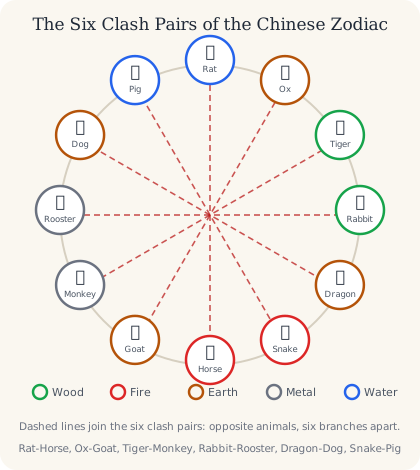
Ask a room of people about zodiac relationships and the clash pairs come back first. Rat against Horse, Ox against Goat, the opposites across the wheel. The clash guide on this site covers those six pairs at full length. But a traditional reader working through a chart tracks more than the loudest relationship on the wheel. Three quieter sets sit underneath the clashes and the harmonies, and between them they touch every animal on the wheel: the six harms, the punishments, and the six destructions.
The three sets answer three different questions. A harm asks where one branch interferes with another branch's best relationship. A punishment asks which branches, gathered together, strain each other in a repeating pattern. A destruction asks which pairs wear each other down slowly instead of colliding. None of the three needs a birth chart to learn. All three are fixed lists, printed in the same form in reference after reference, and anyone can check a pairing with the tables below and a finger on the wheel.
This guide lists all three sets in full, shows the small piece of geometry that generates the harms, works through the cases where one pair of animals carries two relationships at once, and then applies the sets twice: once to the annual Tai Sui lists for 2026 and 2027, where harm, punishment, and destruction are three of the five named forms, and once to a labelled hypothetical set of four branches, checked step by step. Everything is reported as the tradition states it. A branch relationship is a pattern inside a cultural system. It is not a measurement of a person and it does not predict events.
The full relationship map on one table
Start with the whole map, because the three new sets only make sense next to the three already familiar ones. Every animal has: two trine allies (San He), one harmony partner (Liu He), one clash opposite (Liu Chong), one harm partner (Liu Hai), one destruction partner (Liu Po), and a place in the punishment patterns (San Xing). Six relationships per animal, all fixed, all listed here.
| Animal | Branch | Trine allies | Harmony partner | Clash | Harm | Destruction | Punishment pattern |
|---|---|---|---|---|---|---|---|
| Rat | Zi 子 | Dragon, Monkey | Ox | Horse | Goat | Rooster | Rat-Rabbit pair |
| Ox | Chou 丑 | Snake, Rooster | Rat | Goat | Horse | Dragon | Ox-Dog-Goat trio |
| Tiger | Yin 寅 | Horse, Dog | Pig | Monkey | Snake | Pig | Tiger-Snake-Monkey trio |
| Rabbit | Mao 卯 | Goat, Pig | Dog | Rooster | Dragon | Horse | Rat-Rabbit pair |
| Dragon | Chen 辰 | Rat, Monkey | Rooster | Dog | Rabbit | Ox | Self, when doubled |
| Snake | Si 巳 | Ox, Rooster | Monkey | Pig | Tiger | Monkey | Tiger-Snake-Monkey trio |
| Horse | Wu 午 | Tiger, Dog | Goat | Rat | Ox | Rabbit | Self, when doubled |
| Goat | Wei 未 | Rabbit, Pig | Horse | Ox | Rat | Dog | Ox-Dog-Goat trio |
| Monkey | Shen 申 | Rat, Dragon | Snake | Tiger | Pig | Snake | Tiger-Snake-Monkey trio |
| Rooster | You 酉 | Ox, Snake | Dragon | Rabbit | Dog | Rat | Self, when doubled |
| Dog | Xu 戌 | Tiger, Horse | Rabbit | Dragon | Rooster | Goat | Ox-Dog-Goat trio |
| Pig | Hai 亥 | Rabbit, Goat | Tiger | Snake | Monkey | Tiger | Self, when doubled |
Read one row slowly and the system stops looking like a pile of lists. A Rat sits in a working triangle with Dragon and Monkey, pairs quietly with Ox, faces Horse across the wheel, is interfered with by Goat, is worn down by Rooster, and forms a two-branch punishment with Rabbit. Six different verbs for six different partners. The clash pairs guide works the clash column and the trine and harmony columns at length. The rest of this guide works the last three columns.
One structural fact is worth fixing before the detail. The harm and destruction columns are pairings in the strict sense: if A harms B, B harms A, and the same holds for destructions. Read down either column and every animal appears exactly once as a partner, which is what makes the two sets checkable. The punishment column breaks that pattern on purpose. Two of its forms need three branches, one needs a specific pair, and one needs a branch doubled against itself. That irregular shape is the first hint that punishments sit at a different level of the system.
The six harms: friction that arrives through a friend
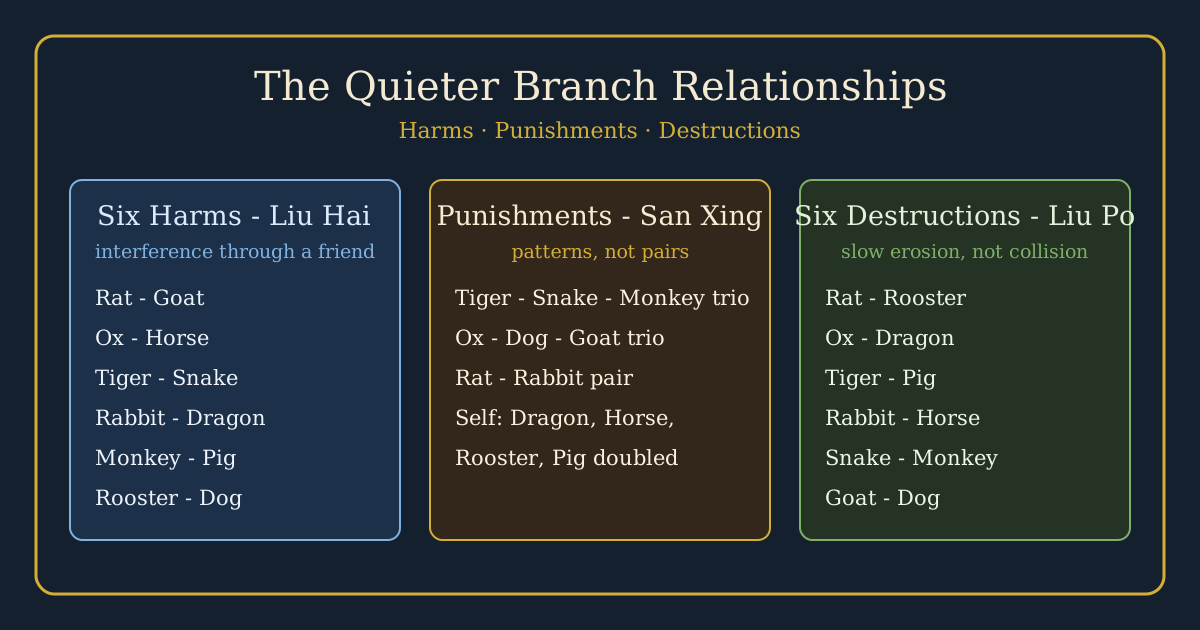
The six harms, Liu Hai, 六害, are these pairs:
| Harm pair | Branches | Fixed elements |
|---|---|---|
| Rat and Goat | Zi 子 and Wei 未 | Water and Earth |
| Ox and Horse | Chou 丑 and Wu 午 | Earth and Fire |
| Tiger and Snake | Yin 寅 and Si 巳 | Wood and Fire |
| Rabbit and Dragon | Mao 卯 and Chen 辰 | Wood and Earth |
| Monkey and Pig | Shen 申 and Hai 亥 | Metal and Water |
| Rooster and Dog | You 酉 and Xu 戌 | Metal and Earth |
The character hai means harm or injury, and the teaching image that goes with it is interference rather than attack. A clash is two branches facing each other. A harm, in the standard description, is what happens when a branch gets in the way of another branch's combination: the pairing that should have formed is blocked or spoiled, and the friction runs through the blocked relationship instead of meeting head-on. References that explain the mechanism, including the Imperial Harvest earthly branches reference read for this guide, describe each harm in exactly those terms, naming the combination each pair disrupts. Rat and Goat are the standing example: Goat is the harmony partner of Horse, and Horse is the clash of Rat, so the Goat stands between the Rat and its opposite, disrupting the Horse-Goat combination from the side.
That example is not a one-off. It is the generating rule for the whole set, and it is the piece of this guide a reader can verify with nothing but the harmony and clash lists:
Your harm partner is the clash of your harmony partner.
Work it for three animals. Rat pairs with Ox in the six harmonies. Ox clashes with Goat. Rat harms Goat. Tiger pairs with Pig. Pig clashes with Snake. Tiger harms Snake. Rooster pairs with Dragon. Dragon clashes with Dog. Rooster harms Dog. The remaining three pairs fall out of the same two steps: Rabbit pairs with Dog, Dog clashes with Dragon, Rabbit harms Dragon. Horse pairs with Goat, Goat clashes with Ox, Horse harms Ox. Monkey pairs with Snake, Snake clashes with Pig, Monkey harms Pig. Six pairs, no memorisation required, and a built-in error check: if a harm list printed anywhere disagrees with the result of those two steps, one of the three lists is wrong.
Folk tradition carried the harms into matchmaking early, and an old marriage verse about the six harm pairs still circulates in Chinese sources, warning in rhyme against Rat with Goat, Horse with Ox, Tiger with Snake, Rabbit with Dragon, Monkey with Pig, and Rooster with Dog. The verse is part of the cultural record and it explains why harm pairs show up on popular compatibility charts at all. It is worth being plain about the borrowing: in chart reading, a harm is a relation between two branches inside one person's four pillars, or between a chart and a passing year. The verse lifts the pair out of that setting and applies it to two people by birth year alone, which is a much thinner use of the system than the one the list was built for. The site love compatibility guide sets out how to hold results like that, as questions to discuss rather than verdicts.
Inside a chart, teachers read a harm by the pillars it joins. A harm between the year and month branches is traditionally discussed in terms of family and upbringing. A harm between the day and hour branches is discussed in terms of the household a person builds later. Those are the tradition's own topic labels for the pillar positions, reported here as part of the method. They describe where a reader looks, not what a reader finds.
Advertisement
The punishments: the pattern that needs a gathering
The punishments, Xing, 刑, are where the system stops being a set of pairs. The classical heading is San Xing, the three punishments, and the three are patterns, not pairings:
| Form | Branches | Animals | Structure |
|---|---|---|---|
| The trio of Tiger, Snake, and Monkey | Yin 寅, Si 巳, Shen 申 | Tiger, Snake, Monkey | Three branches, each punishing the next in a circuit |
| The trio of Ox, Dog, and Goat | Chou 丑, Xu 戌, Wei 未 | Ox, Dog, Goat | Three Earth branches gathered together |
| The Rat-Rabbit pair | Zi 子 and Mao 卯 | Rat, Rabbit | Two branches, a mutual punishment |
| Self-punishment | Chen 辰, Wu 午, You 酉, Hai 亥, each doubled | Dragon, Horse, Rooster, Pig | One branch appearing twice |
A note on names, because English sources split here and a reader comparing lists will trip over it. The Tiger-Snake-Monkey trio is called the punishment of ingratitude (wu en, 无恩) in many teaching lists, and the punishment of power or reliance on force (shi shi, 恃势) in others, with the Ox-Dog-Goat trio taking whichever label the first trio did not. The Rat-Rabbit pair is more stable in translation: the punishment of incivility or rudeness (wu li, 无礼). The Longhu Mountain punishment reference and the Imperial Harvest branch reference read for this guide between them use both label assignments for the two trios. The groupings, the characters, and the circuit structure agree across all of them. Where a label is doing work in a reading, a careful teacher names the grouping by its animals, not by its English nickname, and this guide does the same.
The circuit inside each trio is the detail that separates a punishment from a big clash. In the Tiger-Snake-Monkey trio, the traditional statement runs in a loop: Tiger punishes Snake, Snake punishes Monkey, Monkey punishes Tiger. In the Earth trio the loop runs Ox punishes Dog, Dog punishes Goat, Goat punishes Ox. No single member is simply the victim or simply the source. That circular shape is why the old texts treat a completed trio as a system state rather than an event between two branches, and why readers give a completed trio more weight than any pair in this guide.
Two consequences follow for anyone checking a chart.
A trio can be present in part. Two members of a trio in a chart, Tiger and Snake without Monkey, form what teachers call an incomplete or pending punishment: the pattern is read as latent, and a luck pillar or a year that brings the third branch completes it for that period. This is the single most common way punishments enter ordinary readings, because a four-pillar chart has four branches and a decade-long luck pillar adds a fifth that sits over the chart for years at a time. When the third branch arrives, the trio is treated as switched on. When it leaves, the reading returns to the two-branch state.
Self-punishment needs a double, and only four branches can do it. Dragon, Horse, Rooster, and Pig punish themselves when the same branch appears twice. One Dragon in a chart is just a Dragon. Two Dragons, in any two pillars, or one Dragon in a chart met by a Dragon year, form the self-punishment. Teachers read the pattern as the branch's own quality turned up past the point where it helps: the loop has no second party at all, which is exactly what the name says. The year 2026 gives a calendar-wide example, covered below: Horse is a self-punishment branch, and a Horse year doubles the Horse in the chart of every Horse-born person for the year, which is one reason the own-year customs in the ben ming nian guide are described the way they are.
The six destructions: the slow set
The six destructions, Liu Po, 六破, are the quietest set of the three, and the easiest to miss in a chart because nothing in them collides.
| Destruction pair | Branches | Fixed elements |
|---|---|---|
| Rat and Rooster | Zi 子 and You 酉 | Water and Metal |
| Ox and Dragon | Chou 丑 and Chen 辰 | Earth and Earth |
| Tiger and Pig | Yin 寅 and Hai 亥 | Wood and Water |
| Rabbit and Horse | Mao 卯 and Wu 午 | Wood and Fire |
| Snake and Monkey | Si 巳 and Shen 申 | Fire and Metal |
| Goat and Dog | Wei 未 and Xu 戌 | Earth and Earth |
The character po means break or damage, and the teaching description is erosion: a pairing that weakens gradually rather than a pairing that fights. Several of the pairs run along the generating cycle rather than against it, which is the part readers find counterintuitive. Metal generates Water, and Rat with Rooster is a destruction. Water generates Wood, and Tiger with Pig is a destruction. The traditional explanation works in terms of degree: support pushed past balance, nourishment that arrives in a quantity or at a timing that undermines the thing it feeds. A reader does not have to accept the explanation to use the list, but the list itself only makes sense inside the system once it is clear that destructions were never meant to be read as small clashes. They are a different mechanism in the system's own grammar.
Destructions also produce the guide's clearest overlaps, the cases where one pair of animals holds two relationships at once:
- Tiger and Pig are a six-harmonies pair, the combination teachers list as producing Wood, and at the same time a destruction pair. It is the most quoted overlap in the system: the closest formal bond and a slow erosion, assigned to the same two branches.
- Snake and Monkey are also a harmony pair, listed as producing Water, and also a destruction pair, and Snake and Monkey are two of the three members of the Tiger-Snake-Monkey punishment trio. No other pair stacks three readings this way.
- Goat and Dog are a destruction pair, and both sit inside the Ox-Dog-Goat punishment trio, so a chart holding Goat and Dog carries a destruction on its face and two thirds of a punishment underneath it, waiting on an Ox branch to complete the trio.
Overlaps like these are why single-pair compatibility charts mislead even on the system's own terms. A chart reader never scores a pair and stops. The pair is one entry in a table of everything the two branches do together, and the entries can point in opposite directions without any contradiction inside the method, because each entry names a different mechanism. Popular charts that print one symbol per pair have thrown away most of the table.
Where the quiet sets show up every year: the five Tai Sui forms
Most readers meet harms, punishments, and destructions first in a New Year list, not in a chart. Annual fan tai sui lists name the signs said to be in tension with the year, and the full form of the list has five entries, one for each relationship type: Zhi, the year sign itself; Chong, the clash; Xing, the punishment; Hai, the harm; and Po, the destruction. The last three forms are exactly the three sets in this guide, applied between a birth branch and the year branch.
The 2026 list is worked in full in the ben ming nian guide on this site, and it can be re-derived from the tables above in under a minute. The year branch is Horse. Zhi: Horse. Chong: the Horse clash partner, Rat. Hai: the Horse harm partner from the harm table, Ox. Po: the Horse destruction partner from the destruction table, Rabbit. Xing: Horse is one of the four self-punishment branches, and the year doubles it for Horse-born readers, so Horse appears on the list twice, once as the year sign and once in the punishment seat. Four signs are named in most 2026 lists, Horse, Rat, Ox, and Rabbit, and every one of them falls out of the three tables in this guide plus the clash table.
Run the same derivation for 2027, the Fire Goat year that runs from February 6, 2027 to January 25, 2028 by the calendar dates in the site Fire Goat year guide. The year branch is Goat, Wei. Zhi: Goat. Chong: Ox, the branch opposite Goat. Hai: Rat, because Rat and Goat are the first pair in the harm table. Po: Dog, because Goat and Dog close the destruction table. Xing works differently this year: Goat belongs to the Ox-Dog-Goat punishment trio, so the punishment relationship is carried by the trio members meeting each other rather than by a doubling, and year lists for 2027 commonly name Ox and Dog in connection with it, the same two animals the clash and destruction derivations already produced. A reader who has the tables does not need to take any of that on trust from a social media graphic. Each name is one lookup.
Two cautions belong with any year list, and both are about scope. First, a year list works from the year branch alone. A full chart reading weighs the month branch most heavily of the four pillars, because it sets the season of the chart, and a harm against a year branch and a harm against a month branch are not read as equals. Second, the forms are a traditional vocabulary for pacing and care during a year, the same framing the ben ming nian customs use. They are not a schedule of events, and treating a list as a forecast gives it a job it cannot do.
Checking a set of branches, step by step
The method a reader uses on a real chart is mechanical until the last step. It is set out here on a labelled hypothetical, because the steps are the content: the same six steps run on any four branches.
The hypothetical. Suppose a chart, invented for this example, carries these four branches: year Rat, month Horse, day Dragon, hour Rooster. In branch names: Zi, Wu, Chen, You.
- List every pair. Four branches make six pairs: Rat-Horse, Rat-Dragon, Rat-Rooster, Horse-Dragon, Horse-Rooster, Dragon-Rooster. Work the pairs in a fixed order so none is skipped.
- Check the loud relationships first. Rat-Horse is a clash, the one opposite pair in the set. Dragon-Rooster is a harmony pair. Rat-Dragon are trine allies, members of the Rat-Dragon-Monkey trine with the third member absent.
- Check the harms. Rat harms Goat, absent. Horse harms Ox, absent. Dragon harms Rabbit, absent. Rooster harms Dog, absent. This hypothetical carries no harm. Note the negative result rather than skipping the step: a set with no harm is a finding, and it took four lookups to earn.
- Check the destructions. Rat-Rooster is a destruction pair, present, joining the year and hour branches. Dragon's destruction partner is Ox, absent. Horse's is Rabbit, absent. One destruction, in the same pair list where step 2 found the set's harmony and its trine, which is the overlap problem in miniature.
- Check the punishments, including the doubles. No trio is complete and no two members of one trio are both present: Rat and Rabbit would be the pair pattern, and Rabbit is absent. Dragon is a self-punishment branch, but it appears once, so no self-punishment stands. A Monkey branch arriving by luck pillar would still not complete a trio here, since neither Tiger nor Snake is present. Name what would complete each pattern, not just what is present.
- Only then, weigh. The tradition's own weighting habits, stated as habits and not laws: relationships touching the month branch are read first, because the month sets the season; a completed pattern outweighs a pending one; a pair that carries two relationships, like Rat-Rooster here with its destruction sitting across the year and hour pillars, gets discussed as a pair, not as two separate scores. The BaZi chart reading guide on this site works the weighing layer at full length, including the Day Master and the ten gods, which sit above branch relationships in most readings.
Six steps, and only the last one needs a teacher. The first five are table work, and they are the difference between reading a listicle that names your sign and checking a chart the way the system itself is built.
What these lists can and cannot do
The checkable layer of this guide is the lists themselves, and they check out in a satisfying way: the harm set can be regenerated from the harmony and clash sets by one rule, every animal appears exactly once in the harm pairings and once in the destruction pairings, the punishment circuits close into loops, and the 2026 Tai Sui names fall out of the tables without adjustment. A system does not have to be true about people to be internally consistent, and the consistency is the part a reader can verify at a kitchen table.
The interpretive layer is a separate matter, and this guide keeps the two apart on purpose. That a completed punishment trio is read as a period of strain, or a destruction as slow erosion, is a statement about how a tradition talks. It is not evidence about what will happen in a marriage, a business, a body, or a year. Decisions about health, money, contracts, and property belong to clinicians, documents, and arithmetic. Decisions about a relationship belong to the people in it. The branch tables can give a reader a shared vocabulary and a set of questions. They cannot carry more weight than that, and any reading that asks them to is asking the wrong thing of a calendar.
Sources and method
The six harm pairs, the six destruction pairs, and the punishment groupings in this guide were checked against two branch references read in full for this guide in October 2026: the Imperial Harvest guide to the twelve Earthly Branches, which lists all five interaction sets (combinations, clashes, harms, punishments, destructions) with branch characters and produced elements, and the Longhu Mountain BaZi branch analyses, which state the harmony, clash, and harm pairings and the punishment circuits in prose. The two references agree on every pairing used here. They differ on the English labels for the two punishment trios, as noted in the punishment section, and this guide follows the groupings rather than either label set. The 2026 Tai Sui forms follow the ben ming nian guide on this site, which lists Horse, Rat, Ox, and Rabbit for the Horse year, and the 2027 forms were derived from this guide's own tables using the same method, with the Fire Goat year dates taken from the site Fire Goat year guide. The hypothetical chart in the checking section is invented for instruction and is labelled as such. No pairing in this guide comes from a single unsourced list.