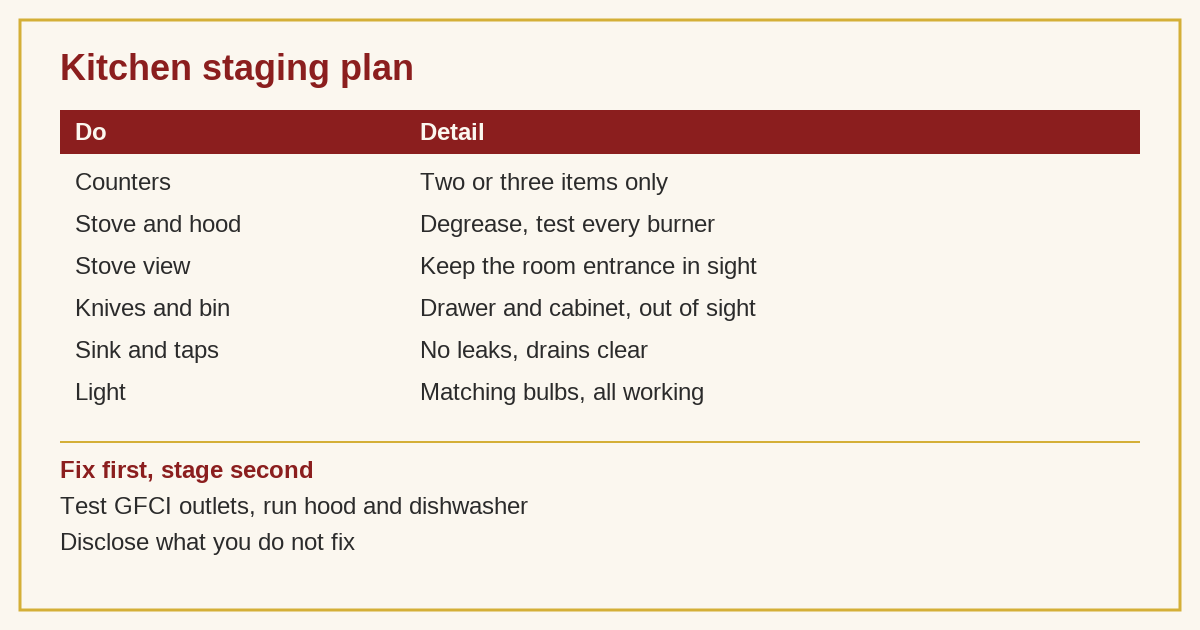
To stage a kitchen to sell, cut the counters down to a few items and make sure every burner, light and tap works. Scrub the stove and hood, hide the bin and the knives, and fix anything an inspector would flag before a buyer sees it. The tradition's kitchen rules (a clean stove, a stove that can see the entrance, knives out of sight) sit comfortably with that list. A fresh coat of paint usually does more for a sale than a remodel.
Code reference and reports checked: 23 November 2026
Only the kitchen-for-sale job is covered here. A layout to live with is in kitchen layout, the whole-house plan in feng shui for selling a house, and more in our real estate and home buying guides.
| Code, reports and tradition | Figure or rule | Source |
|---|---|---|
| Countertop outlets | The model electrical code requires ground-fault circuit-interrupter (GFCI) protection for kitchen countertop receptacles (not verified since November 2026) | National Electrical Code, Article 210.8 |
| Cost versus value | The annual Cost vs. Value report compares what minor and major kitchen projects cost and recoup; read the current edition for figures | Remodeling Cost vs. Value report |
| Staging report | The NAR Profile of Home Staging reports whether agents say kitchens are among the most important rooms to stage; read the current edition for the ranking | National Association of REALTORS |
| Tradition: stove | Practitioners say the cook should see the room's entrance from the stove, and that the stove and sink should not sit side by side | Form School practice |
| Tradition: knives | Practitioners say knives should be kept out of sight and not pointing at the room | Form School practice |
On this page
- What a buyer checks in a kitchen
- Counters, stove and sink
- Fix before you stage
- Paint, hardware and small updates versus a remodel
- Appliances: what stays
- Staging checklist
- Five ways sellers spoil a kitchen
- FAQ
- This weekend
What a buyer checks in a kitchen
Buyers open drawers, turn on taps, look under the sink and try the stove. They notice smells, grease and dim light straight away. The tradition treats the kitchen as the home's source of nourishment, which is why it cares about cleanliness and a stove that works. On this the two views agree. The kitchen has to look, and work, like a place where food gets made.
Advertisement
Counters, stove and sink
- Clear the counters down to two or three items, such as a bowl of fruit, a clean cutting board and a plant. Put the toaster, the dish rack and the stack of mail away.
- Clean the stove and hood thoroughly. Degrease the hood and its filter, scrub the burners and replace burned-out drip pans. The stove is the centre of the kitchen in the tradition, and it is the first thing a buyer tries.
- Keep the entrance in view from the stove. Practitioners say the cook should be able to see the way in. If an island or tall cabinet blocks that line and can't be moved, the traditional workaround is a small mirror or a shiny backsplash. For staging, simply keep the view open.
- Don't let the stove and sink become a cluttered pair. The tradition says fire and water should not clash; see stove and sink placement. A clear gap between them with a dish towel looks tidy to any buyer.
- Put the knives away. An in-drawer block beats an open knife block on the counter.
- Hide the bin. A trash can under the sink or inside a cabinet looks cleaner.
A worked example: take an 8 by 12 foot galley kitchen with a stove, a sink, a fridge and 8 feet of counter. Leave a fruit bowl and a plant on the counter, a folded tea towel on the oven door and soap with a brush by the sink. If you put anything on the stove, make it one clean pot. Everything else goes into the cabinets, so buyers see the full counter length and an open work triangle.
Planning a full remodel layout instead? See kitchen remodel layout.
Fix before you stage
Inspectors go over kitchens closely, and any visible problem costs you in negotiation. Start with the cheap fixes:
| Check | What to do | Note |
|---|---|---|
| Burners and oven | Test every burner and the oven, and repair or disclose a fault | An unusable burner is a common negotiation point |
| Countertop outlets | Press the test button on each GFCI outlet, then reset it | The code expects GFCI protection (not verified since November 2026); if absent, ask an electrician |
| Taps and drains | Look for drips and slow drains, and check under the sink | Leaks stain cabinets and show in inspections |
| Range hood | Run it, and clean or replace the filter | Buyers notice a loud or smelly hood |
| Bulbs | Replace bulbs so they all match in colour temperature | Even light makes the room look cleaner |
| Cabinet doors and drawers | Tighten loose hinges and pulls | Buyers open everything |
| Dishwasher and fridge | Run a cycle, and clean the seals and the fridge | Smell and mould put buyers off |
Anything that doesn't work and won't be fixed has to be disclosed under your local rules. No amount of staging hides a fault.
Paint, hardware and small updates versus a remodel
A full kitchen remodel is rarely worth doing just before a sale. The annual Cost vs. Value report compares what common projects cost with what sellers get back, so read the current edition before you decide. Most sellers do better with the cheaper route:
- paint the walls a clean neutral (the tradition's palette is in kitchen colours);
- paint or reface worn cabinets, and replace tired pulls;
- swap a dated faucet or light fixture;
- deep-clean the grout and the countertop;
- if you do change the counters or splashback, read countertops and backsplash first.
Ask your agent whether buyers in your market expect an updated kitchen. Don't pay for a remodel unless you can show it will earn its cost back.
Appliances: what stays
Put in writing which appliances go with the house, and don't stage with any you plan to take. An empty gap where the fridge stood looks bad in photos, so settle this before the photographer comes. The listing and the contract should both say what stays, and your agent can word that for your jurisdiction.
Staging checklist
- Counters nearly bare
- Stove, oven and hood clean, every burner tested
- A clear view of the kitchen entrance from the stove
- Knives in a drawer, bin out of sight
- No leaks under the sink, taps run clear
- GFCI outlets tested
- All bulbs working, same colour
- Fridge cleaned, no smell
- Appliances that stay are listed
- Windows and floor clean
Five ways sellers spoil a kitchen
- Cooking something pungent before a showing.
- Staging with fake fruit or props that look cheap.
- Paying for a remodel while the leaks and clutter stay.
- Hiding a broken appliance rather than disclosing it.
- Following a tradition rule so far that it blocks the work triangle.
FAQ
How do I stage a kitchen to sell?
Clear the counters, clean the stove and hood, test every burner and tap, hide knives and the trash, replace dead bulbs and fix small defects. Keep the room bright and plain.
Does feng shui say anything about selling a kitchen?
The tradition values a clean, working stove, a stove position that sees the entrance and knives kept out of sight, and it warns against a stove next to a sink. These overlap with plain sell-ready advice. It makes no claim about prices.
Should I remodel the kitchen before selling?
Usually not. A full remodel rarely pays for itself in a sale, though your market may differ. Look at the current Cost vs. Value report and ask your agent what comparable homes have, then compare a paint and hardware refresh against a remodel.
Is it okay to hide an old appliance behind staging?
No. If an appliance does not work, repair it, remove it or disclose it as your local rules require. Staging cannot replace disclosure.
What kitchen smells put buyers off?
Strong cooking smells, garbage and damp. Take out the trash, clean the drains and run the hood, then air the room before a showing. Avoid heavy air fresheners, since buyers may suspect they hide something.
Should the kitchen be staged with food or props?
A little, such as a bowl of lemons, a plant or a cutting board. Keep it to that, because real food spoils and obvious props feel false.
This weekend
Work through the fix table, then clear the counters and photograph the kitchen in daylight. The bedroom and the entry are next.
Sources
Checked November 2026. Remodeling costs and recovery percentages change with every annual edition, so we name the reports for you to read in their latest edition rather than quote old figures. The one code reference is marked "not verified since November 2026"; ask an electrician which edition your area has adopted.
- National Electrical Code, Article 210.8 (GFCI protection), National Fire Protection Association.
- Cost vs. Value report, annual, Remodeling magazine and its research partner.
- Profile of Home Staging, National Association of REALTORS, annual report.
- Our own kitchen layout guide for the tradition's rules.
Editorial note: Feng shui is presented here as a cultural and design tradition. Confirm electrical, appliance and disclosure questions with a licensed electrician, inspector or agent.