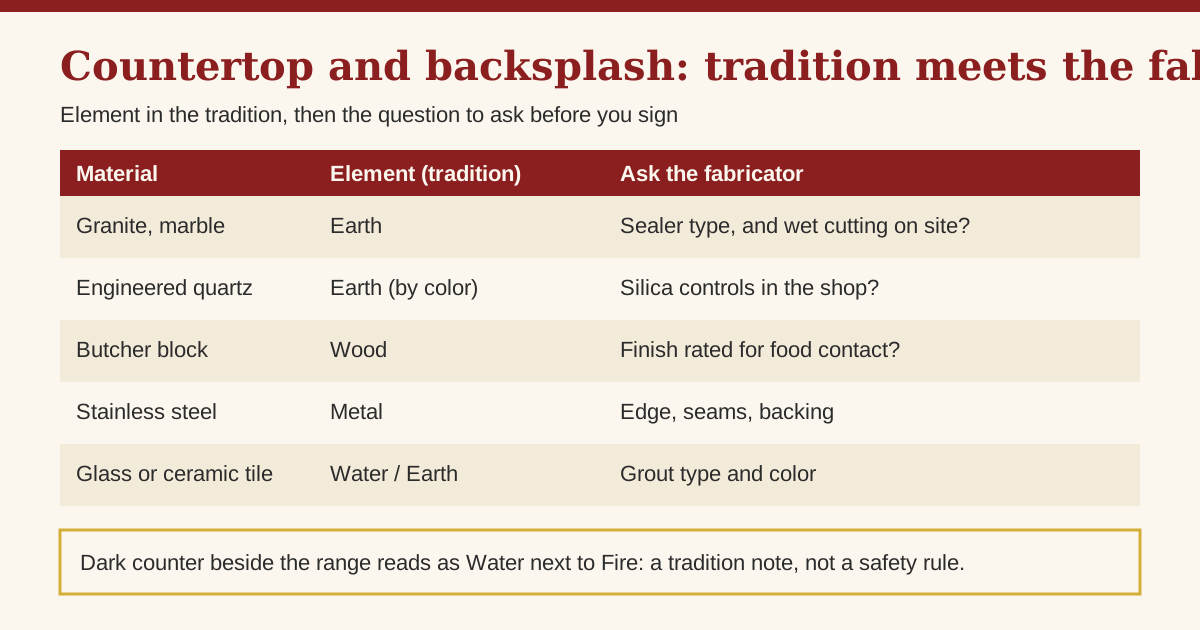
For feng shui kitchen countertops, practitioners match material to element (stone is Earth, butcher block Wood, stainless steel Metal, glass tile Water) and avoid letting a dark, Water-toned counter sit right beside the range (Fire). The practical choice comes from how you cook, how you clean, and what the fabricator can tell you about safety, sealing and heat.
Last checked: 17 November 2026
| Key fact | Figure or rule | Source |
|---|---|---|
| Silica in engineered stone | Up to 95 percent crystalline silica (table range under 0.2 to 95 percent) | OSHA/NIOSH Hazard Alert 2026-101 |
| Silica in natural stone | Granite 10 to 50 percent; quartzite 95 percent or more; marble and limestone under 5 percent | OSHA/NIOSH Hazard Alert 2026-101 |
| Early silicosis cluster | 18 cases, including two deaths, among stone fabrication workers in four states | NIOSH (2019) |
| Australia | Use, supply and manufacture of engineered stone benchtops banned from 1 July 2024; import from 1 January 2025 | Australian DEWR |
| Radon and granite | Some countertop granite may contribute variably to indoor radon; data insufficient to conclude more | U.S. EPA |
| Radon action level | Mitigate if a home test reaches 4 pCi/L | U.S. EPA |
| Wood boards | Deep grooves and cracks should be replaced when they cannot be cleaned effectively | University of Maine Cooperative Extension |
This page is part of our renovate and build with feng shui guide. It covers one narrow decision: the counter and the backsplash. Colors across the whole kitchen are in the kitchen colors and cabinets guide, and where the range, sink and refrigerator go is in the kitchen remodel layout guide. We do not repeat those here.
On this page
- What the tradition says about counter materials
- Dark counters beside the range
- The safety facts that decide some choices
- Food contact and sealing
- Backsplash
- Decision table
- Worked example: range beside the sink
- Questions to ask the fabricator
- Common mistakes
- FAQ
- Where to go next
- Sources
What the tradition says about counter materials
The five elements are Wood, Fire, Earth, Metal and Water; our five elements balancing guide lays out how they feed and control each other. Practitioners assign countertop materials to them by what the material is or looks like:
- Stone and ceramic: Earth. Granite, marble and stone-look surfaces are the usual Earth answer, especially in warm sand, honey or terracotta tones.
- Timber butcher block: Wood. Often suggested as a go-between because Wood feeds Fire and is drawn from Water.
- Stainless steel: Metal. Read as clean and sharp, and said to be strong when it covers a very large share of the kitchen.
- Glass, and black or deep blue surfaces: Water.
- Laminate and solid surface: no fixed element. Practitioners read these by color, not by material.
Schools differ. Form School practitioners care more about shape, glare and whether you can see the room from where you cook. Compass School practitioners place an element by the direction of the kitchen. None of this is a promise about money, health or luck; it is a design vocabulary.
Dark counters beside the range
The common teaching is that the range or cooktop is Fire and water (the sink, the dishwasher) is Water, and that placing them side by side is a clash to be softened. A dark counter, read as Water, right beside the burners can seem to add to that. Practitioners suggest a lighter or earth-toned counter at the stove, a wood board, or a mid-tone backsplash behind the pair.
That answers "is black granite bad feng shui" the way the tradition frames it: it depends on where it sits. A black slab across a whole kitchen with the range far from the sink raises less concern than a black slab with the range and sink at one end. Practical notes belong beside it: black shows dust, water rings and fingerprints more than most people expect, and a dark counter needs good task lighting (see our lighting guide).
The safety facts that decide some choices
This is where a homeowner's choice can affect other people, so it is worth being exact.
Engineered stone and silica. The joint OSHA and NIOSH hazard alert (NIOSH 2026-101, February 2026) is about workers who make, finish and install natural and engineered stone countertops. Its table lists crystalline silica at under 0.2 to 95 percent for engineered stone, 10 to 50 percent for granite, 95 percent or more for quartzite and under 5 percent for marble and limestone. Note that quartzite, a natural stone often offered as an alternative to engineered quartz, sits at the top of that table, so "natural" does not mean low silica. An earlier NIOSH bulletin reported 18 silicosis cases, including two deaths, among stone fabrication workers in California, Colorado, Washington and Texas, many under 50, and said engineered stone may contain more than 90 percent silica against under 45 percent in granite. The risk is dust created when slabs are cut, ground and polished. The alert tells shops to avoid dry cutting, grinding and sweeping, to use water and local exhaust ventilation, and to use respirators when those controls alone cannot bring exposure down to the OSHA limit; the earlier bulletin calls respirators the least effective control. We found no statement in these pages that a finished, installed counter is itself a hazard to a household.
Australia's ban. The Australian government's Department of Employment and Workplace Relations says the use, supply and manufacture of engineered stone benchtops, panels and slabs has been banned from 1 July 2024, and importation from 1 January 2025. Porcelain and sintered stone are not covered. We could not open the Safe Work Australia page itself (its site blocked our fetch), so the dates here come from the DEWR page. Outside Australia, rules differ by country, state and province; ask the local workplace safety regulator.
What this means for a buyer: you cannot see silica control on a showroom sample, but you can ask the shop how it cuts (see the questions below), and you can weigh materials with lower silica content (the alert's table puts marble and limestone lowest).
Radon and granite. The EPA's page says some granite used for countertops may contribute variably to indoor radon, that the existing data is insufficient to say more, and that there is no accepted testing protocol and no regulation for it. It points out that soil is the main source in homes and recommends testing the air and mitigating at 4 pCi/L. Test the house.
Advertisement
Food contact and sealing
We did not find a university page that ranks countertop materials as a whole, so we make no ranking. What we can cite is wood and cutting surfaces. The University of Maine Cooperative Extension says wood can absorb moisture and bacteria if not properly maintained, that boards with deep grooves or cracks should be replaced when they can no longer be cleaned effectively, and that sharp knives reduce deep grooves. It also advises against soaking wood. The same logic is why a butcher-block counter is often kept for bread and vegetables, and why raw meat is better cut on a board you can replace or sanitize.
For sealing, follow the product label and ask the fabricator what they apply and how often it should be renewed. Do not assume that a sealer, an oil or a wax is rated for food contact: ask for the data sheet.
Related reading: the floor under all of this follows its own rules in the feng shui flooring guide by room.
Backsplash
In the tradition the backsplash is the wall where Fire and Water meet, so it is a natural place for the go-between: green, timber-look or earth-toned tile, with glass tile read as Water and metal tile as Metal. Practically it is a cleaning surface. Choose tile and grout you can wipe, keep the grout color close to the tile color if you want fewer visible lines, and take heat and clearance rules for the range and hood from the appliance installation instructions and your local code. We did not open a code or NKBA text that gives a backsplash height or outlet rule, so we state none; our remodel layout guide covers the electrical points we could source.
Decision table
| Material | Element in the tradition | Care | Heat | What to ask the fabricator |
|---|---|---|---|---|
| Granite | Earth | Sealing may be needed; ask how often | Ask for the data sheet | Sealer used, wet cutting, how seams are placed |
| Marble | Earth | Check how it reacts to acids and stains | Ask for the data sheet | Finish (honed or polished), sealer, cleaning products to avoid |
| Engineered quartz | Earth or Metal, by color | Ask what cleaners to avoid | Ask for the data sheet and trivet advice | Silica controls in the shop and on site |
| Quartzite | Earth or Metal, by color | Ask about sealing | Ask for the data sheet | Silica controls: the alert lists quartzite at 95 percent or more silica |
| Solid surface | By color | Ask about repair of scratches | Ask for the data sheet | Seam appearance, edge options |
| Laminate | By color | Wipe-clean; check the edge | Ask for the data sheet | Edge and backer details, water at the sink cutout |
| Butcher block | Wood | Oil or finish renewal, no soaking | Keep hot pans off unless the maker says otherwise | Finish rated for food contact, how it is sealed at the sink |
| Stainless steel | Metal | Shows scratches and fingerprints | Ask for the data sheet | Edge, seams, backing, noise |
| Tile counter | Earth or Water | Grout is the weak point | Ask for the data sheet | Grout type, sealing, flat setting |
We state no heat or stain ratings in this table because we did not find a citable source for them. Use the maker's own data sheet.
Worked example: range beside the sink
Inputs. A galley kitchen with the range and sink about 24 inches apart, a window over the sink, honey-colored cabinets and a vinyl floor. The cook wants a tough counter and has a small budget. The household has a young child. No radon test has been done.
Tradition reading. Fire (range) and Water (sink) are close, so practitioners would look for a go-between. They would not put a black Water-toned counter in the gap between the two. A Wood or Earth element in that stretch is the usual answer.
Practical choice.
- Counter: a mid-tone stone-look surface in a warm sand color, avoiding both near-black and bright white near the range. Ask the fabricator for the maker's data sheet on heat and staining. A short run of butcher block can sit away from the stove as the Wood element, with the finish confirmed for food contact.
- Silica: if the proposal is engineered stone, ask how the shop cuts it (wet methods, extraction) and whether the cutouts for the sink and range are done at the shop, not on site, since dust is made when slabs are cut and ground. Consider other materials if the answers are vague.
- Backsplash: a green or earth-toned tile with grout close to the tile color, running behind both range and sink so the same color links Fire and Water. Heat clearance comes from the range and hood instructions.
- Radon: buy a test kit or hire a tester for the house. Do this whichever counter you pick.
Result. The tradition decides the color and where the dark and light areas fall. The practical answers decide the material and the shop.
Questions to ask the fabricator
- Which material do you recommend, and can I see the maker data sheet for heat, staining and sealing?
- How is the slab cut: wet methods, dust extraction, a shop cutting area or on site?
- What sealer or finish do you apply, is it rated for food contact, and how often must it be renewed?
- Where do the seams fall, and how are they colored and finished?
- Who does the sink and range cutouts and the edge detail, and where?
- What does the warranty cover and exclude?
- Is a permit or an inspection needed for the plumbing or electrical work that comes with this job? Check your local building department.
Common mistakes
- Choosing by element alone. A material that fits the element but cannot take your cooking will fail the household first.
- Treating a radon fear as a countertop problem. The EPA says soil is the main source; test the house.
- Skipping the fabricator's silica answers. The hazard is to the people who cut the slab; a vague answer is a reason to look elsewhere.
- A dark counter and poor lighting. Add task light before you decide the slab is too dark.
- Letting the color of the counter ignore the backsplash. Judge them together under the same light.
Advertisement
FAQ
What is the best countertop material for feng shui?
There is no single best material in the tradition. Practitioners link stone to Earth, butcher block to Wood, stainless steel to Metal and glass tile to Water, and say a balanced kitchen mixes them rather than relying on one. In practice, choose by how you cook, then use the element reading to choose the color and finish. Ask each fabricator for the maker's data sheet on heat, staining and sealing.
Is a black granite countertop bad feng shui?
Practitioners often read a black or very dark counter as Water, so beside a gas range or cooktop (Fire) it is said to sharpen the Fire and Water clash. The usual advice is to soften it with a mid-tone or earth-colored backsplash, a wood board or a warm-toned counter near the range. This is a tradition preference, not a safety or performance finding.
Is a white quartz countertop good feng shui, and is quartz safe?
In the tradition a white counter is read as Metal, or as a neutral that suits Earth. Practically, engineered quartz can contain a very high share of crystalline silica (up to 95 percent per the OSHA and NIOSH hazard alert), which is a hazard to the people who cut and finish it, not to a household using a finished counter. Ask the fabricator how dust is controlled, and ask about alternatives.
Do granite countertops give off radon?
The U.S. EPA says some granite used for countertops may contribute variably to indoor radon levels, that the existing data is insufficient to conclude more, and that the main source of radon in homes is soil. It recommends testing your home air and mitigating if the result reaches 4 pCi/L. A home radon test tells you more than a countertop worry does.
What color should a feng shui backsplash be?
In the tradition the backsplash sits where Fire (the range) and Water (the sink) meet, so practitioners often use it as the go-between, with green, timber-look or earth-toned tile. Practically, it is a cleaning surface behind the range and sink: pick tile and grout you can wipe, and confirm heat clearances for the range and hood from the appliance installation instructions.
Where to go next
If the counter is chosen, the next decision is the floor underneath it: our feng shui flooring guide by room covers it. For the wider colors and cabinets, read the kitchen colors guide.
Sources
Checked November 2026.
- OSHA and NIOSH, Hazard Alert: Worker Exposure to Silica during Countertop Manufacturing, Finishing, and Installation, NIOSH Publication 2026-101 (cdc.gov/niosh/publications/numbered/2026-101.html and its PDF).
- NIOSH, Outbreak of Silicosis among Engineered Stone Countertop Workers in Four States (cdc.gov/niosh/bulletin/2019/silicosis-countertop.html).
- Australian Department of Employment and Workplace Relations, Prohibition on the use of engineered stone (dewr.gov.au/engineeredstone).
- U.S. EPA, What about radon and radioactivity in granite countertops? (epa.gov).
- University of Maine Cooperative Extension, Bulletin 3108, Safe Cutting Boards: Materials, Usage, and Cleaning Tips (extension.umaine.edu/publications/3108e/).
- Sources we wanted but could not open today: the Safe Work Australia engineered stone ban page (blocked to our fetch), so we state no figure from it; any university table of countertop heat or stain ratings, so we state none.
Editorial note: Lucky Properties presents feng shui as a cultural and design tradition. This guide is educational. For heat, care and sealing, the fabricator's and maker's written instructions for the exact slab you buy come first.