Feng shui flooring starts with the room's job. Most modern practitioners read wood floors as the Wood element and tile, stone and clay as Earth, and want quiet, grounding floors where people rest. The building facts then decide the shortlist: a floor walked on wet should test at a wet DCOF of 0.42 or more, and wide wood planks need a subfloor within 2 moisture points.
Last checked: 16 November 2026
| Key fact | Figure or rule | Source |
|---|---|---|
| Slip resistance for level indoor floors walked on wet | Wet DCOF of 0.42 or more, the figure the tile industry treats as standard; measured under ANSI A326.3 | Crossville, ANSI A326.3 explainer |
| ANSI A326.3 use categories printed on tile specs | Interior Dry, Interior Wet, Interior Wet Plus, Exterior Wet, Oils/Greases | Crossville, ANSI A326.3 explainer |
| What counts as porcelain | Water absorption of 0.5% or less (ANSI A137.1:2022, tested by ASTM C373) | ANSI blog |
| Solid wood floor vs subfloor moisture | No more than 4 points apart for strips under 3 inches wide; no more than 2 points for planks 3 inches or wider | National Wood Flooring Association, in Hardwood Floors magazine |
| Sound between apartments (Los Angeles bulletin based on the building code) | Floor-ceiling assemblies rated STC 50 and IIC 50; 45 on a field test for an individual job | LADBS bulletin P/BC 2023-069 |
| Composite wood inside flooring | Made or imported after 22 March 2019: labeled "TSCA Title VI compliant" | U.S. EPA |
| Low-emission marks | FloorScore for hard surfaces, adhesives and underlayment; Green Label Plus for carpet, cushion and adhesive | SCS Global Services; Carpet and Rug Institute |
| Old vinyl tile and sheet flooring | Some contains asbestos in the tile, backing or adhesive; do not sand it | U.S. Consumer Product Safety Commission |
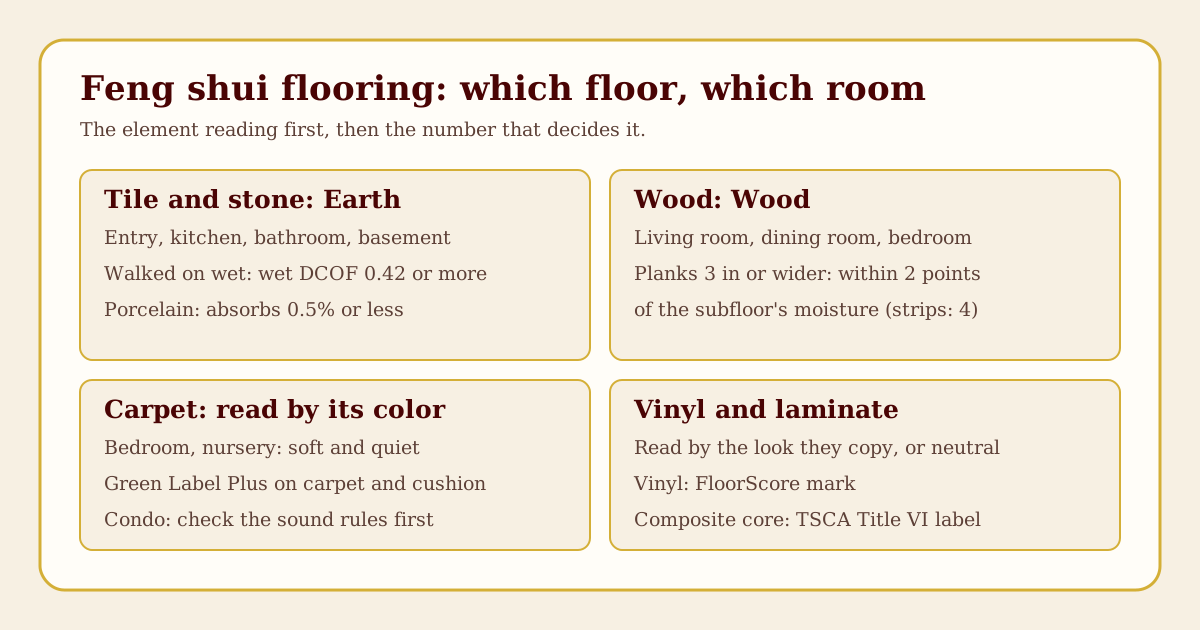
This guide is about the floor itself: the material you buy and lay. If you already have the floor and want to change how a room feels, start with our rug size, shape and color guide instead. Rugs are the cheap, reversible layer; flooring is the expensive, long-lived one, so it is worth getting the room, the element and the specification right together.
Room-by-room picks
The table below is the short version. Each row pairs what the tradition tends to ask of the room with the one or two numbers that decide whether a floor will work there. Read across the row before you read the material sections further down.
| Room | What the tradition asks of the floor | Materials usually chosen | The check that decides it |
|---|---|---|---|
| Entry and mudroom | A clear, welcoming path where qi comes in; Earth floors read as steady | Porcelain or stone tile, sheet vinyl, sealed concrete | Walked on with wet shoes, so look for a printed wet DCOF of 0.42 or more |
| Living room | A gathering, active (yang) room; Wood floors read as growth and warmth | Solid or engineered wood, wood-look vinyl or laminate, with a rug | Wood moisture check against the subfloor; a rug to soften sound |
| Dining room | A steady room for meals; Earth or Wood both used | Wood, tile, or vinyl | Chair legs and spills: a surface you can wipe and refinish |
| Kitchen | Fire (stove) and Water (sink) meet; many writers add Earth or Wood between them | Porcelain or ceramic tile, vinyl, sealed wood | Spills and splashes: wet DCOF 0.42 or more on tile; a moisture-tolerant product |
| Bathroom | A Water room; practitioners usually want it dry, clean and contained | Porcelain tile, sheet or tile vinyl | Wet DCOF 0.42 or more; porcelain absorbs 0.5% of its weight or less |
| Bedroom | A quiet, restful (yin) room; soft floors are often preferred | Carpet, wood with a large rug, cork-backed vinyl | In a condo, footfall noise: Los Angeles rules, for example, are built on STC 50 and IIC 50 |
| Child's room and nursery | Calm, soft, easy to keep clean | Carpet or wood with a non-slip rug | Low-emission marks on carpet, cushion and adhesive |
| Home office | A focused room; many writers use Wood or Earth tones | Wood, vinyl, low-pile carpet | Chair casters: a hard floor or a chair mat |
| Basement | Below ground, so damp is the main worry; Earth floors read as natural here | Tile, vinyl, sealed concrete, engineered products approved for below grade | The product's own below-grade approval and the moisture tests it asks for |
Two patterns stand out when you lay the readings next to the numbers. First, the rooms where the tradition reaches for Earth (entry, kitchen, bath, basement) are exactly the rooms where water and dirt arrive, so the element reading and the slip and moisture checks point the same way. Second, the rooms where the tradition asks for softness and quiet (bedrooms and nurseries) are the rooms where impact sound matters most in a multi-unit building. In other words, you rarely have to choose between the tradition and the building; the conflict, when there is one, is usually about color or a material that imitates another.
How the tradition reads floor materials
Feng shui reads a floor through the five elements (Wood, Fire, Earth, Metal and Water) and through color. There is no single authority, and the readings below are the common ones in modern English-language feng shui writing rather than fixed rules. Our five elements balancing guide explains the generating and controlling cycles behind them.
| Floor material | Element most writers assign | What practitioners like about it | Common caution |
|---|---|---|---|
| Solid or engineered hardwood, bamboo | Wood | Warmth, growth, a natural feel underfoot | Very dark, glossy finishes are sometimes read as Water instead |
| Ceramic and porcelain tile, terracotta, brick | Earth | Stability, grounding, easy to keep clean | Can feel cold and hard in rooms meant for rest |
| Natural stone (slate, sandstone, limestone) | Earth | The most grounding reading of all | Polished, cold stone in a bedroom is often softened with a rug |
| Marble and polished concrete | Earth, sometimes Metal | Clean lines, durability | Cool, reflective surfaces are read as Metal or Water by some schools |
| Carpet and other textiles | Read by color and pattern | Softness and quiet, favored for bedrooms | Must be kept clean; stained carpet reads as stagnant qi |
| Vinyl and laminate | Read by the look it copies, or as neutral | Practical, moisture tolerant (vinyl) | Some practitioners prefer real materials over printed ones |
| Cork | Wood | Soft, warm, quiet | Less water tolerant than tile or vinyl |
Color carries as much weight as material
Most of the time, a floor's color matters more to the reading than what it is made of, because a brown tile and a brown plank are both read as grounding. Browns, tans and wood tones sit between Wood and Earth; sandy, ochre and terracotta tones are Earth with some Fire; grays and whites lean Metal; black and very dark blue lean Water. Many practitioners prefer a floor that is darker than the walls, with the ceiling lightest of all, so the room reads as grounded below and open above. Our color guide, room by room sets these readings beside how daylight changes a color.
Pattern and direction
Practitioners also comment on pattern. Planks laid lengthwise toward the main door or a window are sometimes said to lead the eye, and qi, straight out of the room; planks laid across the room, or a herringbone or basketweave pattern, are read as slowing that movement. Busy, high-contrast patterns are usually kept out of bedrooms. None of this has a measurable effect on luck, money or health, and no reading here should replace the practical checks below. Treat it as a way to choose between floors that already pass those checks.
Advertisement
What to check before you buy each material
Every material below gets the same three questions: where it belongs, the number or label that decides it, and the mistake buyers make most often.
Solid hardwood
Where it belongs: living and dining rooms, bedrooms, hallways and offices above ground. It is the classic Wood floor and can be refinished many times.
The number that decides it: moisture. Wood swells and shrinks with the moisture around it, and the National Wood Flooring Association (NWFA) sets limits on how far apart the flooring and the wooden subfloor can be at installation. For solid strip flooring under 3 inches wide, the two should be no more than 4 moisture points apart. For planks 3 inches or wider, the limit tightens to 2 points, because a wider board moves more across its width. Brett Miller, then the NWFA's vice president of education and certification, set out these figures in Hardwood Floors magazine in 2017. The flooring should also acclimate to the conditions the home will have when people live in it, not to an empty, unheated site.
Worked example. You buy 5-inch white oak planks. Your installer's meter reads the planks at 11% and the plywood subfloor at 8%. The gap is 3 points, and the limit for planks 3 inches or wider is 2, so installation should wait while the materials and the room settle. If the same readings came from 2¼-inch strip flooring, the gap of 3 points would be inside the 4-point limit for strips. Same wood, same room, different answer, purely because of board width.
The common mistake: choosing wide planks for their look in a home that swings between a dry winter and a humid summer, then blaming the boards for the gaps and cupping that follow.
Engineered wood and laminate
Where they belong: the same rooms as hardwood, plus some basements and rooms over radiant heat where the manufacturer approves them. An engineered floor has a real wood top layer over a plywood or composite core; laminate is a printed image under a wear layer, over a fiberboard core.
The label that decides it: many of these products contain composite wood in the core. Under the Formaldehyde Standards for Composite Wood Products Act (TSCA Title VI), the U.S. Environmental Protection Agency regulates hardwood plywood, medium-density fiberboard and particleboard, and products made or imported after 22 March 2019 must be labeled TSCA Title VI compliant. A finished product's label names the fabricator, the production month and year, and a compliance statement. Hardwood Floors magazine's guide to these labels gives an example of the wording on flooring: engineered flooring with plywood parts "compliant with EPA TSCA Title VI and CARB ATCM 93120." If the box or the product data sheet has no such statement, ask the seller for it before you buy.
The common mistake: assuming every laminate tolerates water. Read the warranty for what it says about spills and standing water before you put it in a kitchen or bathroom.
The tradition: engineered wood has a real wood face, so most practitioners read it exactly like hardwood. Laminate is where schools split; see the table above.
Porcelain and ceramic tile
Where it belongs: entries, kitchens, bathrooms, laundry rooms and basements. It is the classic Earth floor.
The numbers that decide it: two figures on the spec sheet. The first is slip resistance. ANSI A326.3 measures the dynamic coefficient of friction (DCOF), and Crossville, a tile maker, describes a wet DCOF of 0.42 or more as the industry standard for tile in level interior spaces expected to be walked on when wet. It also cautions that the figure and the use categories should not be the only basis for a choice, so treat 0.42 as a floor to screen with, not a guarantee. Tile makers also print one of five A326.3 use categories: Interior Dry, Interior Wet, Interior Wet Plus, Exterior Wet, and Oils/Greases. The second figure is water absorption. Under ANSI A137.1:2022, porcelain is ceramic tile that absorbs 0.5% of its weight in water or less, tested by ASTM C373. Lower absorption means a denser tile that takes up less water.
Worked example. You are choosing a bathroom floor between two tiles. Tile A's sheet lists a wet DCOF of 0.44 and the Interior Wet category. Tile B lists 0.36 and Interior Dry only. Tile A clears the 0.42 screen for a floor walked on wet; Tile B does not, so it belongs in a dry room such as a hallway or a bedroom, whatever its color says in the five-element reading. If a tile has no DCOF figure at all, treat it as unproven for a wet room.
A back-door mudroom used daily with wet boots is the same decision: tile at a wet DCOF of 0.42 or more, or a sheet vinyl its maker states for wet areas, in a sandy or terracotta tone if you want the Earth reading, with a washable mat sized to the door swing (our rug guide has the sizes).
The common mistake: choosing a polished tile for a shower room because it looks clean. A glossy finish reads well in the tradition (bright, clean, reflective), but what matters on a wet floor is the wet DCOF printed for that exact finish, and a polished tile's figure can be lower than the same tile's textured version. Check the sheet for the finish you are buying.
Natural stone
Where it belongs: entries, bathrooms, kitchens and living areas, where its weight and cost make sense. It is read as the most grounding Earth floor.
What decides it: the finish and the sealing. Ask the supplier for a wet DCOF figure for the exact finish, since honed, tumbled and polished versions of one stone are different surfaces, and, as our own rule of thumb rather than a stone standard, screen it against the same 0.42 figure for a floor walked on wet. Many stones, especially limestone and marble, are porous and need sealing; ask the supplier what the stone needs and how often.
The tradition: practitioners often like stone in an entry because it reads as a steady place for the home's qi to arrive. Our entryway guide for small condos covers that layout.
Vinyl and other resilient floors
Where they belong: kitchens, baths, basements, laundry rooms and rentals. Sheet vinyl, luxury vinyl plank (LVP) and vinyl tile tolerate water far better than wood.
The label that decides it: FloorScore. SCS Global Services developed it with the Resilient Floor Covering Institute, and it certifies hard surface flooring, adhesives and underlayment against the California Standard Method for VOC emissions testing (CA Section 01350, Standard Method v1.2). The mark is a third-party test, not a marketing claim. The adhesive under a glued floor counts too, so look for the mark on both.
The common mistake: pulling up an old vinyl floor to lay a new one. The U.S. Consumer Product Safety Commission says some vinyl floor tiles, the backing on vinyl sheet flooring and the adhesives used with them contain asbestos, and that sanding tiles can release fibers. Its advice is not to sand or level such flooring, to leave material in good condition alone, to lay new flooring over it where possible, and to use a trained contractor for removal. The CPSC also notes that until the 1970s many building products used in homes contained asbestos. If your home is older and you do not know what is under the current floor, test before you scrape.
Carpet
Where it belongs: bedrooms, nurseries, family rooms and stairs in homes where softness and quiet matter. Tradition reads carpet mostly by its color and pattern.
The labels that decide it: the Carpet and Rug Institute's Green Label Plus program certifies carpet, carpet cushion and adhesives as low emitting after independent laboratory testing. In apartments and condos the second check is sound: a Los Angeles Department of Building and Safety bulletin built on the building code's sound rules (P/BC 2023-069, effective 1 January 2023) sets floor-ceiling assemblies between units at STC 50 for airborne sound and IIC 50 for impact sound, with 45 accepted on a field test for an individual job. Its standard assemblies assume carpet and pad, and allow sheet vinyl or linoleum with a resilient backing of at least 1/8 inch in place of carpet only in kitchens and bathrooms, and only where the ceiling below is on resilient channels. Other cities adopt their own versions, so check yours.
The common mistake: replacing carpet with a hard floor in a condo without reading the building's rules. A condo board or building can set its own rules on flooring changes, such as approval or a sound-rated underlayment, so read them before the carpet comes up.
Worked example. A second-floor condo bedroom sits over a neighbor's living room, and the owner wants a Wood floor for its warmth. A bedroom is a yin room, so practitioners would favor a calm floor in a warm, mid-tone color. The building's flooring rules come first, because the impact rating belongs to the floor-ceiling assembly, not to the room. If the rules allow hard flooring over a rated underlayment, an engineered wood floor with a TSCA Title VI statement on its label and a large rug under the bed meets both. If they do not, a wood-brown carpet with Green Label Plus carpet and cushion keeps the color reading and the quiet floor.
Advertisement
When the look and the material disagree
The hardest flooring questions in feng shui come from products that copy another material. A wood-look porcelain plank is Earth by substance and Wood by appearance. Practitioners who read a room by what the eye sees will call it Wood; those who read by what the floor is made of will call it Earth. Neither school is wrong by its own logic, so the useful step is to pick one way of reading and apply it to every room, rather than counting a wood-look tile as Wood in the living room and as Earth in the kitchen to make each room come out right. The building checks never follow the look: a wood-look tile still needs its wet DCOF for a wet room, and a stone-look vinyl still needs its emissions label.
Color can split the same way. A gray-washed oak is Wood by material and leans Metal by color, and a black slate is Earth by material and leans Water by color. If the color reading matters more to you than the material, our color guide, room by room is the better tool for the decision.
Continuous floors raise a related question. One floor running through living, dining and kitchen areas has no fixed reading in the tradition, but it does have one practical rule: if the kitchen end is walked on wet, the whole run has to meet the wet-area checks, which usually points to tile or vinyl rather than solid wood. Where two floors meet instead, a raised threshold strip can become a trip edge, and the CDC's fall-prevention checklist asks for floors kept clear and rugs fixed with double-sided tape or a non-slip backing; the same thinking applies to any edge you add.
Basements bring damp up from the ground, so read the manufacturer's installation instructions for below-grade approval, and the moisture tests they require, before buying any wood product for a room below grade. Tenants, who rarely change a floor at all, bring an element into a room with a rug instead; our renters' viewing checklist covers what to look for in an existing floor, and buyers of a new build can settle layout first with our new-build floor plan review before picking the wet-room tile, then the main floor, then bedroom carpet from the builder's list. If your project is a bathroom, the bathroom layout guide places the toilet, door and mirror, which is worth fixing before the floor is set.
Sources
- Crossville, Porcelain tile DCOF ratings and applications: ANSI A326.3 as the DCOF test, the 0.42 wet DCOF industry standard for level interior spaces walked on when wet, and the five use categories. Checked November 2026.
- ANSI blog, Porcelain and ceramic tile: ANSI A137.1 and ASTM definitions: porcelain defined by water absorption of 0.5% or less under ANSI A137.1:2022, tested by ASTM C373. Checked November 2026.
- Hardwood Floors magazine, Eleven considerations for acclimation success (Brett Miller, NWFA, 1 June 2017): moisture limits between solid wood flooring and subfloor, 4 points for strips under 3 inches and 2 points for planks 3 inches or wider. Checked November 2026.
- U.S. EPA, Frequent questions for consumers about the Formaldehyde Standards for Composite Wood Products Act: covered products and the TSCA Title VI label from 22 March 2019. Page updated 30 March 2026; checked November 2026.
- Hardwood Floors magazine, Name, rank and date: TSCA labels for flooring (27 March 2018): what a flooring label shows and an example compliance statement. Checked November 2026.
- SCS Global Services, FloorScore: what FloorScore certifies and the California emissions method it tests against. Checked November 2026.
- Carpet and Rug Institute, Green Label Plus: low-emission certification of carpet, cushion and adhesives. Checked November 2026.
- Los Angeles Department of Building and Safety, bulletin P/BC 2023-069, Sound-rated partitions and floor-ceiling construction: STC 50 and IIC 50 for floor-ceiling assemblies between units, 45 when field tested, and the carpet-and-pad basis. Effective 1 January 2023; checked November 2026.
- U.S. Consumer Product Safety Commission, Asbestos in the home: asbestos in some vinyl floor tiles, sheet backing and adhesives, and advice not to sand. Checked November 2026.
- CDC, Check for Safety home fall prevention brochure (2017): keep objects off the floor; fix rugs with double-sided tape or a non-slip backing; non-slip mats in the tub or shower. Checked November 2026.