For 2027, the Fire Goat (Ding Wei) year, practitioners flag four sectors of a home for no ground-breaking or heavy renovation: the north (Five Yellow), the northeast (Sui Po, the Year Breaker), the southwest (Tai Sui, the Grand Duke) and the west (San Sha, the Three Killings). The flags run from Li Chun on 4 February 2027. This is a tradition, not a safety rule, and your building code and inspector come first.
Last checked: 17 November 2026
| Key fact | Figure or rule | Source |
|---|---|---|
| Year start | Li Chun, 4 February 2027, 9:46 a.m. China Standard Time (UTC+8); Lunar New Year is 6 February 2027 | Jade Almanac; Lucky Properties 2027 Fire Goat guide |
| Tai Sui 2027 | Southwest, Wei mountain, 202.5 to 217.5 degrees | Lucky Properties annual afflictions guide |
| Sui Po 2027 | Northeast, Chou mountain, 22.5 to 37.5 degrees | Lucky Properties annual afflictions guide |
| San Sha 2027 | West, core 247.5 to 292.5 degrees (wide count 232.5 to 307.5) | Lucky Properties annual afflictions guide |
| Five Yellow 2027 | North palace, 337.5 to 22.5 degrees | Lucky Properties annual afflictions and Flying Stars 2027 guides |
| Tai Sui custom | Traditionally taboo to build a house facing Tai Sui in the matching year | Wikipedia, Tai Sui |
| Permits (US model code) | The IRC requires a permit to construct, enlarge, alter, repair, move or demolish a building, or to alter plumbing, gas, electrical or mechanical systems | ICC IRC R105.1, as quoted by Jaspector |
| Lead in older homes | EPA's RRP rule covers renovation that disturbs lead-based paint in homes built before 1978 and requires certified firms and renovators | U.S. EPA |
This page is part of our Renovate and Build with Feng Shui guide. It is the 2027 spoke: it takes the year's annual afflictions and turns them into a planning table for a homeowner with a project. The reasoning behind each affliction lives in the annual afflictions guide, and the star-by-star chart lives in the 2027 Flying Stars guide. Both use the same sector values as this page.
On this page
- The 2027 sector table
- What counts as breaking ground
- How practitioners sequence works
- Worked example: a west-side kitchen remodel
- Finding the sectors on your own floor plan
- The practical side: permits, dust, noise and lead
- Common mistakes
- FAQ
- Where to go next
- Sources
The 2027 sector table
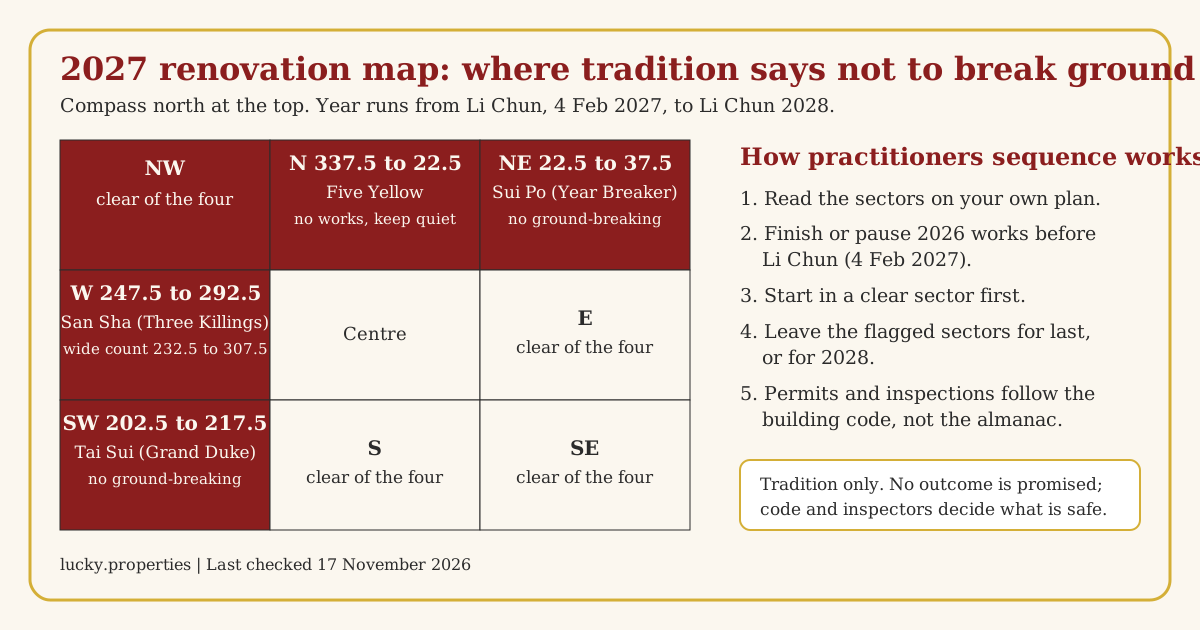
Four sectors carry one of the four annual afflictions in 2027. No sector carries two at once, which is a change from 2026, when the south held both the Five Yellow and the Tai Sui. The remaining four compass directions carry none of the four.
| Sector | Compass degrees | Affliction in 2027 | What tradition says about starting works there |
|---|---|---|---|
| North | 337.5 to 22.5 | Five Yellow (Wu Huang), the whole palace | Quiet rule: no renovation, no drilling, as little sustained noise as practical |
| Northeast | 22.5 to 37.5 (Chou mountain) | Sui Po, the Year Breaker, opposite Tai Sui | No ground-breaking or deliberate disturbance in the 15 degree strip |
| Southwest | 202.5 to 217.5 (Wei mountain) | Tai Sui, the Grand Duke, the year branch direction | No digging, drilling, knocking through or demolition in the strip |
| West | 247.5 to 292.5 core; 232.5 to 307.5 wide count | San Sha, the Three Killings | No ground-breaking; the widest of the four, so it often covers a whole room |
| Southeast, south, east, northwest | The rest of the compass | None of the four | Treated as the clear sectors for works this year |
Two details matter when you mark a plan. First, the three affliction types have different widths: Tai Sui and Sui Po occupy single 15 degree mountains on the 24 mountains ring, the Five Yellow occupies a full 45 degree palace, and the San Sha is counted at 45 degrees (core) or 75 degrees (wide). Second, the wide San Sha count is where published charts disagree. The core is the part every school accepts, so treat it as the firm no-works zone and the flanking mountains as a caution margin.
The Flying Stars chart adds its own stars on top. The 2027 chart puts the 2 Black in the west and the 3 Jade in the northeast, so those two sectors are read as doubly flagged, while the southwest holds the 6 White beside the Tai Sui. The Flying Stars 2027 guide names the east (7 Red) as a lighter case: keep it secure and well lit rather than closing it to works. This page follows the lighter reading for the east and does not list it as an avoid sector.
What counts as breaking ground
The works rule in the tradition is narrower than "no renovation at all". Practitioners name digging, drilling into structure, knocking through walls and demolition inside the flagged strip. The Tai Sui entry on Wikipedia records the older form of the custom: it has traditionally been considered taboo to build a house facing Tai Sui in the corresponding year. Modern advice turns that into a floor plan habit.
Usually inside the rule, as practitioners teach it:
- Demolition, removing walls, opening a floor or ceiling.
- Digging, trenching, new footings, a new extension in the sector.
- Drilling for structural fixings, new window or door openings.
Usually outside the rule, though teachers differ and you should follow the one you trust:
- Living, cooking, sleeping and working in the room.
- Painting, cleaning, hanging a picture with a small anchor, fitting furniture.
- Emergency repairs. A burst pipe or a failing roof is repaired when it fails, and no tradition asks otherwise.
Advertisement
How practitioners sequence works
The common teaching is a sequence rather than a ban. Our annual afflictions guide describes the same logic in its worked apartment: put the big job in the year its sector is clear.
- Read the year before you book trades. Mark the four 2027 sectors on your plan, using the table above.
- Finish what started in 2026. Works under way in the west, north, northeast or southwest are best completed before Li Chun, 4 February 2027. In 2026 the west holds none of the four, so a west-side job done before the turn sits on the 2026 map.
- Start in a clear sector. In 2027 that means the southeast, south, east or northwest. A bathroom in the south or a bedroom in the east can start in the new year.
- Move into the flagged sector last, or wait. Practitioners often move the disturbance into a flagged sector in the next year it is clear instead. In 2028 the San Sha moves from the west to the south, according to our Flying Stars 2027 guide, and the Li Chun date for 2028 should be confirmed in a current almanac.
- Keep a record. Write the start date of each trade in the sector. The renovation start date and Chinese almanac guide explains how practitioners choose a start date inside a clear year.
Related reading: the Fire Goat 2027 year guide sets out why the year turns on 4 February and not at Lunar New Year, and what that means for dates near the boundary.
Worked example: a west-side kitchen remodel
The inputs below are hypothetical. They show the method, and they are not a real house or a prediction.
- House: a two-storey home with the kitchen on the west side. A compass reading at the centre of the plan puts the kitchen's centre line at 268 degrees, and the room spans roughly 250 to 285 degrees. That sits inside the San Sha core of 247.5 to 292.5 degrees for 2027.
- Plan: demolition of a non-structural partition, new cabinets, a new sink location (a plumbing alteration) and a new electrical circuit for the range.
- Today: 17 November 2026, which is 79 days before Li Chun on 4 February 2027.
| Decision point | What practitioners would say | Practical check |
|---|---|---|
| Is the kitchen flagged? | Not in 2026 (the west holds none of the four). Flagged from 4 February 2027 (San Sha core) | Confirm the 268 degree reading with the method in the compass guide |
| Can the ground-breaking happen before Li Chun? | Possible only if demolition and rough-in are done and signed off before 4 February | Ask the building department whether the plumbing and electrical alterations need permits and how long the review takes; the review time depends on the city |
| What if the permit is late? | Pause cleanly. Do not start demolition on 5 February and call it 2026 | A stopped job needs a safe state: gas capped, openings closed, temporary kitchen |
| Can the finishes continue into 2027? | Many teachers treat painting and fitting cabinets as ordinary use; stricter ones wait | Ask your practitioner; the contractor only needs the code |
| What goes into the clear sectors in 2027? | Start the bathroom or any job in the south, east, southeast or northwest | Sequence trades so the kitchen is not left without water or power longer than the household can manage |
In this example the outcome is a scheduling choice, not a forecast. Option A compresses demolition and rough-in into the 79 days before Li Chun and accepts the permit risk. Option B leaves the kitchen alone through 2027 and moves the same budget into a clear sector, then reopens the kitchen in the next year its sector is clear. Neither option is better in any measurable sense. The tradition prefers a calm, finished project over a rushed one, and a rushed demolition that skips a permit check would fail that test on its own terms.
Finding the sectors on your own floor plan
A sector is only useful if it is on the right part of your plan. Do the measuring once, then reuse it.
- Take the compass reading using our compass reading guide: stand at the centre of the home, keep metal and electronics away from the compass, and read the facing and each room's direction.
- Decide which method of sectors you will follow. The Bagua compass method guide explains the difference between laying the map by compass direction and laying it by the front door. The 2027 annual afflictions are compass-based, so use compass directions here, not the front-door Bagua.
- Draw the degree ranges from the table on your plan: a strip each for Tai Sui and Sui Po, a palace for the Five Yellow, a sector with a margin for the San Sha.
- Mark each room, wall and planned opening by whether it falls in the strip, the margin or outside. Rooms that straddle an edge are judged by where the work happens, not by the room name.
- Keep the plan with your contractor documents so the schedule and the sectors are read together.
A phone compass beside a steel door frame can be several degrees off, and the Tai Sui and Sui Po strips are only 15 degrees wide, so measure away from metal and repeat the reading.
The practical side: permits, dust, noise and lead
The almanac sets a preference. The code sets the rules, and they apply whatever the year.
Permits. The International Residential Code, the US model code, says a permit is required to construct, enlarge, alter, repair, move or demolish a building or structure, or to erect, install, enlarge, alter, repair, remove, convert or replace any electrical, gas, mechanical or plumbing system, and the permit must be obtained first. The same code exempts some finish work, and a page summarizing it lists painting, papering, tiling, carpeting, cabinets and countertops. Cities adopt and amend the code, and Canadian provinces and cities follow their own building codes, so ask your building department what your project needs. We could not open the ICC code page directly today; the wording above comes from a page that quotes it, so confirm it locally.
Inspection. Inspections happen at stages set by your jurisdiction. A feng shui date does not move an inspection, and an inspector can require changes whatever the sector.
Dust, noise and working hours. Noise ordinances and permitted working hours are set city by city. This guide states no hours or decibel limits because they differ. Check your city's rules and your building or condo rules before you schedule loud work.
Lead in older homes. In the US, EPA's Renovation, Repair and Painting (RRP) rule covers renovation that disturbs lead-based paint in homes built before 1978 and requires firms to be EPA or state certified and to use certified renovators with lead-safe work practices. EPA says the rule generally does not apply to homeowners doing their own work in their own home, but recommends lead-safe practices anyway, and notes that scraping, sanding, cutting and demolition can create lead dust. If you cannot determine your home's age, EPA advises assuming lead-based paint is present. Canada and other countries have their own rules, so check locally.
Advertisement
Common mistakes
- Using the 2026 map after Li Chun. The 2026 and 2027 maps disagree in every row of the table. The south was the double-flagged sector in 2026 and is clear in 2027.
- Using Lunar New Year as the cut-over. The feng shui year turns at Li Chun. A crew scheduled for 5 February 2027 is already on the 2027 map.
- Ignoring the time zone. Li Chun 2027 falls at 9:46 a.m. China Standard Time on 4 February according to the Jade Almanac, which is 01:46 UTC. In US Eastern time (UTC-5) that is the evening of 3 February. Most practitioners work by the calendar date, and teachers differ on whether the hour matters, so this only matters if you are scheduling work that close to the boundary.
- Treating the whole room as one sector. A 15 degree strip is narrow. Mark the strip on the plan rather than closing a whole room.
- Letting the almanac skip the permit. The tradition asks you to be careful, not to avoid inspection.
- Merging the person and the house. The afflictions here describe sectors of a floor plan. Which zodiac animals clash with the year is a separate layer, covered in the Fire Goat 2027 guide.
FAQ
Which directions should I not renovate in 2027 according to feng shui?
Practitioners flag four sectors for the Fire Goat year: the north (Five Yellow, 337.5 to 22.5 degrees), the northeast (Sui Po, 22.5 to 37.5 degrees), the southwest (Tai Sui, 202.5 to 217.5 degrees) and the west (San Sha, core 247.5 to 292.5 degrees). The rule is about ground-breaking and heavy disturbance in those sectors during the year, not about living in the rooms.
When does the 2027 feng shui year start for renovation purposes?
At Li Chun, the Start of Spring solar term, on 4 February 2027 in China time. It is not 1 January and not Lunar New Year (6 February 2027). Works finished before Li Chun belong to the 2026 map; works started after it belong to the 2027 map.
Can I still live in or use a room in an afflicted sector?
Yes. Tradition treats the flagged sectors as places to keep quiet and undisturbed, not places to abandon. You can sleep, cook and work there. What the rule names is breaking ground, demolition, drilling into walls and major structural change during the year.
What if my renovation is already under way and crosses Li Chun?
Practitioners usually advise finishing the works in the sector that becomes flagged before Li Chun, or pausing them cleanly and restarting in the next feng shui year. Finishing trades such as painting and fitting furniture are often treated as ordinary use, though teachers differ, so ask the practitioner you follow.
Does feng shui override my building permit or inspector?
No. A permit, the building code and an inspection decide what is safe and legal, and the almanac does not change them. Many places require a permit to alter, repair or demolish a structure, or to alter plumbing, gas, electrical or mechanical systems. Check your local building department before scheduling anything.
Is there evidence that renovating in these directions causes harm?
This guide found no study showing that the direction of a renovation affects health, money or luck, so it makes no such claim. The sectors, degrees and rules are a traditional calendar and compass system. Treat them as a scheduling preference you may choose to follow, not as a prediction.
Where to go next
Read the renovation start date and Chinese almanac guide next: once you know which sectors are clear, it explains how practitioners pick a start date inside that year. For the layout decisions that do not depend on the year, use the feng shui renovation dos and don'ts guide, and return to the renovation hub for the rest of the series.
Sources
Checked November 2026.
- Lucky Properties, Tai Sui, San Sha, Sui Po and the Five Yellow: annual afflictions 2026 and 2027: sector degrees and the works rule.
- Lucky Properties, Flying Stars 2027: the annual chart: 2027 stars by sector and the 2028 San Sha move.
- Lucky Properties, Fire Goat 2027 year guide: Li Chun 4 February 2027 and Lunar New Year 6 February 2027.
- Jade Almanac, Li Chun 2026 and 2027: Li Chun 2027 at 9:46 a.m. China Standard Time. We cross-checked it with the lunar-javascript 1.7.7 almanac engine, which gives 09:46:18 on 4 February 2027; we did not check an observatory table.
- Wikipedia, Tai Sui: the name, the Jupiter cycle and the custom about building facing Tai Sui. It does not mention digging; the works rule here comes from the Lucky Properties guide.
- International Code Council, International Residential Code 2018, section R105.1 (page at codes.iccsafe.org would not open for us), as quoted at Jaspector, IRC 2018 R105.1. The exemption list there is a paraphrase, so check your local code.
- U.S. EPA, Lead Renovation, Repair and Painting Program Rules: pre-1978 scope, certified firms and renovators.
- U.S. EPA, Lead-Safe Renovations for DIYers: homeowners' own work, lead dust, assume lead if the age is unknown.
Sources we wanted but could not open today: the ICC code text itself, and an observatory table of the 2027 solar terms.
Editorial note: Lucky Properties presents feng shui as a cultural and design tradition. This guide is educational. Annual sector readings never override what your building department and contractor say about safe, permitted work.