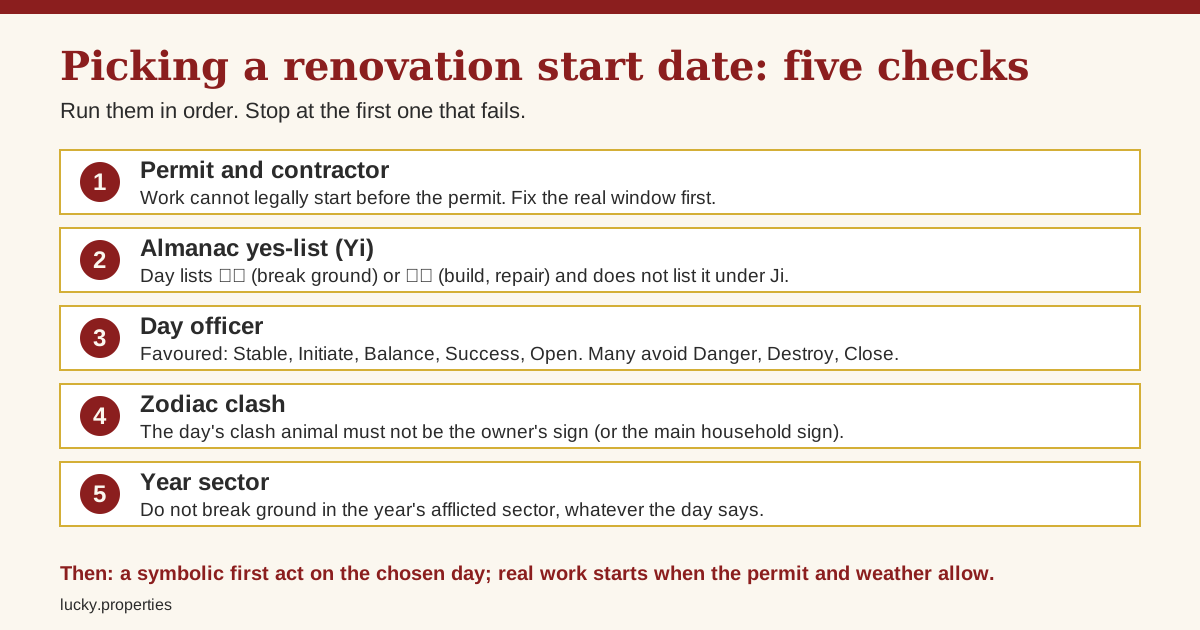
An auspicious date to start a renovation is a day whose almanac (Tong Shu) suitable list names breaking ground (动土) or building and repair (修造), whose day officer is not Danger, Destroy or Close, whose clash animal is not your zodiac sign, and which does not send the digging into the year's afflicted sector. Then the permit and your contractor's real schedule decide whether that day can be used.
Last checked: 17 November 2026
| Key fact | Figure or rule | Source |
|---|---|---|
| Almanac engine | Day lists, officers and clash animals below come from lunar-javascript 1.7.7, the engine behind this site's date tools | Lucky Properties 2027 dataset page |
| Tracked term | A day qualifies when the activity term is in the Yi list and not in the Ji list | Lucky Properties 2027 dataset page |
| Jan to Jun 2027 result | 68 of 181 days list 动土 or 修造 as suitable; 38 list both; 26 of those 38 avoid the Danger, Destroy and Close officers | Our run of the engine, 17 Nov 2026 |
| Permit rule (example city) | Starting without a required permit means a stop work order, and work resumes only after the permit is obtained | City of Chicago |
| Cold-weather concrete | Cold-weather provisions apply when air temperature is below 40°F, or expected to be, during the protection period | ACI 306, via STRUCTURE magazine |
| Early freezing | The rules prevent damage from early-age freezing of the water needed for cement hydration | ACI 306, via STRUCTURE magazine |
This guide is part of our renovate and build with feng shui guide. It covers the "when" of a project. The "where" (which sector of the house is risky to dig or open up this year) is in the 2027 renovation directions to avoid guide, and the room-by-room "how" is in the feng shui renovation dos and don'ts. Most pages on this topic give a rule of thumb and stop. This one shows what the almanac actually prints, gives a real list of 2027 days from the engine, and then fits the ceremony into a build that has permits, crews and weather.
On this page
- The almanac terms for starting work
- How day officers and the clash animal are used
- A five-step way to pick the day
- Real 2027 example: January to June
- Fitting a ceremonial date into a real schedule
- Talking to your contractor
- Common mistakes
- FAQ
- Where to go next
- Sources
The almanac terms for starting work
The Tong Shu prints, for every day, a list of things the day suits (宜, Yi) and things to avoid (忌, Ji). Several terms matter to a home project. Practitioners read them as follows.
| Term | Meaning | Typical use in a house project |
|---|---|---|
| 动土 (dong tu) | Breaking ground, moving earth | Foundations, extensions, digging a garden or pool, trenching |
| 修造 (xiu zao) | Repair and building work | General renovation, rebuilding, structural repair |
| 上梁 (shang liang) | Raising the ridge beam | Framing and roof structure of a new build |
| 破土 (po tu) | Breaking earth | Read by many practitioners as grave-related, so check the context before using it for a house |
| 入宅 (ru zhai) and 移徙 (yi xi) | Moving into a home, moving house | The end of the project, a separate date from the start |
Treat 入宅 and 移徙 as a different date question. Our auspicious dates guide covers moves, weddings and openings, and notes that two genuine printed almanacs can mark the same day differently. The same is true of software: the day lists below are one engine's output, and your practitioner may read a printed edition differently.
How day officers and the clash animal are used
The 12 Day Officers (建除十二神) repeat in a cycle, and the tradition gives each a character. Our guide to the twelve officers lists them in full; for starting work the commonly cited readings are these.
| Officer | Reading for starting construction |
|---|---|
| Stable (定) | Fixing things for the long term; listed for starting construction |
| Balance (平) | Listed for starting construction |
| Initiate (执) | Listed for beginning renovation work |
| Success (成) | The strongest all-purpose day, for most major undertakings |
| Open (开) | Opening and welcome; listed for business openings, house warming and starting a job. It is not on our guide's list for construction, so ask your practitioner |
| Danger (危) | Risk present; some readings allow ground breaking, many avoid it |
| Destroy (破) | Reserved for demolition and deliberate endings |
| Close (闭) | Sealed and still; poor for new starts of any size |
| Remove (除) | Clearing and release; suits clearing out, not things meant to grow. It passes the officer filter below, so weigh it with your practitioner |
| Receive (收) | Collecting and taking in; listed for closing a deal or starting a job. It also passes the filter below |
The clash animal is a separate filter. Each day clashes with one zodiac animal, which the almanac prints as "chong" (冲). Practitioners who use it avoid a start day that clashes with the owner's sign, and often the main household signs. Check it against your sign using our zodiac clash pairs guide.
Practitioners differ on how strict to be. Some require every layer to pass; others accept a good Yi list and a non-clashing day and relax the officer. Agree the rule with your practitioner before you look at dates, so you do not shop for the answer you want.
Advertisement
A five-step way to pick the day
- Fix the real window. Get the permit date and the contractor's available weeks. Dates outside that window are decoration.
- Filter by the almanac. Keep days whose Yi list names 动土 (for earth work) or 修造 (for general building) and does not list it under Ji.
- Filter by officer. Drop Danger, Destroy and Close days if you follow the stricter reading.
- Filter by clash. Remove days that clash with the owner's zodiac sign.
- Check the sector. If the first act disturbs soil, do not do it in the year's afflicted sector. See the directions to avoid and the Tai Sui and annual afflictions guide.
You can run steps 2 to 4 for any day of 2027 in our auspicious dates 2027 tool, which filters by activity, officer and your zodiac sign. For one specific day, the daily almanac guide shows how to read the full Yi and Ji lists.
Real 2027 example: January to June
We ran the lunar-javascript almanac engine (version 1.7.7) over every day from 1 January to 30 June 2027, 181 days. A day counts here when 动土 and 修造 are both in the Yi list and neither is in the Ji list. The engine gave 68 days where either term qualifies, and 38 where both do. We then removed Danger, Destroy and Close officer days, which leaves 26 days.
The table below is exactly that output. It is an example of the method, not a recommendation: dates follow the engine's almanac, and your practitioner may use a printed edition that differs. The clash column is the animal the day opposes, so skip any day that matches the owner's sign.
| Date (2027) | Weekday | Day officer | Day clashes |
|---|---|---|---|
| 1 Jan | Fri | Stable | Dog |
| 2 Jan | Sat | Initiate | Pig |
| 14 Jan | Thu | Stable | Pig |
| 23 Jan | Sat | Remove | Monkey |
| 21 Feb | Sun | Initiate | Ox |
| 25 Feb | Thu | Receive | Snake |
| 4 Mar | Thu | Stable | Rat |
| 6 Mar | Sat | Initiate | Tiger |
| 23 Mar | Tue | Open | Goat |
| 30 Mar | Tue | Initiate | Tiger |
| 2 Apr | Fri | Success | Snake |
| 17 Apr | Sat | Open | Monkey |
| 7 May | Fri | Initiate | Dragon |
| 17 May | Mon | Balance | Tiger |
| 18 May | Tue | Stable | Rabbit |
| 19 May | Wed | Initiate | Dragon |
| 27 May | Thu | Remove | Rat |
| 3 Jun | Thu | Success | Goat |
| 5 Jun | Sat | Open | Rooster |
| 9 Jun | Wed | Remove | Ox |
| 12 Jun | Sat | Stable | Dragon |
| 16 Jun | Wed | Success | Monkey |
| 18 Jun | Fri | Open | Dog |
| 21 Jun | Mon | Remove | Ox |
| 25 Jun | Fri | Initiate | Snake |
| 28 Jun | Mon | Success | Monkey |
Two notes on reading it. Dates from 1 January to 5 February 2027 fall before the lunar new year (6 February 2027, per our 2027 dataset page), so some practitioners place them in the previous lunar year. And many of these days sit on weekdays when crews work, but not all: for example, 2 January and 6 March are Saturdays, which may cost extra or be unavailable.
For reference, the engine's list for 1 March 2027 includes both 动土 and 入宅 under suitable, and lists 作灶 (building a stove) and 掘井 (digging a well) under avoid, which shows why the Ji list should be read as well as the Yi list.
Fitting a ceremonial date into a real schedule
A start date in the almanac is a moment for a ceremony, not a promise that crews arrive that morning. Three practical limits apply.
The permit comes first. Work that needs a permit cannot start before it is issued. As one example, the City of Chicago says that starting without a required permit leads to a stop work order, that work can resume only after the permit is obtained, and that you may pay a penalty and have the permit fee tripled. Rules differ by city and country, so ask your local building department what needs a permit before you fix a date.
Do the symbolic act, then let the work follow. A common solution is a small first act on the chosen day: turning a spade of earth at a point that is not in the afflicted sector, marking the first stud, or lighting incense and stating the intention. Practitioners treat this as the "start". The excavator, the demolition or the structural cut begins when the permit, the crew and the weather allow. If the real start slips by weeks, the ceremony still stands.
Weather decides foundations. Cold is the main calendar risk for concrete. ACI 306, the American Concrete Institute's cold weather standard, applies its cold-weather provisions when air temperature is below 40°F (about 4°C), or expected to be, during the protection period. According to a STRUCTURE magazine summary of the standard, those provisions exist to prevent damage from early-age freezing of the water needed for cement hydration, and surfaces in contact with the concrete, including formwork and reinforcement, should be above freezing. If your lucky day falls in a freeze, keep the ceremony and let the contractor decide the pour day. Frost, rain and ground conditions vary by region, so use your local guidance.
Related reading: the Tai Sui and annual afflictions guide explains why a lucky day does not cancel a sector rule.
Talking to your contractor
You do not need to explain the almanac. A short checklist helps.
- Ask for the permit status and the earliest legal start date in writing.
- Ask which weeks are realistic for site access, and whether weather could move earth work or concrete.
- Say plainly that you plan a short private ceremony on a date you have chosen, that it will not change the schedule, and that the crew need not attend.
- If you want work to begin on a specific morning, ask early. Tell the contractor that the date may move if the permit or weather does.
- Keep the real schedule, and the contract, as the document that governs the job.
Common mistakes
- Picking the date before the permit. A beautiful date that arrives before the permit cannot be used for real work.
- Reading only the Yi list. The Ji list for the same day can forbid related work, as the 1 March 2027 example shows.
- Ignoring the clash animal. It is the quickest filter and costs nothing.
- Using one tool's answer as final. Printed almanacs, apps and practitioners differ.
- Letting the date push a concrete pour into frost. The ceremony can move less than the structure can.
- Breaking ground in the afflicted sector. The year layer outranks the day layer for digging.
Advertisement
FAQ
What is the best date to start renovation?
There is no single best date. In the almanac tradition a good start day is one whose suitable (Yi) list names breaking ground (动土) or building and repair (修造), whose day officer is not Danger, Destroy or Close, whose clash animal is not the owner's zodiac sign, and which does not send the digging into the year's afflicted sector. After that, the permit and your contractor's real schedule decide the day.
What does dong tu (动土) mean?
Dong tu means breaking ground or moving earth. In the Tong Shu it is the almanac term for digging, foundation work and similar earth-disturbing jobs. A day is read as suitable when 动土 appears in that day's Yi list and not in its Ji (avoid) list.
Can I start renovation before the auspicious date if the permit is ready?
Practitioners usually say yes in spirit: hold a small symbolic first act on the chosen day, such as turning a spade of earth or marking the first cut, and let the real work follow when the schedule allows. Real work should not start before the permit is issued, because local authorities can stop work and charge penalties.
Does the zodiac clash day matter for a renovation start?
Practitioners who use the clash rule avoid a start day whose clash animal matches the zodiac sign of the owner, and often of the main household members. The almanac prints one clash animal per day, so you can check this in seconds. Some practitioners weigh it lightly for a project, but a clash against the homeowner is the one most often avoided.
Is it fine to pour a foundation in winter on a lucky day?
The almanac does not know your weather. Concrete engineers treat cold weather as air temperature below 40 degrees Fahrenheit (about 4 degrees Celsius), and early-age concrete must be protected from freezing. If the auspicious day falls in a freeze, keep the ceremony and move the pour to a day the contractor can protect, as the structure matters more than the calendar.
Where to go next
Open the 2027 renovation directions to avoid guide next: once you have a date, it tells you which side of the house not to dig on that year.
Sources
- STRUCTURE magazine: Cold and Hot Weather Concrete (Cawsie Jijina, September 2017), for the ACI 306 cold-weather definition (below 40°F), early-age freezing and the above-freezing surfaces rule. Checked November 2026.
- City of Chicago: What happens if I start work without a required building permit?, for stop work orders, resuming only after the permit and penalties. Checked November 2026.
- Lucky Properties: Auspicious Dates 2027 dataset, for the engine (lunar-javascript 1.7.7), the Yi and Ji qualifying rule and the 2027 lunar new year date. Checked November 2026.
- Our own run of the same engine over 1 January to 30 June 2027, for the counts and the table above. 17 November 2026.
- Lucky Properties: Auspicious dates and the Tong Shu, for the twelve-officer readings and the Yi and Ji lists.
Sources we wanted but could not open today: the printed Tong Shu itself and ACI 306's own text (a paid standard); we used a published summary instead and state only its figures.
Editorial note: Lucky Properties presents feng shui as a cultural and design tradition. This guide is educational. A chosen date is a ceremony; the real start of work still depends on your permit, your contractor and the weather.