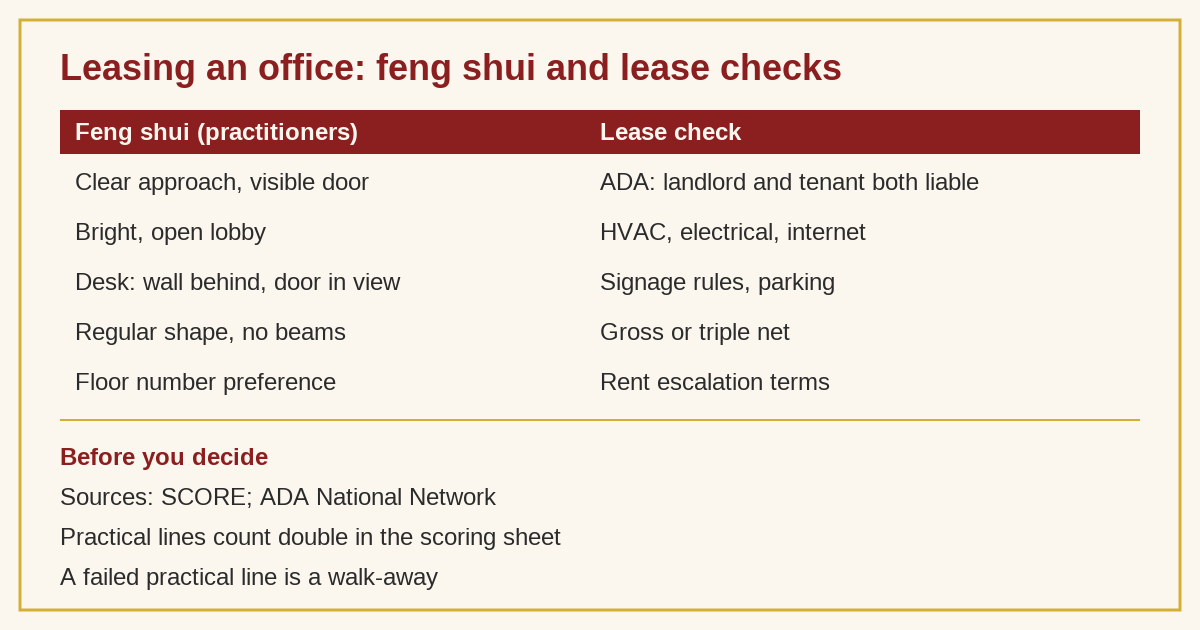
When practitioners judge an office for feng shui, they look at how you approach the building and its entrance, whether the lobby is clear and welcoming, and whether a desk can sit with a solid wall behind it and the door in view. They also look for sharp corners or beams aimed at seats. The lease comes before any of that. Accessibility, building systems, signage rules and total cost decide whether a suite works at all.
Lease sources checked: 23 November 2026
Once you have the space, feng shui for your desk at work covers arranging the desks. This guide, filed with our real estate and home buying guides, is about choosing the suite.
| Lease point | Rule or point | Source |
|---|---|---|
| ADA duty | In leased places of public accommodation, landlord and tenant both hold the legal obligation. The lease can say who makes changes, but both stay legally responsible | ADA National Network |
| Location factors | SCORE lists demographics, co-tenancy, size and shape, infrastructure, signage and visibility, parking, competition and cost | SCORE |
| Infrastructure | HVAC, plumbing and restrooms, electrical, internet, building code and ADA compliance are on the checklist | SCORE |
| Cost structure | Whether the lease is triple net or gross, how often and how much rent can rise, plus utilities, insurance and property taxes | SCORE |
On this page
- What practitioners look at first
- The lease checks that come first
- Scoring sheet
- Inside the suite
- Worked example
- When to walk away
- FAQ
- Visiting your top two suites
What practitioners look at first
Form School practitioners read an office building much as they read a house. They look at how people approach it, what faces the door, and whether the entrance feels open or cramped. In an office, that comes down to six things.
- Approach and entrance. They want a clear, well-lit path and a front door you can see. An entrance hidden behind a blank wall, a path that dead-ends or a road pointing straight at the door all count against a building; see poison arrows and T-junctions.
- Lobby and corridor. The lobby should be bright and uncluttered. A long, narrow corridor to the suite is read as pushing energy through too fast.
- Command position. The principal's desk should have a solid wall behind it and a view of the door, without sitting in line with it; see command position.
- Light and air. Windows, daylight and fresh air all count; see lighting.
- Shape. Practitioners prefer a regular, rectangular suite to an awkward, pointed one, and they avoid exposed beams over desks.
- Floor and unit number. Tenants who follow Chinese number customs often take the number into account; see lucky business numbers. It is a preference, not a lease term.
Advertisement
The lease checks that come first
No amount of feng shui rescues a suite that fails the practical checks. Run through these before you fall for a floor plan.
- Accessibility. The ADA National Network says landlord and tenant are both legally responsible in a leased place of public accommodation, even when the lease says who makes the changes. Ask what the building has already done and who pays for fixes. If clients visit your office, check the entrance, the restroom and the route between them. That is US law. In Canada accessibility rules come from the provinces and building codes, so check the rules in your province.
- Infrastructure. SCORE's checklist covers the build and upgrade years, HVAC, plumbing and restrooms, electrical, internet, building code compliance and ADA compliance.
- Signage and visibility. Ask what signs the lease and building rules allow and whether you need a permit. Sign rules and fees are set locally, so we give none here.
- Parking and access. Find out who nearby shares the parking, whether it is free or paid, and how deliveries get in.
- Cost. Check whether the lease is gross or triple net, how often and by how much the rent can rise, and what extras you pay, such as utilities, insurance and property taxes.
Scoring sheet
Score each line 0 (fails), 1 (acceptable) or 2 (good). The practical lines count double.
| Line | Check | Weight |
|---|---|---|
| Accessible entrance, route, restroom | Walk it; ask for written answers | x2 |
| HVAC, electrical, internet | Ask for service history | x2 |
| Rent escalation and cost type | Read the lease | x2 |
| Parking and delivery | Visit at busy time | x1 |
| Approach and entrance (feng shui) | Clear path, visible door | x1 |
| Lobby and corridor | Bright, not a long tunnel | x1 |
| Desk can sit in command position | Wall behind, door in view | x1 |
| Beams, pointed corners over desks | Look up | x1 |
| Floor or unit number preference | Your call | x1 |
If a suite scores 0 on any doubled line, walk away, however good its feng shui.
Inside the suite
Mark on the floor plan where each person will sit, then see which seats can face the door without lining up with it. Place the principal's desk first and fit the others around it. Our home office desk guide works the same way on a smaller scale. A glass-fronted suite raises its own questions, covered in glass buildings.
Worked example
The inputs are invented for illustration. A 6-person team views two suites. Suite A has a step-free entrance, a recent HVAC service record, an annual rent escalation written into the lease, a clear lobby, and an awkward pillar near the planned principal desk. Suite B has a street pointing at the door, no ramp, and an unknown HVAC history, but an auspicious floor number.
Suite A passes every doubled line. The pillar costs it one point, and the desk can be moved. Suite B fails on accessibility and HVAC, so the floor number cannot save it. The team takes Suite A and puts the desk where the pillar does not point at it.
When to walk away
- The landlord cannot say who is responsible for accessibility fixes.
- Nobody knows the HVAC or electrical history, and the landlord will not put it in writing.
- The lease allows large, open-ended rent increases.
- The building will not allow the sign you need.
- The only thing you like about it is the unit number.
FAQ
What does feng shui look for in an office space?
Practitioners look for a clear approach and visible entrance, a bright lobby, a regular suite shape, daylight and a desk position with a solid wall behind it and a view of the door. These are traditional preferences. Check the lease and the building before you let them decide anything.
Does the floor number matter for an office?
It matters to some tenants. Those who follow Chinese number customs often prefer certain numbers and avoid four, but that is a cultural preference, not a lease rule. Weigh it last, after accessibility, building systems and cost. See our guide to lucky business numbers.
Who is responsible for accessibility in a leased office?
In the US, the ADA National Network says both landlord and tenant hold the legal obligation in leased places of public accommodation, and the lease can decide who makes the changes. Ask for that split in writing, and check the rules where you are.
What should I check in an office lease besides feng shui?
SCORE's list covers infrastructure (HVAC, plumbing, electrical, internet, code and ADA compliance), signage and visibility, parking, competition and cost, including whether the lease is gross or triple net and how rent can rise. Read all of it before signing.
What if the office has a bad feng shui feature I cannot change?
Practitioners suggest moving the desk, adding a screen or a plant, or changing the seating, all of which are design choices. A physical safety or access problem is different. That belongs in the lease negotiation, not the feng shui.
Visiting your top two suites
Print the scoring sheet and visit your top two suites at a busy hour. Ask each landlord in writing who is responsible for accessibility and what signage is allowed. Then lay out desks with feng shui for your desk at work.
Sources
Checked November 2026.
- ADA National Network, who has responsibility for ADA compliance in leased places of public accommodation
- SCORE, choosing the perfect commercial location
We did not verify a source on sign permits or on Canadian accessibility rules, so no figures from either appear here.
Editorial note: Lucky Properties presents feng shui as a cultural and design tradition. This guide is educational; confirm lease, accessibility and zoning questions with a licensed commercial real estate professional or lawyer.