A house near a hospital is not bad feng shui by default. Practitioners describe a hospital as a place of strong yin and sudden movement, so the tradition cares about what you face and how settled the home feels. A buyer's tests are plainer: night noise from sirens and helicopters, street parking, light, and any planned expansion.
Sources last read: 23 November 2026
This guide sits alongside our other real estate and home buying guides on difficult neighbours.
On this page
- Noise figures at a glance
- What the feng shui tradition says
- Noise: the part you can measure
- Resale and the upside
- Hospital buyer scoring sheet
- Remedies you can actually do
- When to walk away
- What catches buyers out
- FAQ
- Plan the night visit
- Sources
Noise figures at a glance
| Measure | Figure or rule | Source |
|---|---|---|
| WHO 2018 guideline, road traffic noise (Europe) | Average under 53 dB; night under 45 dB | WHO guidelines as reported by Hearing Review |
| WHO 2018 guideline, aircraft noise | Average under 45 dB; night under 40 dB | WHO guidelines as reported by Hearing Review |
| Siren sound level | "As high as 120 dB" (no distance stated) | TSI, emergency responder noise page |
| Recommended 8-hour occupational exposure limit | 85 dB, and 3 dB more halves the allowed time | NIOSH, as summarised by TSI |
| One hospital helipad expansion (UC Davis, California) | About 100 homes could be affected; up to $35,000 offered per home for acoustic windows and doors | CBS Sacramento |
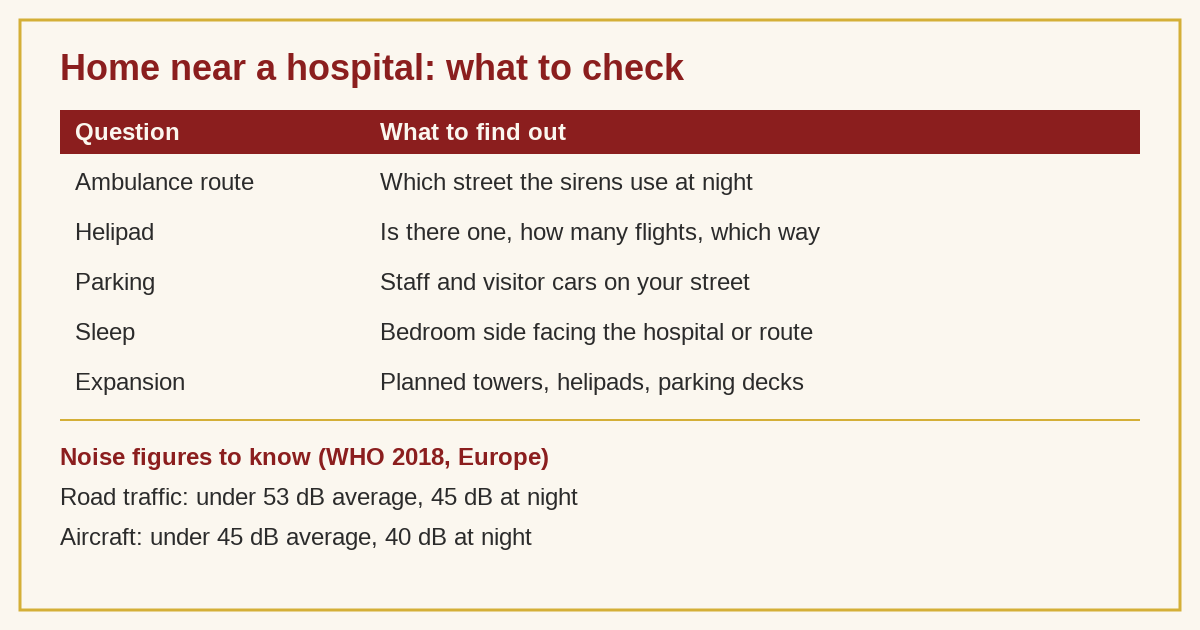
The WHO values are health guidelines for the European Region, not US legal limits. They still make a fair yardstick when you stand on the street at night.
What the feng shui tradition says
Hospitals hold illness and birth, urgency and grief, so practitioners tend to call the energy around them heavy and yin, broken by bursts of fast yang from emergency traffic. Three cautions come up most:
- Do not face it directly. A front door or main window looking straight at a hospital building is the stronger concern in Form School reading.
- Watch the road. A straight road that carries ambulances toward your door is treated like a sha qi path, a point covered in our poison arrows and sha qi guide.
- Protect the bedroom. Practitioners want the bed away from any wall or window that faces the hospital or the ambulance route.
None of this is a promise about health or luck. It describes a home with a lot of disturbance nearby. In practical terms, that comes down to sleep.
Advertisement
Noise: the part you can measure
Siren noise is the usual complaint. A TSI summary of emergency responder noise says sirens can reach "as high as 120 dB", but it gives no distance, so that is not what you will hear inside. Test the house yourself:
- Visit at night and at shift change, not just at a showing hour.
- Stand in the bedroom with windows closed, then open, and note whether you would wake.
- Ask which street the ambulances take, and whether the route changes with traffic.
- Ask if the hospital has a helipad. At UC Davis Medical Center, the hospital said about 100 residences could be affected by a helipad expansion and offered up to $35,000 per home in high-noise zones for acoustic windows, doors, skylights and insulation. So at least one hospital treats helipad noise as a real cost, though its offer is not a rule anywhere else.
What else affects sleep in the bedroom is in feng shui bedroom sleep environment.
Resale and the upside
We found no large, recent sales study on homes near hospitals, so we give no price effect. Two forces pull in opposite directions. Noise, parking and helicopter traffic can put off some buyers, while short trips to emergency care and a large local employer can draw others, such as hospital staff who want a short commute. Only local figures settle it. Compare recent sales and days on market for houses on the ambulance route against houses one or two streets away. For a fire or police station nearby, which raises the same siren question, see feng shui house near a fire station.
Hospital buyer scoring sheet
Score each line 0, 1 or 2, and add it up before you offer.
| Item | 0 | 1 | 2 |
|---|---|---|---|
| Main door or bedroom window faces the hospital | No | Angled | Direct |
| Sirens heard in the bedroom at night | None | Occasional | Frequent |
| Helipad on site or planned | None | Unknown | Yes |
| Street parking by staff or visitors | None | Some | Daily crowding |
| Planned expansion nearby | None found | Unknown | Yes |
| Double glazing and window quality | Good | Mixed | Single pane |
Worked example with stated inputs: a house scores 1 for angled view, 1 for occasional sirens, 0 for helipad, 2 for daily staff parking, 1 for unknown expansion and 0 for glazing. Total 5 out of 12. Parking and the unknowns cost the most points here, so ask the city about expansion and the neighbours about parking permits before you offer.
Remedies you can actually do
- Upgrade the windows facing the hospital. Acoustic glazing is the practical fix, and it matches the tradition's advice to protect the bedroom.
- Move the bedroom. If you can, use a room on the far side of the house.
- Block the sightline. Use lined curtains, a screening hedge or frosted film on the one window that looks straight at the building. See windows, curtains and light.
- Ask about a permit zone. Many cities can limit parking to residents. Whether yours does is a question for the local transport office.
When to walk away
Walk away if the bedroom hears frequent sirens or helicopters and you cannot move it or fix the glazing, or if an expansion that would raise noise is planned and you cannot confirm the details. Before you sign, ask the city planning office about the hospital's growth plans. How you ask, and how much is public, varies from place to place.
What catches buyers out
- Viewing only on a quiet weekday afternoon.
- Treating the house as quiet because the hospital is two blocks away. The ambulance route matters more than the building.
- Assuming one hospital's helipad noise numbers apply to another.
- Reading a guideline value as a legal limit.
FAQ
Is it bad feng shui to live near a hospital?
Practitioners call hospital surroundings heavy and yin, with sudden yang bursts from emergency traffic. The usual advice is not to face the building directly and to protect the bedroom from noise and view. It is a design reading, not a guaranteed outcome.
How loud are ambulance sirens near a house?
A TSI summary says sirens can reach as high as 120 dB, without stating a distance. What you hear indoors depends on distance, route and glazing, so listen from the bedroom at night.
Are there noise guideline values I can compare against?
The WHO 2018 European guidelines recommend road traffic noise below 53 dB average and 45 dB at night, and aircraft noise below 45 dB average and 40 dB at night. They are health guidelines, not US legal limits.
What about a hospital helipad?
Ask whether one exists or is planned. UC Davis Medical Center said about 100 homes could be affected by its expansion and offered up to $35,000 per home for acoustic upgrades in high-noise zones. Your hospital may differ.
Should I walk away from a home across from a hospital?
Only if your nights are disturbed and you can't fix it, or a noisy expansion is planned. Use the scoring sheet and visit at night.
Plan the night visit
See the house at night and again at shift change, and take our feng shui home buying checklist with you. A road that runs straight at the door is dealt with in the corner lot, cul-de-sac and slope field guide, and other neighbours in our real estate and home buying guides.
Sources
Checked November 2026.
- Hearing Review, WHO environmental noise guidelines for Europe (2018)
- TSI, noise exposure limits for emergency responders
- CBS Sacramento, UC Davis hospital helipads
We could not confirm the WHO document itself or its metric names, since the Hearing Review summary does not name Lden or Lnight. The figures above are only those the summary gives.
Editorial note: Lucky Properties writes about feng shui as a cultural and design tradition, for general information only. Confirm planning, noise and legal questions with a licensed professional and your local authority.